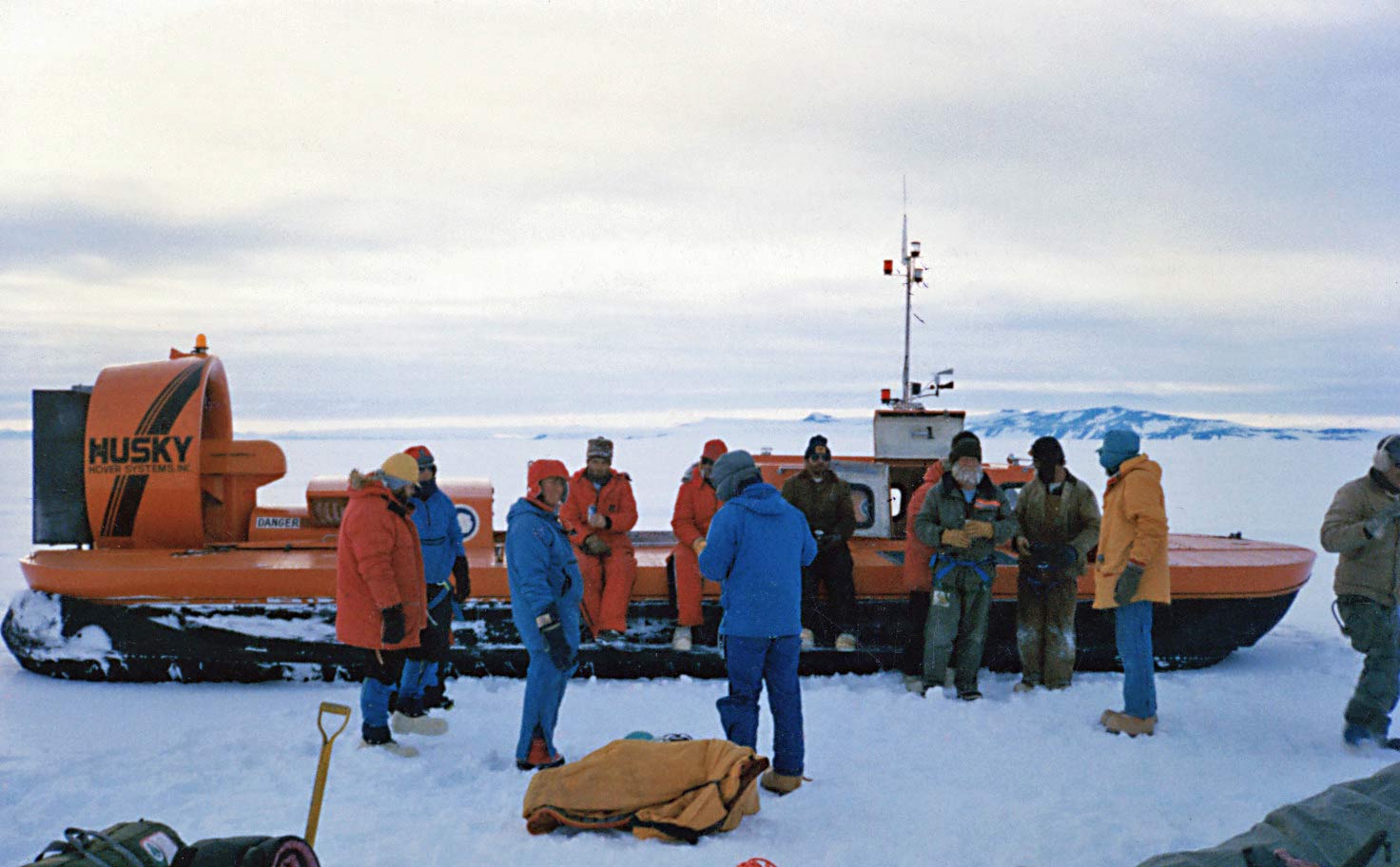
The hovercraft...

February 1988, initial testing of the newly arrived and assembled hovercraft...note some of the packaging still on the front seats. Lou Albershardt is at left in the red hat...the guy in Big Red is probably the instructor from the operator training (MD).
The two original operators that went to that training were Sarah Krall and Lou Czarniecki (now Albershardt). Sarah had been a field processing assistant in 1986-87, her second season on the ice, and Lou had been a night janitor in her first season. The hovercraft was named Maxine after Lou's mother. The hovercraft was shipped to McMurdo on the vessel that arrived in January 1988, assembled and tested at the end of the season, and placed in service in 1988-89. It was about 35 feet long, with an aluminum hull and a two-section cabin--the aft section could be removed to permit more cargo capacity. The maximum payload was 2000 pounds, theoretically 10 passengers, this was roughly comparable to the payload of one of VXE-6's Bell 212 helicopters. It was powered by a six-cylinder Deutz diesel engine, which drove two fans, one for lift and one for forward propulsion. To retain the air under the vehicle, there was a rubber skirt in a louvered chevron design that proved excellent for maneuvering. | |
 The hovercraft and its 1988-89 operators, Sarah Krall and Lou (PB). |
 Offloading drums for a fuel depot. Lou is on the ground, and Sarah is operating the gantry remote (PB). |
 Out on the ice shelf, with Erebus in the background. Sarah is seated at left, with Lou standing (PB). |
 Traveling across the ice shelf, summer 1990-91 (JT). |
|
Hovercraft are designed to operate over water or reasonably smooth surfaces such as ice. The USAP vehicle was never intended for normal use on open water, although a few of the cruise ships have brought them to McMurdo Sound for that purpose in the past. This model of hovercraft had a normal operating height ("loft") of 18", but Maxine had been modified with the addition of two braces running the length of the hull, to strengthen it against impact from a hard surface. These struts reduced the clearance to 14", so navigation through areas of pressure ridges or sastrugi was difficult. And the hovercraft could not navigate across open crevasses of the type found on glaciers, since crevasses are basically slots in the ice, all of the loft would be quickly lost, and a crane would probably be required to recover the vehicle. Still, with experienced operators, Maxine saw a lot of use taking out scientists, supporting dive operations, setting out fuel caches, and showing Distinguished Visitors around, among other things.
The manufacturer of the airboat, the American Airboat Corporation (then located in Florida), offered to provide the vehicle to VXE-6 for testing purposes. The company, now located in Orange, TX, is still offering these airboats. their FAQ carefully defines the difference between an "airboat" and a "hovercraft." Their airboat engines use only a small percentage of their power to provide loft--perhaps a few inches, compared to those of a hovercraft which might use 50% of its power to provide significant loft. Then as now, one had to be properly trained and licensed to operate vehicles and equipment. Here's Dick Spaulding's airboat license from 1974. I first met Dick a couple of years later at Pole when he dropped in for a visit (literally, via parachute).
New information...here is an excellent Antarctic Sun article about the hovercraft, published by Peter Rejcek on 1 November 2013. Newer information...after an owner or two, Maxine was acquired by Howard Smith, a now-retired wildlife biologist living in Rosseau, Ontario. He's invested considerable time and money in Maxine...including a trip to the manufacturer Griffon in England where he tested a similar model, and then made some modifications including remounting the duct relative to the fan, and adding a separate 80 HP diesel engine to run the lift fan. The result...it gets over the hump in less than 10 seconds. Below, several photos of Maxine--or Northern Myst, as she is officially registered--the registration happened before Howard learned that she was originally dubbed Maxine. | |
 An undated photo of the hovercraft presumably on Lake Rosseau. |
 Docked... |
 Cruising on ice-covered Lake Rosseau. |
 Here she is trailered. |
|
Credits--much of the information here is from Sarah Krall; also some is from Lou Albershardt. The photo at the top of the page is by Matt Davidson (MD), his photo is here in the Antarctic Photo Library. The Delaware River photo is by an unknown photographer, also here in the Antarctic Photo Library. The JT photos are courtesy of Jeff Thompson. The PB photos were taken by New Zealand field mountaineer Peter Braddock and were furnished by Sarah and Billy-Ace Baker. The photo of Cole Mather was a screen grab from this Youtube video of a Jerry Bowen visit to the ice in November 1991. Billy-Ace also provided the information about the VXE-6 airboat; the photo of it is by Alan Unthank. The information about New Zealand's test vehicle is from Antarctic (the bulletin of the New Zealand Antarctic Society), Vol. 8, No. 1, March 1977 (the photo, by Neville Peat of the NZ Antarctic Division, appears on the cover). The recent photos from Howard Smith are credited above. | |