About that Antarctic contract rebid...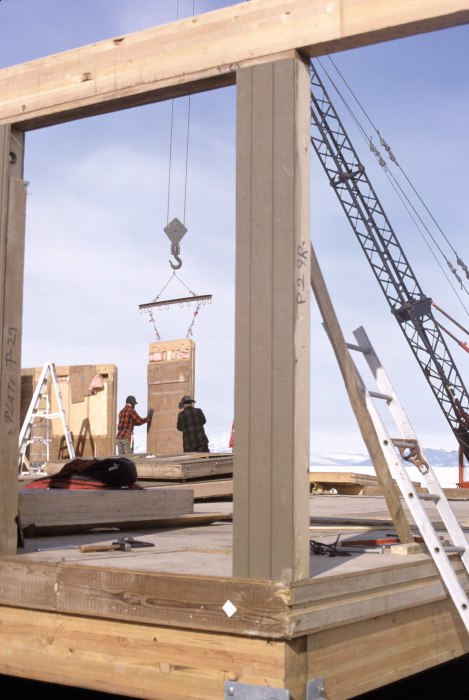

Above...construction of the landmark Chalet in McMurdo in 1969-1970. This distinctive prefabricated structure, the main NSF office facility in McMurdo, was the first major building project completed by a prime NSF support contractor, which at the time was Holmes and Narver, Inc. (H&N). Except for site preparation by the Navy the previous year, it was successfully completed in the one summer season. (Left photo by RM3 Ken "Hogman" Trettin, WO McMurdo DF-70; right U. S. Navy photo from the Antarctic Journal, July/August 1970)
Note: The history of the U.S. Antarctic Program's contracting activity has been moved to a separate page. Interest was stirred up in 2007, but the first official announcement was made on the FedBizOpps (archived FBO site) on 30 April 2008. [Note that the GSA has changed the Federal bid site to SAM.gov. The contracting info for older contracts such as this were not migrated to the new site. The old site contained all of the detailed official announcements, presolicitation conference presentations, and the RFP itself, along with amendments and links to pages with more information and lists of interested participants, and I'll link to the archived pages where possible. As things progressed, there were no announcements as to the actual lists of serious bidders, participants in the site visits (which were the week of 17 November 2008), the joint venture posturing, or similar information. An archive of he NSF information site page (which was first issued in 2008) is located here; it included a detailed schedule of the bid program as well as "reading room" links to extensive quantities of additional information--site details, procedures, and other data of greater or lesser importance (you may find some of it of interest, check it out before it disappears). Some of the backup proposal data was due in January 2009, the final due date for submitting those pallet loads of bids and supporting information was 23 February 2009. Ever since then, one would think that the real serious arm twisting, negotiating, and "best and final" offering would have continuing behind closed doors. Not. At least not yet. [As of 2 February 2012, the FBO and NSF sites were updated to reflect the contract award.] On 28 August 2009, NSF started notifying the seven bidding teams that everything was off. There would be a revised schedule and solicitation amendment issued by the end of September...for what basically is a year's postponement. RPSC is being asked to provide a 1-year extension. The final turnover to the new contractor will not be until 1 April 2011. Behind-the-scenes discussions obviously continued, but it would be several months before the official NSF or FBO sites would be updated. Not quite...the FBO page was revised on 10 September 2009 to announce an update, but the update was missing. Actually, the reveal was in this 7 October 2009 announcement that Raytheon's contract was being extended for another year through 31 March 2011 (including the 6-month October 2010-March 2011 transition period). A 19 August Engineering News-Record article (no longer available to non-subscribers) basically outlines that mum was the word in Arlington, although more than one of the bidders has opted to buy billboard space near the NSF headquarters. An earlier 4 June 2009 Washington Technology news article tells us that the whole thing could be worth over $1.5 billion if the options for all of the 13 years are exercised. Rick Yuse, president of Raytheon Technical Services (parent company of RPSC) stated that his company had partnered with AECOM this time--AECOM was of course the successor company to Holmes and Narver, Inc., the 1970's contractor as well as the lead partner in the Antarctic Support Associates (ASA) joint venture that was "Denver" in the 1990's. This joint venture had launched itself as TransPolar LLC; with a short FAQ page from president Sam Feola directed primarily to current RPSC employees (their web presence has since disappeared). Another bidding joint venture consists of Computer Sciences Corporation (CSC) and EG&G--this team called itself Antarctic Research Support (ARS) (their web presence has also disappeared for reasons that are obvious). EG&G was the other original ASA joint venture partner. A total of seven bidding teams submitted proposals before the original February 2009 deadlines--the other bidders were ITT (the 1980's support contractor), KBR, a Fluor/Day & Zimmerman joint venture, CH2M Hill, and Lockheed Martin. Some of the bid teams had been collecting resumes since 2009, either on their own web sites or job recruiting web sites. In October 2009 came the announcement that the contract award would be delayed a year...not directly, but through this announcement that Raytheon's contract would be extended a year through 31 March 2011 (including the October-March transition period. One of the issues that continued to confound both the bidding teams and the NSF proposal evaluators was the new requirement that a significant amount of the work must be subcontracted--perhaps nearly 25%--just a bit more than the current operation (although not THAT much more if you include the other NSF contracts such as the Navy SPAWAR contracts for McMurdo air traffic control and weather). Finally in December 2009 the FBO site (archive) was updated with stale news of "amendment 6" which had been issued in October requiring the bidders to restate their financial information in a different format by 24 November. The amendment (which is no longer available online or archived) also included new Q&A's outlining some of the additional forthcoming proposal review steps. Denver reporter Jonathan Shikes of Westword covered the contract award delay in this archived 30 December 2009 blog. And finally on 5 January 2010 NSF revised its main solicitation page (archived site, many links are dead) to include a new schedule...further competitive range determination in February and March 2010, evaluation and "best and final" negotiations between March and June, and contract award by the end of the 2010 boreal summer. Since then, the current RPSC contract was finally officially extended for a year, less than a week before it was due to expire on 1 April (5 April 2010 Raytheon press release). But other than that...nothing. There were several hints and announcements that the field would be narrowed by 1 April...or in May...but all has been silent and the official pages were not updated for many months. On 20 August 2010...at last...an announcement of the "downselect" or the "best and final" or whatever. The three finalists are CH2MHILL, Lockheed Martin, and KBR. And of course some of us expected an announcement of the award in another month or two per the then-current schedule. But no. On 20 September, NSF announced they were extending things ANOTHER year, with this announcement, which was actually the announcement of the planned extension of RPSC's contract through March 2012. On 26 October the FedBizOpps site posted a new amendment with a new set of data requirements with a new deadline of 6 December. Later came another round of Q&A's which may be of interest to the pedantic accountants among you (and which may be viewable only if you have MS Word 2007 or later or a viewer for .docx files). And on 19 November this deadline was pushed back again to 20 December 2010. Which, as far as I know, is where we are now. Per the current NSF schedule, the award will be in September 2011. As for the one-year extension...with all of the continuing Federal budget negotiations...as expected, it took awhile for the 1-year RPSC contract extension to be finalized. This didn't officially happen until 31 March 2011, and the announcement wasn't issued until 1 April (!). Here's the archived official fbo.gov announcement page, a hard copy of the extension justification, the 8 April Raytheon press release, and a bit of commentary from the 12 April 2011 Westword (Denver) Off Limits column (scroll down to the second half of the column). June 2011...the number crunching continues. Amendment 11 was issued on 20 May--it requested some significant recalculations and resubmittals. Amendment 12, issued on 3 June, included Q&A's about Amendment 11...postponed the resubmittal date to 14 June...and clarified that only the 3 best-and-final bidders were expected to resubmit. Otherwise, rumors continued to fly, but I wasn't privy to them. Late July 2011...OPP director Karl Erb outlined the contract award status at the 28-29 July National Science Board meeting. There would be final discussions with the proposers in mid to late August...followed by final proposal revisions to be received in mid to late September. The goal was to announce the award no later than mid November. And a few days later, RPSC put up a "transition" page (no longer available) on the Raytheon website, as a source for news, updates, and FAQs about the award and transition process. September/October 2011...there were FOUR contract amendments posted in September on the GSA contract web site...and two more in mid-October. Mostly they provided an opportunity for the number crunchers with KBR, CH2M Hill, and Lockheed Martin to break out their #2 pencils and spreadsheets one more time, for another final submission due 30 September. One of the data items in the amendments (they are now up to amendment #18!) was an updated list of USAP subcontracts and leases that are part of the contract. Everything from the Xerox machines and ATM...to the N B Palmer...to...the lease on the RPSC building in Centennial. Which was scheduled to expire on 30 April 2012. No one has negotiated an extension. Also...the schedule on the NSF contract site was adjusted on 2 September to indicate that the evaluations/negotiations would run to 30 September and the contract award would be in November. And the RPSC "Transition" page and FAQ were updated several times to reflect the mid-November award schedule. More recently...a mid-November award didn't happen. The rumor around at the time (which was all it was) was that the award would be announced on 1 December. Well, that didn't happen either. Around that time, the Blue Ribbon panel led by Norm Augustine was in McMurdo...on Sunday 4 December they held an open discussion. Before the main presentation, Dr. Karl Erb said that that an announcement about the contract rebid would be made within the next two weeks...which was close to the truth.  On 22 December at 1600 US Eastern time (1000 Friday at Pole) the initial announcement was made to the USAP community that the contract had been awarded to the Lockheed Martin Corporation. A few hours later on the same day, Sam Feola sent out the official announcement. The official public press releases didn't happen until after the Christmas holiday on 28 December 2011...here's the Lockheed Martin press release, and the NSF announcement. And Science/AAAS issued this news article on the 29th. With only about 2 months before the scheduled closing of McMurdo, and 3 months before the official transition date of 1 April, things started happening frantically. Lockheed Martin established a project website(which was since revised frequently before being taken down). They held an information session with RPSC personnel in Denver on 5 January (information from the RPSC transition page). And the jobs postings began. Not only by Lockheed...but also by many of their subcontractors. Terms of the new contract required even more subcontractor participation than that in the RPSC contract...and the subcontracting picture was made even more complicated by the fact that Lockheed Martin's original bid had included participation by their wholly owned subsidiary Pacific Architects and Engineers (PAE)...but that entity had been sold to private equity firm Lindsay Goldberg, LLC in April 2011. Celia Lang, the project director for what Lockheed Martin calls the ASC (Antarctic Support Contract) (yes, more new acronyms) put up a welcome message on the web site in early January; the page included this listing of Lockheed Martin and subcontractor functions:
(Note that the above list reflects the contractors as of the original December 2011 award. The prime ASC contract was transferred by Lockheed-Martin to Leidos in August 2016; for the current list of active contractors/subcontractors, refer to my Antarctic Jobs page.) Celia and other Lockheed team members visited McMurdo and Pole in late January as part of the transition process. The first priority for hiring was arranging for transition of the winterover contracts. She was back in Denver to work with folks in the RPSC office the first week in February. At the time various Lockheed Martin and subcontractor web sites were listing many jobs, summer and winter, in Antarctica, Denver, and elsewhere. For a time it was a fluid fast-changing situation on the web, as it must have been in the office. One issue was the fact that portions of the contract structure were several years old and did not reflect current "projects"--as such, many "project" oriented RPSC jobs were not part of the new contract. Also, some of the RPSC job functions were to be relocated (such as some of the science planning activities, which will be relocated to the DC area near NSF), totally assigned to subcontractor locations elsewhere, assumed by existing Lockheed Martin organizational functions, or eliminated for other reasons. So as the dust settled, some incumbent RPSC folks, including long-time employees, found themselves with a need to relocate...or without a job altogether. By the way...yes, there was a protest. CH2M Hill was officially debriefed by NSF on 5 January and filed a protest the next day. This Engineering News-Record story is still available (behind a paywall), along with this this Washington Technology article. "CH2M HILL Antarctic Support, Inc. is disappointed with result of the NSF's selection process for the Antarctic Support Contract," the company said in a statement. Lockheed-Martin declined to comment on the protest. And NSF contracting officer Bart Bridwell noted, "I'm afraid Federal acquisition isn't for the faint of heart." According to the official court docket, a decision was due by 18 April. By February, Lockheed Martin had consolidated the job seeker information onto a Facebook page (you do not need to belong or sign up for Facebook to see it). The "Jobs" tab links to a variety of positions with both Lockheed and the subcontractors...the "Links" tab has differently ordered jobs with Lockheed and some of the subcontractors. Since then, the listing of hundreds of jobs has dwindled to less than a couple of dozen. As of late April it was not clear whether the positions for the 2012-13 summer/winter would be selected from previously received applications or whether they would be readvertised. It appears that the hiring for at least some of the subcontractor positions were being handled by their representatives in the Centennial office, and as of April some people had already been hired for the 2012-13 ice season.
The latter stages of the contract transition appeared from this distance to go smoothly. Over the weekend of 1 April, Lockheed Martin took over the office spaces and issued new badges to all continuing ex-RPSC employees, and the RPSC contract web site disappeared except for a single page of referral information (archive site) for former employees and vendors. And a few days later, Celia Lang posted on the project web site that the contract transition had been successful, and that the first Annual Program Plan had been delivered to NSF--it included specific projects which NSF was to review and approve. And a postscript...the CH2M Hill protest was denied on 18 April 2012, originally reported summarily without comment by the U. S. Government Accountability Office (GAO). On 9 May, the decision details were announced. In summary, the protest involved 3 major issues--the technical rating given to CH2M Hill's vs Lockheed Martin's proposal (one significant item here was the risk assigned to CH2M Hill's plan to relocate the data center), the fact that after the bid closing NSF had "discussions" with Lockheed which may have been inappropriate, and the fact that the Lockheed proposal as valued was priced slightly higher than the CH2M Hill proposal. A summary of the decision is contained in this 8 May Washington Technology news article, and more details are provided by the redacted version of the official decision released on the GAO site. Another postscript--this 31 May 2012 MSN NZ Money article describing the NZ$100 million role of PAE NZ as the subcontractor providing the New Zealand support for the contract...apparently only in New Zealand, as no mention is made about hiring Kiwis for work on the ice, as had been done in the past. |