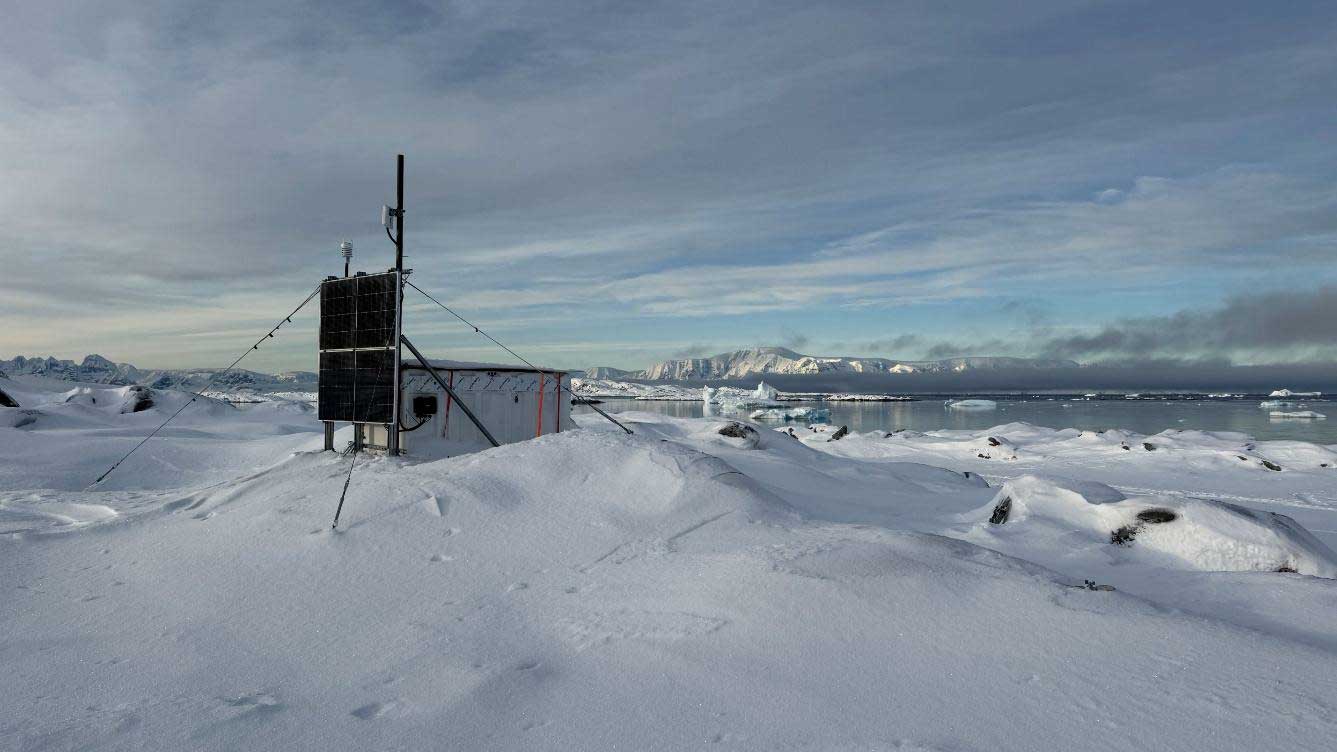
This project, with principal investigator Lukas J. Blom of the Wilson Alaska Technical Center (University of Alaska Fairbanks) (website and science planning summary page), has been a long-running effort at McMurdo, with an infrasound array at Windless Bight as part of the US Comprehensive Nuclear-Test Ban Treaty (CTBT) observations. Such arrays detect and capture sound and mechanical waves below 20 Hz...which would be created from a nuclear test. In 2025-26, a team of five arrived at Palmer to set up four monitoring sites H1-H4--two in the backyard and two on Bonaparte Point. These sites consist of an equipment enclosure and a Wind Noise Reduction System (WNRS). The equipment enclosure, similar to a large pelican case, contains an infrasound sensor, data recorder, lead-acid batteries, power distribution equipment, solar panel, and radio antenna. The WNRS will be composed of an array of flexible, reinforced hoses arranged in four rosettes with an air inlet at the end of each hose. The purpose of the WNRS is to connect the infrasound sensor to a spatial distribution of air inlets. Related equipment is in TerraLab. Two folks will show up in 2026-27 to troubleshoot and service the equipment, per the USAP science planning summary.
This isn't the only CTBT project at Palmer...there's a long-running air monitoring project, now in TerraLab (aka the International Monitoring Station (IMS) building), which collects and analyzes air samples for radiation (science planning summary page). The CTBTO website is here, with more information about the infrasound network.