Winter 1990
Manager: Tom Fay, population 20
Notable Antarctic aviator (who made his first of many flights to Pole in 1976, and later started Adventure Networks) Giles Kershaw dies in an ultralight accident on the Jones Ice Shelf near Rothera (3/5)

He died as part of an ill-fated documentary filming which was also intended to be covered in National Geographic. During his career Giles made a number of visits to Pole. This photo (of what he did often) was taken during his support of Ran Fiennes' Transglobe Expedition which visited Pole in December 1980. A few months before this picture was taken, Giles participated in a medevac near SANAE. (photo courtesy 80-81 w/o Chuck Huss)
Support contractor changes from ITT ANS to ASA, a joint venture of Holmes & Narver (H&N, the first support contractor in the late 60's through 1980) and EG&G (1 April).
Greenhouse experiments underway in former paint/DNF storage hut moved into the dome.
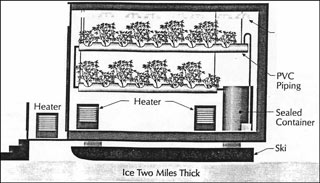
The small building, also previously used for DNF storage, was gutted, reinsulated and vapor sealed, and equipped with a vestibule. More info, a photo of the interior, and credits are here.
Comms department completes move into new addition.
Seminal brief Greenland project provides proof-of-concept for what would become IceCube (15 August).
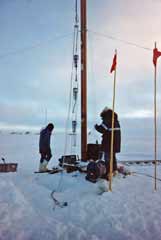
This amazingly brief project (less than 4 days on site) took place in mid-August 1990 at the GISP-2 glacial ice drilling site in south central Greenland...at what would later be the site of Summit. Tim Miller and Steve Barwick, then at UC Berkeley, assembled a string of three photomultiplier tubes, which were taken to Greenland, submerged in a drill hole, and activated for a 20-hour period to detect...passage of neutrinos. Hmmm. Next step...try this at Pole in 1991-92. Details and photos of the Greenland project are here.
USAP moves offices, warehouse and CDC to the Antarctic Centre site (September)
 The old NSF and Navy base site at the airport entrance
roundabout was part of this real estate swap with the
airport authority and a developer. The old site would
be used for air cargo companies; this new facility
replaced USAP offices downtown, and provided space
for the NZ program. Plans at the time included what
would become the Antarctic Centre, later constructed
in the foreground of this photo (project info)...as well as temporary
living quarters for science and contractor personnel...which never happened (Antarctic
Journal, December 1990).
The old NSF and Navy base site at the airport entrance
roundabout was part of this real estate swap with the
airport authority and a developer. The old site would
be used for air cargo companies; this new facility
replaced USAP offices downtown, and provided space
for the NZ program. Plans at the time included what
would become the Antarctic Centre, later constructed
in the foreground of this photo (project info)...as well as temporary
living quarters for science and contractor personnel...which never happened (Antarctic
Journal, December 1990).
Summer 1990-91
Pomerantz Land (solar-polar) site, CMBR sites are operated again.
Power plant upgrade continues, #3 engine is replaced with a new 3412, one more to go...

Looking into the main part of the power plant from the addition, towards the end of the summer. The original radiator plenums have all been replaced with the new heat exchanger stands, and 2 out of 3 engines are new, but #2 (center engine) is still the original 353...to be changed out during 1991-92 along with the water tank behind it. (Photo by Janet Phillips)
New summer camp emergency galley/lounge is constructed to replace structure damaged by fire the previous season.
Major water system repair effort conducted to fix leaks.
Dome structural and panel repairs are completed.
Five fuel bladders in the fuel arch replaced (with new bladders).
Switch from DFA and JP-4 to a single fuel (JP-8/AN-8) is underway.
Foundation for Carnegie-Mellon CMBR telescope (s) is constructed at CMBR.
LGP D-8 "Linda" tumbles blade-first into a crevasse some 27 miles east of McMurdo (21 November)

On this day before Thanksgiving, Linda was part of a 3-vehicle convoy hauling explosives and other supplies to a US/NZ seismic project along the southwest edge of the Ross Ice Shelf, when suddenly "gravity struck" and the D-8 plunged straight down, still hitched to its sledful of dynamite. The sled was perched precariously across the crevasse and above the tractor. A SAR team was called in from McMurdo, and several hours later the two drivers Brian Wheater and Quentin Rhoton ("Q") were hauled safely to the surface. The story with photos...
In what is almost certainly the last presence of sled dogs at Pole, Norwegians Simen and Sjur Mørdre, Ralph Høibakk, Herman Mehren, Carl Emil Petersen, and photographer Hallgrim Ødegaard arrived at Pole on 14 December 1990, with 11 dogs, 3 sleds, and skis. They had started on 22 October from Berkner Island and had been resupplied three times en route. The Mørdre brothers and Ødegaard continued to McMurdo on skis without dogs (I've seen conflicting information about the extent of participation of Petersen and Ødegaard).
Ironworker Charlie Blackmer summits Mt. Erebus on his day off (19-20 January) (!)
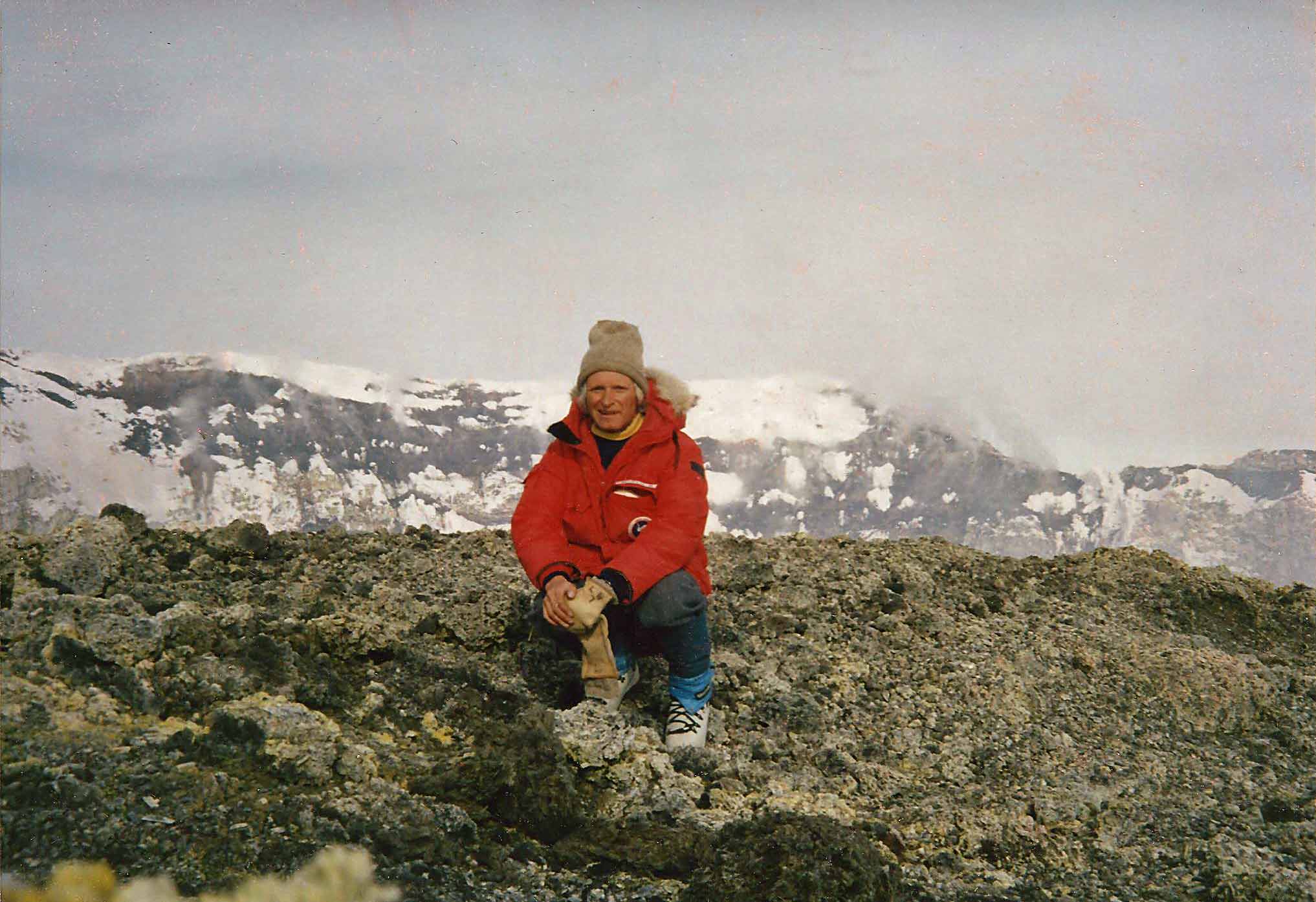
His solo venture was clandestine, unassisted, and of course totally unauthorized. He borrowed a snowmobile which took him up to 7,000 feet, from where he went on foot to the top. The trip took about 17 hours...his only food consisted of a couple of sandwiches and water. Fortunately he had good weather. At left is one of his selfie photos for documentation...here is another.

Sadly, Charles "Charlie" "Moe" Blackmer died unexpectedly of natural causes at his Minnesota home near Deer Lake, on 24 February 2015 (old obituary link not properly archived).
Winter 1991
Manager: Dennis O'Neill, population 21
Dump burning is discontinued, recyclables and hazardous waste is collected and saved for retrograde.
Open burning of trash at McM Fortress Rocks Landfill is stopped (2 March) after asbestos discovered on site; "temporary" incinerator installed (in the in the same building which had housed the 1972 incinerator and used for food wastes and landfill operations discontinued--all other wastes were stored for retrograde (the incinerator story).
First galley addition constructed, this was the 2-story extension toward the freshie shack, including new counters and a dishwasher.

The galley as it appeared after winter 1991...the extension on the south end toward the freshie shack is visible from the change in the red and white siding. The aluminum porch and landing are in front of the first floor entrance (the wooden stairs in the background are to the roof of the freshie shack). (CARA photo) (archive site).
Former McM chapel (Quonset hut next to building 155 in use as the temporary chapel between 1978 and 1989) destroyed by fire (May) (chapel information)
CARA organization officially established encompassing future COBRA, AST/RO, SPIREX projects.
Midwinter airdrop includes a bunch of McMurdo mail.
"Madrid" Environmental Protocol adopted by the Antarctic Treaty nations (10/4), ratification would take a few more years.
Summer 1991-92
PICO (Polar ice coring office) shows up and drills 4 820m holes for strings of photomultiplier tubes (PMT's), testing for a future SPASE/GASP project to detect neutrinos, this project would later become AMANDA (Antarctic Muon And Neutrino Detector Array)...and eventually, ICECUBE.
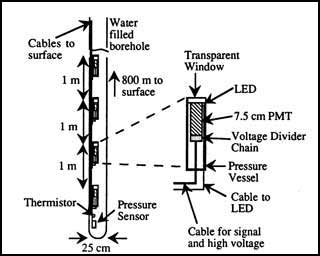
At left, a schematic of the drill string, which was intended more to study the Cherenkov light transmission properties in ice than to actually collect data on particle-generating events. The project also confirmed the performance of PMT's to be able to detect Cherenkov light. The test string was also monitored in 1992-93, and the rest is history, as IceCube installation was completed in 2010-11. More information, documentation and credits.
Summer camp consists of 10 Jamesways, 2 heads, one galley/lounge. Maximum station population cap was 140, making for crowded mealtimes and bathrooms...
More piping rework in the power plant to improve the glycol system performance.
Construction began on the exhibit portion of the International Antarctic Centre in Christchurch.

At left is the construction sign for the second of three planned phases of this project, which was being developed by the Christchurch Airport Company. This contract was awarded in November 1991. The first phase, the offices, warehouse, and CDC, had been occupied in September of 1990. The straight and curved lines of columns were intended by the architect to extend the lines of the Phase 1 structures and reference the South Pole and an east-west meridian. The exhibit hall was officially opened on 31 August 1992. Phase 3, planned temporary housing, was never constructed (photo from Frederick McDougall).
Third 3412 (engine #2) is installed to complete power plant generator upgrade project, work slowed by another asbestos survey, this time some is found in the exhaust stack insulation.
Potable water tank in power plant is replaced with larger capacity stainless steel tank.
Remaining bladders in the fuel arch are replaced.
"White Dish" CMBR telescope, predecessor to Python etc., erected at CMBR site.
USGS installs new GPS station on roof of skylab and discontinues doppler satellite tracking program (December)
AST/RO (Antarctic Submillimeter Telescope/Remote Observatory) building foundation and structural steel erected, to be the first structure in the new dark sector.

The AST/RO structure after the first year of construction; the building panels were staged on top of the platform for the winter. This was the first use of those foam insulated wall panels that would later be used for everything else including the new station. (photo by Galen Rowell)
Where'd this stuff come from? The first summer airdrop since the pre-Herc era dropped some of the larger components for this structure.
New seismo vault occupied, sponsored by IRIS (Incorporated Research Institute for Seismology) but still operated by USGS; Drum-type analog seismographs in the science building replaced with digital models, earthquakes will never look the same.
Norwegians Monica Kristensen and Heinrich Eggenfellner come looking for Amundsen's tent (16 Feb.).
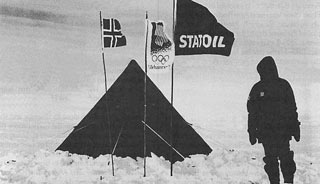 This was part of a planned 3-year glaciology expedition (the Aurora Programme) to study climate change. It traveled to the ice on the MV Aurora (which Monica had previously purchased for her unsuccessful 1986-87 NGA South Pole trip) and set up a 5-hut base (Blaenga) at 77.5ºS-34.2ºW. In mid-February, Monica and Heinrich visited Pole for a few hours and set up a pyramid tent above the presumed location of Amundsen's tent, using data from Scott's and Amundsen's records, GPS, and presumably GPR studies. The plan was to recover the tent for display at the 1994 Winter Olympics in Lillehammer. My coverage, including links to full details of the Aurora Programme expedition.
Japanese adventurer Shinji Kazama reaches Pole (3 January) on a specially modified Yamaha motorcycle.
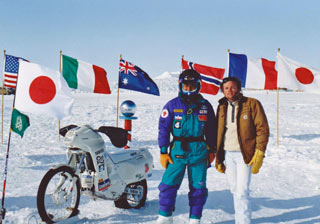
The trip from PH took 24 days. Shinji was supported by a snowmobile which provided occasional assistance over rough areas. More information...
Construction starts on Pegasus blue ice runway near McM.
Albert P. Crary Science and Engineering Center (CSEC) dedicated at McM (5 November).
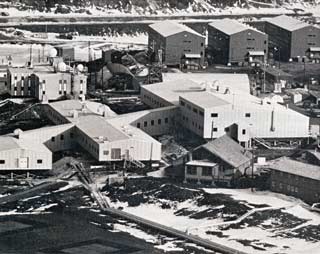
The facility was named after glaciologist/geophysicist Albert P. Crary, who among other distinctions was the first person to set foot on both the North and South Poles (he arrived at the South Pole overland on 12 February 1961). Construction of the facility had begun in 1987. It was dedicated by Walter Massey, the NSF director. Earlier this season the two-story upper section had begun limited operation. The second pod, housing atmospheric and earth science research, was scheduled for full operation in November 1992, and the bottom pod, housing the dive locker and aquarium, was to be completed later that season. Here's more information and photos...
Winter 1992
Manager: Gary Freeman, population 22
New greenhouse equipment and lighting (prefabbed in McMurdo by Phil Sadler and volunteers); managed at Pole by Kitt Hughes. (Here is the archived environmental impact statement for this effort...in this era was writing these up for many Antarctic projects.)
International Antarctic Centre exhibit hall dedicated (31 August) by British botanist David Bellamy shattering an artificial ice wall with an ice axe. It was opened to the public the next day (earlier information about the project).
Daylight saving time, most recently reintroduced in New Zealand in 1974, adopted by the US and New Zealand programs. Clocks at Pole and McMurdo were turned ahead to UTC+13 at 0200 4 October.
Navy helicopter crash northeast of Cape Royds kills 3, including 2 New Zealanders (13 October).
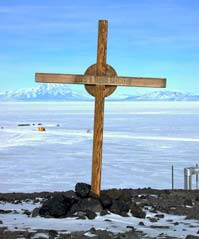
The VXE-6 "Huey" helicopter was returning to McMurdo from Cape Bird in the early evening, when it became overdue in what became whiteout conditions. After an air and ground search, the wreckage was found. Pilot LCDR Ed Crews and copilot LT John Seralles were alive but injured. Crew chief AMS1, along with New Zealand passengers Garth Varcoe and Terry Newport, did not survive.
At left, the memorial to Ben Micou at McMurdo. The details and more photos....
Summer 1992-93
Summer population cap 125; much more supportable than the previous year's 140.
AST/RO building construction continues, structure enclosed and interior work underway.
CARA tests prototypes for AST/RO and COBRA (COsmic Background Radiation anisotropy) experiments.
Current array of long-term snow stakes installed using GPS survey techniques--a total of 240 poles in 6 20km strings 60° apart. The stakes were installed so the original height of each pole above the snow surface was exactly 6'. They are monitored yearly.
Black Island gets an actual MARISAT internet terminal.
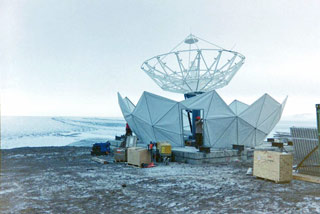
Black Island had been the site for the INMARSAT terminal since the mid-80's...which meant it was also the transit point for Pole internet traffic that reached McM from the SPSDL system. The 7.2 meter antenna seen at left was the first of two Black Island uplink/downlinks; a few years later it would be replaced by the current 11 meter antenna. All of the history.
Completion of the data link allowed for the first live television broadcast ever from Antarctica--a 24 November (US time) ABC Nightline show where Chris Wallace and Michael Guillen interviewed Dave Bresnahan (YouTube link).
Compressor/vaporizer system installed to enable use of liquid helium instead of gas bottles for weather balloon launches.
Wet silencers installed on generators for additional heat recovery for Rodriguez well.
Wind profiler radars (five 2x2m antennas) set up on the surface southeast of CAF.
 This view from the met tower shows the five new 2m x 2m
square antennas in scooplike shields next to CAF (presumably
the trench is unrelated). Additionally there were
four acoustic sources, and as part of this project, an
array of four automated weather stations (AWS) were in-
stalled at 89ºS, 90 degrees apart. The 915-mhz radar
detected the movement of moisture, hence wind, up to 2km
above the surface. The late Kathie Sharp (later Kathie
Hill Baker) was the winterover who monitored this project.
This photo also gives a good view of the SPASE-1 boxes
and the GASP telescope (Jesse Leech, Antarctic Journal, 1994 review issue)
This view from the met tower shows the five new 2m x 2m
square antennas in scooplike shields next to CAF (presumably
the trench is unrelated). Additionally there were
four acoustic sources, and as part of this project, an
array of four automated weather stations (AWS) were in-
stalled at 89ºS, 90 degrees apart. The 915-mhz radar
detected the movement of moisture, hence wind, up to 2km
above the surface. The late Kathie Sharp (later Kathie
Hill Baker) was the winterover who monitored this project.
This photo also gives a good view of the SPASE-1 boxes
and the GASP telescope (Jesse Leech, Antarctic Journal, 1994 review issue)
CRREL makes first Rodriguez well installation at the domed station (a "sewer bulb" in reverse, hot water is circulated to melt more, when the bulb gets developed enough, some of the water can be used by the station). Water treatment system is installed too, but all this is finished too late to permit winter use--or, as has been said, the plan was to allow 1 year for water circulation for bulb creation (the well idea was originally developed by Army engineer Raul Rodriguez, for Camp Century, Greenland in 1960-61; the first rodwell at Pole was tested successfully in 1972-73). Here's the inside story on the Pole rodwells including video (!)
New GCA (ground control approach/air traffic control system) installed.
NGA (Non Government Activity) events--Five Norwegians, Ralph Høibakk, Herman Mehren, Sjur Mørdre, Simen Mørdre and Hallgrim Ødergård, are the first to use the now well-traveled route from Berkner Island to Pole (error, they came in 1990-91). Norwegian Erling Kagge is the first solo trekker to arrive--he skied unsupported from Berkner Island, in 50 days (1/7) "Antarctic Women's Expedition" arrives also, but doesn't continue to McM as planned due to time constraints.
Shell of Elevated Dorm (blue building) completed.

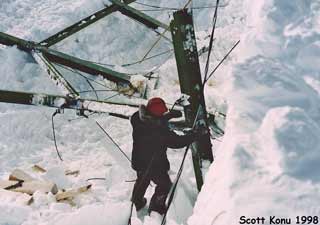
Well, this is not a photo OF the elevated dorm...but rather a February 1993 photo from the roof of the incomplete structure, which Scott "snackbar" Konu sent me on my birthday in 2016. It is a classic keeper from a brand new vantage point. Looking at this makes me a bit sad that I was somewhat involved in the demolition of the domed station.
Scott would later winter in 1996...alas, he is no longer with us.
New summer camp development advances.
 Here's another of Scott's photos, from the same time, of the then-new arrangement of summer camp. The two blue buildings, Ice Palace and Inferno, were the new head facilities constructed that year. The buried structures in the right foreground were the head module and Jamesways J1 and J2 from the old 1981-82 summer camp. The plywood structure in the right background was Mickey's Folly, which once housed 2 342 generators, a proposed supplement to the dome power plant. After they were removed, it was used for berthing. 2/3 of it later became the Cheese Palace, the other third was moved to be the weight room for the summer camp gym. In 1997-98 when summer camp was moved to a new berm, Ice Palace and Inferno were connected together in the center of the complex.
McM Pegasus blue ice runway certified for use by wheeled C-130's. Originally 6000 feet long and 300 feet wide...its first LC-130 takeoff using wheels was on 8 February.
The DC Appeals Court rules that the National Environmental Policy Act (NEPA) applies to Antarctica (29 January), the decision was not appealed, so the "interim" incinerator at McM was shut down (22 March), and NSF discontinued plans for the permanent replacement.
Winter 1993
Manager: Stan Wisneski, population 28 (!) a new record
New stove exhaust hood system installed in the galley.
Fire escapes and emergency exit hatches installed on dome berthing rooms (by winter construction crew--the first since the dome was built).
Construction crew finishes out interior of Elevated Dorm
31-gallon oil pans are installed on Caterpillar 3412 Genset numbers two and three. This allows an extra two hundred and fifty hours between services.
Electrical code violations corrected in the Greenhouse. Completion of these repairs allowed use of this facility to continue.
The main sewer outfall elevation dropped approximately six inches breaking heat tape and disabling the line. After two months of attempts to repair the line, it still did not function. Backup line used until a new line could be run the following summer.
All use of the dump at Pole discontinued in accordance with Madrid Protocol; all waste saved for retrograde.
Serious McMurdo windstorm blows down the cross atop Observation Hill...it was reinstalled the following summer (see below).
Summer 1993-94
SPIREX (South Pole Infrared Explorer) telescope installed temporarily on roof of AST/RO building.
CMBR telescope PYTHON erected between AST/RO and MAPO building sites.
CARA/AMANDA building construction started, building framed and enclosed, partially in use by AMANDA group.
 This photo, looking northwest from the AST/RO building
roof in January 1994, shows the newly enclosed CARA/
AMANDA building (as yet unnamed anything else) still
under construction. It is missing the SPIREX platform,
which would be constructed on the near end of the structure
a year later. In the foreground is the CMBR telescope
PYTHON, in the left background is the PICO site where the
first permanent AMANDA holes are being drilled. The dome
is directly behind you across the skiway. (CARA archive photo).
This photo, looking northwest from the AST/RO building
roof in January 1994, shows the newly enclosed CARA/
AMANDA building (as yet unnamed anything else) still
under construction. It is missing the SPIREX platform,
which would be constructed on the near end of the structure
a year later. In the foreground is the CMBR telescope
PYTHON, in the left background is the PICO site where the
first permanent AMANDA holes are being drilled. The dome
is directly behind you across the skiway. (CARA archive photo).First permanent drilling/construction for AMANDA, four strings are installed to ~1km deep and made operational.
Monica Kristensen tries for Pole again to search for Amundsen's tent...
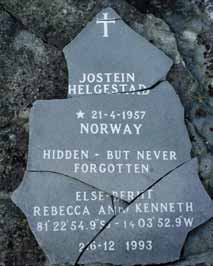
...and it ended in tragedy. The goal of the project was to return the tent and flag to Norway to be displayed at the 1994 Lillehammer Winter Olympics. Some of the expedition members were underway on a snowmobile traverse to Pole, when they encountered a severe crevasse field. Jostein Helgested was killed in a 130' crevasse, and The USAP/NZ SAR team led by Steve Dunbar goes in via Pole and lands at the site in a Twin Otter to rescue the rest of the NGA expedition from a serious crevasse field in the Shackleton Range. Here's the full story of the venture, along with a detailed account of the rescue.
Elevated dorm completed and occupied (December)
 The 3000-square-foot structure was originally configured
to house 19 people, with 2-1/2 baths, galley,
lounge, and laundry. The solar panel heating system
cut fuel usage from 56 gallons to 12 gallons during
the first week of operation. It was designed for summer
berthing and winter use as the emergency camp
(Antarctic Journal (NSF photo), 1994 review issue).
Three more of these berthing structures had been procured,
but they never were used for berthing. So then...
The 3000-square-foot structure was originally configured
to house 19 people, with 2-1/2 baths, galley,
lounge, and laundry. The solar panel heating system
cut fuel usage from 56 gallons to 12 gallons during
the first week of operation. It was designed for summer
berthing and winter use as the emergency camp
(Antarctic Journal (NSF photo), 1994 review issue).
Three more of these berthing structures had been procured,
but they never were used for berthing. So then...
4.5m antenna installed on elevated dorm for GOES-2 "broadband" access and 2 small antennas were installed to hit LES-9...

An aerial view looking toward the dome, with the new elevated dorm in the foreground and the GOES dish on its roof. This picture was probably taken in about 1995-96 (from this archived NASA site).
This provided some of the first real-time internet connections
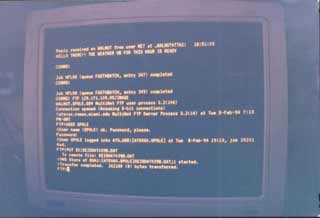 Here is the screen shot of the first true Internet
connection from South Pole to the outside world, via
LES-9, on 8 February 1994. Prior to this connection,
data was sent over a serial modem, in much the same
way teletype messages were sent over HF to McMurdo in
the old days. With the old, non-internet connection,
all data and email traffic went through the comms
operator who batched things up, (after reading the
mail for the juicy bits) and manually transferred
the data up north. (More information, credits, and
larger screen shots...)
Here is the screen shot of the first true Internet
connection from South Pole to the outside world, via
LES-9, on 8 February 1994. Prior to this connection,
data was sent over a serial modem, in much the same
way teletype messages were sent over HF to McMurdo in
the old days. With the old, non-internet connection,
all data and email traffic went through the comms
operator who batched things up, (after reading the
mail for the juicy bits) and manually transferred
the data up north. (More information, credits, and
larger screen shots...)Major galley addition started on "window" side as well as on the end towards the main entrance arch.
Rodriguez well certified as a potable water source
Movable 10,000 gal steel fuel tanks on skis show up for storage of emergency fuel, replacing bladders on the surface
Scott's memorial cross reinstalled on Observation Hill (23 January).

The cross had been originally erected on 22 January 1913 by surviving members of Scott's Terra Nova expedition...it took them 2 days to carry the cross up the hill. More recently...members of the McM and Scott Base communities carried the cross up the hill. This was not the first time the cross needed to be reinstalled...in August and September 1974 it was dislodged by severe storms. More photos and information.
McM Pegasus runway in service for C-141's in February.
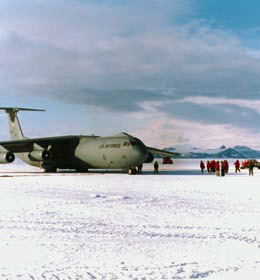
The photo at left depicts the first C-141 aircraft to be on deck at the Pegasus runway, on 7 January 1994. Construction of what originally was described as a "blue ice" runway had begun in 1991-92; by the end of the 1992-93 season it was partially complete (6000 feet long) and certified for use by wheeled C-130's; the first such LC-130 wheeled takeoff was on 8 February 1993. In its completed state seen at left, it was 10,000 feet long and 300 feet wide (more information, construction documentation and references)
Winter 1994
Manager: Janet Phillips, population 27
SPIREX catches Shoemaker-Levy comet collision with Jupiter, watched by some of the first CARA w/o's with data sent back via the new satellite links
Galley interior completed
 This 1998 view from the top of the dome shows the more recent
additions to the galley, including the dining area expansion
and interior stairs on the east side, they lead up to the bar
or what is now more commonly known as the upper galley. Also
there is a new pantry and upper lounge area on the north end.
The large white area in the center of the picture is the roof
of the greenhouse, which was built in 1994-95 on the roof of
the Annex...directly above the room I occupied in 1977. Hmm,
I heard the roof would sometimes leak...the 1989 addition to
the east end of comms can also be seen. To the left of the science building is the electrical substation which was built in 1994-95. This picture also shows the "fire escape" hatches which were installed on the berthing rooms in 1993. (photo by Robert Schwarz)
This 1998 view from the top of the dome shows the more recent
additions to the galley, including the dining area expansion
and interior stairs on the east side, they lead up to the bar
or what is now more commonly known as the upper galley. Also
there is a new pantry and upper lounge area on the north end.
The large white area in the center of the picture is the roof
of the greenhouse, which was built in 1994-95 on the roof of
the Annex...directly above the room I occupied in 1977. Hmm,
I heard the roof would sometimes leak...the 1989 addition to
the east end of comms can also be seen. To the left of the science building is the electrical substation which was built in 1994-95. This picture also shows the "fire escape" hatches which were installed on the berthing rooms in 1993. (photo by Robert Schwarz)
Serious power outage in March due to frozen glycol in the radiators; summer camp generator fired up to backfeed station after 50 dark minutes, more than 3 hours elapse before full power is restored.
Before water consumption began, the Rodriguez water well heat tape catches on fire in the hole and the system freezes up, one day after the power outage; snow melter ops continue (about the rodwell).
CARA building interior construction continues in winter.
First videoconference from Pole (9/13) using CuSeeMe software and the LES-9 satellite (archived post). Michael Hancock talks to CARA in Wisconsin from the new CARA building.
Janet Phillips was first female Pole manager; after McM winfly all 3 US stations have female sm's (Ann Peoples at Palmer, Karen Schwall at McMurdo). Here's an article Janet wrote about this for her local paper, the Jemez [Springs, NM] Thunder, for Women's History Month.
Summer 1994-95
CARA building finished and dedicated as Martin A. Pomerantz Observatory (MAPO) (3 December).
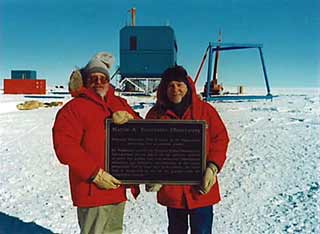
At left is John Lynch with Dr. Pomerantz. They are holding the plaque which would be installed inside the building to commemorate the dedication. This would be Marty's last trip to the ice (more photos and the Antarctic Journal article about the dedication). Behind them to the right of MAPO is the early construction of the SPIREX platform. And perhaps coincidentally or perhaps not...
...the Pomerantz Land solar observatory site operated for the last time.
CRREL comes back to rework the water well; new hole drilled (water in bulb still liquid after 9 months), water again officially declared potable (they also harvest micro- meteorites from the water bulb).
Kenn Borek Air crew killed in Twin Otter crash while taking off from Rothera en route to Pole (24 November). Below, the flag at the South Pole was accordingly lowered to half staff.
 This was an early season positioning flight, heading ultimately to the Italians' Mario Zucchelli Station at Terra Nova Bay to support their science program. There were four fatalities--pilot J. Corcoran, first officer Eirik Odegaard, Dale Fredland, and Corcoran's father Neil. All were Canadians, and all except Neil were Kenn Borek employees. The aircraft failed to gain enough altitude, perhaps due to a stall. It hit an iceberg and burst into flames. Two incident reports--one from Aviation-Safety.net, and another from UPI News. The aircraft was reported as seriously overweight based on manufacturer specs...but this is typical for all such flights between Rothera and Pole (photo from Scott Konu).
AST/RO telescope installed, annex added to AST/RO building for liquid helium storage.
SPIREX platform constructed on MAPO, telescope moved from AST/RO building.

The dark sector as it appeared in January 1995 as you approach from the dome. The AST/RO telescope has just been installed on the right side of the roof of the AST/RO building in the foreground. Behind the CMBR telescope, the SPIREX platform is under construction on the end of MAPO (Photo by April Lloyd).
New Gorman-Rupp pump and aircraft refueling station set up.
Permanent greenhouse constructed on top of annex.
The NOAA "slushies" tradition reportedly begins...a weekly event, in CAF, of course.
New electrical substation building constructed in the dome (next to the main entrance, north of the science building) to replace all of the manual transfer switches in the power plant arch.
The third of four broadcasts in the "NASA QUEST "Live from Antarctica" TV series aired.
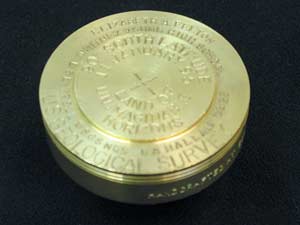
It was titled "Spaceship South Pole" and aired on American television on 10 January. The "Live from Antarctica" project provided interactive contacts between station residents and students. And yes, one student was named on the Pole marker seen at left--Elizabeth Felton, who won a NASA/USGS contest and got to come to Pole to see the science and position the marker. Here's an archived page about the NASA QUEST Live from Antarctica series, and an archived text file about the project. More information about that Pole marker and its creation...
Retrograde of backlog of solid waste since 1991 (300+ tons) completed.
[?]Met tower in clean air sector relocated (to make way for the new NOAA building?) (? Or did this happen early 95-96 )
SPASE-II construction started in dark sector 1/4 mile SW of MAPO
Winter 1995
Manager, John Parlin, population 28
First greenhouse operations limited by electric power shortages.
First AST/RO observations.
Summer 1995-96
SPASE-2 array construction starts 1/2 mile south of MAPO.
CRREL shows up and tests their new utilidor tunneling machine (at one time there had been plans for a tunnel all the way to the dark sector, under the skiway...) (my coverage of the tunneling projects).
New 2-story building for NOAA under construction 500' east of CAF which it will replace (photos and story).
4 more AMANDA holes, these 2-2.2 km deep "AMANDA-B" drilled and put in operation.
U.S. government shutdowns (14-19 November and 16 December-6 January) force contingency planning to reduce operations to "maintenance mode"--which would have reduced the 1996 w/o group to about 10 people. Fortunately the issue was resolved.
Summer visitors include...
- Norwegian Børge Ousland, trying for a solo unsupported crossing, he bagged the second half due to frostbite but would be back to finish whole thing the next year.
- Marek Kaminski from Poland, trying the same thing, he didn't make it across either, but he did hit both poles in one calendar year...he came back to Pole in 1996-97 as well.
- w/o Chris Bero's father Robert Bero, who showed up on an ANI aircraft for a brief father-son visit.
- Science fiction author Kim Stanley Robinson, with the NSF Artists and Writers program, digging up background for his next book "Antarctica," researches in, around, and under the station (!?)
- Norman Vaughan, the last surviving member of Byrd's first Antarctic expedition in 1928-30, on which he'd dealt with training and maintaining the sled dogs. At age 90, Norman is the oldest documented person to visit Pole.

 Norman planned a dog team venture to climb Mt. Vaughan in 1993-94 before dogs were banned from the continent. That didn't work--the aircraft carrying the dogs crashed short of Patriot Hills (Amazon link to the book about this strange tale). He did successfully summit "his" mountain in 1994-95, albeit without dogs. In 1995-96 he returned to the ice and visited Pole...at left, he's shaking hands with comms guy Neil Conant who provided this photo. Polies visible behind them--at left under the aircraft window is winter site manager Tim Coffey, between Norman and Neil is Jeff Matney (sp?) (Kathy Hill's friend), Doug Forsythe (in black hat), and electrician Kerry Vigue (in beige balaclava). At right is another Norman hero shot, to his right is Mike Salasek who provided this photo.
Winter 1996
Manager: Tim Coffey, population 26

No midwinter airdrop; discontinued due to email, supply system improvements, greenhouses, and budgets...
Internet darts match with a DC team documented (10 August).
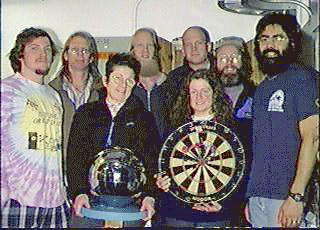
The opponent was a team from Mr. Eagan's Restaurant--a darts-friendly venue which closed on 18 March 1999. Radio darts had already been going on for years...I participated in all 3 of my winterovers, but in 1996 this internet thing was something new. At left, the intrepid Pole team--from left, Bob Farrell, Jason Dorpinghaus, Betty Carlisle, Mike Salasek, Jeff Otten, Katherine Caesar, Dan Ireland, and Ricardo Ramos. Here's the full documentation. The venue for this event was the venerable Clean Air Facility...on its last winter of operation. Thanks to Mike Salasek for sharing this link.
Beer is brewed...by winterover materials guy Jason Dorpinghaus, one of the members of the Dome Brewers Association. Here's his story courtesy of Brew magazine. With recipes...
Environmental protocol ratified by Congress, final "official" implementation would take a bit longer yet.
First use of C-141 aircraft (instead of LC-130s) for WINFLY flights to McMurdo
Summer 1996-97
CRREL returns with tunneling machine, digs 400' x 7' wide x 10' high snow tunnel branch off the utilidor for gravity sewer outfall.

The completed utilidor tunnel with the sewer outfall piping in service. The elevated station uses a similar tunnel system for water and sewage; the waste water is dumped into played-out Rodriguez well bulbs. (1999 photo by Joel Michalski)
Here is more than you ever wanted to know about the tunnels...
SPASE-2 finished along with intermingled VULCAN (Cherenkov detector) array, AMANDA construction continues with 6 more 2 km strings installed finishing AMANDA-B.
Viper steel structure for the instrument and its control room erected west of MAPO

The Viper structure under construction in 1996-97. In this view looking northwest, the steel support structure is being erected behind the control room which has yet to receive its blue siding panels. This photo was taken by Todd Cardiff, one of the ironworkers who was putting this puzzle together next to MAPO.
Here is a closer larger view of the nearly completed structure, from Chris Rock.

AASTO (Automated Astrophysical Site-Testing Observatory) installed
 This structure was a prototype "super-AGO" installed SE of
the AST/RO building, soon the web cam would come too, courtesy
of JACARA (Joint Australian Centre for Astrophysical Research
in Antarctica) (archive site). Also involved were Jack Doolittle, 1977 Siple
w/o, more recently the AGO guy, and fellow Stanford OAE Ev
Paschal who was one of the first 4 Siple w/o's in 1973. The
project had problems with the propane generators the first few
years and was never relocated to Dome C as had been considered,
but the testing here was used to develop the units later set up
at Dome C and Dome A. The photo is by Michael Burton, from the
paper "The history of astrophysics in Antarctica". The appendix table (list of projects) is here.
This structure was a prototype "super-AGO" installed SE of
the AST/RO building, soon the web cam would come too, courtesy
of JACARA (Joint Australian Centre for Astrophysical Research
in Antarctica) (archive site). Also involved were Jack Doolittle, 1977 Siple
w/o, more recently the AGO guy, and fellow Stanford OAE Ev
Paschal who was one of the first 4 Siple w/o's in 1973. The
project had problems with the propane generators the first few
years and was never relocated to Dome C as had been considered,
but the testing here was used to develop the units later set up
at Dome C and Dome A. The photo is by Michael Burton, from the
paper "The history of astrophysics in Antarctica". The appendix table (list of projects) is here.
New "Balloon Inflation Facility" (BIF) occupied...
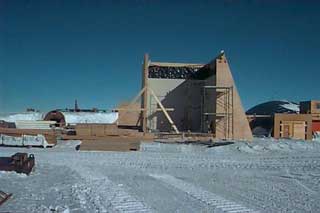
Before BIT could be torn down, a replacement balloon inflation facility (BIF) had to be completed...here's a construction photo (Chris Rock) is to be credited for this and the next 5 ASA photos...
(more photos of the BIF and original cryo construction).
Other replacement structures....

...the new helium storage buildings, one of which is shown here under construction. Some of the liquid helium would also be used for balloons.
...and the new cargo building.

the new cargo building...
The new helium and cargo buildings are occupied...

as seen here from the top of the dome...from the left is the BIF (balloon inflation facility), helium storage, and cargo office. Notice the naked end of the helium arch.
as demolition of the 1975 station begins on schedule to make way for the next one: the Balloon Inflation Tower goes away, followed not long afterward by the helium arch.
Demolition of the BIT is underway here, with the Mantis crane pulling stuff out of the inside. The radome has been removed--it was originally part of the original IGY station, and it is still sitting on the berm. Here is a detailed sequence of photos of the demolition!
This was followed by the cargo/helium arch, removed to make way for the new garage shop building
 The cargo arch was excavated and removed gently
for possible future use...and some of it was.
Seems that the new arches (garage and power plant)
were designed to be aligned with the original
garage arch, but it turned out that the old
garage arch was one rib short. The rest of this
arch is out on the far berm. That Russian aircraft that arrived in 2002 was parked next to it
for a few years. All the photos are here.
The cargo arch was excavated and removed gently
for possible future use...and some of it was.
Seems that the new arches (garage and power plant)
were designed to be aligned with the original
garage arch, but it turned out that the old
garage arch was one rib short. The rest of this
arch is out on the far berm. That Russian aircraft that arrived in 2002 was parked next to it
for a few years. All the photos are here.
Hose/cable connections to Rodwell relocated to clear footprint of new garage arch; the new routing blocks access to the snow melter, which was abandoned. A portable fuel-fired snow melter was obtained for use as a backup.
Visitors include Edmund Hillary along with the PM of New Zealand
New summer camp power plant completed with two 150kw 208v generator modules and an interconnecting module (one of these would later be moved to the dark sector and added to Building 61 substation there). The old 1981-82 camp power plant was demo'd and retrograded.
And...a new dome substation building was constructed to feed summer camp with 4160v power under normal conditions.
New NOAA building completed/dedicated/occupied, CAF is abandoned for the winter.

The newly completed Atmospheric Research Observatory (ARO) is shown here with the shipping crates for the instrumentation and other equipment that is being installed. None of the roof-mounted sample collection systems are in place yet. More photos and info about the construction completion and dedication are here (NOAA/CMDL/ESRL photo).
3.2KW prototype wind turbine installed on 40' tower
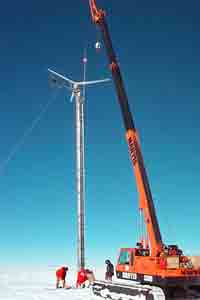
The Northern Power Systems (NPS) turbine project was begun in 1995, and the unit was installed at Pole in January 1997 for what turned out to be two winters of testing...with an estimated 10,000 hours of rotation.
A related project at the same time installed photovoltaic panels on the four sides of the roof of ARO (more pictures and information on these projects).
Wells Fargo ATM put in service at McM (10 January)...documented by Ethan Dicks who used it that day. A guy on a Pawn Stars episode tried to sell a receipt he got the next day...the receipts had a date and said "Antartica" (sic). Oh, the guy was also trying to sell a 1997 Pole marker (more info).
Winter 1997
Manager: Don McCreight, population 28

Digital all-sky camera in skylab replaces the 35mm model.
Major pipe freezing problems in the galley.
Congress approves full funding for the new station (the "South Pole Modernization Project," signed off on by President Clinton in November).
Summer 1997-98
CAF demolished after sitting empty all winter...the equipment had been moved to the new ARO after its dedication in January 1997.
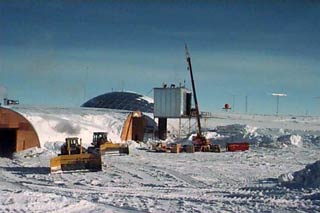
This large hole is where the remaining CAF foundation is being removed. I don't have many photos of the CAF demolition...but a couple more are here. Meanwhile, the new ARO structure, which had been occupied during the 1996-97 summer, was officially dedicated on 12 January 1998 (Antarctic Sun article published on 28 January).
Summer camp moved east; the Jamesways are picked with the crane and moved in one piece. instead of dismantling/reassembly.
 The easy way to move a Jamesway nowadays since
there is a crane available... Oh yes, if you
haven't been inside one of these in awhile, keep
in mind that there are permanent fire-resistant
partitions and private rooms inside instead of
those bunk beds with sleeping bags, No more Navy
blankets hung up on ropes. No more Preways either,
the forced-air furnaces are in separate structures
to improve fire safety. (Chris Rock)
The easy way to move a Jamesway nowadays since
there is a crane available... Oh yes, if you
haven't been inside one of these in awhile, keep
in mind that there are permanent fire-resistant
partitions and private rooms inside instead of
those bunk beds with sleeping bags, No more Navy
blankets hung up on ropes. No more Preways either,
the forced-air furnaces are in separate structures
to improve fire safety. (Chris Rock)
SPASE-1 boxes removed from in front of the fuel arch, they never detected cosmic gamma ray sources, the original goal...
Old Pole fuel recovery conducted to salvage 10,000 gallons of DFA for use by PICO...along with most of the old weather balloons.

Plumber Scott Smith at the bottom of the main entrance during the multi-year investigation and recovery effort...here are more pages of photos and info....
GASP telescope shut down at the end of December and removed, replaced by VULCAN
Three NGA skydivers killed as they land with unopened parachutes (7 December)
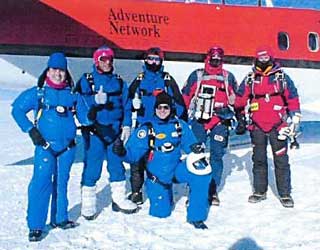
The group was sponsored by the same group that would later coordinate the "Millennium Expedition" with those snow buggies, more planned skydiving that didn't happen, and the balloon ascent that did. The photo at left is their "thumbs up" picture at Pole, after they'd set out the drop zone target and just before the event. Four of the six jumpers (in blue in the photo) planned a four-way jump starting with free fall...three of them hit the snow with unopened parachutes. With Polies watching (the full story with many photos).
Three more AMANDA strings, this is start of "AMANDA 2"
Arctic Trucks, based in Iceland, brings their first Toyotas to the ice to test their performance.

Two modified Toyota 80 Land Cruisers and two men came along on the S. A. Agulhas which was bringing cargo to Sweden's Wasa Station near the eastern Weddell Sea. The unloading point was 72º39'S 16º39ºW at the ice edge; the station is at 73º05'S 13º25'W. They assisted with ship offload and also traveled up onto the plateau, reaching 76ºS 8º03ºW. In comparison with the Swedes' Hagglunds, the Toyotas could handle less weight, but they traveled much faster with much lower fuel consumption. Here is the archived Arctic Trucks news page which is also the source of the photo at left. Arctic Trucks would return to Antarctica in 2008-09.
New garage/shop arch erected.
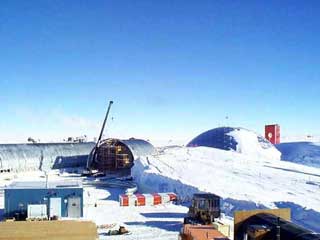
The new garage/shop arch under construction. The blue structure in the foreground is the cargo buil- ding; the red/white structure is part of the rodwell complex. (Chris Rock). Oh yes, many more photos are here.
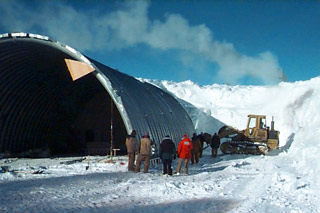
Existing garage arch dug out with the help of explosives, jacked 3' and erected on new kneewalls to match new garage arch elevation.
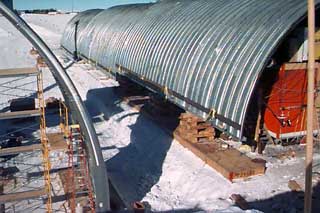 Explosives actually had to be used to break up some
of the hardest ice, particularly for installation
of the new footings. This photo shows the beginning
of the jacking process, as well as the start of the
new garage arch. Lots of photos (well, none showing
the blasting) are here. The project also included
interconnecting the two arches with corrugated steel
passages. The new garage would be built starting in
1998-99; in 2008 the logistics facility would be built
in the old garage arch.
Explosives actually had to be used to break up some
of the hardest ice, particularly for installation
of the new footings. This photo shows the beginning
of the jacking process, as well as the start of the
new garage arch. Lots of photos (well, none showing
the blasting) are here. The project also included
interconnecting the two arches with corrugated steel
passages. The new garage would be built starting in
1998-99; in 2008 the logistics facility would be built
in the old garage arch.VIPER equipment/telescope installed and put in service.

At left, the completed VIPER telescope structure. This view is from behind MAPO (which is on your left out of the photo. More information and photos.
AASTO module installed successfully
GCA system replaced with new TACAN unit.


Perhaps as a sign that the Naval Support Force Antarctica was leaving, the old system (left photo) was being replaced with the new up-to-date unit, which was on site until about 2007 when it was moved to the berm in deference to newer navigation systems. The old dome may be left over from the original IGY station. (Chris Rock)
SPTR (South Pole TDRSS Relay, the TDRS-1 satellite link) established

The satellite connection set up in 1993-94 using the LES-9 and GOES-2 satellites would be inadequate to handle increased data requirements from new dark sector projects such as AMANDA, so a new communications link was set up using NASA's TDRS-1 satellite. The station was housed in the second floor of the elevated dorm, with two small antennas mounted on the roof. At left...one of the project graphics depicting the new system. Details and photos...
Former astronaut Owen Garriott visits Pole and leaves his mark in Skylab (15 January).
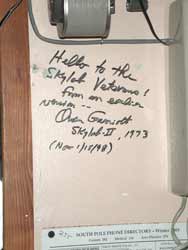
Garriott spent 60 days in space aboard NASA's SKYLAB III mission in 1973, as well as ten days aboard Spacelab-1 in 1983. He was visiting Pole as a member of a meteorite collection project--one of 3 such trips he'd make to the ice. He returned to Pole in January 2000 along with fellow astronaut Jim Lovell as part of a private expedition to search for exotic microbes. (2005 photo by Will Silva originally from the Antarctic Photo Library which is no longer online) (go here for the full size version and caption).
Freshie shack enlarged.
IRIS/USGS seismo equipment moved to UCLA "cold tunnel."
Treaty nations complete final ratification and approval of Madrid (Environmental) Protocol.
Winter 1998
Manager: Katy Jensen, population 28

Cargo vessel MV Green Wave suffers engine failure two days after departing McMurdo (15 February).
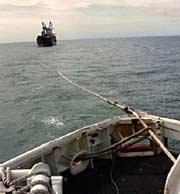
This would eventually result in the death of the chief engineer, who was crushed by a cylinder head when the ship rolled unexpectedly. The Green Wave was towed to Lyttelton by the Polar Star (left, the Green Wave under tow as seen from the Polar Star), resulting in an emergency exception to the US policy about not admitting whether nuclear weapons were aboard its military vessels, because this involved a vessel in distress and a seriously injured crew member (the full story and photos).
NSFA (Naval Support Force Antarctica) leaves the ice for the last time and is disbanded.
Unique evening performance of short plays and monologues held (August)

During the 2008 winter I spent a bunch of time cleaning, sorting, and reorganizing the quiet reading room. One evening I was quite surprised when this program fell out of a book! Looks like it was an interesting fun evening back in the days before Antarctic film festivals. I did some searches on the obscure works that were presented, and at least one of them was published and performed elsewhere.
If you are reading this site you will most certainly recognize many of the names of the performers :)
Next generation of videoconferencing--first MBone multicast video/audio presentation (4/1) as a part of "Live in Antarctica II" (this was not the first live video from the station, that happened during the 1994 winter (archive link).
Iridium satellite streaks show up in the sky amongst the auroras.
Summer 1998-99
Garage/shop building in new arch framed and enclosed (all the photos)
Cosray platform jacked 10'
Massive solar display of sun dogs/halos and refractions observed and photographed, probably a record event.
Old Pole salvage operations continue--heavy timbers removed for use in the new station construction.
Second Pole wedding happens (1 January)
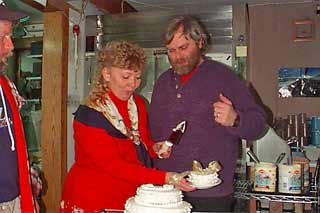
The folks involved here were winterovers Roger and Donna Aldrich Hooker. The ceremony was conducted by Alaskan guy Ken Lobe. Here is a bit more documentation.
Chilean S-70 Blackhawk helicopter shows up (28 January).

The helicopter arrived from Punta Arenas via Frei, Carvajal, and Patriot Hills. It carried the chief of the Chilean Air Force, General Fernando Rojas Vender (news story). The Black Hawk helicopters were first introduced in 1974 by Sikorsky; by 1999 more than 2,400 variants were in service in many countries. The photo is from Brian Ellspermann.
Air Force LC-130 discovers a crevasse while taxiing for takeoff near Upstream D.
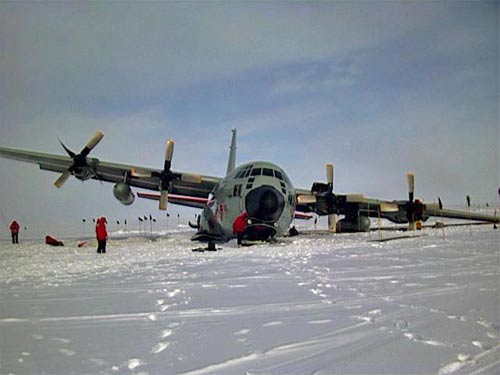
This was at Upstream D (81°S-140°W) on 16 November. There was no injury or really serious damage, but lots of work was required to get the aircraft fixed up enough to fly out (more information and photos).
End of fuel arch dug out (a "slightly" bigger job than it was 10 years previously), bladders replaced with 45 10,000 gallon tanks with containment, a new pump station module installed. Also, new OSHA compliant escape towers installed on the sides and end of the arch...all this to remain as part of the new station
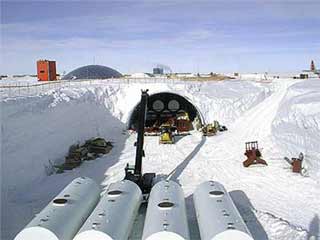
A view of the massive excavation required to expose
the end of the fuel arch. The tanks are stacked in
the arch in 9 groups of 5. (story and photos)
The Navy VXE-6 squadron makes its last flight to Pole, soon to be disestablished (the Navy is not completely out of the USAP program; they continue to manage the planning and design of major construction projects including the new station)
Winter 1999
Manager: Mike Masterman, population 41
...a new w/o record. The winter construction crew for the garage/shop building lives outside the dome in the elevated dorm.
First satellite phone call between South Pole and the North Pole (28 April).

This was part of a NASA connectivity project...the chief instigator was friend "NASA Mike" Comberiate who had been involved with a number of Antarctic communications projects including the SPSDL...I met him when that antenna was relocated away from the dome so that the base ring repairs could be made. Here's the Guinness World Records certificate, a photo of one of the NASA folks on the phone at the North Pole, a view of their campsite, a close-in campsite view, and the Guinness Records web page which lists all of the participants. Note that the South Pole participants were comms tech Tom Carlson and NOAA lead researcher Joel Michalski. All of these photos and information are from Mike Comberiate. Also, here is a NASA article describing the North Pole internet activity, while the "A Very Cool Place" image at left is from this "Ripley's Believe it or Not" cartoon of the day.


New garage/shop building is finished out on schedule except that the paint went bad (!)
Local Pole time was shifted from New Zealand time to the Denver time zone for the winter, to improve coordination with the ASA office (this experiment was never repeated).
The world and the news media focus in on the midwinter medical problems which bring on the first airdrop since 1995 (Saturday 10 July).
 The airdrop involved a C-141 as well as a KC-10 tanker, both departed ChCh in the afternoon. The C-141 was refueled by the tanker over McM between 1930 and 2030 SP time, and by 2230 it was overhead at Pole. [Note...as described above, for this winter only Pole was on Denver time, UTC-6.] A total of 6 boxes were dropped, including the medical supplies, freshies, mail, a few supplies, and fresh flowers. One if the boxes was signed with well wishes from the entire air crew. The actual drop took only 10 minutes, but it was difficult to find all of the boxes, as the attached strobes didn't last long in the -86ºF temperatures. Recovery of the last box took 90 minutes.
At right, harvesting the fruits (and vegetables) of the first airdrop since 1995 (Photo from Joel Michalski). Here is a 17 July Los Angeles Times article and a montage of more of Joel's photos.

Power outage less than 24 hours before airdrop wipes out the last spare governor board, requiring some serious reverse engineering.
First phase of major McMurdo renovation of housing facilities remodels the Building 155 food preparation and "Highway One" areas (31 October Antarctic Sun article).
First USAF test flight of a C-17 aircraft into McM from ChCh (15 October), it has more than twice the load capacity as a C-141 (24 October Antarctic Sun article).
News media focuses on Pole again, the most coverage since Byrd flew over the place in 1929...
Summer 1999-2000
...as cancer patient Dr. Jerri Nielsen is evacuated on 16 October, the earliest first flight to Pole ever...(more information) Alas...Jerri's cancer returned, and she died in 2009 after remarrying.
...and probably the first operational use of JATO for takeoff from the present skiway.
Taxiway reconfigured to make room for new station construction, not to mention that encroaching line of survey markers
New garage completed and occupied

The interior of the new garage, heavy shop, vehicle maintenance facility, or whatever... It was officially completed and occupied in December. It is 5 times larger than the original garage, which wasn't demo'd for a few more years. Here's the rest of the story, photos and info.
Margaret Lanyon, NSF representative in ChCh, retires after 36 years.
Art Mortvedt lands historic Cessna 185 "Polar Pumpkin" at Pole (22 November)
 Not the first single-engine aircraft at Pole, but
more recently this one has generated additional
interest. An Alaska bush pilot, Art worked for ANI
for multiple years, and also flew for Delta. This
aircraft was owned by ANI at the time and had previously been flown by Giles Kershaw. When ANI decided to get rid of this single-engine aircraft, Art purchased it. In 2011 he was en route to the North Pole,
to make this the first aircraft to land at both poles...that attempt was unsuccessful, as was his 2012 try. But on 6 April 2013 he finally succeeded (archived link)...after which he spent the night at Barneo before heading back south.
Not the first single-engine aircraft at Pole, but
more recently this one has generated additional
interest. An Alaska bush pilot, Art worked for ANI
for multiple years, and also flew for Delta. This
aircraft was owned by ANI at the time and had previously been flown by Giles Kershaw. When ANI decided to get rid of this single-engine aircraft, Art purchased it. In 2011 he was en route to the North Pole,
to make this the first aircraft to land at both poles...that attempt was unsuccessful, as was his 2012 try. But on 6 April 2013 he finally succeeded (archived link)...after which he spent the night at Barneo before heading back south.
Construction of new power plant arch and structure underway in front of old garage arch

The new power plant structure is being erected at the same time as the arch...to the right is the "original" garage arch which has been elevated on new kneewalls, and to the right of it is the new garage arch, containing the garage/shop structure officially completed in December 1999. Here is the large version of this picture...(photo by Brad Halter)

SPIREX infrared telescope shut down and removed; DASI, the next CMBR detector installed in its place
Exterior shell of new Dark Sector Lab constructed.
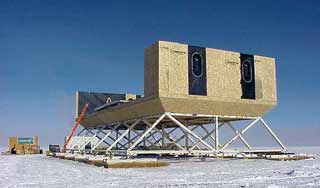 DSL would drop in priority and wouldn't be framed
out until 2002-03. Still unoccupied in 2004, it
was designated as the replacement structure for
most of the skylab science, as well the future 8m
telescope, which turned into a 10m telescope. Here
are the construction photos as well as more information.
DSL would drop in priority and wouldn't be framed
out until 2002-03. Still unoccupied in 2004, it
was designated as the replacement structure for
most of the skylab science, as well the future 8m
telescope, which turned into a 10m telescope. Here
are the construction photos as well as more information.
"Millennium" live TV coverage features the annual relocation of the Pole, NOAA balloon launch, and the New Years party.
"Russian Millennium Expedition" arrives at Pole a few days after 1/1; the longest rubber-tired vehicle traverse in history shows up and launches the first hot- air balloon!


At left, one of the 6x6 gasoline-powered "snow bugs" demonstrates its extreme low ground pressure by driving over some of the Polies; at right is the historic balloon flight (photos by Robert Thompson); (my page with more details and links).
7-person Argentine Army team of geography professionals arrives unannounced from Belgrano on snow machines for an unassisted official scientific visit (4-7 January)

The team: Lieutenant Colonel Victor Hugo Figueroa, Captain Eugenio Nicolas Bernardi, Principal Deputy Officer Julio Cesar Dobarganes, Assistant Sergeant Ramon Rosamel Celayes, Assistant Sergeant Luis Armando Cataldo, Sergeant First Juan José Brusasca, and First Sergeant Daniel Rafael Paz. Photo legend translation: "Today, January 5th, the arrival at the geographic South Pole of the 2nd Technical Scientific Patrol is commemorated, made up of seven members of the then Army Antarctic Command." This photo with thanks to Adriana E. Romero, wife of LTC Figeroa.
New toilet facility in upper galley (bar) completed, replacing hot-water urinal in fan room.
Six more AMANDA strings drilled and put in service.
NASA Astronaut Jim Lovell visits Pole (January 2000).
 Jim Lovell had been to space several times, including as mission commander for the disaster-stricken Apollo 13 mission which he brought back to Earth safely. The trip was an 8-menber team on an expedition to search for exotic microbes--the team included fellow astronaut Owen Garriott who had visited Pole in January 1998. They visited Patriot Hills and the Moulton Escarpment in the Thiel Mountains, and then instead of a few hours, they spent 3 days at Pole 16-18 January due to weather. Here he is with comms operator Diana Logan...photo from Drew Logan.
Here's a page of information and photos of the meteorite collection team (archived from Steven McLachlan's Antarctic philately web site), as well as an archived NASA News article about the 2000 venture.
Jim Lovell had been to space several times, including as mission commander for the disaster-stricken Apollo 13 mission which he brought back to Earth safely. The trip was an 8-menber team on an expedition to search for exotic microbes--the team included fellow astronaut Owen Garriott who had visited Pole in January 1998. They visited Patriot Hills and the Moulton Escarpment in the Thiel Mountains, and then instead of a few hours, they spent 3 days at Pole 16-18 January due to weather. Here he is with comms operator Diana Logan...photo from Drew Logan.
Here's a page of information and photos of the meteorite collection team (archived from Steven McLachlan's Antarctic philately web site), as well as an archived NASA News article about the 2000 venture.Jim Lovell died on 7 August 2025.
Tunneling begins for main water/sewer system for new station--first of 3 years of work for the CRREL machine. Project led by tunneler John Wright
Unheated hypertat walkway built to facilitate winter berthing use