South Pole News Archive[I recheck the links now and then, but still they tend to disappear...sorry. And...this page has grown to be rather large...]
25 October...lots of news, first from Pole! The station received two Twin Otters on 5 October transiting from Rothera to...not McMurdo, but an Australian station for a medevac. And in addition to freshies (the Clementines were a big hit) they also brought pax! They returned to Pole with the patient on 8 October, en route to McMurdo...and this provided a unique opportunity for the winterover photo! Note that no information has been released publicly about the medevac patient or station involved. SAHPR continues to be a significant NSF issue, recent details of which cannot be discussed here. On 15 October, NSF issued this Reminder...for 2024-25 Antarctic summer Season. That announcement may have been an attempt to respond to this 10 October letter from the House Science Committee to the NSF director regarding the issue. AARGH! Another issue in the mix for the long-delayed issuance of the RFP for the next Antarctic support contract.
Main body flights began on about 24 September. 4 September 2024...an old ~1969 NYC radio commercial I remember is "Money Talks, Nobody Walks" (that was for Dennison Clothes in Denison NJ)...but "money talks" seems to be the phrase of the moment for USAP...after all, no one can walk to Antarctica. After long delays, the preliminary Request for Proposal (RFP) for the next Antarctic support contract was issued on 26 July. No updates as of now (4 September). But the long delay required that an extension be issued to the current support contractor Leidos. For 18 months through 30 September 2026! That was also issued on 26 July. Leidos had previously expressed reluctance to accept a contract extension, and that they would not be bidding on the next contract. 28 August (sorry, was awhile...blame music festivals)...WINFLY is complete! The last of 4 flights arrived on Monday 26 August after a 5 delay. The earlier flights were more timely...first one was on 16 August...just before the first McM sunrise on the 18th. Something that came out on 17 May 2024 but I was only reminded of it recently...the updated "United States Policy on the Antarctic Region" (archive). It was originally issued on the White House website--at the September Antarctic Treaty meeting in Kochi, India it was issued as this PDF, along with this fact sheet (archive). Nothing really new at least for those of us following the US Antarctic Program, but it replaces a 1994 document. Back to the "money talks" stuff. NSF is facing another significant fiscal 2025 budget cut. Old news, but nothing has happened recently as Congress is in recess until 9 September. Per this 26 June AAAS/Science article, NSF's budget might rise 2% to $9.26 billion, which is less than President Biden's request and well below what NSF got in 2023. And on the Senate side, NSF would get a 5% increase to $9.55 billion, less than half of what Biden requested. (26 July Science article). And of course the funding shrinkage means that research vessels are going away. The Laurence M. Gould's contract has been terminated as of June 2024 its story. And another research vessel, the drill ship JOIDES Explorer, has also lost its NSF funding and is being mothballed (26 August 2024 New York Times article, the JOIDES Resolution website, and an open access 23 July EarthDate article. The vessel has worked in the Southern Ocean.
Space news! My second ice friend after Christina Hammock Koch (whom I wintered with in 2005--she's heading back to the Moon next year)...Australian polar guide friend Eric Philips is heading to space as part of a 4-person crew on a SpaceX Crew Dragon capsule...on the unique FRAM2 polar-orbiting mission to study the polar regions. The 4-person crew also includes filmmaker Jannicke Mikkelsen (Svalbard), Rabea Rogge (Norway), and Chun Wang (Malta/Svalbard). This all started when bitcoin billionaire Chun Wang joined one of Eric's Svalbard ski trips! The team has been at SpaceX headquarters this month for training. ExplorersWeb article as well as this 13 August Space.com article shared by Eric. Out on 13 May 2024...a new draft Master Plan for South Pole Station. Lots of history, general alternatives and discussion, but no specific plans for the next (?) station. They were looking for comments before 13 June. Here's the link for access. I must note that that page title and the URL referring to the "ARCTIC (!) Research Policy Committee Draft Arctic Research Plan" is inaccurate, but the actual referenced document is the correct one. Thanks to McM winter site manager Erin Heard for the heads-up! Lots of information...much more detailed than the South Pole Master Plan prepared by Metcalf &Eddy in the late 80s (which promoted the reuse of the Dome...or even building another one)...but just as vague as for actual plans. Way too much bad news about USAP has come out in the past week or two...so I'll start with something positive: a couple of great Antarctica podcasts out there. First, there's a brand new one out there, "Antarctica Did That For Me" hosted by Keri Nelson and Cassa Grant, who have a total of 9 seasons on the ice, at all 3 stations. Very upbeat...episodes released in the past month include discussions of the recent solar eclipse visible in the US, Taylor Swift, "Antarctica Sucks,"...well, you get the idea. And now...more of the strange and bad news that has come out in the past week. NSF reminded everyone on 29 April that the Laurence M. Gould would be going off charter on 16 July 2024 due to shifting science priorities and budget constraints. At left, a 11 April photo by Rachel Cook of the last departure of the vessel from Palmer Station. The draft RFP for the forthcoming Antarctic Support contract, promised by the end of March, still has not been issued. The contract expires on 31 March 2025, it's way too late for a new contract to be awarded and effective by then, and as said previously, the current contractor Leidos has said they will not accept an extension. But...while checking regularly to see if the RFP is out yet...something else came to light...an RFI looking for a provider of "Transport Aircraft in support of NSF." The ski-equipped C-130s are getting old, and NSF is increasingly frustrated by their frequent maintenance issues and delays. And it's not just the NYANG...remember that the closure of McMurdo this year was delayed over a month by a broken USAF C-17. That RFI on its face would seem to be seeking a contractor to show up and provide a fleet of ski-equipped transport aircraft (think like the McM helicopter support contract). Everyone knows better of course. But who knows...some of the older LC-130s are owned by NSF. And someone suggested ALE which of course operates the tourist camp and Pole. They bring large wheeled transports into Union Glacier (some of which have been Russian operated) but do not presently have large ski-equipped transports. Yet another dismal report...this in an 8 May article by William Muntean II published by the Center for Strategic & International Studies. The title says it all: "U.S. Operational Retreat from Antarctica." I'll summarize it with that ancient WABC New York radio ad tagline I remember: "Money talks, nobody walks." Or flies or....does science. Speaking of science at Pole, a major project cancellation was announced: CMB-S4--which would have put various types of telescopes/detectors at Pole and the Atacama Desert in Chile to study cosmic microwave background radiation. The project would have been international involving many institutions. Here is the project website...and the 9 May Science magazine article "NSF halts South Pole megaproject to probe infant cosmos' growth spurt" which you should be able to access. 
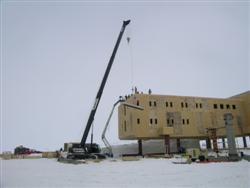
Other older news from NSF...more clarification on the results of budget cuts. No new Antarctic research projects will be funded. What WASN'T news from NSF...the draft RFP for the new support contract that was supposed to be released by the end of March...wasn't. Otherwise at McMurdo...construction was suspended this past season for the IT&C building which is still a year away from completion...and more recently work was also suspended for the new VEOC (aka new garage/VMF) in order to concentrate on the new dorm...as lack of bed space has hindered science and support work at McMurdo. At right, a 12 April photo of the new dorm from Michael Christiansen...looks like it needs a couple more seasons to finish. Enough bad news...here's my coverage of winterover statistics updated for 2024! Oh...I've updated my coverage of previous Pole trekkings/skiing/ballooning/skydiving back to 1995, as well as info on who might be showing up to the tourist camp next summer here. It's dark at Pole...there was a successful sunset dinner. Things at McMurdo have been more interesting...the "end of summer" for some folks got postponed for over a month due to the usual suspects--the weather, and a broken airplane. The C-17 that was supposed to come down in March...didn't. And got broke. And mechanics that got sent down to fix it had...their baggage not show up in Christchurch. Eventually the RNZAF got called into service...for a medevac! Its wheeled C-130 showed up at the Phoenix Airfield on Monday 15 April...in addition to the medevaced person and medical support, 12 members of the New Zealand Defence Force and a few of the summer McM folks were flown north. The Herc made another trip later that week to bring more people north...and the C-17 finally showed up on 20 April to bring the rest of the summerovers home. Well, I WAS going to New Zealand in mid-January, but a case of pneumonia made me cancel that. Meanwhile, yes, Pole closed on 2 March--the latest closing date ever, leaving behind 41 souls for the winter. Other stuff still to be caught up on here...but breaking, the Coast Guard is planning to buy an icebreaker from a unit of Edison Chouest Offshore--yes, the folks who operate the Gould and the Palmer. Details!
Meanwhile, the nongovernmental ventures continued to plug away...or quit. They had to reach Pole by about 18 January per ALE...and their season is over. Updates!. 3 January 2024...Happy New Year! Blame bluegrass shows and festivals for the lack of updates, but they're done for a bit...until I fly to Christchurch (tourist only) on the 14th. Yes, the new Pole marker, fabricated by Cal Neske, was unveiled on New Years Day, I'll get to that with photos in a day or two. Meanwhile...there have been LOTS of nongovernmental ventures...finally tracked all of them down (I think) and my update is here. Several surprises, including a sudden late entry by Colin O'Brady, who showed up at Union Glacier on the 23rd, set out only to stumble into a crevasse after only 4 miles. As for the Antarctic support contract rebid...on 18 December an announcement was made, including an updated schedule and links to reading material...the draft Request for Procurement should be issued by the end of March 2024. 17 December 2023...it's been awhile so there is lots of news! First...the shipping news. The Coast Guard icebreaker Polar Star left Seattle on 15 November heading for the ice (16 November Coast Guard News release). It stopped in Honolulu for several days over Thanksgiving, departing on the 27th...crossed the Equator and the Date Line on 4 December, spent several days in Sydney on the 12th, and then headed for Hobart. As for the cargo vessel Ocean Gladiator, it was in Ensenada a week ago, next stop Port Hueneme. The NY Air National Guard got a bit of a late start, but as of 9 December there had been 9 LC-130 flights...and the first Antarctic Logistics & Expeditions (ALE) Basler carrying tourists also showed up that week.
The ozone hole this year is described as "modest" in this 20 November Colorado Sun article which features an interview with scientist Stephen Montzka of the NOAA Global Monitoring Lab in Boulder, CO. As for contracts...the helicopter contract award got announced on 1 November to Pathfinder Aviation, based at Merrill Field in Anchorage. It's a series of one-year extendable contract periods. The outgoing contractor Air Center Helicopters did NOT take all of their helicopters home yet, contrary to what I'd heard. But, still no word on bidding for the next Antarctic support contract as of 16 December. 31 October (happy Halloween!)...Pole winter is over! The first Kenn Borek mobilization flight stopped on 24 October on the way from Rothera to McMurdo...bringing freshies from Punta Arenas of course...and the first official summer flight showed up on the 28th! It brought more than a dozen new folks, and a few of the winterovers headed north. Although there's at least one C-130 in Christchurch, I hear they won't show up at Pole until mid-November.
14 October...the first mobilization flight may pass through Pole around the 19th, with the official opening flight around the 26th. Speaking of aircraft, McMurdo's first main body flight happened on 7 October, but as the Airbus full of toasty winterovers rolled for take off for Christchurch, it aborted. Mechanical issues. Everyone got off and went back to town. The aircraft and the winterovers got to head north 2 days later. The dire NSF warnings of budget cuts and subsequent science project cancellations/delays discussed below have translated into terminations for 24 Antarctic Support Contract employees on 6 October. It's the end of September 2023, the sun has been sighted at Pole after some stormy days, and the first main body flight to McMurdo is scheduled for 8 October. U.S. government shutdown update: With less than an hour to go, a 45-day temporary funding bill was passed and signed into law on 30 September. Several previous shutdowns have impacted the U.S. Antarctic program...most seriously in October 2013 when many researchers and employees were sent home from McMurdo and many projects were cancelled. More recently the program and the ASC contractor has put money aside to fund program activities for a time after a shutdown begins. And on 25 September NSF issued a "...Plan for Operations During a Lapse in Appropriations" which briefly addresses the Antarctic and Arctic programs...perhaps this plan will still be necessary in mid-November. NSF's "Morale Program Initiatives" announcement (in other words, ending drink sales at McMurdo and rationing store purchases at all stations) was discussed here when it came out in early August, but at the end of September it hit the news wires. Here's an archived 27 September 2023 item from ABC News which details the issues and quotes NSF as saying the changes involving alcohol are related to morale and welfare and were not aimed at preventing sexual harassment or assault. As for the support contract rebid...something was supposed to be announced in September...but instead of a request for proposals, a Request for Information was issued on 28 September...it seems that the program is still seeking outside input (including from small business) on the type and form of the next contract, as they have been for awhile. The RFI does include a brief draft statement of work. Off the Antarctic coast, it's been reported that the Southern Ocean's sea ice coverage this past winter reached a record low since things have been measured, per this 25 September Washington Post article (which is not paywalled). The article is based on this archived 25 September 2023 report issued by the NSIDC in Boulder, Colorado. Some sad news to OAES...Neil Randall Conant, who worked Pole comms for many years, died on 18 September in West Virginia at the age of 86 (link to obituary pages). He was first hired by the program to work at Siple Station. I remember him well from my time at Pole in the late 80s. At right is a photo (from Jerry Marty) of Neil with Katie Hess during the 2005-06 season when Neil was involved in moving comms from the dome to the elevated station. And That Is All. This 14 September Science article titled "Antarctic Meltdown" (and subtitled "U.S. cancels or curtails half of its Antarctic research projects") describes...just that. The funding cuts were hinted at during the July "Antarctic Science, Infrastructure, and Logistics Office Hours" webinar I witnessed, but this article spells out all of the sad details. The issues are...money of course, program recovery from COVID, and the lack of McMurdo housing as the 203 dormitory has been demolished and the new housing being erected in its place. Signs of spring, the Pole window covers were removed on 31 August, and plans are underway for the sunrise dinner scheduled for Saturday, 23 September. In late August NSF hosted a charrette (participatory design planning process) to provide a forum for science and other Pole folks to give input for preparation of a South Pole master plan. It consisted of four 6-hour sessions in late August--I lurked on Zoom. One purpose was to introduce members of Stanley Consultants, the firm tasked with preparing the plan, to the issues and details of Pole science and operations. I'm hoping that some sort of final report on the sessions will be issued.
And another bit of strange news...despite the fancy new earth station at McMurdo, other options are still being considered by NSF...there is a proposal out there to run a submarine cable to McM from either NZ or Australia. At present they're just doing a market study to see if there is a consultant who can work on this potential project...details here. I'm reminded that 20 years ago NSF was considering running a cable from Pole north to somewhere where they could set up a remote earth station that could see geosynchronous satellites. Wonder how long that would have stayed up...seriously, they should have run that cable to Concordia! As for Winfly, it finally started on 26 August, more than 2 weeks late! And after the cold weather that had postponed it, more recently there's been some Condition 1 instead. Winfly is happening...the C-17 is in Christchurch but...no flights yet AFAIK on 22 August. A week late due to weather as usual, but this time not because of storms but because of temperatures...it's been below -40 (ºF/ºC)!
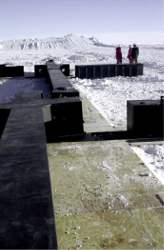
Several other relevant items appear on the SAM.gov site...including procurement of additional scaffolding material for the NOAA met tower at Pole, as well as procurement of a floating pier barge to be used at McMurdo in lieu of the ice pier or pontoon causeway system. Bids on that are due on 6 September. At right is the general arrangement plan of the 328' x 100' barge; additional details are on these PDF drawings selected from the many in the bid package. Also of interest...this 1 August USAP.gov article which indicates that the floating pier is to be delivered in February 2026. Speaking of things that float...on 9 August Bollinger announced that they'd cut the first steel for what will be the first of the Coast Guard's new heavy icebreakers aka Polar Security Cutters...the future USCGC Polar Sentinel (PSC-1) per this U.S. Naval Institute article...which notes that the vessel design is based on that of the yet-to-be built German icebreaker Polarstern II...thanks to Russell Rapp for this article. Meanwhile, this 31 July Maritime Executive article reports that there have been unreliable schedule and cost estimates for the new icebreakers, in part due to significant design issues. Note that the construction of this vessel was originally awarded to VT Halter, but this Pascagoula, MS shipyard was sold to Bollinger in 2021.
A sad note regarding...the implosion of the submersible Titan on 18 June...it seems that one of five passengers was Hamish Harding, who'd been involved with the development of White Desert and the Wolf's Fang runway...had accompanied Buzz Aldrin on a fateful NGO visit to Pole in December 2016 (Aldrin was medevaced), and also was the chief pilot on a record-setting business jet transpolar world circumnavigation in July 2019. On 12 June 2023 NSF announced their COVID-19 management plan for the 2023-24 season...briefly, this involves testing before deployment, masking and some isolation for 5 days before leaving McMurdo for field camps, for 5 days after arrival at Pole, or if tested positive at any of the stations. Also, NGO group tours will be permitted at all 3 stations provided that tour group members have tested negative within 72 hours, and all tour members as well as their guide must wear masks. The full details are outlined on this NSF page and detailed in the linked detailed management plan document (PDF). Also issued on 12 June, this 2023 Update on Science Support and Infrastructure in Antarctica--brief summary: the stations and research vessels are pretty well booked up.
Sunset has happened at Pole...at least "officially" as the March equinox happened at 1024 on Tuesday 21 March (BTW Pole and NZ are still on daylight saving time/UTC+13 until 2 April). Needless to say there will may still be sun sightings in the next days due to atmospheric refraction. And there was a Sunset Dinner on Saturday the 25th.
After the ship offload evolutions at McMurdo were completed, Polar Star transited to Palmer Station, arriving in early March. This was its first visit to Palmer since 1988! Here's the 10 March USAP.gov article...the photo at right from the article, Polar Star in Arthur Harbor, is by Marissa Goerke.
Ship offload update...a second cruise ship has passed briefly by McMurdo...this was the Heritage Adventurer which actually made TWO brief passes by McMurdo. The more recent visit was around 1800 18 February for a medevac. A C-17 stayed overnight at McM to pick up the patient. Link to that portion of my ship offload coverage.
Signs of the end of summer...Antarctic Logistics & Expeditions (ALE) closed up their Union Glacier camp on 31 January...after earlier shutting down the tourist camp at Pole. Who showed up at that tourist camp (other than by airplane)...my final coverage of the 2022-23 venture season.
And speaking of the Australian program, its director Kim Ellis has resigned (30 January), with little explanation...although this ABC News (Australia) article refers to a "cultural review" which revealed accusations of sexual harassment. He'd been in the position since February 2019...earlier he'd spent 24 years in the Australian Army between 1973 and 1997, during which he'd spent time in Antarctica. McMurdo vessel update...the most important thing to note is that there is now a pier webcam at this USAP.gov site...updated every few seconds with archives from the past 24 hours. As of 26 January McM time, the first cargo vessel Ocean Giant had docked at the ice pier, which has been moved away from the ship offload site. Components of the pontoon causeway were offloaded and assembled...and ship offload is now well underway...my detailed coverage is here.
The Nathaniel B. Palmer showed up at McMurdo briefly for 3 days on 15 January as seen in the photo at left by Peter Neff, which also shows the icebreaker Polar Star in the background. What's of interest here is...that ice pier. It's unsuitable for ship offload as it isn't thick enough and has a crack, but it was okay for light docking use such as happened here. It left on the 18th for a long science cruise, the next scheduled port is Lyttelton on 28 February.
Alas, COVID has not been fully absent from Pole...or McMurdo. To try and stop the spread, there are isolation and masking protocols in place at both stations.
Other news...the Polar Star showed up in McMurdo on 3 January 2023. It had left Seattle on 16 November. It next spent almost 6 days at Joint Base Pearl Harbor-Hickam between 24 and 30 November where Thanksgiving was celebrated. It then continued on to a Royal Australian Navy fuel pier at Chowder Bay (near downtown Sydney) where it received fuel and supplies on 14 December (15 December Coast Guard News article). Next stop: Hobart, where it spent nearly 4 days between 17-21 December (23 December Coast Guard news release) and (27 December gCaptain article). Despite the fact that there wasn't any ice around a few months ago, there is some now. Polar Star first encountered pack ice on Christmas Day, and here is a Coast Guard/dvids video showing the icebreaker transiting through pack ice on Boxing Day. On 18 November NSF issued a revised Coronavirus Update...significant details: no new cases in the previous 4 days, and a total of 29 currently active cases. All cases but one have been mild. The details from NSF:
15 November...over the past weekend NSF sent out this Coronavirus Update by email...of note is that all but 1 has been mild. In other news, at least one LC-130 flight with passengers has traveled from McM to Pole, and the first South Pole Traverse (SPoT 1) left McM on about the 13th! 6 November 2022 update...COVID-19!! More than 70 cases in McMurdo. On 4 November NSF issued this "Response to Covid cases..." which is the first time as far as I know that this situation was made public. The first case was confirmed on 24 September. Some responses...all flights between McMurdo and Pole have been suspended, interaction between Scott Base and McMurdo has been stopped except for necessary work, with the New Zealanders wearing N95 masks. As I mentioned here earlier, this year the deployment process was mostly back to pre-pandemic operation (no quarantine isolation, commercial flights etc.). Here is an interesting 4 November NBC News article which includes comments from program participants. And on 5 November NSF announced a minimum 2-week suspension of all flights between Christchurch and McMurdo except for essential health and safety reasons. They also recommended(!?) KN95 masks. 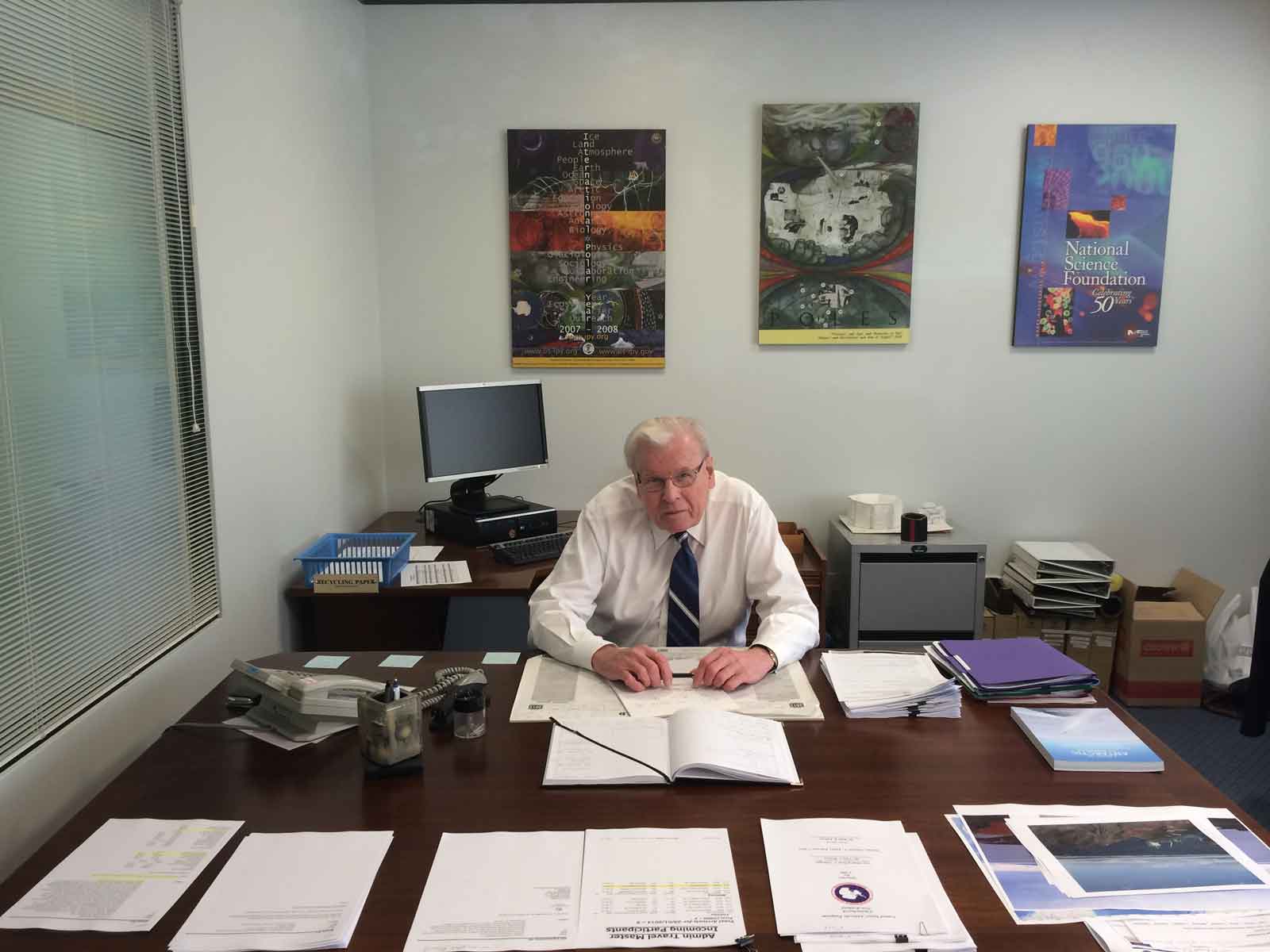
5 November...Art Brown passed away on 4 November US time at the age of 87. For ITT Antarctic Services in the 1980s he was the Continental Systems Manager (McMurdo, Pole, Siple Stations), later into this century he served as the NSF manager in the Christchurch office. Earlier, he worked for ITT and other contractors at DEW Line and BMEWS sites in Greenland and Alaska. I first met him in Thule in 1978 when he was the ITT BMEWS Site 1 manager there, and I was hired as the facility engineer. Earlier...in the early 60s he worked as a technician at the DEW Line site at Oliktok Point, Alaska, which is very close to the present Prudhoe Bay oilfield. Of course this was before oil was discovered there in 1967. Hopefully I'll have more obituary or memorial information available soon. And note...hopefully unaffected by the COVID mess, a number of new nongovernmental Pole ventures have been announced or updated. My coverage is here, remember that this is the only website that has continuously provided coverage since the last century.
In early September, NSF released a report (report PDF) indicating that the US Antarctic Program is rife with sexual harassment and assault. This report was covered in depth in two Science magazine (AAAS) articles. The first of these, published on 2 September 2022, is titled "Sexual harassment plagues Antarctic Research", while the second, published on 14 September and titled "Sexual harassment ignored by U.S. Antarctic research program, employees say" quotes some people you might know. And on 3 October the National Science Board (NSB) issued this Statement on Sexual Harassment and Misconduct in U.S. Antarctic Program which includes additional information links. The New York Air National Guard (NYANG) started sending the first of five ski Hercs south from Schenectady on 19 October 2022...the folks in Denver are still looking to fill a bunch of summer and winterover positions...check out my updated Antarctic jobs info page.... And it looks like there will be a huge crowd of nongovernmental travelers to Pole this summer--have a look at my updated list! And I must add...as this year the deployment process is mostly back to pre-pandemic operation (commercial flights etc.)...there still are COVID tests required here and there, and folks have tested positive in McMurdo...oops. 11 August 2022...I'm way behind on things here (blame bluegrass festivals) but I must share two obituaries of friends who left us in July 2022...Johan Booth, who wintered 20 times at Pole and Palmer (and once with me in 2008), and Billy-Ace Penguin Baker, who wintered 4x at McMurdo in the 60s and 70s and kept the Old Antarctic Explorers Association on track.
Upcoming and historical nongovernmental expedition updates...I've now updated my archives back to the 2001-02 austral summer season, and I've also added a couple of planned ventures for the upcoming seasons...go here! Communications...satellites...and even an undersea cable...are described in this interesting 7 April 2022 article "Connecting the South Pole" from DCD (datacenterdynamics.com). It addresses the pandemic-driven delay in completing the new McMurdo data center known as the Information Technology and Communications (IT&C Facility as well as historical and current communications methods at Pole.
Older news, but something that was just discovered...did you know that there are multiple unicyclists wintering at Pole? This 21 January 2022 article from KMUW (NPR in Wichita, KS) describes winterover physician John-Michael Watson's background and preparations for the winter, and it notes that his talents as a unicycle rider are not unique at Pole--there are others including winter site manager Eric Hansen. For those of us in the northern hemisphere, what we call the vernal equinox occurred at 0933 mountain daylight time (my time zone) on Sunday 20 March, but this also means that the official sunset at Pole happened at the same time...1533 UTC, or 0333 Pole time on Monday the 21st. Which means that there was a sunset dinner on Sunday 20 March, although when the actual disappearance of the sun will happen is still open to conjecture. But despite the onset of autumn in Antarctica...in the past few days the temperatures around the continent have been as much as 70 degrees (F) warmer than normal. For example, the normal March high temperature at Vostok is around -63ºF/-53ºC...but on Friday 18 March the high was 0ºF/-17.7ºC! Here's a great 18 March Washington Post article "It's 70 degrees warmer than normal in eastern Antarctica..." which discusses this situation and features friend Matt Lazzara and Linda Keller from the University of Wisconsin. The Pole weather this past week was relatively normal...between 12-18 March the average temperature was -52.0ºC/-61.5ºF. A reminder that the Pole weather for the past 24 hours is always available via the NOAA folks in ARO here.
Speaking of sunken Antarctic vessels...the recovery/removal of the R/V Hero from the Palix River estuary at Bay Center, Washington has been delayed until at least May or June when water levels will be lower and more conducive to diving operations...per this 22 February Chinook Observer article...and yes, the Antarctican Society is involved!
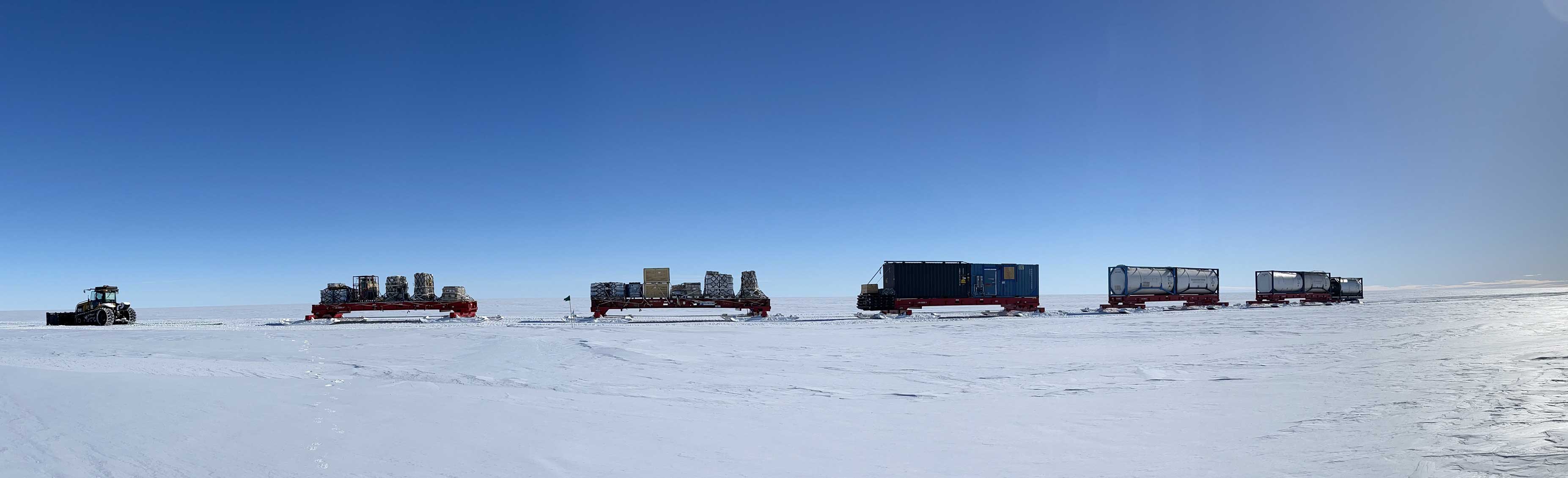
Back to Pole news...lest I forget...the latest and greatest Pole marker was unveiled to the rest of the world on New Years Day! It was designed by BICEP Array winterover Brandon Amat and created by machinist Dave Pernic. Newer news...the third South Pole Traverse (SPoT3) arrived on 7 February, topped off the fuel arch with 180,000 gallons of AN-8, and stayed around 6 days before heading back north with retrograde cargo and waste.
Airplanes? Well, it seems that the first LC-130 ski aircraft since February 2020 arrived at Pole during the week ending the 18th!!
As mentioned below...some of the nongovernmental treks to Pole are underway! My coverage...including some updated coverage from earlier years. Recently (as of 27 December) there have been two medevacs, one cancellation, and one route shortening due to poor travel conditions. Contractual stuff...PAE, one of the Antarctic Support Contract contractors, is in the process of being purchased by Amentum per Amentum's 25 October press release. Amentum, privately held, was formerly the government contracting portion of AECOM, spun off in February of 2020. Its heritage includes several previous entities involved with Antarctic support contracts, including Holmes & Narver and EG&G. The acquisition is scheduled to be completed in the first quarter of 2022. No word yet on the potential effect on their Antarctic subcontract. Lots of news...let's start with some from Bay Center, Washington...where that venerable former research vessel R/V Hero sank in 2018. The State of Washington has awarded a contract to remove it from the Palix River estuary...no detailed plans until after early January...but here is what I know now. Other McMurdo stuff I need to get to...the successful installation of the "Ross Island Earth Station" dish this month...delays in the IT&C building construction...stay tuned. Pole stuff...there were 85 souls on station at the beginning of this week. Earlier, in the second week of November, two techs arrived from Terra Cat (formerly Goughs, the NZ Caterpillar company) to conduct a 60,000 hour overhaul of generator #1 including a crankshaft replacement. As for flights...3 LC-130's have made it to Christchurch, but none have flown to the ice yet. Otherwise...preparations were underway for Thanksgiving dinner on Saturday the 27th and the first 2-day weekend of the summer. There WILL be cargo and tanker vessels showing up in McMurdo this summer. To get ready for this, the Polar Star departed Seattle on 13 November local time and headed south. This will be the Polar Star's 25th voyage to the seventh continent, per this 14 November U.S. Coast Guard press release. Nongovernmental stuff...if you've been here awhile you may have noticed that THIS website is the only one that has continually chronicled NGO ventures to Pole and elsewhere on the continent since 2000. None happened last year due to a certain pandemic, but there are many expeditions planned for 2021-22. I'm still updating (read dealing with all the dead websites and trying to discern what's left) the older stuff, but this page outlines all of the currently planned expeditions that I know of.
October means many things...including...that ozone layer! The folks at CIRES in Boulder have been documenting things on their blog. Their most recent entry on 15 October by Irina Petropavlovskikh and 2009 NOAA winterover Patrick Cullis describes the current situation...about the same as last year, but it could have been worse. Here is their CIRES blog post with links to earlier posts about that pesky ozone layer. On 27 October NOAA announced that this year's ozone hole was the 13th largest on record and was likely to persist through November. It was at maximum on 7 October.
More aircraft news...Operation Deep Freeze (ODF), the name of the U.S. Antarctic program military support operations from the IGY days, is still a thing. This season's work began in early September as C-17s headed to Christchurch in September in preparation for those main body flights in early October...after COVID quarantine, of course. Here's a 14 October 2021 news article from the Army/Operation Deep Freeze. Meanwhile...another ODF component, the New York Air National Guard's 109th Airlift Wing, will also be heading south soon. Last year their ski-equipped LC-130 aircraft made only six trips to the ice, 3 of which were for medevacs. This year they will have a much more normal schedule with 3 aircraft, supporting field camps as well as Pole. Here is a 6 October Air Force News article about their upcoming season.
Meanwhile...at Pole the station opening tasks are well underway...skiway preparation and runway marker installation...and the annual station deep cleaning otherwise known as "Mighty Mouse."
Other news...it's deployment time for many. For the next bunch of main body folks heading to McMurdo, they've been enduring what the NZ government calls Managed Isolation and Quarantine (MIQ) at government-run hotels including the Sudima (formerly the White Heron) near the airport, and the Crowne Plaza downtown. They may fly south in a few days...or they may not...depending on weather. Meanwhile, the summer Palmer support crew endured a couple weeks of isolation at a hotel in Puerto Natales, about 150 miles northwest of Punta Arenas, before moving aboard the Laurence M. Gould a few days ago. The vessel is scheduled to head south toward Palmer Station on 4 October. Remember that there will only be long-term ongoing science happening at Palmer this summer, as the major activity will be construction of the new pier.
After about a month of quarantines and weather waiting...the first WINFLY flight finally made it to McMurdo on 14 August. Not the first southbound flight for the first half of Cohort 1...on 9/10 August they flew 4 of the 5 hours to McM before boomeranging due to deteriorating weather. But...all was not well, as the 14 August flight headed back to ChCh with no passengers due to mechanical landing gear issues. Stay tuned...there is still a bunch of Cohort 1 folks in ChCh awaiting the next flight. Meanwhile...the summer Palmer crew has been in firefighting training in Denver this past week...they will head to San Francisco to begin their isolation/deployment on 6 September, while the next cohort of McMurdo people will head to SFO on 11 September. Want to tour the Pole "virtually?" The Byrd Center at The Ohio State University hosted a special presentation on 23 June at 2000 Eastern time. Information and registration is here. An archive is not available, but there are participant bios and shared links. Yes...the Midwinters Day dinner and festivities happened on 18 June...have a look at the celebration and the midwinter greeting card! It's almost Midwinters Day...planning has been progressing at all 3 stations. At Pole, the wax-sealed invitations have been sent out for the 18 June event which will feature seafood crepe and seared duck main courses. Interestingly, McMurdo is celebrating on the 19th and Palmer's festivities are on the 21st. If you were wondering, the actual solstice occurs on 21 June 2021 at 0332 UTC or 1532 South Pole time. Otherwise, things have been fairly quiet at Pole. Preparations have begun for the annual Pole Marker competition...on 26 May the Polies had an excellent view of the blood moon/lunar eclipse, and on 11 June, for the first time the temperature dropped below the magic -73.3ºC, which in some parts of the world is known as -100ºF. Pole's Physician Assistant Josiah Horneman, whose videos have been mentioned here before, was interviewed by NPR's Scott Simon. Here's a transcript of the interview which was broadcast on Weekend Edition Saturday on 12 June US time. Oh, here is his YouTube channel, as well as an earlier Buzzfeed article about his TikTok activity. There was a virtual job fair today (6 May 2021 Denver time) held by PAE looking for employees for the 2021-22 season. I didn't mention it previously...but I hear that over 100 people participated. Here's a good 5 May Colorado Sun news article describing the job fair as well as a bit of program contracting history...in the 80's I worked for the contractor in Paramus, NJ...and oh by the way, here is my more detailed version of the USARP/USAP contracting history. Palmer update...the Gould did not arrive until about 13 May, after leaving Palmer Station on the 24th. It arrived at Punta Arenas with the summerovers on the 29th. That left 18 souls at Palmer Station for the winter. More news from the other side of the continent from McMurdo...the Laurence M. Gould headed south from Punta Arenas on Saturday 1 May with the winterover crew--who had been quarantined aboard in PA for two weeks after a previous quarantine in San Francisco. They'll arrive at Palmer on 8 May...and the summer crew will head north around the 27th. Also regarding Palmer...the pier replacement project has been given a go-ahead for the 2021-22 summer season...which means that during that period there will be NO science projects on station...only the ongoing monitoring projects which will be tended by research assistants. Here's the 21 April USAP report about the pier project...and this FAQ provides additional information. Note that the preliminary 35% design was completed by ASC in 2017 and the preliminary "sources sought" request for procurement was issued in December 2018. The project was obviously delayed by the COVID-19 pandemic...the task for contractor Pacific Pile and Marine (Seattle) includes completing the design.
Two images denoting the end of the summer season on the ice, both shared by the NSF Polar Programs Facebook page...on the left, during the last full week of March, Pole folks gathered to say goodbye to the sun and lower the American Flag while BICEP winterover Brandon Amat (not in the photo) was playing the National Anthem on electric guitar...photo by Josiah Horneman. It should be noted that although the official sunset day was cloudy, things later cleared up and the famous green flash was seen on 25 March. And on the right, folks at McMurdo present a toast (with ginger ale) to the closing flight of the season (photo by Nikki Klein). In the evening of Wednesday 17 February...the last outgoing passenger flight left Pole for McM...leaving behind 39 Pole souls, the smallest winterover crowd since 1998! Something that only happens every 10-12 years...NSF is preparing for the next rebid of the Antarctic support contract. The current contract which is held by prime contractor Leidos (transferred from Lockheed-Martin) was originally announced in 2007...the first formal announcement came out on 30 April 2008...for a contract originally to be awarded in time to start fully on 1 April 2010 (after an austral summer transition period), with a 4-year original term with two 4-year renewal options. That didn't happen...things were delayed for 2 years before Lockheed-Martin took over fully on 1 April 2012...so the full 12-year term now is scheduled to end on 31 March 2025. So...time to start the process again. I have updated my detailed coverage of the previous rebid process which you will find here...it includes all of the gnarly details, fancy presentations, and arcane contractual verbiage. In case you missed it...I've finally gotten around to adding some new South Pole links, including blogs from two of the 2020 winterovers. Here! As of 16 February, what is known as the "air bridge" began with the first arrival to McMurdo of a C-17 on 11 February. It would take some of the summer folks home the next day. Earlier...2 weeks ago the last "cohort" including most of the remaining Pole and McM winterovers arrived...on a NYANG ski LC-130 aircraft...actually their trip involved THREE ski aircraft. The first one boomeranged, and the second one had mechanical issues before it took off. As for other travelers to Pole, the third SPoT Traverse showed up on 3 February (right; photo by Gabe Nerf) and is now on the way back to McMurdo. In Seattle, the icebreaker Healy arrived at its snowy home port on 13 February. Work on aligning the replacement motor is continuing...earlier, the vessel spent a couple of weeks at San Francisco's Pier 27 (updates).
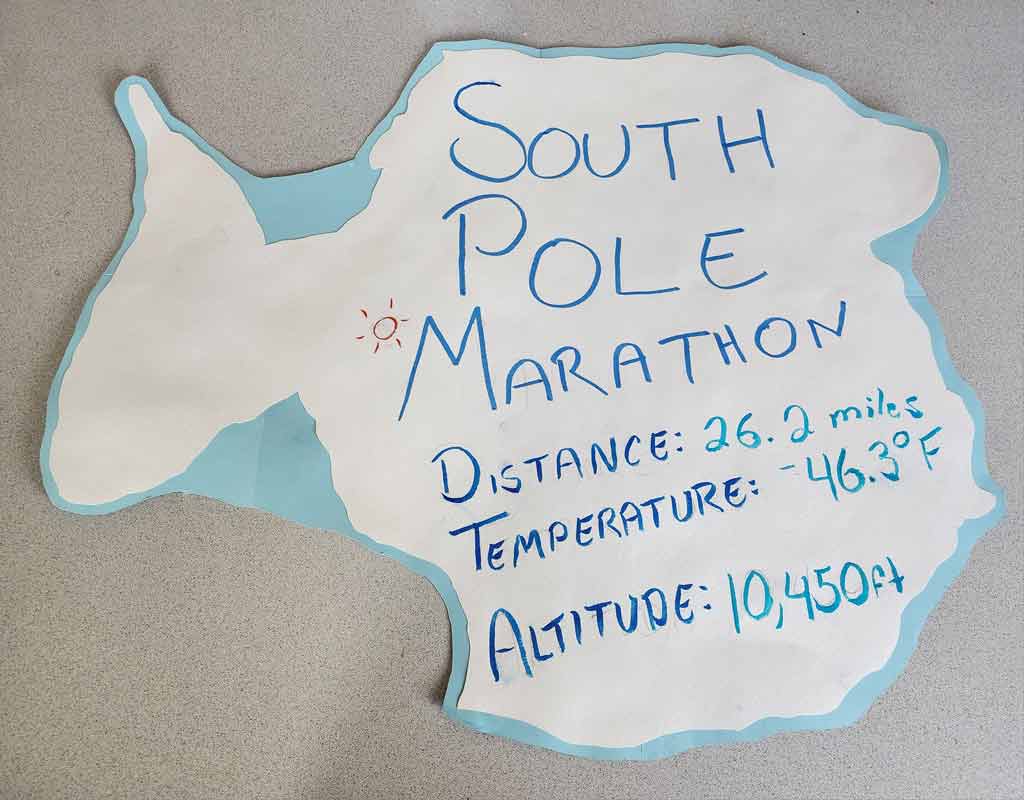
Happy New Year! Yes, the newest latest Pole marker was unveiled on New Years Day! Have a look at the marker, the ceremony, and the design! Other holiday and midsummer events included a great Christmas dinner, the Round the World Race on the 26th, and the South Pole Marathon and half marathon on 10 January. The marathon winner was Brandon Amat (BICEP) with a time of 4.5 hours...not a very good time for Boston but quite impressive at Pole temperature and altitude. The rest of the 2021 winterovers are currently in isolation in Christchurch, scheduled to head to Pole near the end of January. Meanwhile, the current Pole population is about 63...fewer people than the 86 that I wintered with in 2005. 28 December...a couple of sad updates. First...the previous Antarctic COVID-19 outbreak was at Chile's isolated Bernardo O'Higgins station on the Peninsula mainland...but on 23 December news came out that another outbreak had occurred at the village of Villa Las Estrellas at the west end of King George Island...which includes the Chilean base Presidente Eduardo Frei Montalvia as well as Bellinghausen (Russia) and Great Wall (China) as well as the airfield. Given the logistics aspects of the airfield presence, this outbreak has a more significant potential for spread. More information from this 23 December Polar Journal article. And then there is the sad story of what was to be the Russia's shipment of the modules for the new Vostok, which was covered here earlier. It seems that the Russian nuclear cargo vessel Sevmorput transporting the modules south...had one of the 4 blades of its single screw break off somewhere west of Angola. After futzing around in the southern Gulf of Guinea for several weeks, divers arrived and cut off the opposite screw blade...so that the vessel could...head back north to St. Petersburg. More details including exclusive coverage!
Oh, it is the holiday season, so THIS happened (left). Seasons Greetings from South Pole Station!! As of this past weekend there were 61 people at Pole...a smaller crowd than we had during my 2005 winter. A major project was recently completed...the overhaul of generator #3, with lots of help from several New Zealand folks from Terra Cat (formerly Gough). The work included replacement of the crankshaft. Two more engines to go.
Alas, the coronavirus pandemic has reached Antarctica. Nowhere near any of the American stations, as the US and NZ have been bending over backward to keep the continent safe (such as folks in November who were quarantined/isolated for 45 days in San Francisco and Christchurch, with later delays due to...weather. No...this is at Chile's Bernardo O'Higgins station, which is located on the mainland of the Antarctic Peninsula (63º19'S-57º54'W). All 60 people from the base were evacuated to Punta Arenas last weekend...36 of them had the virus. The station was then thoroughly cleaned before a new crew took over. Two news links...this 22 December New York Times article...and (with no paywall) this ABC (Australian Broadcasting Company) article with a video.

At right...photos from 10 December of the first two Air National Guard LC-130s...as seen by Ethan Rudnitsky from his quarantine room at the new Novotel at Christchurch Airport. The third one showed up on the 13th. After the flight crews complete their required 14-day NZ quarantine, the aircraft will...stay in New Zealand for the rest of the season unless they are required for medevac or search-and-rescue.
The second flight to Pole this season didn't happen until Tuesday 24 November...delayed by weather this time at McMurdo. The flight weather margins for Basler aircraft are stricter than for the LC-130's as Baslers fly at a lower altitude and are slower. The next flight showed up on Thursday the 26th. Meanwhile, the northbound winterovers have been spending the weekend at McMurdo due to some urgent repairs needed to the Phoenix runway...and the boomerang of a RNZAF C-130. What's happening at Pole this summer? Not nearly as much as usual. Many of the ongoing projects are not sending any representatives this year...work on them is being done as needed by the research associates. And some of the larger projects such as IceCube are having the 2020 winterovers hang around for part of the summer to work with the new winterovers, in lieu of sending a summer team. What's really going on with science this year at Pole and on the rest of the continent...can be found in the 2020-2021 USAP Science Planning Summary.
Looking at the other side of the continent, the summer Palmer team finished up 10 days of quarantine in San Francisco and flew to Punta Arenas on a charter flight on 9 November. They're currently in 14 days of quarantine aboard the Laurence M. Gould before that vessel heads south.
Flight updates...the USAP-chartered Kenn Borek Air aircraft--one Basler and two Twin Otters--arrived at McMurdo on Saturday 7 November McM/Pole time, after refueling at the otherwise-closed Union Glacier camp. In the next few days they'll head to Pole to end the 2020 Polies' winter isolation.
On 29 October about 50 of the Pole summerers and winterers headed south from Christchurch to McMurdo, along with other McM folks and 22 Italians heading to Mario Zucchelli Station...on a C-17 with everyone masked up. The first flight into Pole (a Basler of course, again, no Hercs this year) may not happen until at least 10 November. Which is a late opening date in recent years...although back in the day in 1958 the first flight arrived on 16 November, and in 1959 it arrived at Pole on 20 November. Those flights by the Navy's VX-6 were Douglas Aircraft Company's R4D's otherwise known then as DC-3's, and of course the first (and only) flights into Pole this year will be by Baslers (and perhaps Twin Otters) which are after all converted DC-3's. Typically these aircraft transit to McMurdo from Punta Arenas via Rothera and Pole, but this year the transiting aircraft have been stopping and refueling at Union Glacier instead...to limit the potential spread of COVID-19. AL&E has canceled their Antarctic tourist season this year, but special arrangements were made with the U.S. Antarctic Program and the Italian program so that the charter aircraft could refuel at Union Glacier. Earlier in October, two Kenn Borek Air aircraft chartered to the Italian program (a Basler and a Twin Otter) took this route to McMurdo, so that they could fly the the Italian crew to Mario Zucchelli. Here's a good news article from ENEA (the Italian National Agency for New Technologies, Energy and Sustainable Economic Development) which operates Mario Zucchelli Station (in Italian, use your favorite translator). As for the Kenn Borek Air crews flying the Baslers and Twin Otters...they were in COVID isolation aboard the Laurence M. Gould in Punta Arenas...that vessel has been there since the end of the last austral summer. Meanwhile, the Nathaniel B. Palmer had headed to Punta Arenas from San Francisco, on 2 November. It is carrying members of (update) five science teams, led by principal investigators (PIs) Kenneth Halanych of Auburn University (Auburn news article; Kevin Kocot from the University of Alabama Tuscaloosa (Alabama news post); Deric Learman and Andy Mahon from Central Michigan University; and Sarah Gerken from the University of Alaska Anchorage. The teams are posting on the blog Icy Inverts. On 9 November Peninsula time the vessel left Punta Arenas, heading for their first research destination, Neko Harbor, on the Peninsula east of Anvers Island. They were scheduled to arrive on the 14th.
In late October, the news about the upcoming season is getting interesting. There will be NO cargo vessel or icebreaker...partly because of the reduced program due to the pandemic...but more significantly due to the fact that bad weather as prevented the completion of the ice pier. Work on the ice pier has been continuing so that it will be ready for ship offloads in the 2021-22 season. And it may yet see some use this season, as the Nathaniel B. Palmer's next science cruise (after the one described above) includes a return transit from Punta Arenas to McMurdo, with stops in New Zealand before and after the McMurdo port call. All cargo will be shipped south by air from Christchurch on USAF C-17 or on RNZAF wheeled C-130 aircraft. I did not mention the Air National Guard ski LC-130s...as they are not coming south either. All flights from McMurdo to Pole will be on Basler aircraft which means a severe limitation on cargo or mail (no large packages). As for fuel...the program had already planned for no tanker to McMurdo this season, as increased fuel storage and conservation has eliminated the need for an annual tanker visit (there was no tanker in 2018-19). And as for fuel to Pole, I've been assured that the South Pole Traverse (SPoT) will fill the needs. In previous years the traverse has been supporting other field projects/camps which will be minimized this year, so there is more capability for the traverse trains to bring fuel to Pole. Currently there are three SPoTs scheduled, and they will be larger than usual, hauling containers of supplies and food as well as fuel...including a freezer milvan. As for people...the plan continues to be for McMurdo bound passengers to quarantine near SFO for about 5 days, fly to ChCh on a charter, and quarantine there for at least 2 weeks more before heading south on a C-17. The second "cohort" aka the first main body McMurdo flight arrived there on Wednesday 7 October McM time...following two previous WINFLY flights which arrived on 13 and 16 September. Many of the people heading for Pole were quarantined at SFO in early October, scheduled to head south to NZ on 10 October US time...for more quarantine. As of 8 October, the Kenn Borek Air flight crews (those Baslers) are also currently isolating in San Francisco, they are scheduled to fly to Punta Arenas on the 10th and isolate aboard the Laurence M. Gould before transiting to McMurdo via Rothera and Pole...er, not Pole this year. As for Palmer Station...no news yet, although two ocean cruise science teams plus ships' crew are currently quarantined aboard the Nathaniel B. Palmer at Port Hueneme.
9 September update...the storms at McMurdo have cleared (although they did threaten to come back), and the folks in Christchurch waiting to fly south will have to wait in quarantine some more...until at least the 14th! Labor Day weekend...lots of ice news! First, the folks scheduled to fly south on Winfly completed their initial 14-day quarantine upon entering New Zealand, and were then moved to another USAP-chartered hotel to continue quarantine (to keep the ice COVID-free) and they are STILL waiting for the flights south. Because McMurdo got hammered with a mammoth and long-lasting storm that pushed the flight dates back to at least the 10th. The flights had originally been scheduled for the last week of August. The storm's high winds were not as strong as the 2004 storm, but it brought MUCH more snow...which will need to be dug out to check for damages as well as to prepare the skiway. As of Friday McM time things were back to Condition 3 (calm/normal). The Air Force C-17 crew has also been in quarantine since early August (see photo below right) (Air Force Magazine article), which also notes that they brought additional maintenance personnel, and that the aircraft will be equipped with an air-transportable galley and lavatory so that crew and passengers can use separate facilities. Another effect of the global pandemic...on 3 September, AL&E has completely canceled its 2020-21 Antarctic season...meaning no Mt. Vinson climbs and no nongovernmental tourists this season from Union Glacier. Their announcement.
The bad icebreaker news...Healy suffered a fire and propulsion failure on 18 August, 60 nautical miles off Seward, AK while en route to a Bering Sea science project, just after embarking scientists in Seward. The science cruise was canceled, and Healy was transiting back to its home port in Seattle for major repairs. Two news articles--one a 24 August Coast Guard press release, and another article, 25 August, from the US Naval Institute: "Coast Guard Icebreaker Healy Suffers Fire on Arctic Mission; All Arctic Operations Cancelled." Questionable icebreaker news...in June 2020 the White House ordered a review of the Coast Guard heavy icebreaker program. The results were supposed to be released in August, but I don't think they have been released yet. Here's a 10 June US Naval Institute article, and here is the official 9 June memorandum from the President. One option for the next phase of icebreakers included nuclear power, per this July "Breaking Defense" news article. And then there is news about the new replacement Vostok Station that will be brought south this season by the Russian nuclear cargo icebreaker. Alas, my contact and info page for this has been taken down, but for now I'll leave this teaser image which was shared by Russia's Ministry of National Resources. The materials are to be shipped south this season on Russia's cargo icebreaker Sevmorput. My full coverage! 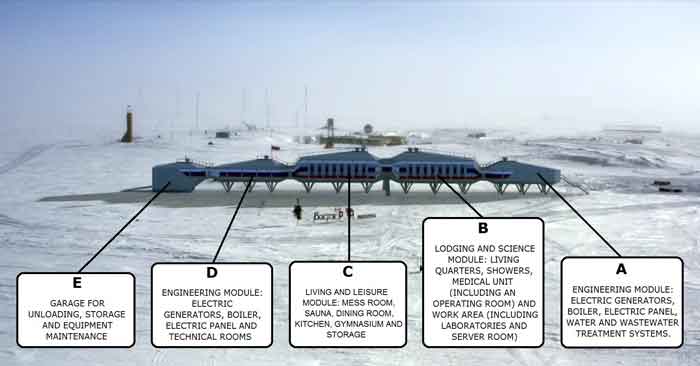
4 August 2020 updates on the 2020-21 season: First, the program announced on 4 August US time that the McMurdo upgrade project otherwise known as AIMS would be suspended for the 2020-21 austral summer season due to the pandemic. Here is that announcement. Meanwhile, there ARE science and support folks who will be heading to Antarctica...the first of these will be heading to McMurdo on the WINFLY flights scheduled for the last full week of August. Some of these people have already been heading to San Francisco...upon arrival in New Zealand they will be quarantined for at least 14 days per this 6 August Christchurch Star article. The deployment list has been seriously curtailed, to exclude people who "don't turn a wrench" (quoting a friend), but the long term science will continue, and the program IS still hiring people to fill critical positions. I have recently updated my Antarctic jobs information page...
I've covered the latest information about how various national Antarctic programs are dealing with the COVID-19 pandemic here before...here is the general news from June 2020. S
And there is unhappy Antarctic news. At 1340 UTC on 21 June, a fire broke out in the met office at Russia's Mirny station. It destroyed the building known as Radio House which housed various science labs and berthing for 11 of the 23 people on station. It spread to the main accommodation building but that building survived. No one was injured, and communications with the rest of the world have been restored. Three articles: this 22 June Washington Post article based on wire services, a longer 23 June article from list23.com, and a pdf report with map (in Russian) from Russia's Arctic and Antarctic Research Institute. Here's Google Translate's English version of the text. And an older bit of news that didn't get much publicity...on 8 May 2020 at Ukraine's Vernadsky station, cook Vasily Omelyanovich apparently committed suicide due to personal reasons. This was his fifth deployment to Vernadsky, which is about 30 miles south of Palmer Station. During my deployments to Palmer in the late 1980s, the base was the British Antarctic Survey's Faraday Station...I saw it from a distance once as we sailed past, but did not get to visit. It was transferred to Ukraine and renamed in 1996. Here is a 9 May 2020 news article from the Ukraine describing Vasily's death. That article states that the issue of delivering the body to Ukraine was being worked on. Accordingly, the Laurence M. Gould called at Vernadsky to transport the body north, this was overnight on 16-17 June after departing Palmer Station on the 16th.
In other Antarctic program news...the latest information from the Western Hemisphere is that the Laurence M. Gould, which left Palmer Station with the rest of the summer folks on 16 June local time, arrived at Punta Arenas on 21 June after taking yet another "scenic route." Instead of the usual route through the Beagle Channel, they passed through the east end of the Straits of Magellan so as to avoid the need for the channel pilot. Sixteen souls are wintering at Palmer Station...for more details see this corner of my Palmer website. Other and earlier COVID-19 related stuff...on 11 June, NSF announced their plans for the upcoming 2020-21 season...keeping the stations operational, maintaining long-term and statutorily required projects--most of which can be operated by ASC employees. Here's a similar 9 June announcement about the New Zealand program from Antarctica New Zealand. I've heard that the PQ requirements for the upcoming summer and winter seasons have been adjusted to restrict people who may have a significant tendency to contract COVID-19...and also that people deploying to McMurdo and Pole next season may have to quarantine in New Zealand for 3 weeks before deploying.
Updates 16 May US time: Normally at this time of year, NSF would be soliciting news media visits to Antarctica, but these have been canceled for the 2020-21 season (the 11 May NSF announcement).. Elsewhere...here is an interesting 12 May report by Dr. Pradeep Tomar, the winterover medical officer at India's Bharati Station (on the coast at 69.4ºE, roughly 120 miles east of Mawson). He describes what life is like on the only continent still untouched by COVID-19. He mentions that India has called off its Arctic science expedition which was scheduled for April, and that Australia will undertake no major Antarctic science projects in 2020-21. AAD's most recent announcement on the subject (6 April) confirms that. Meanwhile, the New Zealand program announced on 13 May that they would announce a plan for their upcoming season by 1 June. The last McMurdo flight happened during the week of 3 May; the next flights currently scheduled are for WINFLY in August. And back in the US of A, the Nathaniel B. Palmer stopped briefly in San Francisco Bay and has been at Fairhaven, CA (on the Samoa Peninsula in Humboldt Bay, west of Eureka) since mid-May per the most recent (18 May) USAP schedule. Updates 11 May US time...here's the latest BAS news release from 1 May, it outlines that all of the BAS stations are in winter status. The James Clark Ross was heading north from Rothera, and it was to meet up with the cruise ship Hebridean Sky which was docked at Port Stanley and already housing summer station crew and wharf construction workers who had previously been brought north by the JCR. The cruise ship will be taking the summer folks back to the UK. As of a few days ago, the Falklands were COVID-19 free, as was the Antarctic continent.
Meanwhile, the other "big red boat," Polar Star, entered drydock at Mare Island on 13 April...it will spend the next four months there. By 16 April it was high and dry (left...photo and info from the Polar Star Facebook page).
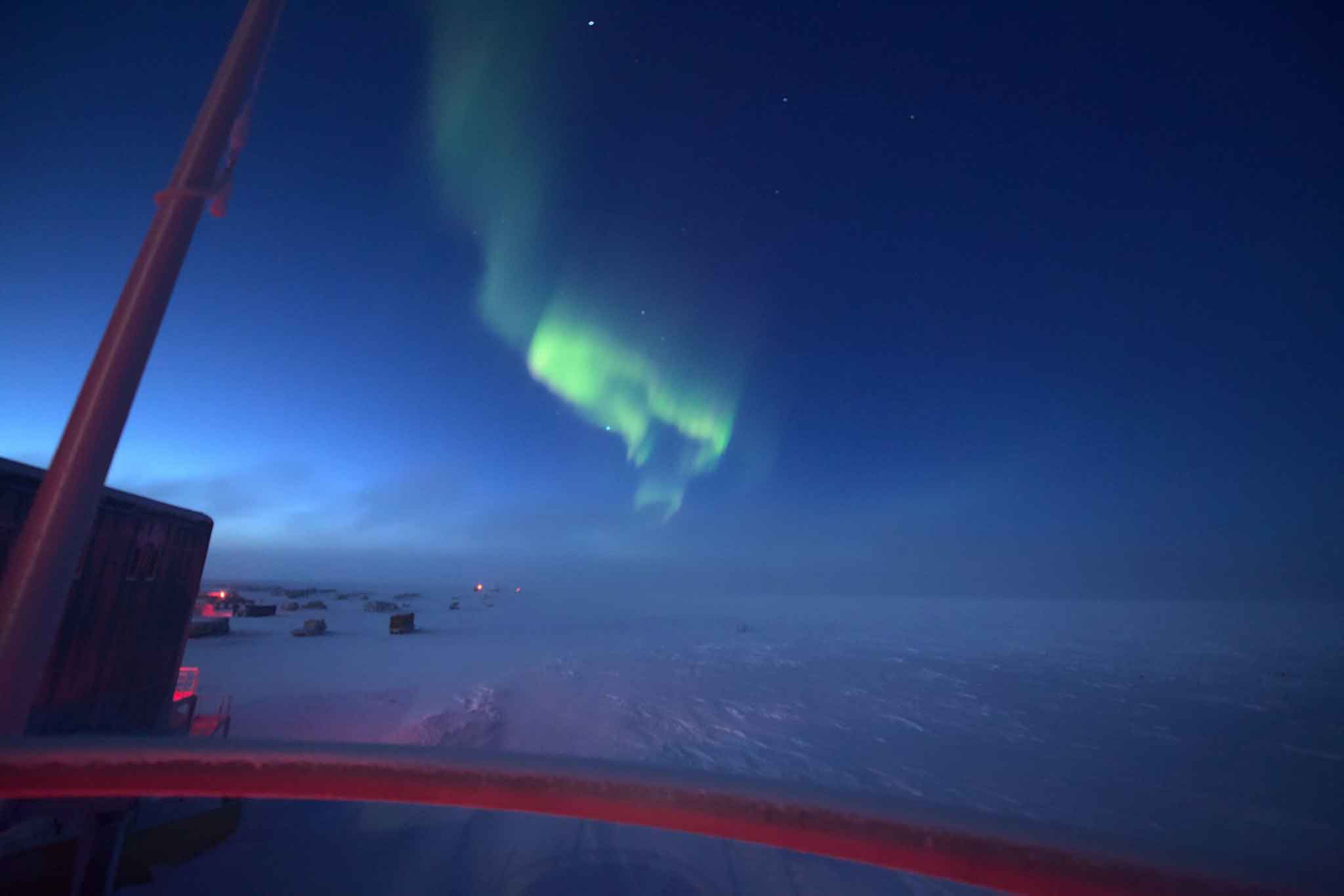
At Pole it has been getting darker...and on Monday 13 April the first auroras of the season made their appearance. Here at left is a sample view shared by Zach Tejral. And it's been getting colder as well--here's a link to the NOAA weather page. Also, here's the 6 April Antarctic Sun report by Kelly Thomas, describing the first two months of winter. And on 10 April, NSF Polar Programs director Kelly Falkner issued this news statement regarding plans to protect the continent from COVID-19; it includes the statement "There are currently no known or suspected cases of COVID-19 in Antarctica." Meanwhile, 3 scheduled flights to McMurdo were underway in mid-April by the Australian A-319 Airbus, but they were not bringing any passengers south. And some of the northbound passengers had originally been scheduled to stay at McM longer.
Southern Hemisphere updates Thursday 9 April 2020 (US time)...the Nathaniel B. Palmer docked in Punta Arenas on 29 March...the one New Zealand citizen caught flights to Auckland via Santiago (he was quarantined for 14 days), while the Americans took later flights to Miami also via Santiago. The 10 British researchers who were dropped off at Rothera, along with 20 others, had been flown to the Falklands where they were quarantined for awhile at the Malvina Hotel in Stanley; they were flown to the UK overnight on Sunday 5 April on a MoD flight that refueled in Senegal as the usual refueling stops on Ascension Island and Cape Verde were closed. But there's a lot going on involving Rothera. The James Clark Ross is currently there unloading supplies for the winter, while summer personnel from the other BAS stations (Signy, King Edward Point, and Bird Island) already are on board. But there are about 90 other summer people at Rothera that need to be gotten home...most of these are construction workers working on the successfully completed new wharf at Rothera. They will be ferried to Port Stanley by the James Clark Ross (JCR), while the remainder of the Rothera winterover crew will be ferried south from Port Stanley. Meanwhile, BAS has chartered the cruise ship Hebridean Sky operated by Noble Caledonia, currently moored off Port Stanley, to house some of the folks from Rothera and eventually take them back to the UK. The Rothera winter will begin on 27 April when the JCR and the last Twin Otter head north. News sources...this 7 April BBC article "Coronavirus complicates journeys home from Antarctica" and this 7 April BAS news release. As for USAP, at the end of March NSF issued a report addressing operational changes in the polar programs in response to the COVID-19 pandemic. For McMurdo, the April flights will not be taking any folks south...and as New Zealand has recently adjusted their travel restrictions, the northbound pax from McMurdo will be able to fly to Auckland and back to the US. For Palmer Station, the summer staff will remain on station until such time as the winter crew can safely deploy, and winter science events have been canceled.
The Polar Star arrived in Seattle on Wednesday 25 March 2020 after a successful Antarctic trip, which not only included breaking ice for the McM resupply, but also involved Antarctic Treaty inspection visits to Mario Zucchelli (Italy), Jang Bogo (South Korea), and Inexpressible Island (China)...this was the first American inspection trip since 2012. Details from this 25 March Coast Guard press release.
And what about that other research and support vessel, the Polar Star? Fortunately, unlike last season when there reports of fires and other casualties, this year we've heard nothing. Or perhaps there's another reason...the vessel has had a severe communications failure during the northbound voyage, so no news may mean just...no news. As of 23 March it was west of southern California and heading north.
Another medical update...this one totally unrelated to COVID-19, the disease caused by SARS-CoV-2...on 14 March the AAD conducted an emergency medevac from McMurdo...their chartered A-319 flew south from Hobart to McMurdo and flew an ill patient to Christchurch. Conditions were challenging as the temperature at McM was -22ºF/-30ºC with wind chill. Here is the AAD news article; the photo above left of the aircraft on deck at McMurdo is from that article. The Pole summer is ...over! The last flight out headed north on the 15th leaving 42 people behind to watch several traditional movies and otherwise get along with each other for the winter!
5 February shipping season update...the Ocean Giant has completed offload, loaded cargo for the trip north and pulled out at about 1500 McM time on 4 February...to be replaced at the pier almost immediately by the tanker Maersk Peary; meanwhile, the second cargo vessel SLNC Magothy completed loading cargo at Port Hueneme and headed south on 22 January (dvids news article with photo). And this 23 January USNI News article about the Polar Star describes the icebreaker's uneventful breakout of the shipping channel...while the Winter Quarters Bay area was free of ice, 23 miles of ice had to be broken out further north, west of Ross Island. Here's another earlier (29 January 2020) Seabee Magazine article about the cargo offload evolution, as well as a later 20 February Military Sealift Command article about the completion of the cargo evolutions. Icebreaker procurement update...on 31 January the U.S. Coast Guard announced they were procuring a contract to extend the life of the Polar Star until the second of the new Polar Security Cutters was available. Details on my icebreaker procurement page which I update as needed.
A death in Antarctica is never good news...and it happened on 11 January 2020. Staff Sgt. George Girtler IV, a member of the 109th Airlift Wing, passed away from natural causes. The cause of death was pulmonary embolism, a blockage of blood vessels in the lungs. Here's a 24 January Stars and Stripes article, an Air Force Times article, and an obituary from the DeVito-Salvadore Funeral Home in Mechanicville, NY. The end of the Pole NGO tourist season came early on 19 January 2020 SP time when an ALE group guided by Christian Styve and including Lucy Reynolds arrived from Hercules Inlet...the team spent 2 nights at the Pole tourist camp before heading north, as the camp was being dismantled. My record of the season is here. Meanwhile, there is news from last year's happenings...in 2018-19 the Brit Lou Rudd and Oregonian Colin O'Brady completed what both claimed to be "solo unassisted Antarctic crossings." The "Antarctic crossing" part was somewhat controversial as neither actually traveled from coast to coast, and "unassisted" is also questionable, as both used the prepared and well-marked route. Now that O'Brady's book The Impossible First came out recently, National Geographic has taken a more detailed look at Colin's claims in a 3 February article "The problem with Colin O'Brady" by Aaron Teasdale. Give it a read! Oh...on 13 February Colin responded to the National Geographic article with a 16 page letter reasserting his claims and requesting National Geographic to retract its article (seen here in Willamette Week, a Portland, Oregon weekly. Meanwhile, after a significant discussion on Facebook, in late February Australian polar guide Eric Philips posited a letter to NatGeo in support of Aaron's article and asking for signature support. I of course agreed, and the resultant letter was set to NatGeo with a list of more than fifty "leading polar explorers, guides, and adventure specialists" including...me. Read the letter here! On 4 March Willamette Week reported that National Geographic stands by Aaron Teasdale's article, although three clarifications were made. The "Impossible Row" has continued to draw media interest...such as this this 28 May 2020 article by ExplorersWeb freelancer Martin Walsh. He depicts the route map of the Ohana ("family" in Hawaiian), notes that the boat's track had to be diverted to avoid the search area for the missing/lost Chilean military C-130 aircraft (Wikipedia article), and mentions that Colin O'Brady was NOT the originator or leader of the rowing event...rather that was Icelandic ocean rower Fiann Paul...who'd recruited a team of experienced oarsmen but was unable to secure funding...so O'Brady, the only non-rower on the team, was brought in. Walsh's article also notes that the chase boat operated by the Discovery Channel was one of the conditions that Chile imposed on the venture.
Other stuff that has been going on at Pole...a large IceCube team showed up to evaluate the long-stored drill camp modules in preparation for the future IceCube Upgrade...by the 21st they'd pretty much finished...meanwhile SPoT 3 was nearing Pole bringing a couple of the drill camp generator modules that had been used for other field projects.
The new year also traditionally brings the first arrivals of NGA skiers/kiters/trekkers...well, actually the first of these arrived in late December. No speed records to Pole this year, but there are other records including an unquestionable Antarctic distance record by Aussie Geoff Wilson (despite his skipping a stop at Pole due to leaky fuel bottles) and a questionable rowing record from South America to Antarctica. Details...
In Port Hueneme, the cargo vessel MV Ocean Giant departed for McMurdo via Christchurch on Christmas Eve...carrying not only cargo but also the floating modular causeway system (MCS) that was first used at McM in January 2012. A second cargo vessel, the MV Magothy is scheduled to arrive in Port Hueneme for onload in a few days. This DVIDS news service article has more information. And what about the tanker, you may ask? After skipping a year, the Maersk Peary is expected to show up near the end of January. Currently (31 December) it is approaching Sri Lanka, and it will also call at Fremantle before heading to McMurdo. And some Antarctic news from 250 miles up in space...as of 28 December 2019, friend and fellow 2005 Pole winterover Christina Hammock Koch set a record for the longest single space flight by a woman--289 days. She is scheduled to remain on the International Space Station until February 6, which would be a record of 328 days. The all-time space flight record is held by Valeri Polyakov, a Russian who spent 437 days aboard the Russian MIR space station in 1994-95. Here's a UPI news article. Robert DeLaurentis completed his overflight of Pole on 17 December 2019...an 18-hour out-and-back flight from Ushuaia (without a previously mentioned refueling stop on King George Island), and the longest ever flight by a Gulfstream Turbine Commander. Since then he flew on to the Falkland Islands before continuing north on his "Pole-to-Pole" venture.
At Pole, preparations are underway for the Thanksgiving dinner on Saturday the 30th...not without a bit of difficulty as the automatic dishwasher is out of action awaiting repairs. Interestingly, instead of paper plates they are relying on extra help from volunteers and from McMurdo. Other things that are going on--a practice C-17 airdrop happened this week...this time it was just an overflight without anything dropped, but on 23 October, test supplies were actually dropped. By 22 November I believe that all of the 2019 winterovers have left Pole...but not all of them have made it to Christchurch yet. So between the summer people and next season's winterovers there are now over 100 people on station. A couple of the new wo's are John Hardin (from St. Louis) and Yuya Makino (from Takayama, Japan)...the 2020 IceCube winterovers who arrived on 8 November. Here's an IceCube News story about them with more information. And by the way, IceCube was now taking applications for the 2021 winterovers. A strange addition to the Antarctic nongovernmental ventures...on the 15 November "Tonight" show, Colin O'Brady announced he's planning a rowboat trip across the Drake Passage for this December. Also check that link for an update on the ski and kite treks...more have been announced, more are underway, and as of the 20th a number of the people were stuck in Punta Arenas.
The season for nongovernmental skiers/trekkers/other visitors to Pole is now well underway. The first to start out, Australian Geoff Wilson, is now heading south from near Novo, and other travelers have been flown to ALE's Union Glacier camp beginning with their first visitor flight from Punta Arenas on 10 November. This 11 November ExplorersWeb article gives a good overview of the expedition plans, and of course I've updated my more detailed references to all of the ventures here, as I've been doing for the previous 21 seasons.
Polar Star updates...in mid-October it finally was out of a six-month drydock period and anchored in San Francisco Bay after some sea trials...and by the 25th it was back in its Seattle homeport. The icebreaker can be followed by anyone on its public Facebook page.
On Tuesday 15 October 2019 (US time) I flew to Columbus, Ohio to attend the "Women in Antarctica" symposium at the Byrd Polar Research Center. I got there a day early so that I could dig through some of the old Operation Deep Freeze cruisebooks. The event timing focused on the 1969-70 science project in the Dry Valleys led by Dr. Lois Jones, and two of the members of that team were present and gave talks. The research team (and two other women on the ice at the time) also had become the first women to visit the South Pole in November 1969. Nearly 100 people attended. The event was featured in this 23 October Antarctic Sun article which also highlights some of the many women involved with the U.S. Antarctic Program. Some of these women were present at the Columbus symposium.
The Polar Star was at Mare Island (CA) Dry Dock for repairs and refurbishment since the end of April 2019...and was scheduled to head back to Seattle at the end of September 2019. Here is a good 12 September KPIX San Francisco news report about the vessel, including an excellent video. And, as for the new "polar security cutters" aka icebreakers, this 16 September USNI article "Polar Security Cutter Fuses Performance Requirements With Maintenance Needs" describes some of the engineering innovations for the new vessels, a June Seapower describes that the first three new cutters will be based in Seattle along with the Polar Star, Healy, and the parted-out Polar Sea. (thank you Chris Rock). These and other articles and information are on my page covering the icebreaker procurement progress, which I am continuing to update as needed.
And astute viewers of that photo of Polies in the large conference room will observe that the cardboard window covers had just been removed! On 1 September 2019, WINFLY FINALLY happened. The first flight arrived at McMurdo on 1 September, THIRTEEN days late. Sustained bad weather was, as usual, at fault, and the storm also caused power outages in town. The end of August means for Pole: nautical twilight, when the Sun is between 12 and 6 degrees below the horizon. so the remaining auroras are increasingly washed out. Otherwise, things are quiet...August events have included the 8-ball pool tournament (for which the table was refurbished for the 4th time) and the Winter Film Festival (an interesting video about this from Viktor Barricklow). And for McMurdo: departing winterovers' travel plans are trashed, freshies scheduled for McM are...hopefully donated to ChCh charities, and Christchurch hotels etc. are overfilled with folks waiting to head south because of bad weather. The first WINFLY flight was supposed to happen on 19 August, but Mother Antarctica has been having other ideas, ie Phase 1 conditions. I do like to hear about Antarctic winterover reunions, as I've attended several for the Pole and Palmer winterovers. Turns out that half a dozen of the 2001 Polie winterovers gathered recently at friend Paul Daniel's place in Grosse Pointe, Michigan. Here's the Grosse Pointe Times article, with an amazing photo!
Less media-worthy but of interest to Antarcticans...the Russians made a preliminary announcement of plans to replace the winterover facilities at Vostok with space for 35 summer people or 15 wo's (to be completed in 2023-24); and the Poles proposed a major replacement of their Arctowski Station facilities on King George Island, scheduled for completion in 2022-23.
This has been out for awhile, but it is a sad 2 August Los Angeles Times article about the Polar Star's voyage to McMurdo last year. There will be at least one new US icebreaker eventually, but our American neighbors to the north are planning to build SIX new icebreakers! Another amazing bit of July 2019 journalism appeared in Scientific American about Pole life at least during the summer: "The Last Good Gig: A Summer at the South Pole," by Michael Nayak. Subtitle quote: "Nobody has lukewarm feelings about Antarctica, and some people don’t fit in anywhere else."
A side note...last year there was NO tanker delivery to McMurdo...only the one cargo vessel. In 2019-20 there will be a tanker, as well as TWO cargo vessels. One will be the traditional vessel doing a return trip from Port Hueneme...the other will be a one-way southbound charter to deliver supplies, materials, and construction equipment for the AIMS project. IceCube is getting an update! In June, NSF formally approved funding for a $37 million upgrade...to install seven new and deeper strings near the center of the existing array. This will enable the detection of lower-energy neutrinos...to overlap with the detection ranges of other neutrino detectors around the world. The project won't actually happen until 2022-23, but preliminary planning last summer involved the digging out and inspection of the IceCube drill camp modules which have been stored on the berm. Several new detector types will be used, including some being tested for a still-out-there IceCube-Gen2 project. Coverage from IceCube includes 2 16 July press releases--"NSF mid-scale award sets off the first extension of IceCube" and "The IceCube Upgrade: An international effort", as well as this article from the Wisconsin State Journal. Surprise visitors...the international team "One More Orbit" overflew Pole on 9 July as a part of their record-setting globe circumnavigation over the poles. The 8-person crew aboard a Gulfstream G650ER jet started and finished from the Kennedy Space Center in Florida and completed their trip in 46 hours 40 minutes 22 seconds, including 3 "pit-stop" refuelings in Punta Arenas, Mauritius, and Kazakhstan. They beat the previous record by almost 6 hours...and the crew was the first to include 2 women--another record. Here's a CNN news article as well as an archive of the project website, which includes a map of their flight route. While over Pole, some of the winterovers had an opportunity to speak with the pilot over radio. Interestingly, there will be another overflight in November...postponed from last summer, by pilot Robert DeLaurentis in his much modified Gulfstream Turbo 900 aircraft. The project, titled "Flying through Life," will not be a record-setting attempt...rather a 3-month project involving stope in many countries as well as overflights of both poles.
Otherwise, there is a fair amount of construction news for the upcoming summer...mostly at McMurdo, although the Palmer pier replacement project is scheduled to get underway. Pole, the first phase of the "blue building" lift (ARO?) is scheduled as well as upgrades to the kitchen exhaust system. At McM, Dorm 203 (formerly dorms 203-205 are scheduled to be demo'd at the end of the summer along with several warehouses, and new lodging begins in January near building 175. During the 2020 winter, NSF will move from the Chalet to Building 165, as the Chalet will become a "social space" to replace the eventual demo of the Coffee House and Southern bar. There also will be a fair amount of excavation and blasting for site preparation and aggregate production. More on this later.
On 23 April, it was officially announced that a contract for a new heavy icebreaker (aka "Polar Security Cutter") had been awarded to VT Halter Marine Inc., of Pascagoula, Mississippi. The price is $746 million, with options for two additional heavy icebreakers (if approved by Congress) that would bring the total price to $1.94 billion. Construction on the first vessel is planned for 2021 with delivery in 2024, although the contract includes financial incentives for earlier delivery. There are too many news reports and press releases with financial and technical details, so I've addressed and linked to them here. The conceptual image at left was provided by VT Halter Marine in their 7 April press release.
And there's also that "polar security cutter" project, otherwise known as new heavy icebreakers for the Coast Guard. This 1 April military.com article (thanks to Russell Rapp for sharing) indicates that the contract for the new icebreaker could be awarded as soon as April 2019, and it also clarifies what the 2019 budget means--that budget appropriated $665 million for the first heavy icebreaker (per this U.S. Naval Institute article), but it turns out that heavy icebreakers are more expensive than that. The 1 April article includes an interview with Coast Guard Commandant ADM Karl Schultz, who pointed out that the first of the three planned icebreakers could cost between $925 and $940 million, that additional money for the first icebreaker was also available from previous appropriations, and that the second and third heavy icebreakers would be cheaper. So what contract might soon be awarded? Here's the RFP which was originally issued on 14 February 2018. Needless to say most of the technical details are classified, but the main takeaway is that (per Amendment 10) the technical proposal was due on 24 August 2018 and the price proposal was due on 16 October. There are reportedly 5 bidders, and if you are curious about how to build an icebreaker, many of the amendments include interesting technical Q&A. Lots o stuff has been going on since I last updated things here. New stuff at Pole...the sun "officially" set at the equinox, which happened when the Sun crossed the equator into the northern hemisphere at 1558 on 21 March. But as usual, it hung around a bit longer, until 1330 on the 23rd. Which conveniently happened to be the same day as the sunset dinner. Other new northern hemisphere stuff--there's an auction of Antarctic surplus stuff this month--online, with the goods actually at Port Hueneme. The auction website has been taken down.
Speaking of icebreakers...old news perhaps except that this was just announced...on 10 February the Polar Star experienced a FIRE on board as they headed north, 650 miles from McMurdo. One of many engineering casualties on this still-not-over deployment. Fortunately, the fire was extinguished after about two hours, and no injuries were reported. Here is the 28 February Coast Guard press release as well as this 1 March gCaptain article. More news about the budget bill that was signed into law on 15 February, as it relates to science and the polar reasons. NSF's total budget was increased 3.7% to $8.075 billion (AAAS Science news article), which includes $103 million to begin work on "renovations to its facilities in the Antarctic" (otherwise known as AIMS project) initially at McMurdo. Here's the NSF press release, the AIMS project site, as well as my coverage of one of the first projects, the IT&C Primary Operations Facility, now underway and with its own webcam. Also, this 22 February Anchorage Daily News article has additional information about the Coast Guard icebreaker project.
Elsewhere at sea on the other side of the continent, the Nathaniel B. Palmer has been involved in the multinational Thwaites Glacier Collaboration project...but it was diverted to Rothera to allow one of the people on board to be landed and medevaced by air to Punta Arenas. Here is the NSF press release. Also, Rolling Stone reporter Jeff Goodell was aboard and was blogging about the cruise here. And further east, on the other side of the Antarctic Peninsula in the Weddell Sea, the South African icebreaker SA Agulhas II was headed for another project researching the Larsen C Ice Shelf when it first searched for Shackleton's sunken ship Endurance. Alas, the AUV (mini submarine) sent down to explore the sea bottom...got lost. So no data. Here is the BBC News coverage. From Washington DC...a couple of news tidbits below the headlines...the passage of the spending bill means there will be no further shutdowns of the National Science Foundation this fiscal year, and also, the Coast Guard received $655 million for continuing funding of the first "Polar Security Cutters" (aka icebreaker)! There is also $20 million for long-lead material procurement for a second new heavy icebreaker. Here's the U.S. Naval Institute article (thanks Russell Rapp!).
And ship offload is over...at about 0200 on 10 February the cargo vessel Ocean Giant left the ice pier (without icebreaker assistance!) and headed north (remember, no fuel tanker this year). A few statistics: 10.5 million pounds of cargo were delivered and 9.1 million pounds of cargo (retrograde, science equipment and samples, and trash) were shipped north.
There have been a number of news articles in the past couple of weeks about the rapid melting of Antarctic ice, including this brief 14 January Washington Post article that says "Antarctica is melting more than six times faster than it did in the 1980s." The source of this news...an article published in the Proceedings of the National Academy of Sciences first released on 8 January. It is open access, so have a look at the basic findings!
That pesky government shutdown...it isn't any fun for the furloughed employees, but "the U.S. Antarctic program remains operational 'for the foreseeable future.'" per NSF OPP director Kelly Falkner...from this 28 December Washington Post article. Meanwhile, the "great race" across the continent between Colin O'Brady and Lou Rudd is over. Traverse news...the first of 3 traverses arrived on 4 December...and the second one (SPoT 2) showed up on the 16th. Interestingly, Thor, one of the people on SPoT 2, posted this highly interesting blog about the trip (incomplete archive site) I like his sense of humor! As for other nongovernmental venturers...they've all been struggling with bad weather and lots of snow (!) Some folks have quit, and a noob has just started. Oh, the New York Times published an update on the Rudd/O'Brady competition on 18 December. But my updates are now more current, although I had remiss in updating things...just spent a couple of weeks rambling and tramping in New Zealand.
There's another McMurdo webcam out there! In addition to the various USAP webcams available here, a University of Oregon project has set up an underwater webcam known as the McMurdo Oceanographic Observatory (MOO). It is 70 feet deep, offshore of McMurdo Station, and it has several different cameras which can be seen here. An interesting media update on the race between Colin O'Brady and Lou Rudd to cross Antarctica alone and unassisted, is in this 29 November New York Times article. They are on essentially the same route but are some miles apart and haven't seen each other since they started. As of 3 December SP time, Colin had traveled 408 miles and was 102 miles from Pole, while Lou Rudd was about 35 miles behind him. My links and more information for these and other expeditions are below. As of 23 December the race was almost over, as both men were speeding down the Leverett Glacier traverse route with less than 200 miles to go. e may be a few more neutrinos out there to be found" align=left>What will be going on at Pole during the 2018-19 summer? A contractor will be on site assisting ASC folks with the electronic/IT portion of the DSCS upgrade that was begun last season. On the science side, the IceCube drill camp components are already being dug out for inspection...this is in preparation for a future project (next summer?) to drill for and install seven new strings (October 2018 IceCube press release). Some of the drilling equipment will be retrograded for refurbishment as needed (at left, the two drill towers and some of the camp modules--photo from Sheryl Seagraves). The new project is called the "IceCube Phase I Upgrade." Meanwhile, in support of the recently launched ICESat-2 satellite, the second of four traverses will be conducted to calibrate and validate GPS altitude data. This year, glaciologist Kelly Brunt will be accompanied by Adam Greeley as well as two ASC support personnel; they will traverse about another 300 km along the west quadrant of the 88ºS latitude line, connecting with the segment that was traversed last year. The total distance traveled will be about 750 km or 450 miles. And the "cosmic dust sucker" (aka CRREL's "Sampling comet dust from Antarctic air" project) will be decommissioned and moved to the building berm. And speaking of CRREL, they will show up with the new GPR SPoTbot robot to do another subsurface survey of what might be left of Old Pole. Another project which seems minor unless you've tried to sleep in one of the berthing rooms with (seemingly) paper-thin demountable partitions--some of these partitions will be replaced with more permanent/soundproof walls.Elsewhere on the continent, the first South Pole overland Traverse (SPoT) of three planned for this season left McMurdo for Pole on 12 November 2018, with 8 tractors and one Pisten Bully. And the nongovernmental tourist/traverse season is well underway as well.
And the Pole opening flight DID happen, on Thursday 25 October 2018 SP time. With a Basler (!) Why? Although the Hercs have started arriving in Christchurch, Williams Field is being relocated a couple of miles, and it won't be ready for a couple of weeks. This 23 October Antarctic Sun article discusses the program's attempt to recover from the earlier weather delays, and it mentions the Williams Field project. Anyway, the first flight brought in 15 people and took out six (that is about the maximum number of pax that can be carried northbound.
Updates on the Polar Star...on Wednesday 17 October it returned to its Seattle home port after six months of maintenance at Mare Island, per this Thursday Coast Guard press release. What went on at Mare Island--here is my earlier page of information and photos. Also of interest, for the first time since 1995, this season the Polar Star's 2018-19 mission will not only include clearing the channel into Winter Quarters Bay, but also conducting official inspection visits of foreign Antarctic stations in accordance with the Antarctic Treaty. The inspection visits will involve a joint team of Coast Guard, State Department, and NSF/Antarctic Program personnel, and they will also require specialized training for the helicopter crews and support teams, as the Coast Guard expertise for polar helicopter operations has atrophied since the 2005 closure of the Polar Operations Division at the Coast Guard's Aviation Training Center in Mobile, AL. Source of this info--page 13 of the first issue (Autumn 2018) of the Coast Guard Roundtable newsletter. 14 October update...all Christchurch-McMurdo flights have been cancelled until at least Monday the 14th after what Antarctica New Zealand is calling the "longest delay in decades" for the start of the season (14 October Christchurch Press article), and there are at more than 500 people in (and somewhere near) ChCh waiting to fly south. Reportedly this has broken the record for the longest delay of the first main body flight. Here's an earlier NSF Polar Programs announcement on Facebook. Meanwhile, at least the first of the NSF chartered Twin Otters arrived at Rothera on the 9th (presumably Rothera time).
30 September: the Defense appropriations bill saw final passage and presidential signature this past week. But although it includes funds for Navy shipbuilding, and the Navy is involved with the Coast Guard icebreaker procurement, the icebreaker funding is included in the Homeland Security funding bill, which won't get discussed in Congress until after the midterm elections. So...in the meantime the Coast Guard has renamed the icebreaker program the "Polar Security Cutter" per this U.S. Naval Institute article. Hmmm...
Elsewhere...a glacier update. It seems that the Board of Geographic Names has changed the name of what was the Marchant Glacier. Why? Sexual harassment accusations against Boston University geology professor David Marchant, made by Jane Willenbring who worked with him in a 1999-2000 field camp. Most recent coverage: this 24 September New York Times article and this 20 September E&E News article which depicts the glacier location in the Royal Society Range not that far from McMurdo. Earlier coverage with details: this AAAS/Science news article has more information and links to the earlier story and investigation, which included this December 2017 letter from the House science committee to NSF director France A. Córdova. Older medevac news I just learned about...on 25 August just after the final WINFLY flight had returned to Christchurch, the C-17 crew learned of a medical emergency at McMurdo. So instead of heading for Guam, they prepared to go south again (at left, a St. John ambulance provides medical supplies to the C-17 prior to the flight south). When the aircraft reached McM, the weather was a bit severe...temperature -65ºF/-54ºC and wind chill -94ºF/-70ºC. But the mission was successful--a critically ill patient (who had just been flown to McMurdo on the final WINFLY flight) as well as another patient requiring medical attention reached Christchurch within 24 hours after the medevac request. The full story is in this US Air Force press release which included the photo at left as well as another photo of the C-17 on deck at McMurdo. 12 September...first, I'll briefly mention that the Pole sunrise dinner is scheduled for Saturday 22 September. More recently...an amazing new map of Antarctica has just been made public. What is called the Reference Elevation Model of Antarctica (REMA) has just been released by a collaboration of Ohio State University and the Polar Geospatial Center at the University of Minnesota. Here's their basic 4 September announcement page, and if you follow the link you will encounter the documentation page with download links. Be careful what you click on--the full image with all layers is more than 43 tb and your hard disk probably will cough at that. But you can get an annotated (with lat/lon lines and info) or an unannotated PDF here. Both are about 48mb. The best article by far that I've seen about this map project is this 7 September New York Times article, which includes sample image grabs from the huge map as well as links to the Minnesota project site.
3 September...spring is coming, and with it the end of the aurora viewing season. Actually, Pole has been in some form of "twilight" since 1 August, when "astronomical twilight" began. with the sun less than 18º below the horizon. Currently the place is in the midst of "nautical twilight" with the sun between -12º and -6º below the horizon. Back in 1977 we of course didn't have the internet to look this up, but our high-powered (!?) computer had a program that would calculate the sun angles.Anyway, that twilight photo by Johannes Werthebach appeared on the NSF Polar Programs Facebook page among other places. Of course, the aurora shows were "eclipsed" literally on 28 July by the total lunar eclipse. The weather was windy with blowing snow, but folks still enjoyed the show. The photo at right is one of several photos and videos from Robert Schwarz--(more of his stuff here). Mars is above the moon. Other events that happen this time of year--WINFLY! Perhaps not quite as big a thing these days as there were some winter flights, but between 23 and 26 August there were several flights (delayed by weather of course) by the Airbus 319 and the C-5. Interestingly, it doesn't look like the "frequent flyers" (ie folks with a lot of ice time) get the airliner flights with windows vs the Air Force aircraft. Icebreaker update...on 13 August the president signed a $717 billion defense authorization bill, which authorizes SIX new Coast Guard icebreakers, with the first to be delivered in 2023! Of course, there's still the funding bill out there somewhere (?!)...here's the CNBC news article (thanks Chris Rock) and the actual text of the authorization act. Other insight, this 21 August U.S. Naval Institute article, outlining the 3 August Congressional Research Report (thanks to Bruce DeWald).
Icebreaker news: the procurement process for the next generation of icebreakers IS continuing...the latest announcements include this gcaptain report from one of the bidders, Bollinger Shipyards, who would build the icebreakers at their Tampa, Florida yard. There are reportedly 5 bidders, perhaps also including Fincantieri Marine Group (Washington DC), General Dynamics (San Diego), Huntington Ingalls (Pascagoula, MS), and VT Halter Marine (also in Pascagoula). All of these companies were contracted for the initial design studies, per this February 2017 Coast Guard news update. As for the current icebreaker procurement contract status...the latest amendment (13 July) states that the technical proposal is still due on 24 August, but the price proposal deadline has been extended from 24 September to 16 October. Thanks to 2000 Pole winterover Chris Rock for this news!
In other news, a recent paper in Nature determined that more than 3 trillion metric tons of ice have melted away from Antarctica between 1992 and 2017. Two good reports, this one from Live Science, and this one from The Conversation. And from the northern hemisphere, here's the 23 May report to Congress on U.S. Coast Guard icebreaker procurement, from the U.S. Naval Institute.
Other interesting Antarctic stuff...icebreakers may be cheaper if bought in quantity. Here's a May U.S Naval Institute article outlining a report to Congress about the heavy polar icebreaker procurement program--buy one for $1 billion, buy 3 for only $2.1 billion. So far, about $360 million has been funded for the preliminary procurement process. And speaking of icebreakers, here from MarineLink is a historical jump back to November 1944 when the first of the four (actually there would be more than four) Wind-class icebreakers was commissioned. And then there's a hot project called SALSA (!) scheduled for the next austral summer. Actually that is the Subglacial Antarctic Lakes Scientific Access project, which will bore into subglacial Lake Mercer, which lies below the confluence of the Mercer and Whillans ice streams. The project will use a hot water drill similar to what was used for IceCube, and drill a 4000-foot hole to reach the lake. Here's the project website...note that Bob Zook will be involved, as the project will include the deployment of the Deep SCINI underwater ROV--this will be the first ROV deployment into an Antarctic subglacial lake. In 2017-18 a traverse team hauled 500 tons of equipment and supplies to the drill site...here's a great video!
Other important stuff...the Pole winterover statistics page has been updated for 2018 Check it out! As I also keep track of NSF's Arctic program, I'll mention that the Arctic support contract is being rebid. It was previously awarded to CH2M Hill for a 4-year base period beginning on 1 February 2012, with options for two 2-year extensions. More recently, CH2M has been acquired by Jacobs in 2017, but the Arctic support contract organization site Polar Field Services has not been updated to mention Jacobs (perhaps this is because the person in the Littleton office who used to update these things, Kip Rithner, is no longer with us. Anyway, the draft RFP was to be issued in April, with proposals due in September and award due in August 2019, presumably to begin on 1 February 2020. Already at least one company (Parsons) is seeking to hire people to work on the proposal. The presolicitation info is here.
"Breaking" news from...the Washington DC Navy Yard (my first duty station in my early 1970's Navy days). On 2 March, the official request for procurement (RFP) was issued for from one to three new heavy icebreakers...in what is called the Heavy Polar Icebreaker (HPIB) program. The RFP release was announced in Coast Guard commandant ADM Paul Zunkunft's 1 March State of the Coast Guard address, and described in these Navy Times and US Naval Institute news articles. The official RFP posting is here, although most of the the technical specs aren't/won't be available to the general public. The first vessel is supposed to be available in 2023, and there are provisions for possible armament. While the icebreakers are destined for the Coast Guard, the procurement is being handled by the Naval Sea Systems Command, which has much more experience with the procurement of large military vessels. Five bidders are expected to submit proposals.
10 February...the summer season is winding down...people are leaving, winterovers are arriving, and it is cool (-35ºF/-31ºC). The summer construction and science season is over...more details are here.
Speaking of the Coast Guard, on 6 February they put out this news article about the Polar Star's adventures and misadventures on their 2017-18 trip to McMurdo. The ice conditions were not as bad as last season, but there was that "flooding" and "engine failure." At left, one of many Coast Guard photos (by CPO Nick Ameen) from the Flickr album accompanying the article--this shows it breaking ice in McMurdo Sound on 13 January. Other photos depict some of the repair efforts. Meanwhile back in the USA, the U.S. Naval Institute has announced that the RFP for a new Coast Guard heavy icebreaker is expected this month. I will be watching for that. Hmmm...FIVE prospective bidders?
22 January...yes, there was a government shutdown. But this time, since the one in 2013, USAP has changed its funding structure so that there is no immediate impact. For a time the Armed Forces Network was shut down, cancelling TV broadcasts to McMurdo, but later it was declared "essential" meaning that folks could watch the NFL playoffs on Monday instead of, say, flying LC-130's to Pole. But it is early yet. In 2013, things went along normally for about a week before things started getting shut down and people started to lose their jobs.
17 January: after the successful lowering of the beer can stairs and adjusting all of the attached piping, some of the attention has turned to doing a bit of jacking and leveling of the elevated station itself. It's early so no photos yet. But...the calendar and the news bring to mind the discussion of another US government shutdown this week. What might this mean for the US Antarctic program? Too early to tell, of course. And hopefully we won't have to find out. The last time a shutdown actually happened was in October 2013...resulting in major program disruptions and lost jobs--many people already deployed to McM or en route were sent home. Some never were rehired. And the end of the shutdown happened less than 24 hours before the Palmer Station summer science season would have been cancelled. Details!
The NGO trekkers continue to arrive and approach as their season starts to wind down. Veteran Ben Saunders reached Pole on 29 December but opted not to continue his planned unsupported trip to the Ross Ice Shelf due to a shortage of food (Telegraph article). And Robert Swan opted to leave his South Pole Energy Challenge trek temporarily as he felt he was slowing the progress. He rejoined his group, along with some "last degree" folks, at 89ºS. They are one of the last 2 NGO teams/individuals still trying to reach Pole. Looks like the deadline for them to reach Pole before ALE pulls out is 17 January.
The past weeks have brought significant progress to the summer construction projects--one of these--a significant effort to lower the stair tower in the beer can was recently completed. This was required because the station is settling faster than the vertical tower structure. The project involved setting up screw jacks on each of the ten columns and slowly lowering the steel structure 12 inches in two six-inch lifts. Modifications to the plumbing, piping, and elevator systems were also required. The result--perhaps one or two less stair steps in that torturous stair climb! Meanwhile, the other projects including the ice tunnel wall cutting and escape raise work, as well as the new DSCS platform are also well underway. The McMurdo shipping season is fast approaching. The first part of that will be the icebreaking by the Coast Guard's Polar Star. It departed Honolulu on Friday 15 December local time (gCaptain article) and arrived in Lyttelton on the 29th. They stayed there for the New Years weekend, during which time some of the crew were to participate in a tree-planting project in the area of last year's Port Hills fire (stuff.co.nz article). They were to head south on 2 January, taking with them a New Zealand naval officer who will be observing things. Meanwhile, the cargo vessel Ocean Giant left Port Hueneme on 2 January SP time and is now heading southwest toward Lyttelton...and the tanker Maersk Peary is heading southeast in the Indian Ocean after transiting the Suez Canal and the Red Sea.
11 December. By this point the major summer projects are finally ramping up after the early season flight delays. On station, the big ones are the rework of the ice tunnel escape raises (emergency access ladders--something that has been cussed and discussed for several seasons), the upgrade of what originally was the GOES-MARISAT antenna (both of those satellites are no longer around) to handle the current DSCS satellite, and the relocation of the sheet metal shop--the last of the old construction Jamesways originally put up to support the elevated station construction. Meanwhile, on the science side, perhaps the largest project is the expansion of the Askaryan Radio Array (ARA) project from three to six sites--the first major expansion of this University of Wisconsin project since it was originally set up west of the IceCube laboratory in 2011-12. Otherwise, the first group of NGO tourists visited Pole recently after having been flown in from Union Glacier...and most of the long polar and other NGO treks are well underway. The Coast Guard icebreaker Polar Star headed south from Seattle a week ago...as of 11 December they were approaching Hawaii. The cargo ship, presumably once again the Ocean Giant, will be heading south from Port Hueneme at the end of the month.
Tuesday 28 November: the dearth of flights continued...until yesterday. On Tuesday the 21st was the last ChC-McM flight to bring Polies south--the New Zealand Air Force 757. But they ended up being stuck in McMurdo over the Saturday Thanksgiving holiday, as did the last seven 2016 winterover Polies who'd flown north to McM on the 22nd. But as I write this, an aircraft just left Christchurch, which should get those last winterovers in ChC early Tuesday morning. And the waiting Polies in McMurdo, including a large SPT crew, reached Pole around 2300 on Monday the 27th. 21 November: a bit more of an update on the Pole flights (or lack thereof). As of the 20th there had been exactly THREE Herc flights to Pole...the most recent of which was that DV flight mentioned below. Which had an extremely rough landing...touching down on the last 1000 feet of the skiway. Well, there WAS another Pole flight on 18 November...but it was a C-17 doing the annual airdrop practice, and it obviously didn't land. But it DID stop at McM on its way north to pick up waiting Pole wo's and others and transport them to Christchurch, although they did carry enough fuel to not land on the way north if the McM weather had turned bad. Did the airdrop drop anything useful? No. Just sand or shredded paper (?). Another good bit of insight on the recent McMurdo weather--this blog post from the University of Wisconsin automated weather station team stating that the McM weather at this time of year is the worst that blogger Carol Costanza and others have ever seen. Slight update...this morning, folks were being checked in at the CDC for a southbound C-17 flight...they haven't posted that they were sent back to their hotels, so hopefully they are in the air as I post this. 18 November...and it has been more than a week since there have been any McM-Pole flights...or ChCh-McM flights, for that matter. Bad weather can be blamed for some of this...a couple of days ago McM was in Condition 1. But at other times the weather seemed perfect. So...this has left the remaining winterovers are stuck at Pole, while others have been stuck at McMurdo...not to mention many southbound pax also stranded. The most recent ChC-McM B-757 was just cancelled, and the next McM-Pole flight is currently scheduled for Sunday 19 November...the NYANG normally does not fly on Sundays. Perhaps the last flight in and out of Pole may have been this one on 9 November. After leaving Pole, McM was socked in so the aircraft and passengers spent the night at the Italian station on Terra Nova Bay. There were no Polies on board, it was a DV flight, so presumably there were USAF public affairs folks aboard...so presumably that's why that article was written. But that's not to say that there haven't been flights into Pole. On the 13th, the first AL&E Twin Otter showed up from Union Glacier, bringing staff to start opening up the NGO/tourist camp. And the NGO trekkers have already started heading south. Meanwhile, the first AL&E Ilyushin IL-76TD aircraft arrived at UG from Punta Arenas on 4 November--two weeks earlier than last year due to good weather. And the flight brought Ben Saunders, the Ice Maiden team, as well as Astrid Furholt and Jan Sverre Sivertsen" (archived site). 8 November...as usual, more LC-130 flights had been scheduled in the past week, and cancelled for various reasons, some for weather, some for ??. But the second one finally did show up late evening on Tuesday the 7th, taking about 30 winterovers north. The summer season is well and truly underway. More strange sad news from Washington state about an old subject...Al Baker's 52-year prison sentence for murdering his reported fourth wife Kathie Hill Baker in June 2012. On 6 October 2017 it was reported that he'd filed another appeal, this time claiming that his trial attorney had been ineffective. ??...read the story yourself in this 6 November Whidbey News-Times article. Trivia with a bit of an update: to date the NOAA winterover teams have included a total of 13 women over the years. As of now, the 2018 w/o team will consist of two women--both the NOAA Corps officer and the civilian tech. Only once before did the NOAA team include two women--that was in 1993 when there were three NOAA folks wintering. The two women were Katy McNitt Jensen and Kathie Hill, who was not part of the ongoing NOAA global monitoring team, but rather monitoring a separate wind profiling project. Yes, THAT Kathie Hill who was murdered in Whidbey Island, Washington, in 2012...per the above paragraph.
Other preparations for other visitors...AL&E got their first two opening/setup flights into Union Glacier in the past week. Just in time, perhaps, as the first expeditioners heading to Pole (as well as Mt. Vinson) will be arriving shortly. Who is coming this year? Remember that this is the only website that has been listing and tracking these expeditions for 19 straight years... 18 October...the first main body C-17 arrived at McMurdo on 13 October, several days late due to weather delays...not at all unusual at this time of year. Meanwhile, the LC-130 Hercs have been heading south from Schenectady...the first one left on 13 October, and two more departed on the 17th. All 3 should be in ChCh by the end of this week (Stars and Stripes article). Also expected next week at McMurdo is the FAA's Challenger 600 business jet...for runway certifications. As for Pole, the opening Herc flight is scheduled two weeks from today, and the transiting Twin Otters could arrive from Rothera by the end of this week.
7 October...less than 2 weeks until the Twin Otters show up at Pole en route from Rothera to McMurdo. Perhaps bringing freshies. And weather permitting, of course. Lots of storms lately. A week ago there were 41-knot winds, and at -50ºF the wind chill was in three digits. Poetry time! Since this past May, Antarctic-themed poetry has been being collected for an exhibition to be staged this summer at Pole. This is a project of 25-year-old Auckland native Laetitia Laubscher--participant in the University of Canterbury's Antarctic studies program. Less than a month left for entry submission...info is here.
Serious attention was turned to the restoration of this statue in early 2016, after repairs to other statues had been completed...and after other options, such as displaying the unrepaired statue and constructing an entirely new memorial, were considered. The issues included not only displaying an accurately restored and strengthened statue, but also meeting building code safety requirements. Accordingly, a scheme was developed (and tested) to use carbon fiber rods drilled into the legs and fixed using adhesive at the broken joints. The plinth was reinforced by drilling and epoxy grouting stainless steel rods. And the statue was attached to the plinth using a heavy steel spring to provide flexibility during future earthquakes.
10 September...yes, it has been awhile, but more on that later. First...the effects of Hurricane Harvey were felt...on the seventh continent. UTMB in Galveston is the longtime USAP medical subcontractor, dealing with hiring of medical folks, PQ processing, and medical consultations from the ice. NSF announced this week that UTMB was being impacted by the hurricane, but it now appears that things were already back to normal, unlike September of my 2008 winter when Hurricane Ike clobbered Galveston and wiped out UTMB for many months.
Other events that have happened recently include the "Christmas in July" which of course included that insane inane gift exchange that I remember from my Christmases at Pole in the late 80s. Too bad we didn't do one of those during my winters in this century. Another unique August event...on 4 August, the ARRL conducted a remote exam at Pole for amateur radio licenses. Not the first time for this...which was in 2010, but this time there were 12 examinees, the largest ever such remote exam event. Folks had to wait until the DSCS satellite was back up...as the examination required three volunteer examiners, one of these was James Casey at Pole (his blog post); James had also conducted the ham radio class. In July and August I spent 2-1/2 weeks on an Alaska trip...mostly a tour...which included time in backcountry Denali, an amazing flight around the mountain, and a Prince William Sound cruise. And there were Polies encountered...at the Skyline Lodge in Denali park as well as in Anchorage. And then there was the 21 August total eclipse, which I saw with ice friends north of Lusk, Wyoming. I'll spare you my lousy attempts at photographing it (I was more interested in just watching)...but it does bring to mind the partial eclipse I did see at Pole on 27 January 1990 SP time. 21 July, now for a bit of news from Pole. First of all, at the beginning of July the DSCS satellite terminal in Christchurch FINALLY got fixed...and this returned the fastest satellite to service after more than 2 months. The impact--lots of delayed large software updates and science data...not to mention a few bits of entertainment such as the first Game of Thrones episode. And at the same time, the folks geared up for the South Pole Winter Games...these contests included physical events such as volleyball, a treadmill 10k, and a Vertical Tower Sprint...as well as mental events including Rubik's Cube, Settlers of Catan, and Supreme Commander. Many medals were awarded. And on 15 July there was a bit of excitement when one of the power plant alternator bearings caught fire, resulting in a 10 minute power outage. The power plant person on duty was able to extinguish the fire with a fire extinguisher, and the alternator has since been replaced.
A couple of website notes: first, I try to collect the aerial photos from each year, but I've been behind in putting them up. No more...I've just added the 2016-17 and 2013-14 photos, although I'm still looking for the missing years. And I also have reviewed and updated the list of nongovernmental Pole visitors for the upcoming seasons. 20 July...lots of Antarctic news from the Antarctic coast has come up in the past week. The best coverage has been from the New York Times--perhaps because they sent an investigative news team to McMurdo this past summer. Said team attempted to get to Pole five times...including several cancelled flights as well as one boomerang where they flew over Pole but were unable to land due to low visibility. Anyway, their most recent article appeared online on 17 July and in print the next day...a detailed and serious article titled Where Else does the U.S. Have an Infrastructure Problem? Antarctica." It addresses the deteriorating McMurdo infrastructure, the need for new icebreakers, and the increasing development of the Chinese Antarctic program--and it also mentions and depicts folks you and I know. As for the icebreaker issue, here's an 11 July phys.org article with more information (thank you Russell Rapp) which provides more information and discusses this 11 July report by the National Academies of Science, Engineering, and Medicine.
And more recently, in 2004, 75 folks wintered at Pole...unlike 1977 this group included WOMEN! A few of this group (as well as yours truly) got together in Denver last weekend for a mini reunion. Event photos are here. 6 June...midwinter month. Pole continues to be humming well and quietly...so lets look back to last June. I finally "think" I've got the June 2016 medevac well covered. I was traveling when it happened and couldn't get everything written up at the time, but this year there has been more/better media coverage out there, including some great video. And fortunately the two patients are both doing well. Meanwhile, Anthony Bourdain's Antarctica show aired on 4 June in the US on CNN...some familiar faces and stories from the 2016-17 summer season. And it may yet be out there on repeats, Amazon Prime, your cable system, or for download somewhere. Very well done!
Another reason things seem to be quiet at Pole is that DSCS, the fastest of the 3 satellites, has been mostly unavailable for awhile, apparently due to some significant problems with the satellite terminal in Christchurch. Apparently these problems were significant enough to require NSF to authorize $$ for repairs, but other approvals are still pending. The 40th Antarctic Treaty meeting, in Beijing, has been underway since 23 May, continuing until 1 June. As in the past couple of years, not much news has surfaced in the media. About all I've seen are reports about China's first paper, about the expansion of their research program (a report from China's Global Times)--they're building a second icebreaker, and planning a fifth research station in the Ross Sea area as well as an airfield (near Zhongstan Station per this April 2017 China Daily article). Interestingly, ABC News chose the headline "...no mining in its immediate plans..." when they reported on that Chinese paper. That fifth Chinese station---earlier reports indicated it would be in Terra Nova Bay, but no location has been selected yet. This past summer, the icebreaker R/V Xue Long investigated a number of sites; the present alternatives include Cape Bird, Marble Point, Inexpressible Island (southwest of the Italian Mario Zucchelli Station in Terra Nova Bay), Brown Peninsula (north of Mt. Discovery), and Newport Point (between Cape Royds and Horseshoe Bay) (February 2017 Xinhua news agency article). Interestingly, the Brown Peninsula and Marble Point sites have no maritime access. And I must also note that Newport Point (called New Port Point on some Chinese sites) was named for NZ carpenter Terry Newport, one of three fatalities of a 13 October VXE-6 helicopter crash at that location.
Speaking of McMurdo, the next of the every-six-week flights scheduled for this winter was scheduled for 31 May. But the winter flights for 2018 have been cancelled. At one time, plans called for one "reverse winfly" flight in April and no further flights until WINFLY, but that was later changed.
26 March...in other news, some of you may remember that I also have a Palmer Station site. I finally decided it needed a bit of updating, perhaps partly because the 2017 winterovers are now approaching the Drake Passage on their way south. So have a look!
Oops...the photo at right below, taken on 5 March, shows the R/V Hero sitting on the bottom, where it ended up the day before. This is the Palix River estuary at Bay Center, Washington, 40 miles north of Astoria, Oregon...near extremely productive oyster beds. Perhaps it was a lot of rain...not uncommon for this time of year...or perhaps the pumps failed. No word yet on what actually happened,
Another reason for that dome photo at right...there was an opportunity to get some pieces of it ;) . After skipping last year, it seems that there WAS an Antarctic auction this year...5-6 April 2017, accessible only from a mobile app, although the items were available for inspection/pickup at Port Hueneme. Here's the basic website which includes one version of the auction flyer. Another link to the auction brochure with photos is available here. The auction itself was online only, through their mobile app, which no longer contains listings or photos of the items, So what's that photo of the dome at right all about? As of 1 March, things are nice and quiet at Pole which is as it should be...so I'll share the first of several reviews of the first of THREE recently acquired new books about the winterover experience. Two of them were written BY winterovers...and the one featuring that dome photo is nonfiction, so you can rest assured that no one dies. Seriously...the book is One Day, One Night, Portraits of the South Pole, by Jennifer McCallum and her then-husband and atmospheric scientist John Bird, describing their 2001 winter...which included among other things some amazing kite photography, as well as that Foucault pendulum experiment in the then-under-construction beer can. I said no one dies...but they did witness and describe the midwinter medevac of Dr. Ron Shemenski at temperatures of -95ºF/-71ºC. The couple are Canadians...and after John was offered a winter research assignment with the University of Illinois LIDAR experiment, a frantic scramble ensued so that his wife Jen could certify dual Canadian/US citizenship, which would allow her to be hired as a DA. Here's John's website about the book...from which one learns that John was a speaker, as was US Secretary of State John Kerry at the November 2016 COP-22 climate change conference in Marrakech. I will say that while the book contains photos, it is not a picture book...so if you are interested in a hard copy to read, purchase the paperback; if you want to see the color photos, buy the Kindle edition. If you want to do both, buy both...rather than investing in the $85 color version of the paperback. Another medevac from McMurdo...remember that a month ago a passenger on the cruise ship M/V Ortelius was flown to McMurdo by that vessel's helicopter and then flown to Christchurch on a regularly scheduled C-17 flight. That occurred during the Ortelius' westbound cruise from Ushuaia to Bluff (Invercargill). Well, on 28 February, during the Ortelius' return cruise to Ushuaia, there was a similar medevac event, with the patient flown to McMurdo by the ship's helicopter on 27 February (NSF press release). This time...there were no more scheduled C-17 flights, so the program had to call upon the AAD for help. Accordingly, the A-319 Airbus flew from Hobart to the Phoenix runway on the 28th, picked up the patient, and flew to Christchurch...not long before a Condition 1 storm hit the McMurdo area.
The NGO drama is not over yet. Although ALE has closed operations, solo kiter Mike Horn was still on the ice after leaving Pole on 11 January heading to Dumont d'Urville. He was not relying on ALE or ALCI to pick him up...rather his yacht Pangaea was supposed to get him. BUT...it had to turn back to Hobart due to electrical issues, and it could be a week or more before Pangaea could make it to the French base. On 8 February Mike reached the coast at Dumont d'Urville after some impressive kiting distances--he was not afraid of taking chances with the wind. He was supposed to be picked up on 15 February, but that didn't work. He left DdU on the weekend of 18 February...aboard the French supply vessel M/V L'Astrolabe...and was reunited with Pangaea back in Hobart on the 24th. Thus ending the extended South Pole tourist season for 2016-17. Back in McMurdo...the Ocean Giant left the ice pier at around 0100 1 February and headed for Christchurch. And it turns out that the predictions of heavy ice conditions were correct. The ice pilot on the Ocean Giant reported: It was a heavy ice year. Seventy miles of sea ice in McMurdo sound. From Beaufort Island to the ice pier. Did a bit of unescorted crunching barely making four knots at full power. Hooked up with the Polar Star off Cape Bird for a sixty plus mile transit in first year fast ice. First off...Polar Star did a fabulous job with channel preparation and transit execution. Can't say enough how enjoyable it was working with that Captain. He worked his way up the ranks, had a lot of boat driving experience and time on the icebreaker Mackinaw in the Great Lakes.
Oh...also in 1 February there was a medevac--the second non-USAP medevac of this summer season. It seems that a 66-year-old Dutch woman had a stroke while traveling on the cruise ship MV Ortelius in the Ross Sea north of McMurdo. NSF announced that they would assist in the medevac (NSF press release). The cruise ship headed south, and on 31 January the patient was flown by the MV Ortelius's helicopter 60 miles south to McMurdo, from where she would be flown north on the 1 February C-17 flight to Christchurch. Here is the initial 31 January Christchurch Press article, as well as a 2 February update after she'd arrived in Christchurch.
If the cargo operations are underway at McMurdo, that means there are less than 3 weeks left before Pole station closing. The last of the NGO skiers/kiters have completed their Pole trips...all except for Mike Horn, who is still heading north, now about 560 miles away from his destination at Dumont d'Urville. He's not dependent upon ALE or ALCI to pick him up...rather, his yacht Pangaea headed south from Perth on 29 January so he can continue the next leg of his travels.
It's January...and that means that the shipping season is approaching. The cargo vessel Ocean Giant headed south from Port Hueneme on schedule on about 31 December, it will call at Lyttelton on the 17th; the tanker Maersk Peary was heading southeast after leaving the Gulf of Aden. It will call at Fremantle WA on 14 January before continuing to McMurdo; and the icebreaker Polar Star left its homeport in Seattle some time ago. It stopped in Sydney for a few days, sailed from there on New Years Day, and as of the fourth it was 30 miles west of Macquarie Island. It is supposed to reach the ice edge sometime the week of 8 January. AND...the research vessel Nathaniel B. Palmer is on a science cruise making its way west along the Antarctic coast from Marguerite Bay...scheduled to reach McMurdo around 20 January. Want to know what it's doing? Check out IT guy/friend David Pablo Cohn's blog as well as University of Rhode Island professor Tatiana Rynearson's science blog.
The first South Pole Traverse of three scheduled for this season showed up on 5 December...yes, Forrest McCarthy was along, and yes, he created this video! (Hmmm...as I wrote this on 14 December Forrest was already chilling out in Christchurch....) The second traverse showed up in time for the Christmas festivities and headed north on the 30th...hauling a bunch of those waste triwalls out.
News from the north...includes the severe earthquake that struck New Zealand at 0002 Monday morning 14 November. At 7.8 on the moment magnitude scale, it was rated more severe than the ones that devastated Christchurch in 2010 and 2011, but as it was centered in a more rural area between Hamner Springs and Kaikoura on the northern South Island, there was less severe damage. Still, several people were killed, and damages were significant, particularly in Kaikoura, an East Coast town I'd visited in January 2014, as the main coastal state highway and rail link was severely damaged. Two links...this national article from the Christchurch Press, and another from the New Zealand Herald.
A few days before the earthquake (and as US election results were becoming known, secretary of state John Kerry made a brief visit to McMurdo station. He arrived in ChCh at 1730 Wednesday evening NZ time. The next morning (Thursday 10 November) he met with the NZ Foreign Minister Murray McCully in the morning and spent time at the Antarctic Centre and CDC clothing issue that afternoon. He flew to McMurdo on a C-17 on Friday morning. Here's the NSF press release and the Press article about his Wednesday Christchurch arrival. Immediately after his C-17 landed at McM early Friday afternoon, he and his entourage of about 13 press and staff (50 more members of his entourage had been left behind in Christchurch) were to board an LC-130 for a flight to Pole, but that was scrubbed due to weather. So he was given a helicopter tour of the Dry Valleys, visited other McM and Scott Base facilities and historic Ross Island huts, spoke for about 40 minutes to a crowd of about 450 folks in the galley on Friday evening, and later attended a smaller gala reception in the Chalet. He flew back to Christchurch on Saturday 12 November (12 November Christchurch Press article), continuing almost immediately to Wellington where he met with Prime Minister John Key as well as Embassy staff. A few hours before the earthquake he flew to Oman en route to the United Nations COP-22 in Marrakech, where he was expected to speak. Here's the State Department page with full details of Kerry's trip, a link to all of the State Department photos including the ones I've used above, and a 14 November commentary article from the Washington Post with a few more photos.
After the transiting aircraft, the first "real" summer flight from McMurdo was a Basler which showed up on 27 October with 8 summer folks; it took 6 winterovers north. The opening flights this season seemed to be a bit different...a few years ago there were serious efforts to schedule early arrivals on a Basler before the first Herc, but after their flights kept getting cancelled, an LC-130 actually made the opening flight. This year...there was a second Basler on 29 October, and the first LC-130 didn't show up until 2 November, followed by another Basler. At present (15 November) the LC-130 flights continue to be severely delayed. 22 October was a sad day for the US Antarctic Program...Gordon Hamilton, a 50-year-old glaciologist from the University of Maine, died after the snowmobile he was driving hit a crevasse and fell 100 feet down. This occurred at the Shear Zone, 25 miles south of McMurdo, where the Ross Ice Shelf meets the McMurdo Ice Shelf. As both of these shelves move in different directions, the area needs to be remediated by exploration, blasting, and other means before the South Pole Operational Traverse can journey through the zone with fuel and other supplies for Pole. At the time of the accident, Dr. Hamilton's science team was camped about 200 yards from the traverse remediation team, so it was a sad day for all concerned. Here is NSF's 23 October press release, a 24 October Washington Post article with an excellent photo of Gordon, and a more reflective article about Gordon from the New York Times.
News from Colorado...starting on 11 October, many of the winterovers gathered at the YMCA in Estes Park for a few days of team-building stuff, to be followed by fire and/or medical training...after which many of them will be flying south. I met a few of them in Denver the day before. Summer is coming...and surprisingly the first two McM main body flights, scheduled for 3 and 4 October, were NOT delayed by weather! And the Kenn Borek Air flights (two Baslers and one Twin Otter) are still scheduled for the 11th. In slightly different flight news, the long-time private company operating the Union Glacier camp/runway mainly in support of private expeditions, has completely rebranded itself as Adventure Networks and Explorations (ALE), getting rid of the former Adventure Network International nameplate of the company created by Giles and Anne Kershaw. Here's their company announcement. And who might some of this summer's private expeditioners be? As far as I know, there is now only one website that is continuing to track them...this one.
Hopefully the final bit of news from Whidbey Island, WA on this sad subject--the final appeal process for Al Baker ended on 15 September (without his knowledge, presence, or consent). He's been resentenced to the same 52-year term that he originally had received. Details in this 21 September Whidbey News-Times article. And if the summer aircraft season is approaching, it must be the peak PQ season. Hmmmm, this just in from usap.gov.
No more winfly? That's hinted at in this Antarctic Sun article. The 2015 winter saw flights to McMurdo about every six weeks; plans for next winter call for more frequent flights, perhaps once a month--this would negate the requirement for an early season cluster of flights. In other flight-related news, the new Phoenix runway at McMurdo is undergoing final shaping, leveling and compaction...with certification scheduled for November. Shortly after that occurs, Pegasus will be closed. As for Pole, preliminary work for opening the station has begun. The schedule now calls for two Baslers and one Twin Otter to show up from Rothera around 11 October en route to McMurdo.
Sad news from Australia--Anton Brown, the 2015 winterover machinist, passed away on 6 September. He was 57. Here's the brief obituary from the Perth newspaper. He, of course, created the present/2016 Pole marker; I have a few photos of him on this page. Early in August, an intrepid multinational construction crew got together and erected...a massive igloo. Large enough to sleep five and keep them warm and toasty (well, about 0ºF/-18ºC). And then it was demo'd. Story and photos here. Yes, as of 16 August the USAP Antarctic support prime contractor is now Leidos. Huh? The details...and of course an updated jobs page.
On 29 June, the GOES-3 satellite, which had been used by USAP for 21 out of its 38-year life, was decommissioned...only to be officially replaced by that much-faster DSCS-3 bird (more details).
Yes, there was a medevac. NSF made the public announcement on 15 June SP time, after the two Twin Otters from Kenn Borek Air headed south from Calgary. A week later, one of the aircraft arrived at Pole...in excellent weather, clear, calm, the Moon was up, and the temperature was -75.6ºF/-59.8ºC. At left, the aircraft was being unloaded after arrival. The evolution was successful...two Polies needing medical attention were safely brought to hospital in Punta Arenas, Chile. The full story is here. Another Polie in the news back home...equipment operator Bruce Tischbein, who has been on the ice since last August, has a feature page on the Zionsville IN Current in Zionsville site. Zionsville is a northwest suburb of Indianapolis. Lots of satellite news in June! The good news is that the DSCS-3 satellite is now in daily use...although this is presumably still in "testing" mode, as this satellite is not yet listed in the online satellite pass schedules. It is considerably faster--with bandwidth approaching 30 Mbps, significantly better than the 1.5-5 Mbps typically available previously. And its visibility fills in part of the gap between the other satellites, thus extending the daily satellite window from 10-11 hours/day to 14-15. On the flip side (perhaps) of the coin, it was just announced that the GOES-3 satellite is being decommissioned, beginning on 8 June per this blog post from the University of Wisconsin-Madison. The loss of GOES may not be such a big deal, as it has been the slowest of the satellites currently in use...and its visibility window mostly coincides with that of the various faster TDRSS/SPTR satellites. On 15 June it was being moved to a "trash orbit."
 The sun finally set on 24 March 2016, after its usual dilly-dallying around...and after presenting a rather spectacular display. At left...an excellent shot by Darby Butts which shows the green flash. He blew it up, here's a larger version of the green flash. Satellite update...starting this past austral summer, tests were conducted on another aging military satellite--one of the DSCS-III satellites that is slowly slipping away from an exact equatorial orbit. Not the first time these were considered...their use was mentioned back in 1999 (NSF meeting proceedings)...one conclusion of that discussion was to consider running a fiber optic cable north, perhaps as far as Concordia station at Dome C. Nothing came of that (fortunately perhaps). But now in with the satellites in use continuing to fail, and communications requirements increasing, the DSCS-III is again being considered (Wikipedia article and diagram). Currently it only reaches about 1 degree above the horizon, but when it is a bit below the horizon it sometimes can still be seen due to something similar to the refraction that makes the sunsets last longer. So far no timetable on its use...but here is a September 2015 Federal Times article about the current satellite situation and the proposal to use the Air Force DSCS satellites. Updates on the pending prime contract changeover that I first mentioned here last July: On 26 January 2016 Lockheed-Martin and Leidos Holdings announced that Leidos would take over the Information Systems & Global Solutions (IS&GS) unit from L-M in some sort of tax-free deal worth about $5 billion. IS&GS is principally L-M's IT operation, but it of course includes the USAP contract. Here's a 26 January Denver Post article highlighting the deal, a 28 January FCW article which provides more detail on what Leidos is taking over, and a 26 January Leidos press release. I understand that there still are some details to work out regarding such things as the building and the data center, but the takeover is supposed to be complete by October. No changes are expected in the subcontractor structure. Meanwhile back in Chicago, the South Pole Telescope folks were working on a new and enhanced microwave-sensitive camera, the SPT-3G (third generation)...which will have 16,000 detectors--10 times more than the presently installed instrument, and weigh 4 times as much. It will be used in the continuing investigation of gravity waves and measurement of neutrinos. The instrument will be installed in 2016-17...see this University of Chicago news release, a February WTTW Chicago Tonight article, and Brad Benson's 2014 paper about the instrument. At the same time, the SPT is moving forward to become a part of the Event Horizon Telescope array. On 30 March, the US Air Force issued this press release announcing the successful completion of the 2015-16 Operation Deep Freeze--the 60th anniversary! Yes, shortly before Christmas Day in 1955, the first few Navy folks were setting up their tents next to Scott's Hut on Hut Point, in preparation for construction of what would become McMurdo Station. The press release includes some high resolution photos of some of the aircraft and vessels involved in this past season. The closing flight did happen on Tuesday 16 February. Leaving behind 48 souls. A bit larger crew than in the past couple of years, in part because of the fairly major winter project to level and clean the fuel tanks in the arch. The closing was actually planned for Monday the 15th...it showed up...but visibility was too poor for it to see the skiway...or for folks on the ground to see the aircraft. So...one day of delay.  7 February 2016, and now it is tanker Maersk Peary's turn to be almost finished with its mission as seen in this webcam image (left), riding high in the water. The Polar Star lurks in the background. At Pole, the remaining winterovers have been arriving as summer people pack up and the temperatures start to dip below -40º. The stuck Herc finally was repaired, it departed on 27 January, while the broken Twin Otter left on 3 February.
29 January...an interesting period for Pole flight operations...or the lack thereof. There have been few flights for various reasons--one of which is the fact that at this time of year the primary effort is to recover folks who have been at field camps...another of which is that some of the LC-130's aren't working. One of these was stuck overnight at Pole--on 18 January it boomeranged and returned due to bad weather at McMurdo. The next day...the crew had timed out on flight hours, and then folks couldn't get the aircraft started. Meanwhile in McMurdo...the tanker Maersk Peary arrived on the 21st, while the Polar Star is also still hanging around, with some of its activities hampered by engine problems. Here's a series of articles about the mission, posted by freelance writer Brandon Reynolds for KQED--the 22 January article describes some of the propulsion issues. Antarctic death...Henry Worsley, who visited Pole a few weeks ago on his crossing from Shackleton Bay to Shackleton glacier...was evacuated a mere 30 miles from his destination on 22 January...and died in a Punta Arenas hospital on the 25th. More details here.
Another Polie interview, this one is with winterover water plant tech William Lindman. He'll be heading south shortly; meanwhile he was interviewed on 12 January by his local southeastern Missouri NPR station. This will be William's first Antarctic deployment, but he's been around...including some time with the Peace Corps in Uganda. He gives quite a detailed description of the PQ and psych process. Science news: the South Pole Ice Core team reached their original drilling target of 1500m on 9 January! They now may reach 1750 meters by the end of the season.
January at Pole...the sun is going down. Well, it won't disappear until late March, but the peak mid summer temperatures are now history, as are the traditional midsummer events. These included the Christmas festivities and the Round the World race as well as New Years weekend celebrations, the unveiling of the brand-new 2016 Pole marker on New Years Day, and the marathon and half-marathon held the following day. There were seven finishers of the 26.2-mile event. Work has been continuing on various small and large projects including the cryo/BIF conversion. A significant effort is being made to reorganize/consolidate/retrograde/shred some of the "stuff" on the berms, some of which has been there since before I first arrived in 1976. The cleanup effort included a December work/food/music festival dubbed "Berming Man." Recently the shredder Fargo successfully got rid of...skylab.
The strange news from Washington State continues. Al Baker's resentencing hearing won't be for a month or two, but in the meantime he's been released from prison and returned to the county jail. More info below... Back up north, NSF announced at an early December Polar Research Board meeting that the first phase of the program to upgrade McMurdo, known as AIMS, was underway. The year-long preliminary design phase began in October. Brian Stone, head of NSF's infrastructure/logistics section, said that construction could start in 2019 and take about 8 years. As with the previous SPSM project, there would (hopefully) be a separate capital construction budget for the effort (AAAS news article with first phase map). Munch munch! Here's a great 30 November 2015 story in Vice featuring a lengthy interview with Darby Butts, the 2016 Pole w/o food services supervisor. He describes the lengthy process to get the job...and get to Pole, as well as his current duties. And here is ANOTHER feature, an 8 December article about Darby from the Annapolis Capital Gazette. Enjoy...thanks, Darby!
A strange bit of news from Whidbey Island, Washington (!) on 17 November has suddenly loomed on the South Pole radar. Remember the longtime science manager Al Baker...who on 31 May 2012 was convicted of first-degree murder for killing his wife Kathie Hill Baker...because another woman he'd met at Pole was scheduled to visit the next day. Al (who'd actually spent 5 years in prison for child sex abuse in the mid 1990's (6 February 2013 South Whidbey Record article) before he wintered at Pole in 2001) was convicted for Kathie's murder in October 2013 and sentenced to 52 years in prison. But he appealed. Recently the conviction was upheld, but there was still a resentencing hearing in the works (11 November South Whidbey Record article). And there could be further appeals to the state Supreme Court. I haven't heard the final result of that, but I do have a detailed transcript from the appeals court opinion. It is way way way too gruesome to post online. Please ask me about it if interested. 27 October--the Basler returned! Bringing...some management folks, heavy equipment operator/friend Boyd Brown, and 800 pounds of freshies! Amongst the freshies were bananas, mandarin oranges, and...100kg of...popcorn! Let the summer times begin! As they did...as the Basler was soon followed by the first LC-130 of the season, which showed up on 30 October. The station is open.
12 October...and the new season for the 2016 winterovers has begun! No...they haven't arrived at Pole just yet, but many of them have gathered in Denver for two weeks of training. First, some orientation in Denver, followed by a week of team-building in Estes Park, fire training at the Denver Metro Fire Academy 18-23 October, and the flight south on the 24th. Meanwhile at Pole the skiway has been prepped, flags reset/reinstalled, and the sun has been shining of late...good signs for the upcoming KBA Baslers/Twin Otters. They had been expected at Pole by now, but as of yesterday they were still in Punta Arenas due to bad weather at Rothera. The eagle (well, the C-17) has landed! The first C-17 flight of main body landed essentially on schedule at 1425 on 28 September, with 107 Antarctic souls on board. More to come! Meanwhile at Pole the sun has finally been sighted (sort of). And the first flights are only 2 weeks ago (well, the Twin Otters/Baslers transiting from Rothera to McMurdo, that is. From my experience it is a strange sight to see different people in the galley after so many months. So what comes next? Sunrise...or at least the first refracted glimpse, was scheduled for the weekend of 19-20 September (the latest Pole news update from Marissa Goerke), but mother Antarctica intervened with clouds. Still, there was a Hawaiian-themed sunrise dinner.
Springtime in McMurdo...or at least the first spring flights. With delays, of course. The first flights made it south on Sunday 23 August...a C-17 and the Airbus (USAF news article about the C-17 flight). But the flight scheduled for the following day was delayed for, well, a week Antarctic Sun article). Now that the bad McM weather has cleared up, the third and fourth flights were in the air again on 30 August. in all there were six flights, four by Australia's A-319 Airbus and two USAF C-17 flights. The last of the six flights happened on 3 September. Some news from the business pages...the word is out there that Lockheed-Martin may be selling or divesting the division that now holds the NSF USAP support contract. This story came up in July of 2015 when, after announcing the purchase of Sikorsky Aircraft, L-M also announced that they were starting to divest much of its IT business. That story didn't hit the program radar until news articles started to mention that the divestment would involve components of its Information Systems & Global Solutions (IS&GS) operations (here's one news article out there). Well, IS&GS is the Lockheed-Martin division that operates the USAP contract. This could be an interesting process...bringing to mind the fact that a few years ago when the current contract was being bid, PAE was owned by L-M...but by the time the contract awarded, it had been divested. But as it was a part of the proposal, PAE is still the subcontractor organization providing many program employees. And thin back to the PREVIOUS contract bid process, when Raytheon had amassed a huge construction organization known as Raytheon Engineers and Constructors (this was touted in their proposal). But by the time the contract took effect in 2000, this division was sold off after being a major money loser (and the purchaser, M-K, didn't survive after the purchase). Stay tuned. Things are lightening up a bit at Pole, as it were. Since the beginning of August the station has been in astronomical twilight, which means that the sun is between 18 and 12 degrees below the horizon. The next stage, nautical twilight (when the sun is between 12 and 6 degrees below the horizon) begins on 22 August. Hence there is now a glow on the horizon. But there are still auroras, perhaps right now...for another couple of weeks they may be visible on the new NOAA webcam, which has been up all through the winter. From up north, there's a bit of information about some of the upcoming projects. In the next year more of the station subfloor will be replaced--the original material is a product generally known as FCB (fiber cement board) which hasn't held up that well over the years. A new project will be a leveling of all of the fuel tanks in the arch...differential settlement is starting to overstress some of the piping.
At Pole, the sky has cleared up again, bringing auroras, but the moon rises on 22 July...and when it sets, the station will be in astronomical twilight, meaning that a bit of light from the sun might be visible to the naked eye (or the camera) on the horizon.
The annual Antarctic Treaty meeting was held in Sofia, Bulgaria (1-10 June), and apparently nothing newsworthy happened, at least according to the news media, which gave it almost no coverage. There were some items of interest discussed, including the annual update of Russia's Lake Vostok activity (Antarctic Treaty home page with links to meeting documents). 27 May--the temperature got into triple digits (-101ºF), perhaps earlier in the winter than about 80% of when it usually happens. It stayed below -100 for perhaps 5 hours. No details or documentation of unusual outdoor activity, other than the continuing amazing auroras.
Before the moon came up, there were some amazing auroras. Of course I'm not there, but I know that no video or photo will do justice to what you actually can see for yourself. But Robert Schwarz comes close with this early winter aurora video. Meanwhile and otherwise...Pole has been quiet. No drama, no amazing construction projects...just the continuing cleanup/shaving/widening of the ice tunnels and the replacement of corroded copper waste piping with better stuff...not exactly a photogenic topic.
On 5 March, after a 5-day delay for major mechanical issues...the last C-17 flight of the summer season flew to McMurdo to take lots of anxious folks out. This was the last "main body" flight--no more flights for...uh, about 6 weeks, in mid-April. The program AIMS higher...or more simply, NSF has requested $3 million in the FY 2016 budget request for the Antarctic Infrastructure Modernization for Science project, to continue such efforts as the McMurdo master plan conceptual design, and replacing the Palmer pier (hmmm...I worked on that project a bit way back in 1986, and the pier hasn't changed since then except for its deterioration). Details in this 23 February Antarctic Sun article. And speaking of Palmer Station...two other bits of news...first, the last week in February brought the 50th anniversary of the dedication of the original "Old Palmer" station at Norsel Point. Here's the NSF Polar Programs Facebook page about it, which anyone should be able to see. Trash talk...last year's auction of USAP surplus was cancelled because the Maersk Illinos had to leave early due to bad weather, before all of the merchandise/trash could be loaded. In 2015, the Ocean Giant was able to get everything loaded, and the auction was being run directly by Best Recycling, the ASC waste subcontractor...and it was online, due to increasing security restrictions at the previous auction site on the Port Hueneme naval base. The auction site was antarcticauction.com, where you could have signed up to visit/inspect the goods...which did include some of those old stretch D-8s including MaryAnn. The inspection dates were 24 and 25 March, the last auctions closed on the 26th.
And with the oncoming Pole winter comes another one of those "weird" articles about it, from The Atlantic magazine. Well, they got the date and the number of folks wrong, can you really believe much else here? I don't think writer Philip Sopher has been to the ice. More than a thousand miles north of Pole, the icebreaker Polar Star didn't have an uneventful trip north. After breaking ice, it arrived at the beset Australian fishing vessel Antarctic Chieftain and took it under a stern tow. Two Coast Guard news stories--this 17 February "final update" news story, and this 14 February story with photos. After reaching open(er) water, the fishing vessel proceeded under its own power while being escorted for the moment by the Polar Star. The Antarctic Chieftain would later be escorted back to Nelson by the NZ fishing vessel Janus (16 February MercoPress article).
Here's my compilation of the private/nongovernmental trips to Pole during the 2014-15 summer--what happened, what was postponed, and what got cancelled or whatever... 5 February...the Pole population is winding down as the summer folks leave and the rest of the winterovers show up. Only about a week left. Meanwhile at McMurdo (hmmm...isn't that a book?) the Ocean Giant headed north on the afternoon of 2 February...only to be replaced by the tanker Maersk Peary around midnight on 4/5 February. Check out the pier webcam here for the current view. It seems that in most years the tanker showed up before the cargo vessel, but apparently not always. The Pole season is winding down...folks are leaving. But a few hundred miles uphill, the Russians have finally penetrated Lake Vostok (details). For some reason this story hasn't received much media coverage. More shipping news...the Nathaniel B. Palmer was at McMurdo (and visible in the pier webcam) for 3 days through the 23rd...and the crew of the Polar Star have been putting up blog posts about their trip to McMurdo. Here is one of them...and another.
This 31 October Antarctic Sun article has the details.
As the new year approaches, thoughts turn to...cargo and ships. The first one to show up will be, of course, our icebreaker Polar Star...on 3 January it was at 43ºS, south of Tasmania. Next...the tanker. Perhaps the Maersk Peary...that ice-strengthened tanker that came last year. Presently it is at 20ºN in the central Atlantic heading south. Maersk (its owner) recently received a contract extension for FY15 fuel deliveries to McMurdo and Thule (scroll down to the NAVY section). And as for the cargo vessel...the Ocean Giant (which was the January 2013 cargo vessel) departed Port Hueneme on 30 December at 2127 local time. Next stop--Lyttelton, on 16 January. Last year's cargo vessel Maersk Illinois is no more; in March Maersk terminated its joint venture which held that vessel, it has been sold to Denmark's Thorco Shipping, renamed Thorco Isadora, reflagged in the Marshall Islands, and is currently anchored in the Columbia River off Astoria, OR. Here's the 24 March tradewindsnews link, which may or may not work without an expensive subscription. The MV Ocean Giant, owned by Intermarine LLC and on charter to the MSC, is ice strengthened (class E3), 15,377 gross tonnage, with two 400t cranes to handle those containers. It was built in 2012. Christmas was celebrated in the traditional ways, sort of, with the latest and greatest Race Around the World racecourse, followed by that dinner that couldn't be beat. Oh yes, a few of the NGO skiers/trekkers were around to observe. Elsewhere, on the science front, the SPICECORE folks have been on station since early November, testing and honing their drilling techniques. Follow their blog here.
On Monday 1 December, controls technician Thomas Lawrence Atkins did not show up for work. After his absence was noticed, he was found dead in his room. His death was apparently due to natural causes. His body has already been flown to McMurdo; it will continue north to his family. He was from Greenville, KY, and this was his first deployment. Here is an NBC News article as well as the NSF press release. My thoughts are with his family, friends, and fellow folks at Pole now. 1 December marked the loss of the TDRS 5 satellite. It was replaced by TDRS 6 which technically provides equivalent internet coverage...but as it overlaps with the GOES satellite pass, almost half of the 14 hours of satellite uptime has been lost. Here's the latest from the USAP satellite announcement page. The ExtremeTech site recently interviewed winterover comms tech Marty Keefe...he describes the station, the science, the equipment he works with, the internet...have a look.
Thanksgiving week was a busy one. The first arrival of the SPoT 1 was on Wednesday the 26th, just in time for dinner. What's it like? Here's a timelapse of the trip taken by one of the traverse folks. Preparations were underway for the big dinner, held on Saturday as usual. Only two seatings needed nowadays. 23 November...while the USAP season was fully underway, there were a few brave souls heading to Pole on their own, on the ground. Already. The season is in full swing. By now, all of the 2014 w/o's should have headed north, and the station population is up to 130. Meanwhile, a bit north, the first traverse team had already reached the Leverett Glacier. heading for the station with a bunch of fuel. They will do THREE fuel traverses to Pole this season...while the other traverse team will be dealing with science cargo at Whillans and elsewhere. On a related note...there are only 78 LC-130 flights scheduled this year...contrast this to 250+ scheduled flights a few years ago when the station construction was still needing cargo and the traverse was still in the "proof of concept" phase. Yes...a couple of the summer folks have blogs. Check them out! Another bit of O&M scheduled--a tech rep for Alimak Hek (vendor for that cranky elevator in the beer can) will be spending some time on station...hopefully to get the lift back humming (for freight, not people). On Tuesday 11 November, the icebreaker Polar Star was headed north to its home port in Seattle after some drydock time at the former Mare Island naval shipyard in San Francisco Bay. Here's a 11 November ABC news article with a photo of it getting ready to leave the drydock. While there, KQED interviewed commanding officer Captain Matt Walker...in which he, among other things, reveals his sure-fire preventive measure for seasickness. Thursday 6 November--the first LC-130 of the season finally landed at Pole in late afternoon. Winter is officially over, and the rodwell is back on line. The first Herc flight WAS scheduled for Monday, but it was delayed for mechanical reasons, and finally cancelled after the pax were halfway to Williams Field. It tried again on Tuesday...it and the pax made it all the way to Pole but boomeranged due to low visibility.
27 October...a few days before station opening. Or at least that was the plan. As of yesterday the 2 Baslers were still sitting at Pole waiting for McMurdo weather to improve. What will be happening? So far, local attempts to fix the rodwell have been unsuccessful. Well, the first flight (perhaps the Basler) may be bringing some hot water drilling equipment (hopefully with a couple of drillers) to get it back in action.
Otherwise...there are plans to demo the VIPER telescope structure...perhaps in preparation for a future raising/moving of MAPO. Winter project plans include replacing the copper waste piping (which has suffered corrosion from those waterless urinals) and replacing some of the FCB hallway flooring. 17 October 2014...the first LC-130 left Stratton Air National Guard Base to head south...(Air Force news article). Pole isolation has ended. Wednesday 15 October...two Twin Otters arrived, transiting from Rothera toward McMurdo. And on Saturday the 18th, two Baslers showed up. With freshies... Bad weather has continued to delay these aircraft from continuing to McM.
28 September...folks are gathering in ChCh for the first of the main body flights into McMurdo, perhaps as early as the 29th. As for Pole, the equinox happened on 23 September, so the sunrise dinner was held last weekend. It was more informal than the sunset and midwinter dinners...still, it featured the unveiling of the 2015 Pole marker, crafted by machinist Matthew Krahn. It was unveiled only to his fellow w/o's...the rest of us won't get to see it until 1 January. Winfly finally got underway 4 days late on 24 August, with a total of 5 flights. Due to bad McM weather, most of the 200+ southbound passengers had several extra days to spend in Christchurch. There were passenger flights by the C-17 and the Australian Airbus on the 24th and the 26th--the final flight was the cargo-only C-17 "night-vision goggles" mission (on the 27th, the weather closed in again. More WINFLY info--this 29 August Antarctic Sun article, which also notes that the first of 91 LC-130 flights to Pole this summer is scheduled for 27 October. Weather permitting... Update...TDRS F5 may stay around for Polies until sometime in November...a short-term reprieve (latest USAP IT service updates). Ugh. At Pole...a satellite availability redux. As my 2008 winter ended, we heard that the MARISAT satellite would soon go away, reducing satellite access by about 30% (12 December 2008 Antarctic Sun article). Fortunately for us winterovers at the time, it didn't go away until we left in October/November. But now there's ANOTHER 30% connectivity reduction about to happen. On about 14 August, NASA announced that the TDRS F5 satellite--one of the major satellites used at Pole, would go away in 30-90 days. The major replacement, TDRS F6, will be able to continue to handle data transmission, but the issue is that the TDRS F6 orbit means that it will be visible at the same time as GOES...thus significantly reducing the hours of internet availability. Ugh. Yeah, I must add that we had a great winter in 1977 without any internet connectivity, not that it had even been invented...but things have changed a bit since then. Anyway, these will be the U.S. Air Force C-17's as well as the AAD A319 Airbus--both of these will bring in pax on two flights each, 2 days apart, and the C-17 will do its night-vision landing (without pax) two days after the second pax flight...although it will take passengers north. As for the rest of the season...this year there will NOT be an annual ice runway. Instead, all flights will use Pegasus through main body deployment in November. After that, all flights for the rest of the season are currently scheduled to be LC-130's operating from a rehabilitated Williams Field, which hasn't been used much since 2009-10. The plan is to preserve Pegasus from the disastrous melt issues. It might or might not be used at the end of the summer season...plans keep changing. But it might be used for April flights...something new that is still being considered. Most but not all :) of these details are in this 15 August Antarctic Sun article, which also describes some of the other major projects...including WISSARD, the South Pole Ice Core Project (discussed just below), and the next-generation BICEP3 instrumentation at Pole...hoping to further confirm the "cosmic inflation" evidence reported by the BICEP team earlier this year. Here is a DVIDS (DOD video/imagery system) article about the beginning of the Operation Deep Freeze season. It's still astronomical twilight at Pole...defined as when the center of the sun is at or above 18º below the horizon. But at 0307 on 22 August the sun will cross above -12º below the horizon, thus beginning nautical twilight. The glow out there along the horizon is increasing, but auroras are still happening. Drilling down...two such projects are happening. First, the South Pole Ice Core Project (SPICE) is continuing plans to conduct two seasons of drilling at Pole beginning in 2014-15. The drill site is about 1-2/3 miles west of the elevated station, and a GPR survey of the area was conducted in the area last season. Here's too much more information about the project and the Intermediate Depth Drill, as well as an older March 2013 Antarctic Sun article about the project. And then there is the 28 July 2014 announcement that the University of Minnesota-Duluth (UMD) and professor John Goodge were awarded a $9m NSF grant to develop a new drilling system. Here is a 24 July 2014 UMD article with more information about the drill they'll be using, which is based on a diamond rock-coring system. Both of these projects will be using Estisol-140 as a drilling fluid--this is a synthetic ester manufactured in Denmark. Here's a link to more information about Estisol-140 from the IDPO. Thanks are due to IceCuber Michael DuVernois for some of this information. There is a bit more out there about that Norwegian "Wild Viking" Jarle Andhøy, whose abortive Pole trip in February 2011 resulted in the loss of three men on his vessel Berserk. He's been out of the Antarctic news for awhile, but in July it was announced that he was refusing to pay his 45,000 NOK ($7,250) fine imposed by Norway for violating the Antarctic Treaty. And...his updated website now contains a cryptic announcement for "August 16,2015--The Hunt for Berserk." My coverage... Some new news about one of the private expeditions to Pole planned for next summer...the British Antarctic Microlight Expedition. This group of injured/amputee British military folks plan to fly from McM to Pole this coming season along the traverse route, with some ground support presumably provided by Arctic Trucks (which hasn't yet mentioned this). Here's a 4 August gizmag article.
How to survive a winter at Pole? That is a complex question, but Business Week made an effort by publishing "A Guide to Wintering in the South Pole" on 11 June. An excellent article featuring some of the current denizens of the elevated station...but books could be written on the subject. And that's not the only story of Pole life to appear in the week preceding Midwinters Day. We also have a tale from plumber Ryan Boggs in the Janesville (Wisconsin) GazetteXtra. Yes, he's pictured with one of the larger pipe wrenches on station. And then there's an interview with IceCube winterovers Dag Larsen and Ian Rees on the IceCube web site. 28 May...things are quiet at Pole. That may be a good thing, meaning that the winter is going well. Or it may merely reflect on the May satellite/internet/email issues (so what else is new). Meanwhile, our 10x winterover astronomer Robert Schwarz is in the news for what may be his next venture. After the Keck Array telescope project ends after 2 more winters, Robert could be heading for an even more isolated place than Pole. On 20 May he was interviewed by NewScientist about his potential trip to Mars. One way. Suppose they held an Antarctic Treaty meeting and no one noticed? It was held 28 April-7 May in Brasilia. Perhaps news coverage didn't happen because of a certain sports event that was held in Brazil a bit later. The only media article I saw was one about Southern Ocean marine species protection--not unimportant, but not the sort of story I was looking for. Several items I was interested in--one was the draft EIS for the new Chinese station to be constructed near Terra Nova Bay north of McM in Victoria Land (the full 20mb file can be downloaded here from the Chinese Arctic/Antarctic adminstration site. At right is an artist's conception aerial view of the station...here's another conceptual view of the main station, these are from that draft environmental impact statement. Unlike the nearby Italian and German stations which are summer-only, and the summer/winter Korean station, this one is planned for summer/winter occupancy, beginning in 2016....Brazil's replacement Ferraz station on KGI...and of course an update from Russia on their most recent Lake Vostok drilling activities.
More aircraft news recently surfaced about a scary McM aircraft landing on 7 October 2013. A RNZAF 757 encountered low visibility (cloud and fog) after passing the PSR. After circling the Pegasus area for awhile to burn off fuel and wait for a break in the weather, they attempted to land more than once...finally doing so successfully. The passengers had been briefed on emergency landing procedures, but they did not find out until deplaning that McMurdo had fully deployed a mass casualty incident team. If a landing had not been possible, they would have touched down in the "whiteout landing area" occasionally used by LC-130's in such situations. But...the Herc's have skis, the 757 did not, so while the passengers probably would have survived, the aircraft would not. Why did this story surface now? A report was released to The Press (Christchurch) at the beginning of May under NZ's Official Information Act. Why the interest? New Zealand's Foreign Affairs Minister Murray McCully was on board. Reportedly he had a stiff drink that night at the Scott Base bar. Here's the Christchurch Press coverage. Oh yes, a good friend of mine was also on this flight.  Global warming must REALLY be affecting Pole weather...at least that is what one might think looking at this photo (right) of 2014 NOAA station chief and winterover Joe Phillips working outside in a short sleeved uniform this past summer. We know better. But the photo is part of an interesting article in the UNC Asheville (NC) Magazine--that's his alma mater. Joe is featured in the lead paragraphs, and there is also another of his photos showing him holding up the Earth with one hand...something that apparently all NOAA Corps officers must learn how to do.
Sunset...well, the official date and time for what we call the Vernal Equinox in the northern hemisphere was at 0557 Pole time on 21 March, or 1657 UTC on the 20th. That's the time when the Sun
Late season McMurdo stuff...on 9 March the last flight headed north, leaving behind 142 winterovers. And here's a 3 March Air Force Reserve Command story about the cancellation of all of the main season C-17 flights. Also...here's an Antarctic Sun article detailing that recent storm among other things...including confirmation of that rumor that there may be some wheeled aircraft flights in early March. And...at last, here's my page of info, video, and photos about that storm that drove the Maersk Illinois away before those ice cores could be loaded.
Remember the US government shutdown? Here is a 13 February ScienceInsider article which describes some of its actual impacts, as well as those of the early cargo vessel departure--per its link to Jessica Lane's blog posts about the storm and its aftereffects. And while that was going on, the decision was made to cancel all of the wheeled aircraft flights because the Pegasus runway was actually more of a lake (109th Airlift Wing (NYANG) press release). There are rumors out there that if Pegasus hardens up by the first of March, one or two C-17 or 757 flights would take place. And they may have by now. But as I said...rumors. Polar Star update...here's an excellent Antarctic Sun article about its adventures at McMurdo and en route. After all of the news stories about heavy ice, it found the most difficult ice conditions on the way to Marble Point.
An update on the proposed Chinese station in Terra Nova Bay--the environmental impact statement is currently being reviewed by Australia, per 27 January 3News NZ report. The Chinese Arctic and Antarctic Administration first announced their plans for the station in October 2013. Something else that sometimes happens around this time of year--the high temperatures and soft runway have delayed the return of wheeled aircraft such as the C-17s (a 24 January Antarctic Sun article). That's keeping the ski-equipped LC-130's busy with flights to New Zealand. As a result, fuel delivery to Pole is behind schedule. Fortunately, two traverses brought 220,000 gallons of fuel to Pole earlier in the season. From what I hear, Pole is about fully staffed up for the winter, there should be about 42 folks left when the last plane leaves. A a couple bits of insight...Jessica Barder, one of the winter cooks, has spent the summer at McMurdo and she gave a Q&A interview published in the Guardian on 30 January. Also, here's an article from the Milford (Texas) Times about winterover physician David Curtis, who showed up earlier this month. David is a longtime UTMB employee, he's worked for them for the last 20 years at Texas prisons. The article isn't perfect...among other things--there was a summer doctor on station when he arrived, but he'll be the only physician during the winter, supported by nurse practitioner Lyndsay Brock.
Old news from Christchurch...in December the south gable of the USAP hangar in Christchurch was repainted with a new NSF logo (right). It seems that former NSF director Subra Suresh suggested several years ago that there be more NSF "branding" in Christchurch and at the stations. This was one result...another was that one of the fuel tanks at McMurdo had "NSF" painted on the roof so as to be visible from satellites. I've seen that photo, now I need to remember where. Yes, that photo is mine...I've been vacationing in New Zealand this month, seeing sights and Polie friends in various parts of the country including Chatham Island. I'm now (31 January) at Christchurch airport waiting on the first of three flights back to Colorado. Speaking of that hangar...as a Seabee veteran I must point out that it was constructed by Seabees in 1959-60.
Here are some blog posts about the tanker's voyage by some cadets who are aboard. Interestingly, its last port was Diego Garcia, a place where I've spent more time than McMurdo. Meanwhile, the cargo ship Maersk Illinois arrived in Lyttelton on 22 January, it should reach McMurdo around 2 February. Maersk has put up some blog posts about its travels. Update...on 7 January, both the Chinese Xue Long and the Russian Akademik Shokalskiy have broken free of the ice after a wind change. And the services of the Polar Star were no longer required (NPR blog post). Whew.... The interesting updates: the Akademik Shokalskiy returned to its departure point in Bluff Harbor (Invercargill, at the south end of the South Island of New Zealand) on 14 January--this was earlier than the evacuated scientists. And, the Polar Star appeared off McMurdo on the 16th (Antarctic Sun report and photo).
Science news...not one, but two Pole projects were highlighted by Physics World, a British publication. IceCube was named the "breakthrough of the year" (their article). In November, IceCube published the first evidence for very high-energy neutrinos; the first announcement was made in the 22 November 2013 cover story in Science IceCube press release with links to the article and data). The South Pole Telescope (SPT) was also cited for the first detection of B-mode polarization patterns in the cosmic microwave background, as described in this September 2013 Antarctic Sun article which includes links to the paper. And here is the NSF press release about these two projects.
Expedition update...many of the delayed private skiers/bikers/kiters finally flew to Union Glacier, arriving in the evening of 29 November 2013 Pole time. And by now Prince Harry and all of the Walking with the Wounded teams were at 87ºS to start their challenge race to Pole. The race started at 0235 2 December (1335 UTC 1 December). But...we do know that Harry isn't the first member of the British royal family to visit...Prince Edward, then 18 years old, showed up on 11 December 1982. He didn't arrive on foot... Some future science...the South Pole Ice Core Project (SPICECORE) is moving ahead with plans to drill and recover 1500-meter 9.8-cm diameter ice cores in the 2014-15 and 2015-16 seasons. Preliminary site selection happened last season...it will happen in the dark sector about 1-3/4 miles directly west of the elevated station. A more detailed survey is planned this summer. The lead principal investigator is Eric Saltzman of the University of California-Irvine. Here's the current project newsletter and the project website home page. Other current science news from elsewhere on the continent: Mount Erebus has been more active than in the past 30 years--no, McMurdo is not about to become the next Pompeii, but the lava bombs have been flying (15 November Antarctic Sun article). And in other volcano news, a team has discovered a nascent volcano buried under the ice near Mt. Sidley in Marie Byrd Land (17 November Washington University in St. Louis news article and NSF press release). And...a 270-square mile of the Pine Island Glacier broke off in early November to become the latest big iceberg (B-31) to start floating north (another 15 November Antarctic Sun article and some NASA images).
Halloween week...meaning the 1 November scheduled first LC-130 flight to Pole is only a couple of days away. And Polies are gathering in McMurdo. What's happening this summer? In a word, less. The government shutdown had little impact on the Pole plans for the season, and the summer population had already been planned to peak at 150 people. No significant new science or construction is planned--which means no jobs for construction folks like me, but it will reduce crowding, wear and tear, and energy use...as described in this excellent Antarctic Sun article. As for the shutdown aftermath, here's a 28 October NSF press release on that subject. Minimal impacts on Pole and Palmer, but the decisions on some McMurdo area projects are still being cussed and discussed. 21 October, more international/political news: China has announced plans for a large new Antarctic station at Terra Nova Bay, 185 miles north of McMurdo and Scott Base. It would adjoin the existing Zucchelli Station (Italy) and the under-construction Jang Bogo Station (South Korea). Here's a TVNZ ONENEWS story and a stuff.co.nz article. Oh, and about that South Korean base, it's expected to be completed by March of 2014 (July 2013 3NEWS.co.nz report with video). Jang Bogo was designed by Hugh Broughton Architects, the same firm that designed that futuristic Halley VI station for BAS and the proposed AWO for NSF's Summit Camp in Greenland. Late on 16 October US time the US government shutdown was ended. NSF has hopes to recover most of the austral summer season, but some projects including WISSARD have been cancelled. The full impact on the program is still being determined....(updated coverage). And on 19 October while all this news was still being digested at Pole, a transiting Basler aircraft showed up with a few more freshies from Punta Arenas. 9 October SP time...it was official. The USAP was shutting everything down for the season except for "caretaker status" per this archive of the official 8 October announcement and this NPR news story. No summer science...people are to be sent home (something that is being frantically planned at the moment). The last government shutdown in 1995-96 occurred during the middle of the season rather than at the very beginning, so there was much less impact. Some things remain essential, such as getting lots of fuel to Pole by air and/or traverse, and that will need to be planned as well. And once people go home there would be no recovery for the summer season--all of the planning and preparation will have been for nothing. A sad day for everyone with an interest in the program...and especially for the many people who just arrived in Antarctica or were about to head south (continuing coverage). After delays due to dicey weather at McM and Pole, the first official Twin Otter passenger flight arrived from McMurdo Tuesday evening (8 October)--the earliest passenger flight in history. The passengers included some management folks and others to start getting ready for the summer season if there is one. At the time the news coverage included this 7 October NPR story on All Things Considered.
Here is another notice which NSF sent to universities and other nonprofit organizations; a similar notice was probably sent to the for-profit contractors. Most purchasing except for life safety items has been shut down. So...once again, the USAP team (including some unpaid NSF folks) are huddling around discussing contingency situations as they've had to do in past years when there might not have been an icebreaker...or a tanker... or those pesky icebergs were blocking things. What might happen--all science personnel would be sent home, most science would be shut down, and of course most of the ASC employees would be sent home as well, as the stations would be put in "maintenance mode" (essentially winterover-sized support crews) to "protect and secure assets"--the only thing for which funding would be assured. And of course the contractors have to calculate the costs of sending everyone home, for which they probably wouldn't be reimbursed as long as the shutdown lasts. Serious science at risk could include the long-term monitoring projects such as the vital NOAA atmospheric sampling and climatic studies which have continued from the IGY to the present. More flight news...the first flight to McM on 3 October was a RNZAF 757, as documented by this 3News NZ clip. And it seems that a 5 October flight will be an Air New Zealand commercial Boeing 767-300 airliner. Air New Zealand has never landed in Antarctica before; they briefly did tourist overflights of Ross Island until their tragic crash into Mount Erebus on 28 November 1979. Alas for those folks with a 5 October ice date...the first flight is a "test flight" with no passengers, although there may be two more revenue charter flights later in the season. Here's an article from the Guardian newspaper about the flights. Interestingly, this is NOT the first commercial airline flight in support of the U.S. Antarctic program...that occurred on Yes, the sun did return to Pole around the 19th or so depending on refraction. And the occasion was marked by the sunrise dinner on Saturday 21 October. The w/o photo was taken earlier that week. Science is happening big time at Pole...that South Pole Telescope is digging deep and far back into the origins of the universe..."lensed B-modes," as described in this latest paper by the SPT collaboration. Our hero here is friend Dana Hrubes, whom I lived next door to during my 2005 and 2008 winters. Here's the Antarctic Sun article he wrote about it, and here's another article about Dana, who's now finishing up his seventh winter. At left is my photo of Dana in October 2005 in the old CUSP lab on the first floor of Skylab. Winfly happened...the start of the 3 Airbus flights was delayed a bit due to weather, but they all arrived during the first week of September. The "main body" flights begin with a scheduled RNZAF flight on 3 October. There's an excellent Antarctic Sun article with winfly info, photos, and details on some of the planned science, happenings, and events. Pole will have to wait another week or so...the first transiting KBA Twin Otter and Basler flights will transit through Pole (from South America and Rothera en route to McMurdo) around mid October. Weather permitting, of course. And once again, the Air Force C-17 cargo aircraft will be absent from late November through late January. August was movie month...for the past few years it has marked the 48 Hour Film Festival, which this year occurred over the weekend of 3-4 August. Entries in the "48 hour" category had to include five elements selected by the previous year's winning station (Kerguelen)--these were: a sneeze, a ping pong ball, a bathtub, a gingerbread man, and the phrase "Voulez vous coucher avec moi ce soir" (need I mention that Kerguelen is a French station?) There were fewer entries from USAP stations this year, and none from Pole in that category, perhaps because there's no longer a bathtub on station. But McMurdo had two entries, and Robert Schwarz had two excellent time lapse films in the "open" category. Here's the lot...enjoy! The first of the early flights to McMurdo for the 2013-14 season, what is known as winfly, happened on schedule on 15 August, bringing 50 people south from Christchurch on a USAF C-17. Here is the pre-takeoff video from 3 News NZ in which you may recognize a few of the passengers as I did. The second flight, an all-cargo (with freshies and mail) flight, srrived a day later than scheduled on Sunday the 18th--this flight was to utilize night-vision goggles. This season the winfly schedule is somewhat stretched out--three more flights are scheduled for early September using the Australian A-319 Airbus. These flights will bring about 100 more folks to McMurdo; the final flight is scheduled for 8 September. Here's the 16 August Antarctic Sun article.
News from the IceCube team in Madison...we have 2014 winterovers! One of them is Ian Rees. He's no stranger to the ice; in 2005-06 he was a fuelie in McMurdo, and he was an IceCube alternate for the 2011 winter. More recently he's been living in New Zealand. And the other guy is Dag Larsen...from Norway! Dag recently acquired a PhD while working on the NA-61 project--a neutrino experiment at CERN, and he will be the first Norwegian to winter at Pole. That is somewhat surprising considering Norway's significant involvement with polar exploration and science over the years...so it is about time! So what are the plans for the 2013-14 summer? Well, as usual, there are lots of rumors, but as usual, I'm not privy to most of them, particularly the ones floating around McMurdo. Dealing with the rumors I have heard...what won't happen is a cancellation of Winfly, a reduction of the stations to "caretaker status," or even a "sharing" of one or more stations with other national programs(!) What is known...the NSF/USAP budgets ARE significantly affected by that Federal budget sequester...perhaps as much as 20%. In fact, on 20 June, NSF posted this letter on the usap.gov home page about the problem...no specific answers, but they're seriously looking for suggestions. The Pole population will go down a bit from last season...to around 150 people, and the McMurdo population will be reduced as well. And so far the only major station projects appear to be...moving the sewer outfall to the old Rodwell #2 bulb (this couldn't happen last year because of problems with the hot point drill) and an "adjustment" of the stairs in the vertical tower (VT), otherwise known as the beer can. It seems that the station is settling at a different rate than the stair tower...this caused problems more than once in the past, as the doors from the station would bind up on the ramps to the stair tower. As we thought that problem had been solved...during the 2008 winter the station doors were moved out to where they were supposed to be. But no...the station is still settling faster than the stair tower, so the doors are once again binding up on the ramps. The British winter crossing of Antarctica...organized by veteran explorer Ran Fiennes, was still mired in a heavy crevasse zone at about 73ºS. They'd hoped to reach Pole before midwinters day. What are their chances? Well, they admitted they had none, and will stay put for the rest of the winter before retracing their tracks. Here's my updated take.
It's looking increasingly likely that the icebreaker for the 2013-14 sealift will be furnished by...the U. S. Coast Guard! Yes, the Polar Star is heading off for some extended ice trials in the Arctic. Plans are for it to remain around Point Barrow and northern Alaska until early August. Here is a 6 July Anchorage Daily News article.
The 36th Antarctic Treaty meeting (or should I say ATCM XXXVI) was held in Brussels at the end of May. Surprisingly, there wasn't much in the US media about it, but stuff was cussed and discussed. I haven't had time to understand all of the details that the Russians presented about the Vostok drilling program.
Also on 12 June (NZ/Pole time), an inquest was held in Auckland to review the tragic January Kenn Borek Air crash. The coroner ruled officially that the three crew members died from multiple injuries resulting from impact. Further efforts to recover their bodies was expected in the upcoming summer season. Here's my updated report with links to news media and their photos from the SAR team. The British winter crossing of Antarctica...organized by veteran explorer Ran Fiennes, was still mired in a heavy crevasse zone at about 73ºS. They'd hoped to reach Pole before midwinters day. What are their chances? Well, they admitted they had none, and will stay put for the rest of the winter before retracing their tracks. Here's my updated take. There just was another McMurdo medevac on Friday 10 May 2013 (Christchurch Press and US Air Force coverage). The US Air Force C-17 aircraft crew again relied on night-vision goggles. This time some replacement winterovers made it to McM, along with freshies. And here's hoping that the medevaced person will quickly recover...to go smell the fall flowers in Hagley Park, head home to family, or whatever. The down side to these medevacs is that they cause the small winter crew A LOT of unplanned extra work to prepare the runway, get equipment ready, and work the flight. Upcoming later in May is the next Antarctic Treaty meeting, this one will be in Brussels, Belgium. Here's hoping that we hear a bit more about the Russian efforts to analyze the Lake Vostok drilling results. Meanwhile we have this inconclusive 30 March report from the Russian Academy of Sciences.
IceCube winterover Blaise Kuo Tiong was just interviewed by the Filipino social media site Rappler.com--Blaise was born in the Philippines, and his family moved to the US when he was 9 years old. He's the second Filipino to winter...and I highly recommend his blog. The 2011-12 season was the year of the centennial of Amundsen's and Scott's visits to Pole...now it looks like the 2013-14 summer will be the year of the bicycle! Yes, surprisingly, after last year's failed Pole venture by Eric Larsen, 2013-14 will see THREE separate ventures attempting to reach Pole by bicycle. I'm hoping they all make it! The winter has barely begun, but already there have been some amazing auroras...I wish I were there to see them in person. Lacking that...some of the winterovers have been posting photos, check out my page of links to see them. But the most dramatic thing I've seen is this YouTube video by Daniel Leussler...handheld, taken from the observation deck above DA. It's hard to photograph auroras, because the cameras typically brighten up the rest of the image excessively, but this video is probably the closest capture of what the auroras really look like. Yes, there was a sudden medevac flight to McMurdo...a USAF C-17 from Washington state flew south from Christchurch on Sunday 21 April, returning to ChCh on the next day (Christchurch Press article). As is usual with such events, no information about the sick individual or other passengers, but there are now 139 winterovers at McMurdo. The flight was arranged too quickly for freshies to be included in the southbound cargo...and a couple of replacement winterovers were left behind as well. But the patient responded positively to hospital treatment in ChCh. Here's the Air Force news coverage.
It's that time of year...time for updated winterover statistics! I think I got things right this time...finally. Also, it's the time of year for sunset and various associated events. The equinox marking the first day of autumn in the Antarctic occurred at 0002 Pole time on Thursday 21 March, just after Wednesday midnight. The sunset wasn't supposed to occur for a few more days, perhaps on Saturday the 23rd, which is when the sunset dinner was held. Despite a bit of overcast, the skies allowed for views of the sunset, blue flashes and all...and thanks to refraction, the sun was still visible a couple of days later. Also triggered by the equinox was the start of the now-five-man Coldest Journey winter crossing of the continent...they hoped to show up at Pole for Midwinters Day, weather, crevasses, and D-6's permitting. A bit of bad news just reported to me by 1981 w/o Mike Gilbert. Off the Florida coast near Cape Canaveral...1981 winterover radio operator Pat Cornelius disappeared...after contacting the Coast Guard on 9 January to say he was having chest pains and tingling in his left arm. When his boat was located, he was not aboard. Here's the Coast Guard news coverage. Delayed from 5 March 2013 by 3 days of mechanical problems followed by one day of weather issues...the final McMurdo flight of the season was completed on the 9th. The RNZAF 757 headed north after leaving behind 143 winterovers--a group that included 34 women. Before disappearing, it wagged its wings in salute to the group gathered at the Chalet. Almost 2 weeks earlier, around midday on the 26th, the cargo vessel Ocean Giant headed off into the sun, with cargo operations complete. On the other side of the continent about 45 miles from the Belgian Princess Elisabeth Station (72ºS-23ºE), a surprising announcement came from Ran Fiennes' "The Coldest Journey" expedition, which has hardly even started. Ran will leave the venture. He developed severe frostbite in his left hand after removing his glove briefly to fix a broken ski binding. The air temperature was -22ºF, although the real problem was probably contact with the cold snow. I and many of us have removed our gloves to do things outside at Pole in much colder winter weather. Ran has suffered from bad frostbite in that hand before, during a failed solo North Pole attempt in 2000. His sled slipped through the ice, and he reached into the frigid sea to recover it...the air temperature was -30ºF. After he returned to London and waited awhile for his left hand fingers to recover, he cut them off himself with a fretsaw (similar to a coping saw), in part to save the £6,000 surgery cost. Oof. Frostbite injuries are cumulative, and the team doctor concurred that he be evacuated...which hadn't happened yet due to bad weather in the area. The other five members of the traverse party intend to continue. The expedition press releases are here. Late in the evening of Thursday 14 February 2013 the last flight of the season departed Pole...after bringing in the last couple of winterovers. The closing date was moved up a day because of bad weather forecasts--a possible storm in McM and cold temps at Pole. And the last flights were not without some boomerang action as one flight had mechanical problems. After the dust settled and that last flyby was over, there were 44 Polies left! Here is Blaise Kuo Tiong's video of the flyby! Oh, the showings of The Thing (all three versions) happened on Friday evening. The final beginning of isolation came on Tuesday the 19th after the last two Twin Otters--one KBA and one BAS, had departed on their way north. An interesting statistic--there were 115 LC-130 flights this season, the fewest in the last 20 years. Hmmm, 20 years ago in 1993 there was no traverse; this year the traverse brought in 140,000 gallons Back at McM, the NB Palmer departed for its next science cruise on schedule...the tanker finished offloading and departed on Friday morning...it was quickly replaced at the pier by the cargo ship Ocean Giant (left, a Friday afternoon webcam view) about an hour later. Oh by the way, if you've been watching that webcam view as I have, you may have noticed that the cargo vessel sat there for several days with very little activity...not much was being offloaded. It seems that the ship hit the pier a bit hard when it arrived...and the pier moved toward the peninsula and grounded in the shallow water. So it took a bit of time to inspect and adjust things before the cargo ops could begin. Since then things got back to normal, with 80+ milvans coming off in a 12-hour shift. There were 679 containers unloaded, so you can do the math. Now (Thursday) they are backloading about 577.
And on 9 February, an airlift update...after earlier cancellations, a C-17 was making its way to Christchurch from McChord Field in Washington. Would the soggy slushy Pegasus ice runway be in condition for them to head to McMurdo on Monday the 11th? YES, according to George Blaisdell, who was quoted in this 18 February Stars and Stripes article. Here is 7 February 2013 Air Force news coverage.
The South Pole summer season is almost over...perhaps only about one more week to go, and folks have been leaving. The first major group departure happened on 7 January, perhaps they'll make it to NZ on Friday. Northbound departures from McM are still being hampered by the slushy conditions at the Pegasus runway at McMurdo---this continues to prevent the larger/faster C-17's from making the trip to McMurdo...and people continue to be bumped from the LC-130 flights because of weight restrictions. But at the end of January the Polies took time out for a group photo (right) in front of DA. I've seen several versions of this from different folks, but this one is from Jeffrey Donenfeld. I think he's the guy in the red coat.
Briefly, the beacon was detected near Mt. Elizabeth in the Transantarctic Mountains...weather did not permit search activities initially. It wasn't until Saturday when an LC-130 spotted the tail of the aircraft on a steep mountain cliff. Further search missions confirmed that the flight was not survivable... eventually search-and-rescue teams visited the site and recovered the cockpit voice recorder and other equipment, but it was deemed too risky to attempt recovery of the bodies. Above left is a January 2011 photo of KBC (the aircraft which was lost) at a field camp in the Transantarctic Mountains... and at right is a photo by Jeffrey Donenfeld of the memorial ceremony held at Pole on 27 January. The detailed timeline of events with links to other information and media coverage has been updated, reorganized, and moved to this page...a sad chronicle of events to be sure. Here's my coverage. Yes, it really is sealift time...and the icebreaker will be first. The Russian icebreaker Vladimir Ignatyuk left the Cape Town area on 9 January 2013, heading southeast. The reported ETA at McMurdo is 2 February. Speaking of icebreakers...perhaps next year at this time the USAP icebreaker will be flying the Stars and Stripes. Yes, in December, the 34-year-old Coast Guard icebreaker Polar Star was reactivated in Seattle after a four-year, $57 million overhaul (Seattle Times article). And on 11 January it completed its initial sea trials (left, the Polar Star returning to port) (USCG photo from their Facebook page). It is one of the world's most powerful icebreakers...and at present it is one of only two American polar icebreakers in service. And speaking of ships which recently sailed from Cape Town...Ran Fiennes' "Coldest Journey" team sailed on 7 January. The expedition ship S. A. Agulhas (a South African ice-strengthened training ship and former polar research vessel, built in 1977 and used for 30 years to resupply the South African research bases in the Antarctic), headed more directly south from Cape Town toward Crown Bay (70ºS-23ºE). They reached that unloading point on 20 January...and after about 2 weeks of unloading and assembly work, the ship headed north on 3 February...leaving Ran Fiennes and the rest of the team on the ice to begin their travels south. Other means of travel in the news...former NASA astronaut Scott Parazynski spent three days at Pole in mid-January...oh yes, he's now the USAP medical director with UTMB--that may a more difficult job at times than his five space shuttle missions. Scott also visited Palmer Station in December.
Antarctic drilling projects have been hot news topics this season...back in early November 2012, Peter Rejcek discussed the three biggest ones in this Antarctic Sun article. The most newsworthy of these projects from last season is of course the Russian penetration of Lake Vostok...but there hasn't been much recent news about it...until 11 January 2013, when the Russian state news agency RIA Novosti reported that the first ice sample of the season had been recovered from the borehole. The sample was recovered from a depth of 3406m/11,175' (a fair distance above the lake surface at 3769m/12,365'). So is it contaminated with drilling fluid? Too little information...presumably we'll hear of more drilling progress later this austral summer, as well as future plans to probe into the lake itself. Their immediate plans are to continue drilling to 3430m/11,253'. Before this news came out, I collected (and summarized) Russia's project technical reports, which were submitted to the Antarctic Treaty meetings each year. Including the fact that they had difficulty evaluating the drilling fluid density because of (inadvertent) hydraulic fracturing. The much-publicized BAS Lake Ellsworth project is located at 79ºS-99.5ºW...175 miles northeast of the ANI/ALE base camp at Union Glacier. (The heavy cargo was flown to UG on the IL-76 aircraft and traversed to the drill site by ALE.) Unfortunately, the effort to drill 10,500' to the lake surface had to be called off after their unique drilling concept failed--they'd planned to balance the lake water pressure (and prevent the drill water from entering the lake or geysering out of the hole) by connecting the drill hole with an underice water reservoir (what we'd call a rodwell bulb full of water) but they were unable to make the two connect. Back to the drawing board.... Here's the project blog (with links to the project web sites), 27 December BBC coverage of the project termination, and an April 2012 BAS presentation by David Blake which describes/depicts the drill scheme and its development (from the 2012 Polar Technology Conference which I attended). And then there is that USAP project, WISSARD, hoping to tap into subglacial Lake Whillans sometime later this month. One of the SPoT teams started hauling their equipment to the site (600+ miles SE of McM near the south edge of the Ross Ice Shelf) on 30 December (due to show up by 12 January). Here's their project home page and blog. Unlike Vostok and Ellsworth, Lake Whillans is not an isolated lake, but rather it is part of an extensive network of lakes and channels running under the ice. It is only about 10m deep, and about 800m/half a mile below the ice surface. They're also using a hot water drill system, which some media (such as this October 2011 New Scientist article) describe as the same method used by the BAS Lake Ellsworth team. But actually the system is more like something from IceCube...and since the team is packed with IceCube veterans as well, it ought to work. Here's their page with photos, information, and a schematic diagram (P&ID) of the drill system. Not to leave Pole out of the drilling discussion...there is a new approved deep ice coring project in the planning stages--the South Pole Ice Core Project has been funded for a 1500m/4900' ice coring project, planned for the 2014-15 and 2015-16 Antarctic field seasons. The project consortium includes UCI, UW, and UNH...and they had a planning workshop in Boulder across the street from my apartment (!) And in more recent news, the ARA project completed drilling their 12 210m antenna holes at Pole on 31 December, and they're now doing the wiring and testing.
After the solstice of course comes the major holiday season of Christmas and New Years...traditionally a time for great dinners, athletic events, and big parties. I'll leave it to Jeffrey Donenfeld to describe a couple of the events...one of the newer traditions is the all-station holiday photo--he includes a video of its creation. As for the athletic events, the Race around the World comes off on Christmas Eve, and it has a rather dramatic course. This event was first created by Casey Jones and Martha Kane Savage in December 1979...before that there used to be a football game, we played the Pole Bowl on Christmas Day in 1976.
Thanksgiving weekend, 24-25 November 2012...by now the early season flight delays have mostly been resolved...the major science groups (IceCube/ARA and SPT) have summer teams on site to do what needs to be done, and the summer construction projects are underway. Well, perhaps not this weekend, as Saturday is the day for the big dinner and the first day of a two-day weekend. There are about 155 folks on station, a few are living in the summer camp Hypertats, the only part of summer camp that is being used.
By Friday 8 November, all but a very few of the 2012 winterovers had headed north...some have made it back to North America already. And the summer people and some of the winterovers have continued to arrive from McMurdo, despite some aggravating flight delays, boomerangs, and cancellations. Both of the 2013 IceCube winterovers have arrived and are busy learning everything. These guys are Felipe Pedreros...who will be the first Chilean to winter, and Blaise Kuotiong...the first winterover originally from the Philippines. And in amongst such things as fire team training, job training, altitude sickness, they've also been blogging and posting photos! Check out the links! Meanwhile, on the other side of the continent, the tourist season is getting started. The Union Glacier camp is up and running, and the first Pole venturer on the ice is American Aaron Linsdau, aiming to be only the fourth person and the first American to travel to Pole and back without assistance or resupply (ulp, that means not one cookie or drink of water from the Polies). He started his trek from Hercules Inlet on 2 November. And last week another American, Eric Larsen of Boulder, CO, announced that he'll make a solo bicycle trip to Pole starting in December 2012. Surprisingly on short notice, the second flight arrived on Tuesday 30 October...it was a cargo flight bringing no new people, but it took the first winterovers north. All Pole flights were cancelled on Wednesday for mechanical reasons...Thursday, plans changed several times, but an evening Herc flight brought in 40 more folks. The summer is truly underway! And on Monday the next passenger flight happened...scheduled to take about 25 of the winterovers north. A few of them who left earlier are already back in the US.  The folks on the Friday (26 October 2012) flight to Pole waited on the ice runway because of a mechanical delay...until 1300. Then the flight was cancelled. On Saturday the Pole flight was an alternate to WAIS...but the first flight to Pole did take off, and landed at Pole around noon on Saturday. At right...some of the new arrivals getting off of the aircraft (photo from Carlos Pobes). Winter is over! Yes, the big airplanes are coming. The first of the NYANG LC-130's left Schenectady NY for the ice on the 16th and 17th...(Air National Guard article). And the first one, Skier 81, reached McMurdo at 1800 on Tuesday 23 October. For a time it was announced that the first Pole flight would be on Thursday the 25th...a day ahead of schedule...and the weather looked good for the first 30 or so Polies to head south. But no...it was cancelled. Then it was to go on Friday the 26th...or.......whenever. Watch the Pole weather and the McMurdo weather...
The McMurdo summer population, like that at Pole, will be a bit smaller this year. Many of the departments have been cut at least 20%, and other cutbacks first mentioned at the annual planning conference held in Arlington in June are being implemented. For example, there will be no C-17 flights from ChCh to McM from the end of November to mid-January...and this of course will result in a cutback in freshies and mail, as well as transportation for people before and after the Christmas holidays. Another McM innovation is "the smell of fresh paint" which involves the first phase of dorm renovations,
Ran last showed up on Pole with his snowmobile-equipped Transglobe Expedition in December 1980...in sunlight and summer temperatures--at right is Ran (left) with station manager Tom Plyler discussing a certain article of clothing (perhaps from a sponsor) of a type commonly worn at Pole (more info and photos). The following northern summer I met him and the team when their ship, en route to the Arctic, stopped in Los Angeles for a trade show. After a fairly significant storm, with wind chill approaching -100ºC, things finally cleared up enough for the sun to peek through the haze on 22 September. The sunrise dinner was Saturday the 15th. But it is still cool...there was yet another 300 Club event in early September...about #8 for the season. Sorry, you'll have to go elsewhere for photos :) Josiah (Siah) Heiser, the heavy equipment operator during my 2008 winter, has just published a book about his life...from growing up, to his work on the ice which included much time at McMurdo as well as Pole...to the present time (he and wife are currently living in the Philippines). The book is now available on Kindle (readable on most anything) at Amazon.com, for not very much money (here's his blog with information and purchase link). I highly recommend it!
Discussing Winfly...here's a 17 August US Air Force press release about this year's Operation Deep Freeze (ODF); it featured the logo at right...I don't know if this is new, but I don't recall seeing it before. More coverage of Winfly the and summer season is this 17 August Antarctic Sun article...which also describes some of the upcoming events for the 2012-13 summer season. Some things we already knew...such as the 168-person Pole population, and attention to the Blue Ribbon Panel report which was released in July. Other items of note...the first main body flight to McM is scheduled for 1 October, and the Pole opening flight is scheduled for 26 October...with a USAF LC-130 rather than a Basler. One of the major construction projects at McM this season will be another 2-million-gallon fuel tank--it would give the station a better capability to operate for 2 years without a fuel resupply. And the status of the ice pier is still questionable due to a warmer-than-usual winter. As for other summer projects at Pole...it is time to do some jacking and leveling of the station, as well as the VMF (garage) building. Hopefully the permanent fuel line from the fuel arch through LO to the VMF arch and under the station toward the flight line will finally be finished, so that the fuel hose can be rolled up for good sometime during the summer. The Old Pole site needs a bit more remediation...using either heavy equipment or explosives. And there will be another attempt to establish communications with another new old satellite, either Skynet-4c or a similar one. The 2012 winter is the last currently scheduled for the BICEP-2 telescope, which is the only all-year science project requiring significant amounts of liquid helium (June Antarctic Sun article). The cryo building will be used for another science project, and there will no longer be cryo tech position after the 2012-13 summer. Google Street View update...it seems that the team also collected photos INSIDE the elevated station!. You can start here inside the galley and navigate through the hallway to Destination Alpha, and then descend the stairs outside the gym to the first floor! It's a bit discontinuous, but here are a lot of things to see along the way, including even a few Polies. Thursday 9 August...a medevac flight to McMurdo was underway. As is usual, there were not many details, but there is an interesting twist or two, as well as the usual media kerfuffle. The aircraft of choice is the Airbus A-319 that the AAD now uses for transport to Wilkins Aerodrome, the artificial ice runway near Casey. The aircraft and a 5-person medical team arrived in Chch on 8 August from Melbourne, via Hobart, and they departed for McM on the 9th, expecting to arrive there at 1300 McM/SP time, per this updated CNN article. Here is the 8 August (US time) an 8 August (US time) NSF press release. As a backup, a US Air Force C-17 is on standby in the US. Winfly was originally scheduled for later this month, with six C-17 flights to McM between 20 and 27 August. The media has been confusing things by showing old photos of the South Pole dome and referring to other Pole medevacs. This ABC Australia Radio article stated that McMurdo's Pegasus runway was "open all year round," which some of the equipment operators at McMurdo might take issue with. And the CNN report states that there are "60 or 70" folks wintering at McMurdo...actually there were 153, with another 14 souls at Scott Base. The update...the flight was successful, it was on deck at the Pegasus airfield at McM for about an hour on 9 August during the midday twilight, and returned to ChCh, arriving about 1700 that evening. The weather at McM was good, the temperature was -31ºF/-35ºC when the aircraft landed. On a related note, Renée-Nicole Douceur, the 2011 Pole winter site manager who suffered a stroke in August 2011, is reported to be recovering from that mishap, "...about 80 percent back by now," in her words. She's been recovering since April, living in her luxury coach "The Gypsy Queen" in Hampton Falls, NH, and she hopes to head for Wyoming. She hasn't ruled out a lawsuit, and there may also be a book. The complete story is in this 8 August Newburyport (MA) Daily News article. Another medical update on a more positive note...UTMB, the ASC medical subcontractor, recently hired Dr. Scott E. Parazynski as the director of their Center for Polar Medical Operations. Scott, as an astronaut, flew on five space shuttle missions, and is also a serious mountain climber--he's the first astronaut to summit Everest in 2009. Here's the UTMB press release.
Several links to note. First and most important, the actual page to download the full report or the executive summary is here. My summary? I defer to others; actually the executive summary is good, or a shorter excellent one was written by Peter Rejcek in this Antarctic Sun article. For more background information, this NSF page includes links to the 23 July webcast which announced the panel's results, as well as shorter video statements by panel chairman Norm Augustine and members Don Hartill, Bart Gordon, and Duncan McNabb, and acknowledgement of the report cover art (right) by NSF illustrator Zina Deretsky. Three of the panel members, Hugh Ducklow, Lou Lanzerotti, and Diana Wall, have spent lots of time doing research in Antarctica, and Hugh spent much of the 2008 winter at Palmer studying microplankton. A couple of other interesting news stories have been making the rounds this week. First, this 17 July feature from the Washington Post's weather blog, "South Pole weather: 200 degrees of separation from Washington D.C.'s scorching heat." It features commentary from several winterovers, including meteorologist Dale Hershlag, IceCuber Sven Lidstrom, South Pole Telescope observer Cynthia Chiang, and physician Dale Mole...and if that isn't enough, given the current Washington D.C summer heat, there is a link to Antarctic jobs (!) And earlier this month the discovery of the Higgs boson stirred new interest in IceCube; one of several good articles appeared in the Huffington Post...this features one of Sven's many amazing outdoor winter photos.
Got helicopters? It seems that the contract for McM helo's, currently held by PHI, (company web site), is up for renewal, effective for the 2013-14 season. PHI got the original contract in 1996, taking over from the Navy flight squadron (VXE-6). Here's an Examiner news article, as well as the fedbizopps.gov announcement page which has additional links and info.
A celebration of life for Kathie Hill was held in the Denver area on 4 August (details). Time to highlight some excellent artistic work. First, Anthony Powell, from Hawera, NZ, has spent 9 winters on the ice (and a few more summers), some with his wife, working at Scott Base, McMurdo, and under NSF Artists and Writers grants. His work has appeared in various places around the world, most recently in the BBC "Frozen Planet" series. Now he's in the final stage of putting together his feature film, "Antarctica: A Year on the Ice," a ten-year project. He's been soliciting funds on Kickstarter, offering copies of the completed DVD and other goodies...it now has been successfully funded, and the Kickstarter preorder period has now closed. But there may be other options to preorder, stay tuned. A glimpse of Anthony (Antz) is at left along with the first trailer; his website is here, it also includes the time-lapse video of the 2012 McMurdo ship offload. His frozensouth.com blog includes both the first and second trailers. Another worthwhile project, although a bit smaller, is already funded, This is "Mikey Going Down the Book" put together my Mikey Kampmann from Portland, OR (and Portlandia) while working at Pole last summer. The kickstarter preorder period has now closed, but stay tuned to mikey going down for other options. The NSF/USAP annual planning conference, 26-28 June 2012 in Virginia, is over. And a bit more news about the upcoming seasons is coming out. The lingering contingencies that were discussed include the possibility of no icebreaker in the upcoming summer, the thin condition of the sea ice around McMurdo (which could affect the science projects traditionally based on the annual ice, not to mention the annual ice runway), and planning for the ice pier (well, if there IS an icebreaker). Closer to Pole...the peak summer population this season may be only 168...or to put it into my perspective, only 200% of the planned peak population for my first season in 1976-77. Instead of opening summer camp (which still has that frozen sewer outfall, remember?) a couple of Hypertats would be moved over close to the station to house the peak population; the occupants would use the bathroom facilities inside the station. I wonder if they'll try and move the freshly upgraded solar-powered Hypertats...perhaps if it can be done this way as was done with the Jamesways in 1997-98.
A week earlier, 2011-12 summer carpenter Jesse Peterson died in a Colorado canoeing accident (story below). The middle of June...things were quiet on the ice. Well, after all, it is the month of midwinter (and the McMurdo folks celebrated on the weekend of 16-17 June). And it has also been cold. At Pole the temperatures dipped back into 3 digits (scroll image and weekly climate summary), with, of course, some of the traditional events associated with that phenomenon. So...much of the major ice news is happening north of 60ºS. First, it must be said that folks are being hired for next season...PQ's are underway...and planning for the summer is happening. On the jobs front, next year's Pole winter site manager has been hired and starts work on 2 July, but there are still lots of openings out there. Is it too late to apply? Well, maybe not, but it is not getting any earlier. Remember, the ASC job postings are on this page, along with links to a few of the other subcontractor positions. ASC announced that they planned to get job offers for next winter for current winterovers made and confirmed by September...but there are lots of other jobs to fill. Otherwise, what happens in the rest of the world during the middle of the austral winter is...meetings. The biggest one is of course the Antarctic Treaty Consultative Meeting which was held in Hobart between 11-20 June. So far there have not been any earth-shaking announcements, but some of the news of interest includes formal approval of a new Korean station next to the Italians in Terra Nova Bay. This will be a futuristic US$ 91 million 50,000 square foot facility depicted and described in this news article, it will be completed and occupied in March 2014. The Koreans as well as the Chinese were being courted to set up major science/support bases in Hobart. And on the science front, an Australian geographic study identified 15 distinct Antarctic regions--a far cry from the generic East and West Antarctica we are familiar with (AAD press release). Concurrently with the Treaty meetings, an Australian Green Party spokesperson hosted a forum on 17 June to discuss a proposal to seek World Heritage status for Antarctica...but some consider this to be an opening to reopen the minerals debate (The Conversation blog post). Other meetings in America...the Blue Ribbon Panel, which visited Antarctica this past season, has held several formal meetings which are documented on the NSF web site. Minutes for the first 3 of the meetings have been published; the first meeting covers the initial charter of the panel, the second is a followup after their visit to Pole and McMurdo, and the third is a later followup after they visited Palmer. The fourth meeting (for which minutes have not been published) addressed the final details of report preparation. Some interesting thoughts...some may get implemented, some we may consider a bit surprising, and some are probably out of the question considering the current state of the economy and the NSF budget. But...remember, the 1997 report by the previous panel resulted in many significant changes...including the final impetus for the current elevated station. The final report is expected to be released before Winfly. Here's the NSF link to the Blue Ribbon Panel documentation; these pages also include other older reports including the seminal 1997 document. And then there was the NSF USAP Annual Planning Conference, which was held on 26-28 June at a Lockheed Martin facility in Crystal City, Arlington, VA. The conference web site includes the agenda and a list of point papers and discussion items...interestingly, some of these are items of interest which were mentioned in the Blue Ribbon Panel meetings...such as icebreaker support, McMurdo and field camp housing, and a runway at Pole for heavy wheeled aircraft (something that people have been talking about since the early 1960s). The first weekend in June saw the voting for the next version of the South Pole marker, which will be created by machinist Derek Aboltins and unveiled next New Years. There were SEVENTEEN entries in the competition this year! Remember the dome? The top ring with the five holes was installed at the new Seabee Museum in Port Hueneme last year, but it was incomplete. The American flag was put in place atop the dome ring by Steve Bruce, Lee Mattis, and Jerry Marty, on 29 March 2012 California time (Antarctic Sun article). Lockheed Martin appears to be progressing with their assumption of the USAP contract. Folks are being hired by them and the subcontractors, the PQ process has been set up by the UTMB (University of Texas Medical Branch) in Galveston, the same organization that studied my swollen knee during my 2008 winter. And plans are being made for next summer (well, assuming there is an icebreaker, see below). At present it looks like the station opening will be one or more LC-130 flights on 27 October, rather than Baslers. The auroras have been amazing this year, or at least so it seems compared to my 3 winters (well, I thought they were amazing then). In addition to miscellaneous photos posted by the winterovers on the links page (and I've added a couple more links), check out this Japanese site for the very latest photos and videos from equipment maintained by science tech friend Ethan Good. On 9 May 2012, NSF announced that the Murmansk Shipping Company, which had contracted to provide the icebreaker Vladimir Ignatyuk for the 2011-12 and future seasons, had advised that the icebreaker would not be available in the future. Here's the "Dear Colleague" letter from Scott Borg, NSF Antarctic division director...and here is a fresh 9 May solicitation by NSF on the FedBizOpps site. They did this last year about this time after the Swedish government withdrew the availability of the Oden. The US Coast Guard icebreaker Polar Star is still in refit and will not be available until 2013. Of historical interest...the solicitation (as did the one in 2011) includes a detailed spreadsheet of US Antarctic icebreaker operations since the IGY. The denial of the CH2M Hill protest of the contract award to Lockheed Martin was announced tersely by the Government Accountability Office (GAO) on 18 March. Finally on 9 May we have the detailed report, or at least a redacted version. Here's the Washington Technology article with a link to the pdf of the decision (which has now also been included in the GAO decision page.
3-5 April 2012...I attended the annual Polar Technology Conference in Fairlee, VT...close to sponsor CRREL (the US Army Cold Regions Research and Engineering Laboratory) in Hanover NH, not to mention Dartmouth. This is a somewhat ad-hoc production...the conference is a volunteer effort, this one drew about 70 people including new and old friends. NSF was represented by Vladimir Papitashvili, the astrophysics/geospace program director. It was a great experience. The formal discussions included power and communications for small remote data collection stations in the Arctic and Antarctic that need to be powered with wind and solar and high-tech batteries, and equipped with hardware that will send data out via Iridium and other satellite systems. There was also discussion about bigger stuff...the traverses to Summit in Greenland as well as from McMurdo to Pole...the new BAS station at Halley that is currently in its first winter season...and the future plans for Summit and/or nearby stations in the middle of Greenland. A bit more "polar technology" news...in mid March a feature story was broadcast on Catalyst, a news program on ABC (the Australian Broadcasting Corporation) highlighting yet another possible communications satellite system to offer broadband communications to Pole and other Antarctic stations, using small satellites (cubes only about 8" on a side) somewhat comparable to mobile phones...or mini cell towers. The concept has been developed at the University of Toronto, and the Australian company, Antarctic Broadband, is currently looking for funding; their current schedule calls for a test launch in 2012 and full deployment by 2014. The satellites would have elliptical polar orbits. The Catalyst video includes a bit of a Pole teleconference with researchers John Kovac and Brad Benson, as well as a "G'day" greeting from Daniel Leussler at the ceremonial Pole. Well, we know that NSF has been looking for more bandwidth between Pole and the rest of the world...in April 2011 a Request for Information was issued looking for industry recommendations for satellite-based broadband communications with Pole. This RFI included an extensive and detailed report on the requirements for such a project. 2 April...Jarle Andhøy was in the news again...his boat Nilaya and crew were arrested by Chilean authorities in Chilean waters while en route to Argentina. They were taken to Puerto Willams...across the Straits of Magellan from Ushuaia, Argentina. The search was conducted in a civil manner...it was reported that the Nilaya would stay at the Argentine base until Busby Noble, the Kiwi who was aboard when the vessel left Auckland, was issued a temporary passport. The vessel and crew were released a week later and headed to Ushuaia. They later sailed to Buenos Aires...Andhøy flew back to Norway on 8 May (update). 31 March...the RPSC contract was at an end, as indicated on their web site. Lockheed-Martin has been updating their contract web site. A bittersweet time especially for the Raytheon full-timers who weren't picked up by the new contractor...reminds me of what happened to Bill Spindler in 1990 when ITT lost the contract. It worked out well for me...I ended up in Alaska, and 15 years later I got back into the program. In March 2012 I moved to Boulder, Colorado, and one of the first things I did when I got here the last weekend in March was attend the "1970s/1990s H&N/ASA Gathering" at Jim Chambers' place in Parker, just south of Denver. 130+ people there, beautiful weather, and great fun.  Before the official sunset at Pole, the weather was raunchy...but at the time of the dinner on the 18th visibility started to improve. At left is a 27 March photo of the sun...well below the horizon but refracted above it...next to ARO. With thanks to SPT winterover Cynthia Chiang. Anthony Powell has put together a fantastic video of the 2012 ship offload...this is the HD version from his web site. He said he used 4 Canon SLRs, and a GoPro HD, condensing over 150,000 photos were condensed down to make this video. The details of the operation are described in this Antarctic Sun article. My collection of time lapse photos and other images is is here. 14 March, there was news that Jarle Andhøy was heading back to the Antarctic...this time to one of the Argentine bases on the Antarctic Peninsula for repairs to a broken boom on his boat Nilaya. There hasn't been much news since then (updates). 13 March, the shadows were getting longer. There was less than a week until the equinox (1814 SP time on Tuesday the 20th), with the sunset happening a few days later. The big dinner was on Sunday evening. New Zealand (and Pole) are still on Daylight Saving Time until the first Sunday in April. The last flight of the season, a RNZAF B757, left McMurdo shortly after 1800 on 6 March 2012, leaving behind 153 McMurdo winterers as well as 14 at Scott Base (Antarctic Sun article)
Yet another vessel in McMurdo Sound...Jarle Andhøy's yacht Nilaya was spotted offshore near Scott Base on the 21st. On Saturday 24 February, Andhøy told a Norwegian paper that their Antarctic venture was at an end, and that they were heading for South America (updates). There was no further news until mid-March.
At Pole...15 February...and the last 2 flights. Winter has begun for the 50 souls left behind. Here's the documentation from the Antarctic Sun with photos from Sven Lidstrom. And at McMurdo... Jarle Andhøy's venture crossed 60ºS into the Antarctic. He's been off the coast of Victoria Land, and planned to head to Franklin Island before trying to get through the ice to McMurdo Sound. The Kiwi workman on board, a Maori activist, actually stowed away...and there are other strange stories about Jarle from Norway.
Lockheed (remember the contract?)...I've updated that page about the contract rebid/transition, including the latest in the fast-changing set of links to the hiring information. Briefly, Lockheed and their subcontractors are focusing on employment arrangements for the current winterovers and incumbent full-timers in Denver... along with all of the other administrivia that goes with the transition. The CH2M Hill protest did not seem to have any impact on the contract turnover process. Shipping update...the tanker (photo below left) finished offloading about 6.3 million gallons of fuel, and undocked from the ice pier on 2 February...the too-thin ice pier will now be moved out of the way to Hut Point to make way for the Green Wave. It reached Lyttelton on 5 February. Because of the weight of the pontoon causeway on board, some of the other containers were offloaded there and are being flown down. The vessel headed south on the 7th. The offload, plus setting up/taking down the causeway, will take about 11 days...the extra time for the ship offload plus the added flights will stretch the McM closing into early March. Pole reportedly received all of its needed supplies.

2 February 2012, the Pole tourist season was over. The last two teams in the Extreme World Races Race to the South Pole arrived on the 28th. After a brief tour of the station, the remaining racers were quickly flown back to Novo, and the Arctic Trucks team packed up their camp a few miles away, and headed for Novo--they should be back by the fifth. The visitors center complex was dismantled the last week in January, and the deserted tourist camp site has also been left to the winterover Polies (left). The only other NGO travelers still moving on the continent are Dixie Dansercoer and Sam Deltour, who have now kited over 3000 miles on a looping track from Novo via Pole and Dome C...setting a new long-distance Antarctic travel record. They were still perhaps 1800 miles from Novo...will they make it back before the end of the season or will they need to get picked up?
News from NZ...Jarle Andhøy and Samuel Massie, the surviving members of last season's tragic Berserk Pole attempt, have come up with a yacht and crew in Auckland and are heading for the Ross Sea...with a Maori worker who was working below when they cast off. and the NZ authorities were looking for them. They announced plans to head for Pole using the quad bikes they left behind at McM last year, or perhaps they're just going to pick up their gear at Scott Base (the latest news).
Yes...1 January did bring the unveiling of the latest and great Pole marker (right)...an amazing construction by Steele Diggles, the 2011 machinist. Just when you thought it might not happen...it did. There is a contract protest. CH2M Hill was officially debriefed by NSF on 5 January and filed a protest the next day. This Engineering News-Record story is no longer available to nonsubscribers, but this article should be around longer. "CH2M HILL Antarctic Support, Inc. is disappointed with result of the NSF's selection process for the Antarctic Support Contract," the company said in a statement. Lockheed-Martin declined to comment on the protest. And NSF contracting officer Bart Bridwell noted, "I'm afraid Federal acquisition isn't for the faint of heart." According to the official court docket, a decision was due by 18 April.
Finally, on 28 December US time, almost a week after the announcement on the ice, we have some official press releases about the contract award. Here's NSF's news release, and here is the Lockheed Martin announcement. Interested in jobs with LMCO or their subcontractors? Go here to the Antarctic Memories message board for hints and tips.
Friday the 23rd around noon SP time...the announcement was made that Lockheed Martin would be awarded the Antarctic support contract. Nothing on the news wires at the time, but the official announcement was made by Sam Feola to everyone in the program. Here's a copy of his email announcement to the community. And Lockheed Martin put up a special preliminary job announcement page for some positions in the program. That is gone, but the current The Lockheed Martin project web site is here. Tuesday the 13th at Pole was "science day" for Prime Minister Stoltenberg...he toured ARO and the dark sector; at left, Bradford Benson explains to the PM what is going on with the SP telescope (info/credit). As for the 14th...the plans did change...he and his party went out a few miles from the station and skied back with some of the Norwegian skiers (the "South Pole 1911-2011" was still 50 miles away... Monday 12 December US time...the Norwegian press is not the only media covering the events. The New York Times published this feature article which describes not only the Scott-Amundsen "race" but also the past and future science objectives on the continent. And on the editorial page, there is also a great opinion piece about Amundsen's venture.
Still more shipping news...it seems that after all that work on the new McM ice pier, it won't work. Too much warm weather and bad weather has prevented its proper completion; it is too thin to support the cargo ship offload. So...the engineers spent some time figuring out what to do...it will be towed out of the way, and pontoons will be used for cargo offload. Where will the pontoons come from and how will they get there? One plan is for the U.S. Army to deploy a modular causeway system (pontoons) with a team of about 40 aboard the cargo ship Green Wave (note, this is NOT the same Green Wave that has visited McM in the past, but a newly reflagged vessel (the rest of the story about the cargo ship contract). Another plan...the responsible agency (the U.S. Navy Military Sealift Command) is looking for a separate breakbulk or LO/LO ("lift on/lift off") ice class vessel--one with cranes that can carry and offload 27 of the 40' causeway sections into the harbor. On 1 December they issued a request for information looking for what's out there. Like yesterday. Hmmm. Remember how easy it was to charter the icebreaker? Here's the 2 December Antarctic Sun article about the pier.
1 December was the day set aside to mark the signing of an important document. No, NOT the contract, but the Antarctic Treaty...which was signed on 1 December 1959. So today is Antarctica Day. Polie Marie Mclane has more information and a collection of good links here. As for the contract award, "mid November" has passed...as of 3 December the facts about the contract were...it had still not been awarded. The most recent rumor at the moment was that it might be announced on 1 December 2011. Well, that was a good rumor, it's time for another one (my updated coverage). The new IceCube winterover team is on station...it includes Carlos Pobes, who, it turns out was the second Spanish person to winter (I was reminded that Francisco Navarro, the 1984 UCLA grantee, also was from Spain). Here's an October interview with Carlos from El Periódico de Aragón (in Spanish). Otherwise, Saturday dinner on 12 November was interrupted by a glycol leak in the power plant...fumes and lots of glycol to mop up, but no power outage...still a significant and successful test for the brand new 2011-12 emergency response teams.
A postscript on February's tragic Berserk expedition...Norwegian captain Jarle Andhøy, who was well on his way to Pole when the boat was lost, was fined NOK 25,000 ($4500) in early November. The official offense was: not notifying the Norwegian Polar Institute, not filing an environmental assessment, and lacking search-and-rescue insurance. Andhøy accepted the fine without comment, although it was announced on 9 November that he would participate with NRK television and produce a documentary about the venture (Vestbold Blad/Norwegian language page) (my coverage of the Berserk incident). More shipping news...on 30 September Maersk Line, Limited (MLL) officially renamed the ice-class double-hull tanker Maersk Peary. The 591-foot, 38,200 DWT (deadweight tonnes) vessel, formerly the Jutul, was built in South Korea in 2004 and flagged in the Marshall Islands. She was officially reflagged into US registry on 19 September (press release from MLL and a (Tanker Operator article). She left Norfolk on 1 October, her next voyage will be to resupply McMurdo in January (earlier coverage on the Military Sealift Command (MSC) tanker contract). Another aircraft update...after a 12-day weather delay, the first ANI/ALE Ilyushin-76 passenger flight from PA to Union Glacier finally arrived at 0745 Saturday morning (29 October) SP time, and some of the first NGO venturers are already out there in tents on the first leg of their trip to Pole. More flights were due to follow. Only about 6 weeks before the Amundsen centenary...hope the store will be well stocked! After icebreaker issues and the normal early season weather flight delays to the ice and Pole, there was another brief travel snafu...on Saturday Qantas decided to immediately cancel all flights and lock out its employees (stuff.co.nz article and Sydney Morning Herald live updates). It was a complicated labor issue...and on Monday the Australian government sent everyone back to work during a cooling off period, so flights resumed Monday afternoon SP/NZ time. Remember that RPSC booked most travel from LAX to ChCh on Qantas, and there were lots of ice folks yet to head south.
In October, NSF was still dithering with the support contract...there were not one but TWO more amendments on 18 and 19 October...we were up to amendment 18, folks. This time...just some error clarifications on the costs for chartering the research vessels...but to give the accountants some time to recrunch, the final submittal date has been pushed back to 25 October. Would the NSF bean counters still be able to announce the award per schedule by mid-November?
Something I missed when it was announced...on 29 September 2011 the NSF support contract for ARCTIC operations was awarded to CH2M HILL, the incumbent contractor (Polar Field Services in Littleton, CO). It is worth $324 million for a 4-year base period beginning on 1 February 2012, with options for two additional 2-year extensions. The contracting process proceeded without hitches or delays...there was a presolicitation notice in October 2010, the original RFP was issued on 16 February 2011, and bids were due on 15 April. There were two bidders, the unsuccessful one was URS. The contract provides research support in a number of locations--45% in Alaska (mostly at the Toolik Field Station, which is on the Dalton Highway north of the Brooks Range), 32% in Greenland (mostly at Summit), with the remainder in Canada and Russia. The GSA contract details and award notice are here. It is worth noting that this award breaks a precedent for not awarding a new contract to the incumbent. There is also a precedent still out there that the Arctic and Antarctic support contracts have always been held by different contractors...yes, CH2M HILL was one of the three finalists for the Antarctic contract awarded in December 2011. Hmmm. The icebreaker...on 5 October the NSF sole-source justification for the Murmansk Shipping contract was published on the GSA contracting site. A history of the procurement activity is provided...the result is that contract for use of the Vladimir Ignatyuk for an estimated $5.66 million this season, with two one-year option periods. Here's the 31 August press release from Murmansk Shipping (Google translation). Another satellite! A system to access a retired British military satellite was to be implemented during the 2011-12 summer season. Links to the Skynet 4c, now in an orbit with a slight (and slowly increasing) inclination, were tested at Pole during the 2009-10 season by a visiting team from Intelsat and SPAWAR, with assistance from 2010 comms tech Shaun Meehan. This satellite, originally launched in 1990, will provide 1.5 Mbps IP link for (initially) 2 hours and 43 minutes a day, on a consistent daily schedule similar to GOES. The project requires some electronics and a small dish, which was installed inside the large radome with the GOES dish (Skynet and GOES are in opposite directions). That part of the system was completed this season...but it seemed that the satellite orbit had been adjusted, so that it was hidden behind MAPO. So...the dish will need to be relocated, perhaps next season. Here's earlier information: the original 2009 GSA Intelsat contract award announcement and a 2010 announcement from Intelsat. The 2011 winter season was over...at least for McMurdo. The first two flights of the season arrived on 4 October, delayed for one day by weather. One was a C-17, the first of 63 C-17 flights scheduled for this season, with 113 passengers. Additionally, the Australian Airbus A319 also arrived from Christchurch with 59 passengers. As for Pole, it will be a few more days yet. The first of the Basler and Twin Otter transit flights from Rothera to McMurdo were expected to stop at Pole around the 13th, with the first Basler passenger flight from McM scheduled for the 17th. The LC-130's operated by the New York National Guard were to make their first appearance on 1 November. For travel to Pole at a more leisurely pace (!) there were to be TWO land traverses this year...sorry no passengers. There was excellent coverage on the end of winter in this 4 October Antarctic Sun article. In case you missed it (well, I did), there were FOUR contract amendments posted in September 2011 on the GSA contract web site. Mostly they provided an opportunity for the number crunchers with KBR, CH2MHill, and Lockheed Martin to break out their #2 pencils and spreadsheets one more time, for another final submission due 30 September...for costs year by year all the way to March 2025. One of the data items in the amendments (they are now up to amendment #16!) was an updated list of USAP subcontracts and leases that are part of the contract. Everything from the Xerox machines and ATM...to the N B Palmer...to...the lease on the RPSC building in Centennial. Which is up on 30 April 2012. No one has negotiated an extension, although when I was last in the office in March 2010 I noted that there was a lot of vacant office space in the area, which I understand is still the case. Also...the schedule on the NSF contract site was adjusted on 2 September to indicate that the evaluations/negotiations would run to 30 September and the contract award would be in November. And the RPSC "Transition" page and FAQ was updated on 4 October to reflect a mid-November award schedule.
The McMurdo main body opening was to happen soon...(Wednesday 28 September 2011 US time) the C-17 was at Hickam, scheduled to fly to Christchurch the next day...on schedule for the first flight to McM on the third. Sunrise has happened...the official time of the equinox was 2105 on Friday 23 September 2011, but the weather was not doing much cooperating then. The official sunrise dinner was on Saturday the 24th, it featured an excellent gathering and big feast with meals to order. That day the weather cleared a bit and the sun was actually visible. But on Sunday the winds came up...around 0300 the wind velocity hit 45kts (52mph or 84 km/h)–a new record for the month of September which came close to the all-time wind speed record (48 kts/55 mph/88km/h) set on 24 August 1989. Earlier, on 16 September...5 days early...the sun had first been sighted....then it was calmer and cooler the temps were in the -90s (°F).
The first of six Winfly flights reached McM on schedule on 20 August...the day after the first sunrise of the spring (Antarctic Sun) article and a 25 August USAF press release. Weather backed up the later flights...they were supposed to run through 29 August, but they ran into the first week of September. Media watch...it seems that HBO has teamed up with Sopranos actor James Gandolfini for a comedy drama series based on Big Dead Place...that iconic Antarctic book written by McMurdo denizen (and 2004 Pole winterover) Nicholas Johnson. Hmmmm. Here's the 1 September deadline.com news article. Oh, and on the bigger screen...14 October will see the release of The Thing, which is actually described as a prequel to that 1982 John Carpenter movie. It stars Mary Elizabeth Winstead. Here's the official site (warning, very high bandwidth required). Yes, there are flamethrowers. And dogs (?)
Thursday, 25 August 2011 (US time)...NSF officially announced that they had engaged a Russian icebreaker for the upcoming season! Yes...here's the press release; also a letter to participants was posted on the NSF Polar Programs web site. Well, 15 August WAS supposed to be the deadline for icebreaker announcements, but not all deadlines get met. Fortunately the talking and negotiating continued...a few days after the deadline, NSF OPP director Karl Erb was quoted that negotiations were underway with the owners of two foreign icebreakers. The 19 August issue of Science, published this news article "U.S. Icebreaking Woes Threaten McMurdo Resupply, Research Plans" (actually the title said it all, but to view more than the summary you needed to have a subscription or pay for access, sorry). He "hoped to tell the community in a couple of weeks that we have a resupply ship lined up..." according to the article. Meanwhile, here is what he said at the 28-29 July National Science Board meeting about this issue. (Below, more earlier icebreaker info and links). Also at the meeting, Dr. Erb announced the current schedule for the Antarctic support contract award, "not later than mid November." Not much more room for schedule slippage. He also announced that tour companies had indicated that more than 300 people would be at Pole on 14 December, the centenary of Amundsen's arrival. More shipping news...on 3 August the Military Sealift Command (MSC) awarded the contract for charter of the cargo vessel for the next few years...to Waterman Steamship Corporation...the Alabama-based division of multinational shipping firm International Shipholding Corporation (ISC). $10 million per year (fixed price !?) for a maximum of five years of resupply trips to McMurdo and Thule. Here's the updated link to the news item, this comes from MM&P. (The contract award announcement (is listed on this page, scroll down a bit). After the award, Waterman reflagged the Cyprus-flagged ice-rated cargo vessel Federal Patroller giving it a historical name...the Green Wave(!) Here are photos of the vessel from Google Images. On a historical note, ISC got its start in the shipping business in 1947 when the then-New Orleans-based company purchased its first vessel, a surplused WW2 Liberty Ship that they renamed Green Wave...honoring Tulane University. Note that this vessel never ventured to Antarctica and is NOT the same one that we are more familiar with. In 1984, the MS Woermann Mira was purchased by the Navy for the Military Sealift Command (MSC) and renamed...Green Wave, and it made its first appearance at McMurdo at the end of January 1985. So the 2012 vessel is at least the third one by this name, and the second one to visit the ice. Science in the dark...here's a fresh Antarctic Sun article by research associate Marco Tortonese about some of the station winter science projects. Oh, Marco continues his outdoor skiing and running during the winter, he now has more than 2000 miles under his belt. Check out his blog! 
On the lighter side...the Antarctic 48 Hour Film Festival took place around the last weekend of July. Entries in the "48 hour" division had to be completely filmed and produced in that period...and they also had to include specific items–a saw, a T-shirt with a chocolate bar stuck to it, the sound of a dripping faucet, the character Popeye, and the dialogue: "….which I imbibed rapaciously." The Pole entry in the 48-hour division is "Popeye the Surgeon Man"...and the Open division entry was the two-part thriller "Attack of the Killer DOMs." And of course many other Antarctic stations have some excellent entries as well. Check out the lot!  Update on the dome (you DO remember the dome, right?)...in Port Hueneme, the top ring has been successfully reassembled and hung in a designated spot in the brand new Seabee Museum (photo at right)! The task was completed by Lee Mattis (second from left), Jerry Marty (fourth) and John Perry (fifth) along with some active-duty and retired Seabee assistance. During the dome erection, Lee was the tech rep from TEMCOR, the dome fabricator, and John was the Navy engineer. Yes, of course I have more photos and links here. Shipping news update...for several months there have been ongoing negotiations and discussions underway about the icebreaker for the 2011-12 resupply. Or, more exactly, the lack of an icebreaker. On 28 July 2011 NSF formally announced the situation to the science community: "...unless we can find and engage a suitable replacement by mid-August, we will have to implement contingency plans that would curtail activities in the near term...." What would be curtailed? Well, field camps and other activities requiring significant air support, among other things...and Pole could close as early as 5 February. The full announcement is in this "Dear Colleagues" letter from Karl Erb, director of the NSF Office of Polar Programs. It seems that the Oden isn't available this year. Why? Well, it seems that there had been domestic complaints in Sweden because ships had been caught in the Baltic Sea ice during the northern winter, while the Oden was at the other end of the world. More shipping news...on 1 July 2011 a MSC contract was awarded to Maersk Line, Limited (MLL) for charter of a modern US-flag ice-strengthened tanker to deliver fuel to McMurdo (and Thule) over the next few years (Maersk press release and some information about the company). This will replace the old MSC tankers that have been used up until the 2010-11 season; the T-5 tankers have been retired, partly due to old age (earlier MSC press release) and partly due to the new international regulations banning heavy fuel oil from Antarctic waters. North of Antarctica, the Antarctic Treaty consultative meeting, otherwise known as ATCM XXXIV, was held in Buenos Aires in June 2011. So what happened? Apparently, not much that interested the news media...here's about the only recent article I found, from the Sydney Morning Herald. But I've been through the documents, and there are a few items which may be of interest to folks reading this. One...a report from the Norwegian Polar Institute that they'd considered (and rejected) several NGO expedition requests to use dogs as part of centenary ventures (!). There are two interesting reports about that berserk Berserk expedition, which I've covered here. Among other things, they're considering another venture to Pole and a winterover somewhere (!!). As for the centennial stuff, the US published their revised NGO guidelines and maps for the upcoming 2011-12 Pole tourist season. I've updated my map section to include all of the current guidelines and maps. And a note of historical interest, there was a submittal of a 2008 Texas A&M paper, "The historical development of McMurdo station, Antarctica, an environmental perspective." The meeting documents can be found from this ATS page; click on the link to ATCM XXXIV and then select "documents." My other treaty links are here. Auroras? Huh? Here's a time lapse that Weeks Heist posted in late June...  A seriously ill contractor employee was successfuly medevaced from McMurdo to Christchurch. With only 18 hours notice, the Air Force C-17 arrived in ChCh from Lewis-McChord base in Washington State. Then with medical personnel aboard, the flight headed south to the Pegasus runway...and were on the ground for only about 40 minutes before heading north with the patient...who was turned over to medical care in ChCh at 2030 on 30 June. The flight had to deal with the usual winter darkness by using night vision goggles, but they also had to contend with volcanic ash from the Puyehue-Cordón Caulle volcano in southern Chile, the ash has been blowing across the Pacific Ocean since early June; the volcano is about 130km NNE of Puerto Montt. The Pegasus runway had been completely prepared for the flight in only 5 days! At right...the patient is being cared for aboard the aircraft. Here's the USAF press release with that and more photos. Folks at Pole did flight following for this mission. Update...there are major science strategy reports forthcoming! Remember...in 1997 NSF commissioned the "Augustine Report" otherwise known as the "Report of the U. S. Antarctic Program External Panel"...a principal recommendation of which was to build a new South Pole station ASAP! The new study by the National Academies of Science, sponsored by NSF, is appropriately titled "The US Antarctic Program: Future Science Opportunities in the Antarctic and Southern Ocean." The report, scheduled for release during the northern 2011 summer, is intended to assess the future science directions of the U. S. Antarctic Program for the next 20 years. And, another major policy review will build upon it. The U.S. Antarctic Blue Ribbon Panel which is also being led by Norm Augustine, will evaluate American long-term strategy for conductiong science and diplomacy in Antarctica and the Southern Ocean region. In late June Bill Spindler attended the 2011 Antarctic Deep Freeze Association meeting/reunion in Gettysburg. It ran from 21-24 June...Wednesday the 22nd, many of us took an excellent tour of the battlefield and museum; most of the key meeting events including my lecture happened on Thursday. This organization consists primarily of the folks who were on the ice before and during the IGY, 1956-58, although there are some younger members such as I. One of the more interesting features of the event is a phone call between reunion participants and people at Pole--at left is a photo of the event...on the left is Cliff Dickey and on the right is Ken Waldron, two of the 1957 Pole winterover crew...between them is a more recent Polie, Andy Martinez. Bill Spindler happens to be the only person who has participated in these phone calls from both ends. Here are some pictures of the Pole end of the phone call in 2005. 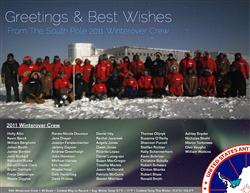
I hope you had a happy midwinters day whenever you chose to celebrate it! The official moment of the solstice was 0516 (SP/McM time) Wednesday 22 June...McMurdo and Pole chose to celebrate the event on Saturday the 18th...noted by the greeting cards you see at left and at right...while Scott Base will hold their special dinner on the 23rd, to commemorate the fact that Scott and Amundsen had midwinter So is the upcoming summer the "chaos season?" Well, on 15 January 2011 this New York Times article (subscription access may be required) suggested that hundreds of people want to visit Pole in 2011-12, which is the centennial of Amundsen's and Scott's arrival. There will be skiiers from the coast, the last degree or the last 20 miles...tourists on champagne flights...competitive racers...drivers arriving overland by truck...and of course a bunch of official government distinguished visitors. Perhaps as many as 1000 people...compared to last season when there were about 300 NGO visitors. Of special interest is the fact that a number of the expeditions will be retracing some or all of Scott's and Amundsen's routes from the Ross Ice Shelf, rather than the usual routes from near Union Glacier. NSF has a special committee at work to determine what the official commemorative events will be...and Raytheon will have a special coordinator on hand to deal with the hordes, sell them stuff in the store, and keep them safe and away from the science. So who all is coming? Well, if you've been here before, you know that this web site has maintained the most comprehensive list of such ventures since 1999...and despite the sputtering economy, this year's list was rather long and kept growing. 4 June at Pole saw the seventh annual renewal of another strange Pole event...the BF5K...or a 5 km race through the halls of the station...18 laps in all. The spectacular part about it, as always, was the amazing costumes worn by the participants! Check out Robert Schwarz's page of photos! 
Global warming? Tell that to the 14 latest members of the 300 Club! Yes...on Friday 27 May 2011 (left) the temps dipped into triple digits...let's welcome Susan MacGregor, who at age 62 is the oldest person to be initiated into that great organization! I don't think I ought to post photos of her athletic performance...but I WILL post a link to her May Antarctic Sun article in which she describes the amazing successes of the growth chamber. Yes, there are photos. Contract news...well, although the rumors are circulating yet again...to the best I've been able to determine they are just that. The facts...Amendment 11 to the RFP came out on 20 May...followed by, yes, Amendment 12 on 3 June! What does this mean? Nothing...except for the number crunchers and bean counters with the 3 finalists who now must recrunch and recount stuff and submit a few more trees by 14 June. We are still supposed to hear something in September...no, maybe in November.
IceCube hasn't found anything yet...according to this April 2011 paper by the IceCube Collaboration (WIRED blog post with links to abstract of paper). Well...not exactly. It has detected neutrinos, but so far, the attempts to correlate them with gamma ray bursts have been unsuccessful. To quote paper coauthor Nathan Whitehorn, "In two years we'll have an answer, or a lot of scratching our heads. We'll either see neutrinos, or something will be strange with the universe." Which is, after all, why we do science...to find out about strange things. April Fools? Well, not really...despite the continuing budget wrangling in Congress...the contract folks finally got around to awarding the 1-year support contract to RPSC...just under the wire on 31 March. This was publicly announced at 1832 Eastern time on...1 April 2011. Well, you saw that news here first. Here's the announcement.  Sunset! The big dinner was 19 March...the official sunset was not until 23 March...and the weather was clear enough for it to be watched and documented. One example is at left...actually showing a bit of that rarely seen green flash (general info page). This particular photo was taken by winterover IceCube astrophysicist Freija Descamps...who was interviewed by PRI (Public Radio International) The World on 24 March. She discussed her life and work at Pole, and presented some photos including the one you see at left. Well worth your time! Oh, and if you are looking for an excellent video of the sunset scene, check out this one by Weeks Heist! The month after closing was the typical hectic round of station closing activities...cleaning and winterizing summer camp...washing all of the dirty linen...rolling up the fuel hose...putting out flag lines to outlying buildings. The outside world was not forgotten...over $10,000 with matching funds was collected to support the ChCh relief efforts...and the folks in Denver are sponsoring a major event to generate additional relief funds--Ice Aid (poster at right) on 16 April at the Bug Theater in downtown Denver. News updates...I'm still working on some of the new big science projects...for example, ARA, the next big neutron telescope. Closing time at McM...a strange end to the rest of the USAP summer. First...the 22 February massive Christchurch earthquake, which devastated the central city and disrupted the final McM redeployment...along with storms and warm weather that broke up the ice around Ross Island...waves were breaking on the McMurdo beach, and open water threatened the road to the Pegasus runway Closing time at Pole...February 15th...leaves 49 winterovers for the 2011 season, although a couple of Twin Otter flights were still transiting. The absolute last plane, a Basler, departed for Rothera on the 23rd. The small crowd...35 men and 14 women. Time to rearrange the galley! Things are pretty busy on station these days with all of the closing activities, so the full statistics are still being calculated... The beginning of February was cargo time at McM (14 February 2011 MSC press release). On the 30th the tanker Richard G. Matthiesen showed up, using the channel previously cleared by the Swedish science/icebreaker Oden, which arrived about 16 January. The Matthiesen has been to McMurdo before...most recently in January 2003...when actually it didn't get to the pier, but hoses had to be laid out from about 4 miles away. This is the last year for the Military Sealift Command (MSC) tanker Matthiesen, which is about to be laid up, following the other T-5 tankers. Why? Other than old age, a new Antarctic treaty protocol prohibits vessels (such as old MSC ships) using heavy fuel oil in Antarctic waters, effective 1 August 2011. Thus, this year's cargo ship was NOT the American Tern of previous seasons, but the chartered BBC EMS, flagged by Antigua Barbuda. It finished up and departed McM on 13 February. Running stuff...not only was the Christmas Day Race Around the World a historic trekking event vs a the tame "3x round the Pole" event of yore...but it developed later into the first real South Pole marathon. Around Christmas 2010, there were lots of NGA visitors...all of the various Last Degree participants, plus the "South Pole Race folks. This created a great crowd of people in the NGA camp, and since many of them had arrived in vehicles, they had lots of "stuff" with them. A great party scene...here's one description by David "Pablo" Cohn. the Race folks departed on New Years. Elsewhere on the plateau, the Russians have finally come up with an environmentally acceptable way to sample the waters of Lake Vostok without contaminating it, and drilling is expected to be completed in January. The top of the lake is about 12,300 feet below the ice surface. When the mechanical drill gets to within 100 feet, it will be replaced with a thermal lance...when that reaches the water, some will be forced up into the drill hole where it will freeze. Next season the team will sample some of that frozen water...(Wired Science article). Perhaps the biggest news of the month of December...IceCube...after many years of planning and 6 seasons of drilling...starting in 2004-2005 when they successfully had ONE hole running that winter...finished up drilling their final 86th hole and setting the string...appropriately numbered #80 based on the original plans for 80 strings. The string deployment was completed and tied off just before 1800 on 18 December. Here's the Decembeer 2010 report (PDF with video link) from the folks in Madison, and an Antarctic Sun article! Well done! Now let's catch and roast some neutrinos...
Thanksgiving weekend the first real tourists arrived, on Saturday four Slovakian "last degree" skiers as well as a Basler with 9 tourists--eight from Russia, one from Switzerland. After a tour, the Basler took the tourists and skiers back to Novo. A less publicized but much more significant event accompanied the arrival of the Indian science team (see below)...a massive fuel airdrop by a Russian IL-76 (21 November), about 32 miles away from the station, for use by future science and NGO ventures to Pole. My exclusive coverage.
The latest twists and turns in the contract...on 26 October a new amendment was posted, outlining a significant amount of new information that the three final bidders would have to submit prior to a new 6 December deadline. But...in November there was a new set of data requirements, questions, answers, and on 19 November another extension of the deadline to 20 December (the latest complete file from the FedBizOpps site and my page of information on the contracting process) IceCube was up and running, they started drilling around the Thanksgiving weekend holiday and finished the last 7 holes perhaps before the end of the year. Their weekly reports were posted on the IceCube home page, and there's a blog as well.
Antarctic Logistics and Expeditions (AL&E, owner of ANI/Adventure Networks) announced in early November that they'd set up a new blue ice runway and primary camp at Union Glacier, about 45 miles northwest of Patriot Hills. The runway has been fully certified. Here's their press release. Camp setup started in early November, but the first Ilyushin-76 passenger flight from PA was delayed for 2 weeks, it did not arrive until 25 November SP time...and the passengers found sunny above-zero°F weather. Another flight was scheduled for the following day. Airplanes...and no airplanes! A storm later named the "death claw" blew in starting on 6 November, record-breaking high temperatures and high winds made a mess of things for the next few days and delayed the departure of some of the winterovers. A flag line was set up from summer camp to the station due to the low visibility. Here's the Antarctic Sun article, and at right is a photo of science coordinator Al Baker weathering the storm at the ceremonial Pole Airplanes at last...the first Herc landed at Pole on Tuesday evening 2 November. There have been more since, and by now most of the 2010 winterovers are in Christchurch or at least on the way. Summer has truly begun. The first of the LC-130s had shown up in McMurdo on 24 October, and original plans were for the first batch of Polies to leave on Friday the 29th, perhaps on a straight through connection to ChCh via C-17. Hah. Weather, mechanical problems, and scheduling delays due to...the tragic French helicopter crash north of Dumont d'Urville (story and photos). So on Halloween weekend the new Polies were cooling their heels in McM and the winterovers were enjoying another weekend of the "soft opening." By now (12 November) most all of the w/o's should be gone, after a 5 day delay of the Herc flight originally scheduled to show up on the 8th.  The Baslers first appeared on Saturday 16 October on the transit from Rothera to McMurdo--left, a photo from Cody Meyer...and here is the Antarctic Sun article. It was a brief stop, and (due to delays) without freshies. The first pax flight was scheduled for Monday but was cancelled because of cold weather. But Tuesday morning 19 October it did take off, and landed around noon with 16 fresh passengers. Temperature was about -65°F. Winter was over. The second Basler flight showed up on the 23rd, and the third on Sunday 24 October, but that one got to stay overnight due to bad weather in MacTown. Only one of the 2010 w/o's left on the Basler flights. In between the frenetic station opening activities, another unique event occurred on 9 October...the American Radio Relay League conducted an exam at Pole... Summer plans and science news--a rather low-key season is planned, compared to previous seasons which saw pieces of the massive new station erected...and the dome removed. The biggest news involves the two largest science projects. IceCube will complete the last 7 drill holes of its 86-string neutrino telescope (and begin to retrograde some if the construction equipment). Here's an October NSF special report/video, a November 2010 Smithsonian Magazine article, and of course the IceCube blog. And the nearby South Pole Telescope will continue its sky surveys...in October the team announced discovery of the largest galaxy cluster yet seen--7 billion light years away (Harvard-Smithsonian CFA press release). Other more mundane planned projects include completion of the fuel piping system between the fuel arch, station and skiway fuel pits...commissioning of "rodwell 3"...and perhaps a bit more "remediation" of the site formerly known as Old Pole. September 2010, the sun is up, but the contract was, well, still out there. On 20 September US time a new one-year extension to the RPSC contract was announced...to give NSF more time to select from the best and final bidders. RPSC now will be running the program through 31 March 2012. Here is the announcement, and my updated contract rebid page. A McMurdo medevac kept the Pole flight following team busy for several days. The first Royal NZ Air Force P-3 Orion flight had to turn around due to bad weather at McMurdo, but another try made it in successfully on the 14th (NZ Herald article). On the 15th the guy, with pneumonia, was discharged from Christchurch Hospital. Yes, as of 20 August we finally have some news on the contract rebid. The three finalists are CH2MHILL, Lockheed Martin, and KBR. Which leaves out the other four bidders: TransPolar (the Raytheon/AECOM joint venture), Antarctic Research Support, the joint venture between EG&G and CSC, Fluor, and ITT Antarctic Services. Hmmm. Hmmm is all I can say at this point. Well, except that there is another Antarctic contract out there. NSF had a preliminary inquiry out for the nest Title II inspection contract. Remember, Title II at Pole was what I did in 2005. Winfly was supposed to start on 13 August 2010...but first there was a mechanical delay, and then some Condition 1 weather in McMurdo. But the first of the 7 flights finally made it in on the evening of the 15th. Here is the Antarctic Sun story about these flights. Important historical stuff from the other side of the continent...the former research vessel HERO has been definitely located in Bay Center, Washington, where the new owner has had it since September 2008. And I do have pictures that friend Jon Lingel took. Bill enjoyed the Antarctic "gathering" 15-17 July 2010, at Paul Dalyrimple's place in Port Clyde, ME. I was not the youngest Polie there...remember that Paul wintered a few years ago in 1958, so his winterover number is 21. The weekend featured lobster and other great food, and many presentations including one from Bob Benson who wintered in 1957...thanks to alphabetical order his winterover number is ONE. There were lots of Antarctic folks there...remember that Paul is the resident editor of the Antarctican Society newsletter, which now has an enhanced web presence documented here. The Fourth of July weekend was celebrated with a pork dinner...with the whole pig getting grilled on the outdoor barbecue. And it was followed up with a prolonged period of triple digit temperatures...plenty of time for more 300 club members! The temps dipped below -100°F several times during the first few days of July...and the Fourth of July was the coldest on record. The 18 June station update in the Antarctic Sun features extensive science coverage by SSL and friend Dana Hrubes, who of course has many more great aurora pictures on his own June web page.
IceCube was in the news again! Yes, on 1 June, the Wall Street Journal found time to cover this amazing project in between more depressing news about the BP Gulf oil spill and Euro finances. Catch the article while it is available. With photos and video of course! It was dark. "Astronomical Twilight" (when the sun is less than 18 degrees below the horizon) ended on 12 May 2010. The auroras are out there and they've been awesome! Here's the site for the all-sky camera that displays thousands of images per day. 
Contract rebid stuff...no news was no news. The "competitive range determination" and revised milestones for the new multiyear contract, originally promised by the end of March and later by 9 April, were not issued until August. Earlier, NSF and RPSC finalized the one-year contract extension on 25 March (the 5 April Raytheon press release). Here's my updated page on the contracting process. It got cold! Surprisingly the temperature dipped into the triple digits on 13 April, as documented by the scroll image at right (thanks Dana Hrubes). The temperature actually stayed below -100°F for 22 minutes...long enough for the first officially sanctioned 300 club running since 2006 (on 2 September 2007 the temperature dipped below -100°F too briefly for anything to happen, and it did NOT get that cold in either 2008 or 2009). The only other year in station history without 3 digit temperatures was 1964. Oh, this is well documented as the second earliest 300 club in station history. (The earliest was in April 1982 as documented by Robert Williscroft.) April 2010 was the coldest recorded April on record, with an average temperature of -80.7°F. On the other hand, 2009 was the warmest year on record (Antarctic Sun article). The sun set, well, perhaps officially around 0900 on 23 March 2010, well hidden behind murky skies. But of course it was marked by an amazing sunset dinner, extremely well documented by cook Cody Meyer. Two polar gatherings of note in Boulder in the spring of 2010...in mid May was the American Polar Society meeting, (detailed information). Earlier, the "Polar Technology Conference" was hosted by UNAVCO on 25-26 March. Here's the web site...the online list of attendees grew rather impressively in the weeks before the meeting, and the presentations are now online. I was around for both meetings, I spent about 7 weeks in Boulder this spring. At the Polar Technology Conference I learned that a new wind turbine was erected at Pole this past summer...a 2.5 KW unit constructed by Abundant Renewable Energy (ARE) (below left). Here are more details... 
More dome details...on 10 March NSF released this extensive press release with photo gallery! The McMurdo summer season officially ended Friday 5 March, as the last flight, the Australian A319 Airbus, departed with the last few summer folks that had been closing thing up for winter. 197 souls remained for the winter. Flight statistics for this season--in addition to several Airbus missions, there were 59 C-17 flights, 7 RNZAF C-130 flights, and two trial flights by the RNZAF 757 aircraft. It turns out that the U. S. Air Force flight season to the ice had been completed the previous week, on 24 February (USAF press release). Some late summer satellite news, there was an enginering test in January investigating the possible use of the Intelsat SkyNet-4c commercial satellite as a replacement for the TDRS-F1 satellite which was decommissioned last October. Who at Pole assisted with these tests...well, Shaun Meehan, the 2008 and 2010 winter comms tech of course. The Skynet satellite is slowly drifting into an orbit with increasing Pole coverage. It could be in service in 2011, here is the contract award announcement, and here is an unofficial IceCube blog presentation about the current and future satellite situation. Use of the current TDRSS satellites costs the program over $100 per minute. Speaking of satellites, NSF has recently updated their Pole satellite stuff including lots of information about the current systems as well as a new availability page which can be found here.
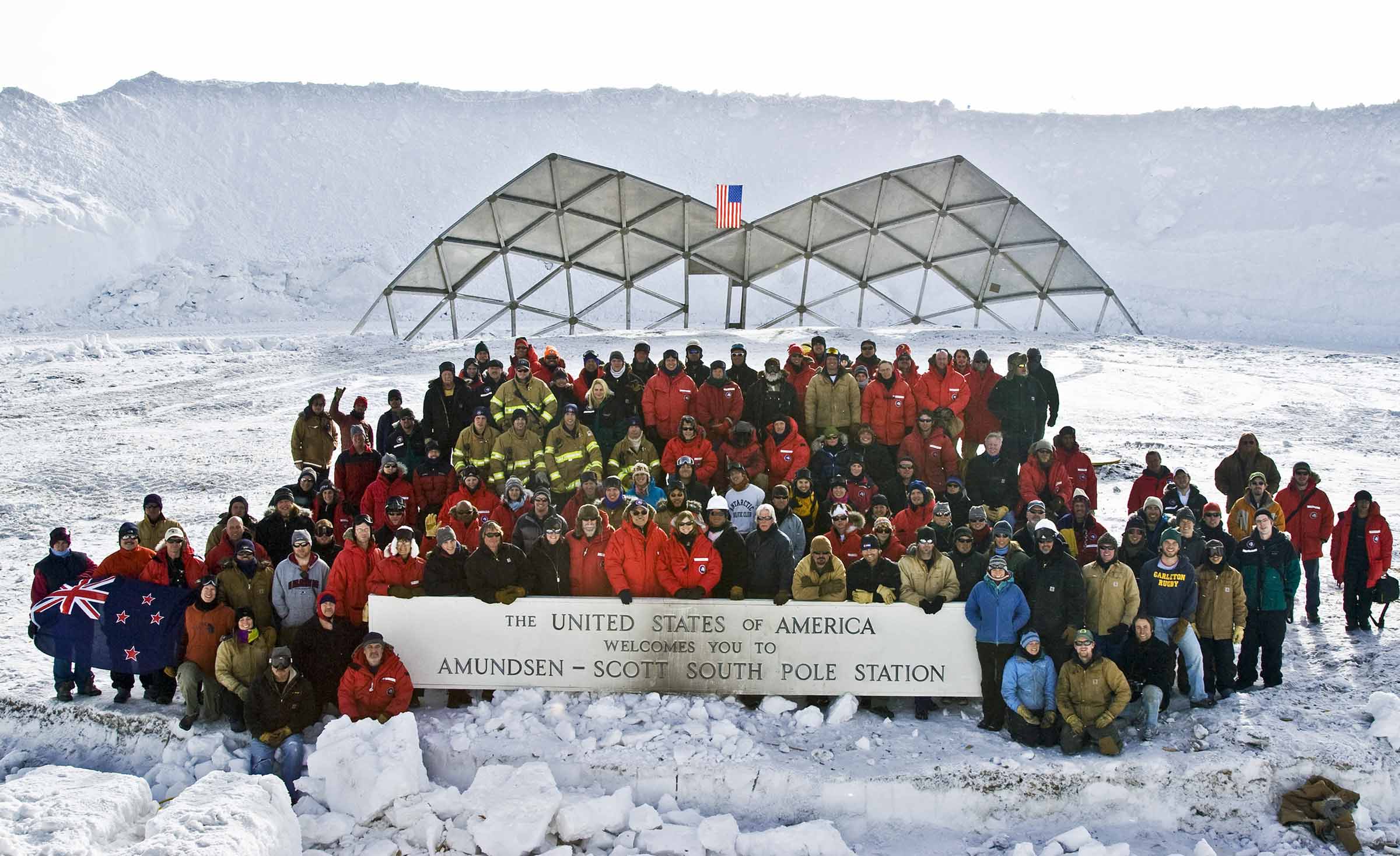 Yes, winter 2010 started on 14 February. This date marked the end of a dramatic summer construction seasson--officially the last for the South Pole Station Modernization (SPSM project). The most obvious change of course was the removal of the dome (left, the 15 January final group photo by Forest Banks, taken just before the last few pieces were removed). But elsewhere things are looking a lot more finished thanks to the completion of the "pretty stuff" as C-note used to describe the siding panels. At right is a February 2010 aerial view of the elevated station (thanks to Ethan Good) showing the finished roof, complete with its yellow grating in the science area above B2. Other buildings around the station also received the finished siding, including cryo, RF, and the SPT wing of DSL. Elsewhere, a bit less dramatic perhaps, the Cheese Palace was made to disappear, and the long-abandoned Hypertats were dug up and relocated, two by summer camp and two at the end of the world. The remediation of the Old Pole site, begun last March, was continued--one possible use for this area that had been considered is a relocated and expanded NGA aircraft parking/camping area. Efforts this summer included a GPR survey followed by some grooming and dragging, but...as happened last March, soft spots opened up, this time sinking a Challenger and the D-8. The equipment was recovered safely, and plans were being reviewed for additional remediation work, which was completed in the 2010-11 summer.
Science stuff...IceCube had yet another successful summer, it is hard for me to believe this was the penultimate drilling season, especially since when I showed up for my 2005 winter they had successfully completed exactly one hole. This season they started drilling on 4 December 2009, and completed 20 holes on 20 January, 10 days ahead of schedule, for a total of 79. Current plans are for a total of 86 holes, which means only 7 to be drilled next summer. All of the holes through the firn have been completed. Here is the end of season press release...the weekly reports from this past summer are available in the archive section here. Hmmm...what will B1 lounge be like next summer? Faciliies related stuff...the IceCube lab (ICL) got a real stairway to the roof this past summer, and the computer room fire suppression system was mostly installed. Moving to DSL, the South Pole Telescope (SPT) is producing an incredible amount of data about the beginning of the universe...which of course means there have been an incredible number of papers published just in the past year. For more SPT info the best source I can think of at the moment is fellow 2005/2008 winterover Dana Hrubes. At the other end of DSL the new incarnation of BICEP, otherwise known as BICEP2, has cranked up to study other angles of the beginning of the universe. The SPASE-2 hut has been retired from the dark sector, and the cosray detectors have been relocated between the station and ARO. Back behind where the dome used to be, the antenna crew took down some of the old towers, although if you look closely at some of the dome demo pictures, there are still a couple left out there.
The Antarctic contract...let me say first that major updates are posted on my definitive commentary page about the rebid. On 23 December 2009 the Federal Business Opportunities site posted another update, but it is already stale, since it describes a request for the bidders to reformat some of their financial information back in October. There also are some additional Q&A's indicating that there will be some "best and final" negotiations at some point. Since then, on 5 January NSF FINALLY posted a revised schedule on their contract rebid website, although there is not a lot of new detail here either. The Denver Westword news blog put out this story on 30 December with additional information on the lack of information; writer Jonathan Shikes quotes RPSC spokesperson Valerie Carroll..."they received a lot of info from all kinds of competitors and bidders, and it wasn't as easy to compare apples to apples." She explains that RPSC is negotiating for a year extension, and that the award is expected around September 2010. New Years Day always brings the unveiling of the new Pole marker at a new location, and 2010 was no exception. Here's my page of photos and info about the marker and the event. The last weekend in November 2009 marked the sad 30th anniversary of the tragic DC-10 crash on Mt. Erebus. The NZ program sent family representatives to the ice for memorial services, a couple of NZ articles are here (from Newshub) and here (from stuff.co.nz).
1977 Pole Soul sad news...and not new. We learned that Dave Pluth, one of our 1976-77 GFA's, died in May 2009 in Rwanda while on assignment with the national tourism agency (more information). The history of early season flight delays repeated itself at the end of the 2009 winter. After too many Basler delays, the Hercs showed up, and the first one headed for Pole on Wednesday 28 October...and landed. Visibility was back down to 1 mile (NYANG press release on their deployment). They kept flying to ramp things up and put the station in summer mode quickly. By mid November all of the 2009 winterovers were gone. The second and third Baslers were scheduled for Friday the 23rd, but the weather observations continued to be bad. Finally one took off...and landed at Pole late Friday afternoon. History repeated itself again, and the stage was set as it were for the First Flight Festival on Saturday evening...a major musical event in the gym. The first Basler arrived on Monday 19 October 2009, bringing 16 new people and taking 3 winterovers north. The Basler along with a Twin Otter had arrived from Rothera on Tuesday 13 October for a refueling stop on the way to McMurdo. The Basler continued on...the Twin Otter crew ended up staying overnight due to mechanical difficulties--it did not continue to McM until Thursday. Since the Twin Otter was the backup rescue aircraft, the Basler couldn't head south on NSF charter until the Twin Otter was in place. So the opening flight originally headed south on Friday the 16th but boomeranged presumably due to lousy weather and visibility at Pole. Last year the Canadians on the transit flight brought a few gifts and freshies from Chile (Pisco and oranges!) but this year they did not. The TDRS-1 satellite was taken out of service on 21 October. From here on, in addition to GOES, the comms will use TDRS 3, 4, 5, and 6 via the SPTR-2 link completed last summer (my complete coverage of the satellite systems and issues past and present is below). TDRS-1 was launched (with difficulty) on the maiden flight of space shuttle Challenger on STS-6 in April 1983. Bill Spindler was among a number of Polies interviewed in early October for this extensive article "Life in Antarctica is cold but bloggers there can still get burned" in the Denver alternative weekly newspaper Westword. 
For some reason or other, a number of past, present and future Polies gathered in Denver at the end of September 2009...including the indubitable Jake Speed along with wife Kathy! At right, some of the documentation... along with an update on Jake, Kathy, and the Jake Speed Fund! The sun came up! And even visible, thanks to a YouTube video from friend Weeks Heist. The sunrise dinner was 18 September, followed by an open mike night. Meanwhile, a New Zealand Air Force (RNZAF) C-130 has made a medevac flight to McMurdo. An environmental agreement by Antarctic Treaty nations and the International Maritime Organization (IMO) threatens to force changes to the NSF resupply shipping to McMurdo. The IMO tentatively adopted a measure banning the use of heavy bunker fuel oil by vessels in the Southern Ocean. The measure is a result of recent cruise ship disasters, and it is aimed primarily at that segment of the shipping industry, but it seems that the older US Military Sealift Command vessels used to resupply McMurdo also require heavy bunker fuel. Here's an August 2009 Science Magazine news article. 
A fresh look at the LO arch (left)...it is now brightly lit and filling up with shelving, thanks to lots of cold weather work by carpenters Todd Adams and Bill Stiner, electricians Robert Dragonfly and Monty Myrtle, project engineer Nathan Greenland, and others to help pull wire and put the erector sets together. Last winter we could not comprehend wire pulling during the winter, but they'd developed a workable system (which requires 7-8 people) to make it happen in cold temps. Soon the contents of the dome will be moved out, some of it to the new shelving units. Many more details are found in a 28 August Antarctic Sun article by correspondent/sous chef Michele Gentille which includes that LO arch photo by Nathan Greenland. After two days of cancellations, the first winfly flight into McMurdo finally happened on Saturday 22 August 2009, bringing 120 smiling tanned new faces to the ice. Ten folks departed, but by one friend's estimate this represented a 12% increase in the Antarctic population. This was the first of five scheduled flights, including another of those "night vision" landings that they started last year (Antarctic Sun article). Late winter fun...the Antarctic Film Festival has happened. Stations all over the continent created short films which had to include required content such as a roll of toilet paper, the sound of a can being opened, and the dialog phrase "Want to buy a dog?" A Rothera winterover shamelessly credits his station's winning video on this blog page, but he also credits one of the amazing Pole creations, a spoof on the making of a trailer for the forthcoming movie "Whiteout," which may actually get released in September. First you need to watch the real studio trailer of the movie here, then have a look at David Barud's vimeo site for the director's cut of the trailer spoof that he and Francis Shiel created, featuring many of the 2009 wo's. And there is also the film "A new FNG." Yeah, I know, this is a historical web site, but these cinema efforts are awesome :) More film links are available on this page, thanks to Anthony Powell at McMurdo. The Jake Speed fundraising effort received great support on the ice and elsewhere. The polar community raised more than $36,000 (and the fund is now closed). An impressive sum...thanks to all who have contributed! In late spring 2009 Jake was discharged from the hospital and was getting outpatient care and therapy near his California home...learning how to use his new bionic features. He still has a long way ahead of him. Please have a look at the photo pages which include lots of photos of the Jake we know.
From 3-5 June 2009 I was at the Antarctic Deep Freeze Association reunion in Madison...a great time to get together with Antarcticans and Polies from 1956 to, well, today, yes we had a phone call with Pole, one of the featured events. Hometown boy makes the papers...well, in this case it is Boulder native and 2009 winter site manager Logan Grover, who happened to get covered by the Boulder Daily Camera on 6 June 2009. The reporter actually asked me for info. Anyway, here's the writeup (archive). News from McMurdo...for the second winter in a row, a significant outbuilding was lost to fire on Saturday night 23 May 2009, . This time it was the Kiwi A-Frame...a structure I remember from my happy camper course back in 1976. The fire started after Scott Base staff had replaced the diesel fuel tanks, and leaked fuel ignited when they were relighting the heater. Here's a news story from the NZ Herald with a spectacular photo.
The demise of AMANDA was mistakenly reported here prematurely, but now we have the word...it was turned off at 1511 Monday 11 May 2009, but not before she complained a bit during her final activity. At right, IceCube winterover Erik Verhagen offers a tribute. Now we'll see if we can keep MAPO and the machine shop warm and toasty for the rest of the winter. Up in the heavens, the auroras have been spectacular. I'm a few thousand miles away, but I strongly recommend you check out the amazing sky shots the winterovers are coming up with!
Also in Madison on 16-17 April--the fifth annual Polar Technology Conference, hosted by IceCube. The meeting purpose was to discuss requirements and planning for polar research. It turned out to be a group of about 40, including yours truly. Bill Spindler was there to discuss such things as the research planning that went into the development of the three permanent stations at Pole (my presentation), and other such stuff...as well as meeting some other Antarcticans that I haven't seen in awhile. Much of the focus was on power and communications--we're talking something like a few watts of power and a few seconds of connectivity to Iridium, to enable remote data collection sites to operate and stay in touch...along with appropriate computer equipment and software. Since these use alternative energy, my talk included the slightly larger (3KW) wind turbine project at Pole (right) back in 1997. Here is the conference web site archive, which includes a link to the lists of the participants for 2005-16; the presentations are posted as well. Yet another of those diplomatic games that sometimes resembles a sporting event, the Antarctic Treaty consultative meeting, otherwise known as ATCM XXXII, took place in Baltimore between 6 and 17 April 2009, complete with a presentation by Secretary of State Hillary Clinton. The major result of this year's meeting was an agreement to regulate cruise ship tourism. These days these meetings happen annually; last year's meeting was in the Ukraine. America hasn't been the venue since 1984, when the meeting was held in Washington, DC. I've been through some of the reports and resolutions on the official Antarctic Treaty System (ATS) site and haven't found anything earth-shattering, but I may have missed something. The meeting was subtitled "50 years of Peace and Science." In addition to the smoke-free meeting rooms, a number of public events started the weekend before the official meeting--here's the NSF press release announcing the meeting and the events.  Remembering the old days...something not to be missed is the collection I call The 1974 Negatives...a unique glimpse of life at Pole 35 years ago this winter. Five years later was 1979, the fifth winter in what we called the new station otherwise known as the dome. This year was fairly well documented by one of the NOAA winterovers, John Bortniak. John supplied a number of photographs to the NOAA photo library, a few of which I have used elswhere on this web site, and he also helped me with other information about his winter. In March John presented an IPY/NOAA lecture/webcast as part of IPY entitled "Recollections on Wintering Over at the South Pole 1979" reflecting on the event of 30 years ago. Here is the link to the presentation, which includes a PDF file as well as audio/video podcasts. And here is a photo that John used in his talk--he is at the bottom of the Holy Stairs...some 30+ feet below the floor level of the vestibule in the left hand photo...down at the original snow surface level where the IGY station was constructed. 
The bids for the next Antarctic support contract were due on 23 February 2009...so the real backroom bidding, arm twisting, negotiating, and "best and final" offering began...and is still underway in 2010. Not a small process, since the winning effort isn't scheduled to be announced for another 6 months or so. In the meantime, our current contractor Raytheon is cranking up to hire next year's crew...all of the jobs were uploaded to Rayjobs at the beginning of March, and some of these have already been oversubscribed. The link to the jobs page is available on this RPSC site. For whatever reason, the Denver people have decided not to have a main job fair this year, as the hiring climate continues to change. If you're new to the process or even if not, 

Jerry Marty, the longtime NSF construction manager for the new elevated station, headed north for the last time shortly before Christmas 2008, and when he departed the station he was saluted not with crossed swords but with crossed measuring tapes (right). On 11 February 2009 he presented the lecture "Building for Science at the South Pole" at the University of Delaware. The presentation was visible not only live and as a webcast, but also in the virtual world Second Life (!). Oh, and it was also saved as a podcast so you can listen at any time...(full story, photos and podcast link). Up north, the Antarctic contract bidders were going through the final number crunching before the bids were due on 23 February...they already had to submit bunches and bunches of backup data last month (contract links and historical information).
NGA American solo skiier Todd Carmichael tried to set a speed record from Hercules Inlet...after 39 days of travel he made it on 22 December. The previous record was 40 days, but his record didn't last long. The 3-man team Richard Weber, Ray Zahab and Kevin Vallely got a later start and beat his record, arriving on 8 January with a record time of 33 days, 23-1/2 hours. More info on these and other ventures is elsewhere on this site. By now everyone who was going to show up had showed up, including the three Shackleton descendents that arrived from Ross Island via the Beardmore at 2200 on Sunday 18 January. The other portion of the team that was doing the "last 97 miles" was a few days behind. Another visitor was Monaco's Prince Albert and party, who joined Mike Horn's team at 88°51' S--they all left that trek campsite and flew close to Pole, where they all spent 2 days walking 22km to Pole, getting the Prince there at 0847 on the 14th. Mike, Børge Ousland and two others then flew back to the campsite to finish the longer walk to the Pole. Patriot Hills closed on the 28th. As for the real reason for the station, the Antarctic Sun recently published an excellent article "Field of Dreams" referring to the science projects that are being attracted there.
Traverse updates...there have been 2 science traverses involved with the the station--one of these is of course ths "South Pole Traverse" which left McMurdo on 23 October on what was to be the first of 2 round trips. But...the "shear zone" on the Ross Ice Shelf was a bit worse than expected and during one period while blasting and filling cracks and crevasses they only made 20 miles in 9 days. They had been scheduled to reach Pole around 6 December... they actually pulled in on the 16th. They left the coast with seven tractors here's one of them in a photo by Ted Scambos of the Norwegian-American traverse. And then there is the second half of the Norwegian-American Scientific Traverse which staged out of Pole to go rebuild and repair their tractors that had been left at "Camp Winter" after 2 of the 4 tractors broke down. Some of the crew made it to the camp site, studied the snow and fixed/serviced the equipment, but their start was also delayed due to weather and poor landing conditions for the Basler at the camp. They packed up the camp and headed for Pole, arriving on 11 December. I met some of these folks at Pole before I left. Now the final traverse team of 12 assembled at Pole, prepared the equipment and supplies for the drive north to Troll, and headed out on the 22nd. As of mid February they were at their last research stop. Yes, the bidders DID make it to the ice for their job walk, although their travel got delayed a day. They flew to the ice on Tuesday, 18 November and had a few hours at Pole the next day. I spoke with a couple of them in Christchurch. Here's my page of historical information and links relating to the contract bidding process... What went on this summer at Pole? In addition to landscaping and other usual stuff, the logistics facility (LO) should be completed this summer, including the rest of the work on the building, exterior ductwork, permanent power and heating supply, and the "front deck" between the downwind end of the building and the door/bulkhead. The bulkhead is being removed to allow for equipment access and to rework the door so it will swing inward over the rollers and ball conveyor system. Outside, the SPTR-2 project (photo below left) will continue to expand and complete the platform as well as to install the antenna, radome, and electronics shelter. The fuel storage pumphouse will get expanded by moving out two walls, and the aircraft fueling module (AFM) will be assembled. Siding work will continue on the back side of the station, IceCube will get a new CO2 fire system in the server room, and on the science side, IceCube originally planned to do 16 holes/strings, with a "stretch goal" of 19. Elsewhere in science, the 3-year BICEP telescope project in DSL wound down in November; the instrumentation was removed and shipped north. Coming next, perhaps in a year, is "BICEP 2" in the same location, along with "SPUD" on the former QUAD/DASI mount at MAPO. Here's an recent abstract which briefly describes these 2 projects. SPUD, also known as the Keck Array, recently was awarded a large grant from the Keck Foundation (press release). And on the other side of MAPO, a the old VIPER control room was to be fitted out to control the reactivated VLF antenna located west of the dark sector buildings. 
Air transport news...a Bombardier Global Express business jet operated by TAG Aviation left Farnborough Airport in England at 2305 Pole time on Friday 21 November 2008 in a quest for a new 50-hour round-the-world over-the-poles record. After crossing the North Pole, it refueled at Whitehorse (Yukon, Canada), Majuro in the Marshall Islands, and Christchurch (0036 Sunday, Channel 3 news story), and passed over Pole later that day in the 11-hour flight to the next refueling stop in PA. The last stop was at Sal, Cape Verde. They ultimately completed the the effort by returning to Farnborough in 52 hours and 32 minutes. There were 8 on board, including 5 pilots, flight engineer, in-flight coordinator, and an observer from Fédération Aéronautique Internationale (FAI) which ratified the world record on 23 March 2009. The previous over-the-poles record of 54:07 had been set by a Pan Am 747SP aircraft back on 28-31 October 1977. Oh, also, the specially modified 109th ANG completed the installation of new 8-bladed propellers on the first LC-130--Skier 92 to be exact. The first operational flight was on 16 September 2008...the new props reduce noise and vibration and may reduce fuel consumption by at least 5 percent. The aircraft was spotted in ChCh on 16 November and was expected at Pole the following week. Here's a copy of a Hamilton Sundstrand press release; the photo at right is courtesy of TSgt Derrick Irish; also here is an earlier Antarctic Sun article.  And back in October a few days before the first flight landed, we had an overflight by an FAA Challenger 601 inspection aircraft--basically a business jet--to certify the navigational aids of the skiway, which at the time was in the process was being relocated. The result is the photo at left...here's more information and links to a couple of other news stories. The accident at Australia's Davis Station (on the coast directly south of Perth) was in the news, as a NYANG LC-130 medevac mission headed there from McM the evening of 4 November, arriving about 0200 SP time on the 5th after a 4-1/2 hour flight. The aircraft, with a medical team on board stayed on deck overnight and then successfully flew the patient the 1500 miles to Hobart, arriving early on the 6th SP time (NSF press release and AAD press release). The story--the Davis w/o cook, 31-year-old Dwayne Rooke of Tasmania, fell off a quad bike on a field trip 15 miles from the base, breaking his pelvis and both ankles. He was in serious but stable condition as he waited for...the icebreaker Aurora Australis, which was diverted from its course to Casey and headed for Davis. A second doctor and other assistants were flown to Davis by helo from the ship on 1 November when the ship got in range and the weather improved Here's an earlier 1 November AAD news release. At that time the plans were to fly him back to the icebreaker when weather improved again. (my coverage with photos). Well, by 6 November 2008 we were supposed to have had about 7 Basler flights bring in folks to raise the population to about 170 people...but no...bad weather has kept them all away until that day, when a Basler along with two LC-130s finally arrived, to bring new people and take a third of the winterovers away. What bad weather, we said as we walked outside and look at the crisp new skiway under light winds and surprisingly warm temperatures? Well, all I can say is that the pilots needed better visibility for the first landings than they do later in the season. Oh, and at least a couple of the cancellations were based on bad weather at McM, or at least fear of it (!). So the SP population has finally moved into 3 digits after being stuck at 91 for over a week. 
At least some of the postulating and posturing over who comes in and who goes out on what flight is based on on the plan for one final winter band concert, the "red headed stepchild of Polestock" to be scheduled some time after some new people get here and before any of the band members leave. Hmmm. Yours truly wasn't scheduled to leave until the 13th. Aircraft may not have been showing up at Pole the fourth week of October, but they were landing elsewhere on the continent. The first NGA ground travelers to Pole landed at the Russian NOVO blue ice runway south of Cape Town, and the first passenger flights to PH were scheduled the first week in November. The 2008 winter ended slowly. The first "soft opening" Basler flight landed on Sunday 26 October (left) bringing 17 new people, more freshies, flu vaccine for us winterovers, absentee ballots, and similar high priority stuff. This aircraft can't carry all that much cargo, so all of the early arrivals have to live out of their handcarry until the 130's can bring in the rest of their baggage. We did have the station suitably cleaned up and decked out for the new arrivals (!). Another flight showed up a day later with another 17 people, and several more were to arrive later in the week...but did not. There were 3 outgoing passengers on the first flight, but no, this was not a "flight of shame" as some of you might be wondering--one grantee got approval for an early departure, one RPSC employee has an urgent dental appointment in McM and will finish his contract there...and a third guy has to hurry home and see family and do all the other stuff before returning to the ice for a winter contract at the beginning of January. Yes...a good winter. 
More airplanes...the C-17 flights to McM that were backed up for a week at the end of September have gotten pretty much back to normal. As for our "real" first flights, the Basler, along with a Twin Otter, were scheduled to cross the Drake from PA to Rothera on Monday the 20th...pass through Pole on the 21st, and then start bringing summer folks in on the 23rd. They finally made it Friday SP time (right, my hero shot by Kevin Torphy)...the Basler quickly headed for McM after trading some fuel for a box of freshies (YUM!) while the Twin Otter crew stayed overnight. Saturday the first Basler passenger flight from McM was cancelled due to bad weather at McM. Here at Pole the skiway was ready, or at least half of it...in preparations for moving it south, the marker flags at the north end have been removed, rearranged, and moved yet again...the first flights brought in some surveyors who know where they really are supposed to go, and lay out the rest of the skiway. 
Further up in the air (where the communications satellites live) we got word that one of the three communications satellites used here, MARISAT-F2, which until the last week of our 2008 winter was the oldest commercial communications satellite still in service, got a bit shaky in its orbit, and the owner (INTELSAT) needed to decommission and de-orbit after 29 November--something we didn't think would affect us winterovers (Antarctic Sun news story). That cut our ~11 hour satellite window by 2 hours...and is only a preview to what may come next when the other 2 aging satellites suffer a similar fate. At left is the first phase of the next big thing--part one of the "SPTR-2" antenna platform which was put up in February out near RF. It is to be completed this summer--complete with a dish, antenna shelter and an 8-meter radome. In theory this will allow access to a number of different TDRSS satellites for short windows as they briefly pop over the horizon...assuming a healthy set of jackscrews to keep the dish moving in our cool temperatures. A couple of other serious disasters hampered national programs in other parts of the continent in October 2008... There was the serious fire on 5 October that burned down the main 2-story berthing building at Russia's Progress Station, leaving 2 seriously injured and one dead. The station is on the coast, about 70 miles west of Australia's Davis Station on the east side of the continent, and only a mile from a Chinese base where medical help was obtained. Other station buildings including the power plant and galley were not affected. Here's an iol.co.za news story, and an excellent Antarctic Sun article. And elsewhere, The medevac of 49-year-old mechanic Sigurd Sande from Norway's Troll Station was successful--15 days after he broke his leg on 3 October while near the top of a 2000m peak. The other folks at the base--72°S-2.5°E and 150 miles from the coast, prepared things for a medevac flight to Cape Town, but the first attempt on the 10th was aborted due to bad weather. The flight in a Gulfstream GIIB business jet took about six hours, 2700 miles each way. His original rescue from the mountain to the station is a fairly dramatic story as well. Here's good coverage from fellow 2008 winterover Steffen Richter, and a good blog entry.
A bit of McMurdo news floated around the wires...the beginning of September saw the conclusion to "Operation Spring Fly" or what goes for winfly this season. It consisted of 4 C-17 flights into the Pegasus runway--three southbound flights with passengers and one with cargo only, and while the last scheduled flight on the 10th was designated a "medevac" (Air Force news article), it really involved an ambulatory patient who just needed a bit more evaluation than was available on the ice. A related news story...after the end of the scheduled missions they did a fifth "training" flight that landed in the dark just before midnight on the 11th. This was credited with being the first Antarctic landing by a pilot using night vision goggles (Stuff.co.nz article) but we all know it wasn't the first night landing...for example there was the Byrd Station medevac in 1961 and the Pole medevac in 2001...coincidentally we watched videos of that event Friday night. About the time it gets light enough outside to uncover the windows, it also becomes time for the NOAA team to uncover what might happen to the ozone hole. The World Meteorological Organization has predicted a "normal ozone hole" this year, whatever that is. The results of the ozonesonde measurements are posted on the wall of the galley, but if you're not at Pole you can follow them here . At the beginning of September 2008 we celebrated Labor Day weekend--two whole days off, and events which included an art show, open mike night, farmer's market (ie pick your own dinner out of the growth chamber), miniature golf, and, well, lots of sleep. Another day we noted was 28 September...that is the latest day in history that the weather reached -300° here. We didn't make it...only the second year in recorded history, the other year was 1964. One other bit of news...it seems that our power plant supervisor wasn't the only person with crutches...yours truly had his knee start complaining from 30 years of running--it basically swelled up and let me know it didn't want to be walked upon. Anyway, after some treatment and several weeks of crutches and canes it seems to be improving and I've been walking without assistance...still a bit slowly, but hopefully a move in the right direction. Back in July 2008 we had a recurring winter problem with the GOES/MARISAT antenna...some of the drive system quit working. After some intrepid disassembly, diagnosis and rework by the garage folks, UT's, and satcom enginner, the elevation worm drive was put back together and should function to give us our full 11+ hours of daily internet connectivity for the rest of the winter. The Antarctic Sun has an excellent feature article here. Recent efforts have gone into upgrading the insulation and heating to keep the drives warm and toasty, as it were. I'll spare you the gory gearbox pictures!
Other news around this quiet part of the continent--one of the power plant folks--James, my neighbor just down the hall, broke his foot in August 2008 in what must have been a fairly serious indoor soccer game in the gym--I was warned in advance and stayed away. And work went on in and around the "LO" that new cargo building that is taking shape in the old garage arch (above right, more current photos). The 31st Antarctic Treaty Consultative Meeting was held in Kyiv (Kiev), Ukraine, between 2 and 13 June 2008. All of the stuff discussed is now online here on the official site, although the lists of meetings and agenda items are difficult to navigate. The 2007 meeting passed a measure "protecting" Pole as a Specially Managed Area. Here is a link to that adopted measure and maps if you drill down to XXXI ATCM and "meeting documents." One of the more interesting Antarctic events happens every 10 years, and it started in late 2007, far from Pole in the environs of Washington DC. No, not another census or Polar Year, but...the 2-year process of rebidding the Antarctic support contract. The potential bidders started to posture and postulate over a year ago, but only in the (northern) spring of 2008 did the formal requests and announcements start to come out. Here is my look at this great decennial sporting event from a historical perspective (well, did you expect anything else from me?) Oh, just out...it looks like the next contract period may be 13 years rather than 10. And I do have links to the official contract information site, includings the list of registered potential bidders and detailed schedule. Oh, the bids are due on 23 February 2009. Our Midwinters day weekend happened...demarking the time when the sun starts to move back towards our horizon...the time for a big dinner and the "Son of Polestock" musical blowout (above left, the main promo poster). Yes, a great weekend was had by all... the last 2-day weekend was in recognition of the Memorial Day holiday...although many folks here have job responsibilities over these weekend breaks. One such guy here is power plant tech Will Brubaker...but he did have time to post the details of our celebration. I didn't throw horseshoes or anything else, but I did enjoy the food and the nitrogen martinis. Thanks Will!
17 April brought an unusual ice event north of here--the end of the "extended season" at MacTown. A C-17 visited them bringing freshies, several thousand pounds of mail and a few late winterovers, and headed north with about 100 passengers, leaving 125 folks behind. Some of the northbound folks were late science projects, some had showed up in February to work on a new fuel tank up where TESL, er, F-Stop used to be. The McM winterovers will be isolated until Winfly...whenever that is or whatever that is called. Instead of some flights in the third week of August, that event will be smaller and occur during the first week of September. For those of you curious about the ongoing winter life at McMurdo, admin guy Tom Hamann's blog is definitely recommended. And also this year the Antarctic Sun is maintaining a winter presence. Meanwhile, our opening flights at Pole will likely be the Basler variety staring in mid-October. Friday 21 March was our big dinner celebration, although we still saw the sun for a few more days on and off and on. Maybe. For the sunset party weekend we have had overcast skies and poor surface definition. Thursday morning 20 March I made the call that we had a "Stonehenge moment"--well, not really, but it seems that at 6 AM the sun shone directly in the window at the sun deck (directly above Destination Alpha (DA), the main station entrance) and a couple hundred feet straight down the main hall, so you could see your shadow in the doors at the other end. Hmmm, at right below is a photo I took of the sun from the same spot in the hallway, looking back towards DA. And here is a hero shot in the B3 hallway...remember I was playing hooky Not long after station close, there was a women-only sleepover at ARO. Well, I wasn't there, but thanks to Heidi Lim and Leah Webster's camera I do have documentation (below left) that we have a well-rounded population. At left below can be seen 11 out of 12 of the female population--From left: Katie, Deb, Calee, Heidi, Jane, Robin, Mandi, Amy, Leah, Terry, and Katie. Sue was absent--she had to go launch a weather balloon. Do check out Heidi's blog, she has been out and about on the station environs, with camera. Yes, we do have plenty of toilet paper for the winter, a highly qualified facilities engineer, and a well-trained trauma team...:) The station was scheduled to close Friday 15 February 2008, but it happened a day earlier on the 14th, leaving 60 of us here, down from nearly 200 only a few days before that. Things are going well--Bill Spindler passed his "winter dental review" and finally moved back into the same room he'd lived in for the 2005 winter. With some familiar friendly next-door neighbors! In the first week after closing we had some warm (-20s F) temperatures, but now in the first week of March it is flirting with the -60s... I must add a sad note here...former coworker and friend Mike Pavlak passed away at home on 23 January. Mike worked in the program for several years in the late 70s with H&N, and continued with it and its successor companies. He showed up at Pole to take over from me as the 1978 station manager. This page (at bottom left) includes a classic picture which includes both of us, taken while I was on R&R at McMurdo in January 1977, and here is a brief obituary (MS Word document) from the DMJMHN intranet site. Well, the icebergs that plagued McMurdo Sound a couple years ago have gone bye bye (watch the icebergs)...but this year we had a new problem--heavy pack ice 500 miles north of McM, much worse than in recent years. The only icebreaker to show up this summer was the Swedish vessel Oden, which got to work after a science cruise from PA. Here's more info on the 2007-08 program, and a link to a PolarTrec blog on the venture. The science cruise departed from PA in late November, the beakers were sent to McM via helo on 7 January before the icebreaking duties began in earnest. Oden first made it to McM on 11 January, after finding much better ice conditions than in the past few years. Meanwhile, the cargo ship American Tern arrived at Lyttleton from PH on the on Friday the 25th as scheduled, and left a couple days later for the ice. But...the tanker was hung up at the pack ice edge, the Oden went up to help, putting the tanker Gianella arrival off until around Tuesday the 29th Offloading finished up and she left late on the 31st. The Tern showed at McM on 6 February and left around the 13th. More on the heavy traverse season. ...the Norwegian-American scientific traverse--from Troll via Plateau Station (where they found the 1960-era USARP station intact--news article. and the Pole of Inaccessibility (where they found that bust of Lenin)--was supposed to roll into Pole around 19 January, marking the end of the first phase of their 2-year project--a return trip from Troll. But...they ended up stranded after first one and then two of their four vehicles broke down, putting them 220 miles from Pole. First they requested USAP assistance, and accordingly the SP heavy traverse (which was heading back to McM) turned around and arrived back on station on 14 January. As things evolved, the project decided to winterize their equipment at their site, and a Basler was chartered from AL&E to fly the team and some of their equipment to Pole. The first 6 made it on the 20th, and the rest of them along with ice cores and other stuff made it on Monday the 21st. The group flew north to McM on Wednesday the 23rd. The new station dedication happened on Saturday 12 January...the guest list was rather exclusive, and the on-station ceremonies were extensive. I do have lots of pictures, but since I'm rather busy doing other things at the moment :) for the moment I must recommend the NSF press release and the excellent Antarctic Sun coverage. An earlier story on this event came from the Aussie media. Meanwhile, the station has also been visited by the annual Congressional delegation. The South Pole Traverse--yeah, that one, the one from McM--doing "trail maintenance"... rolled into the station on 8 January, after advance scout Bill McCormick wandered into the B3 lounge the night before and announced their presence. He was welcomed to Pole, and since he wasn't driving, he was handed a cold beer. The ITASE traverse--this year's venture from Byrd Glacier to Pole--showed up on the morning of Christmas Eve. Teacher Elke Bergholz has an excellent blog entry here. And a bit later there was a Chilean scientific traverse, which appeared to include some paying tourist members. Not unlike recent ISS (International Space Station) ventures. Hmmm.  
This season has been an interesting one as far as aviation is concerned--starting with the "soft opening" using the Basler--something that was to be repeated at station close. Then on the morning of 7 December, TWO Twin Otters with 17 pax showed up from PH (left, photo from Thorsten Stezelberger). What did they do? Well, take pictures and visit the store, of course. And then there was that "mystery aircraft" that was flew over on 8 December without saying hello. But not without this picture (right) by Jill Fox, who was part of a campout and happened to have a camera at the right time. Well, it turned out to be that new Airbus A380...the full story is here thanks to help from the ExplorersWeb team. Oh, here's the complete Airbus press release and an ExplorersWeb followup. And then the USAP-chartered Basler crashed on 20 December 2007 near Mt. Patterson, a West Antarctic field site 550 miles west of McMurdo, during a takeoff attempt after picking up the field party from the POLENET (Polar Earth Observing Network) project, that had just installed GPS units and seismic instruments at the site. Ten aboard-six team members and four crew, and no injuries (NSF press release), and Mitchell's blog with the full story and pics. This has put a crimp in the AGAP project as well as that oft-threatened "soft close". A team was sent in to repair the crashed plane; it was flown out via Rothera before the end of the season.
Oh, as for those NGA folks...the first group of "last degree" skiiers arrived on 15 December and got a tour of the place, including IceCube. IceCube started its first hole of the season (#63) on Wednesday 5 December and completed it a couple days later. By mid-January they'd completed 16 holes, and they finished string deployment on the "stretch goal" 18th hole on 25 January, on schedule. They then moved and winterized the drill camp...the last of the summer folks went home on 13 February. Their goal for next season is 20 holes... And they completed all 28 of the planned IceTop tanks and associated cabling (it will still take a while for the water in the tanks to freeze). You can read their summer weekly reports here.
By now of course the station is fully open for business, but a bit earlier this month things were a bit dicey. The Today Show team from NBC made it to the ice, and while Ann Curry originally planned to go to Pole for a long visit, Mother Antarctica's weather didn't cooperate, so the team barely made it in for a brief triple-shuttle visit early on Friday 9 November. Those flights made it in late Thursday/early Friday giving most w/o's an opportunity to go north after a week's delay. Anyway, for the Ann Curry fans, here is a show website. Hey, in October 2007, the all-new Antarctic Sun had coverage of what Andy Martinez has been doing with all of the old winterover pictures. Not to be missed! The scheduled "official station opening" (first LC-130 flight) on Monday 29 October was cancelled--not for temps (it was a warm -45°F/-43°C) but for visibility. This plane was to bring a big summer crowd (plus more mail and baggage left behind by the Basler pax...) But, a second flight later in the day did show up. Along with more later in the week. At the end of that week things turned bad, on Saturday 3 November all 3 flights aborted...the one that actually made it to Pole (only to boomerang for low viz) ended up returning to Terra Nova! Speaking of the weather, w/o Steffen Richter has created a great automagic weather page...bookmark this for up-to-date met info!
What is a Basler? Basically a completely modified/rebuilt DC-3 (read, jack up the nameplate of a WWII DC-3 (or C-47, or R4-D or whatever) and rebuild and modify it). They've been to Pole before, here is more info on the previous visit and the aircraft. In any case, the plan is to get the population jacked up to 260 people by 5 November. What will happen?? Well, the siding and "chamfer" project will continue, in an effort to save a few more BTUs and KWs as well as make the place look decent for THE DEDICATION OF THE NEW ELEVATED STATION scheduled for 12 January. With of course bunches of DVs scheduled in for a couple of double shuttles...not unlike the first station dedication was held at Pole in January 1975. Oh, yes, that means I must mention this bit of trivia: the actual first station dedication was held in early 1957 in MCMURDO, and the Polies didn't even find out about it until much later. Meanwhile, other construction activity will see erection of the base structure of the SPT ground shield, jacking of the last section of the arch (the old power plant section), removing the old Dome entrance and filling it in with arch connecting the old power plant and biomed arches, and beginning on the foundation work for the logistics facilities to be built inside this arch. Update....the Norwegian-US Scientific Traverse is one of the more noteworthy International Polar Year (IPY) events. This is a 2-season international multidisciplinary return traverse, exploring the East Antarctic ice sheet, from the Norwegian Troll Station (where the team is now) to Pole. The first half happened in 2007-08, and it included a stop at the site of Plateau Station. Plateau was occupied for the 1966-1968 winters and featured a 30-meter met tower, similar to the one at Pole, although a late 80s event failed to find it. One of the participants is Colorado State researcher Glen Liston...who happens to be a 1983 winterover. Back then he was the maintenance mechanic. Their plans were to be at Plateau for 5-6 days drilling a 90m ice core. Well, it turns out they broke down a few miles away, but they still discovered the station only buried up to the roof...and the met tower. By the way, these folks have a great historic page about Plateau, with photos including one of that met tower. This traverse will also investigate some of those subglacial lakes which have become a big thing of late. Would there there be a 300 Club in the 2007 winter? Well, no. Earlier this spring temps dropped briefly below -100°F a couple of times, but not long enough for anyone to gear up. Global warming?? Here's Heidi Lim's view of the scroll the first time the magic number popped up. So far in the 50+ years that folks have been at Pole, the only other winter that it didn't make it into 3 digits was 1964. And here were the dwindling odds that it might have happened (graph courtesy of the NOAA guys).
Yes, happy Midwinters Day, whenever and wherever you are and may celebrate it. Nowadays this celebration is a huge event (well, based on the size of the winterover crew vs the old days) and you now can check out the extensive documentation of things on some of the winterover web sites. 30 years ago things were more modest, here is how we celebrated in 1977. The third annual BF5K was held at the end of April, Yes, I participated in the first version, and based on my lousy finishing time I should have worn a costume. Other serious runners and exercisers are somewhere on the way to MacTown (virtually) as the Race to McMurdo was underway again, hot and heavy, this documentation by Heidi Lim. I must confess that I made it to Mactown and almost back to Pole (Papa) 3 in the 2005 version. On the temporary facilities side, note that the smokers have found a temporary warm place to indulge, "the 2.0 Lounge" which has been parked outside of Destination Alpha for the winter. Those of you who were around back then (2000-01) will recognize this structure as the former "SPARCLE Palace" which is described and depicted here, then and now. Butt...all is not good news for smokers. It has recently been announced that as of 2010 there will no longer be any indoor smoking facilities at any USAP stations.... Tony Meunier, one of the 1974 USGS winterovers, recently revealed to me that his publication U.S. Geological Survey Scientific Activities in the Exploration of Antarctica: 1946-2006... is now available online here. This 15mb PDF document (which actually has a much longer title) documents all USGS events, visitors, winterers, cachets, etc., between Highjump and the present. Northern hemisphere events of note...this boreal spring and summer...first was the American Polar Society symposium at the OSU Byrd Center in Columbus, OH, 25-27...the eclectic program features speakers from the IGY era (including Dick Bowers, builder of the IGY Pole Station) and folks addressing IPY and current concerns. I was there and it was great to get together with old Polie and other friends. Two weeks later in Corpus Christi, TX, the Antarctic Deep Freeze Association (ADFA) met on 8-11 May. This group is composed primarily of the folks who WERE THERE during IGY, unfortunately I didn't make that one, which featured a videoconference with Pole. And last but perhaps not least, we of the 1977 Pole Souls had our second reunion in Boulder, CO, 16-17 June. Unlike the first one in 2000, a few folks didn't make this time...one guy who won't is Alex Zaitsev, whose presence is a victim of the current poor USA-Russia relations, meaning he didn't get a visa in time, although he did visit some of us in August. So what's with all this stuff about folks driving to Pole? No recent or hard detail on the team website, although this International Herald Tribune article is pretty good. The team has applied for the appropriate permits...the only thing is that they have to get their vehicles and alternative fuels to McMurdo in December, which is before the shipping season begins. Hmmm. This may incorporate the previously announced trip by Steve Wozniak, and they may be using Hummers...well, we will see. USAP did three round trips to Pole in the 2006-07 summer, according to some of the news articles. The thirtieth Antarctic Treaty meeting in New Delhi happened 30 April through 11 May. Not a lot of newsmaking issues this time, but new management plans for both Pole and Palmer were addressed. 
Sadly, yet another unfortunate news event--the tragic shooting of 32 people at Virginia Tech--prompted the lowering of the Dome flag to half mast on 19 March 2007. At right is a picture of this event...here are a couple more photos with additional information and credits. 
Yes, the dome demo crew has been back at work. After spending a bit of time gutting the old garage, they attacked the science building in earnest. At left, upper berthing is history, stacked up to ship back up north (Brien Barnett photo). By now (late April) they've finished with the old UB/science building structure, gone back out to the garage arch to wipe out the old garage/carp shop/gym except for the floor, and gone back into the dome to remove the old UB/science floor. Cold temps have hampered equipment operations...but the plan is next to remove the old garage floor next, followed by the old comms floor. After the food gets moved. Again. 
Happy sunset...20 March is the official equinox date in most of the world, but as usual the sun was visible for a few more days. The station bid the daylight farewell with the sunset dinner on 24 March. Another one of those great events...here's a picture of the 11 women on station this winter. Preceding this was the official 1 March inauguration of the International Polar Year...a 24-month modern version of the IGY that spawned the reason for the original Pole Station and the first of what is now 51 winterover crews (NSF press release on IPY, which includes a link to the IPY launch webcast). Yup...after a day's delay, the station closed with the final 3 flights on Sunday 18 February 2007, leaving 54 souls....All about the last day of flights was not uneventful. The last week of summer included lots of last-minute work by the "soft close" SPT team. While they didn't get to stay quite as long as they'd planned, their efforts resulted in a successful first light on Jupiter on 16 February (Eurekalert and SPT group press releases, as well as the NSF press release with videos). The photo at right by Jeff McMahon shows ironworker Brian Hardin celebrating the successful installation. On the waterfront...the shipping season is over. At left, the cargo ship American Tern is seen departing on 10 February; this unique view is from the wharf control tower. Here is what the Tern looked like full of cargo instead of garbage, when it showed up on 4 February (the Tern photos are all by McM w/o Tom Hamman). At right, the tanker Paul Buck, arrived on 31 January with help from the Polar Sea (Antarctic Sun photo by Peter Rejcek). In the background is the NSF research icebreaker N. B. Palmer which had docked earlier to swap out scientists and cargo...and then headed east to PA on a long science cruise. The Buck wasn't around long...after discharging nearly 7 million gallons of fuel, it departed to make way for the cargo ship. 
And at Pole, IceCube finished the season with 13 strings completed on 29 January, and firn hole #14 completed with the new firn drill. This year the drill camp (Seasonal Equipment Site/SES) was staged for the winter at the next drilling location rather than being towed back to the berms. And the permanent IceCube lab had its official dedication. And the SP Telescope is now assembled (at least the big pieces) in all its glory
Christmas holidays brought the usual events--the Race Around the World...fancy dinner...HF radio caroling, and other stuff that can be only done during a 2 day weekend. Here's a good page of holiday photos and video from veteran IceCube guy Darryn Schneider. But the day after Christmas saw a strange power failure caused by some DDC problems which precipitated a glycol leak in the power plant...all is well now. Outside...the British RAF team called off their trip on Christmas Eve due to medical problems 101 miles from Pole, they were evacuated to PA by ALE. Meanwhile, 2 members of the 6-person "last-97-miles" trek (starting from Shackleton's furthest south) led by veterans Mike and Fiona Thornwill--including Mike--had food poisoning before leaving PA...Mike continued but the other group member had to cancel out. Meanwile, the 4-man Royal Navy team arrived on the 27th, and Hannah McKeand completed the fastest trek ever, 40 days, on the 29th.
A bit of history renewed...since the days of the original IGY station (which we may know as Old Pole) ham radio has played an important part in communications with folks and family back home. Perhaps a bit less important now that Polies have IP phones in their rooms, but it is still around. And to mark the transition from the dome to the new elevated station we have a transition from the old dome QSL card to this fresh new one.
Palmer Team 77 had a successful reunion at the end of September 2006, in Newport, Oregon...with 100% attendance from the surviving winterovers, as well as a few hangers-on like me! Hmmm, must be something about 1977, a very good year on the ice. Stay tuned for photos. The current and future power demands have been the subject of continuing discussion and study over the last few months...years...most recently the science community, NSF, RPSC, and RSA Engineering put heads together during the 2006 Pole winter to see if there is enough power available to put the SPT online and still keep the lights on in the gym (studies and findings). Hmmm. Well, do YOU have any suggestions? There will be both astronomy and basketball this winter, but there were also two fuel bladders (remember those?) installed in and atop the biomed arch to ensure enough fuel is on hand for everything. Postponed to 2007-08 along with the dedication--the new logistics facility, perhaps the end of the dome building demolition, the rest of the siding, and perhaps (if it doesn't slip yet another year) the demo of the dome itself. This structure is still planned to be shipped back to Port Hueneme where it may yet grace the Oxnard skyline. Winfly ended successfully; the last of the four C-17 flights to McMurdo was completed over the weekend of 26 August, despite some dicey weather. This time of year also means that the sky over Pole is brightening fast...late August was time for the last nighttime Hash House Harriers "run" of the season. The construction crew is headed back into the dome to continue demo work on what used to be comms. And as the news media once again tries to figure out what is happening to the ozone hole, so is the Polie NOAA team (the NOAA Pole ozone page with current data, animations, and background info).
The Antarctic treaty meeting happened in June 2006, here is the report on the Hallett Station cleanup). Dome demo update...the crew has returned from work in the dark sector and cryo, the next targets are the gutting of comms and upper berthing. Meanwhile up north in NZ, folks are concerned that the US Coast Guard icebreakers may not be up to the task of getting the cargo ships into Winter Quarters Bay (TV NZ article), especially since the Polar Star has now been placed in caretaker status (Seattle P-I article).
NSF has been studying the alternatives for icebreaking and cargo handling for awhile...most recently on 4 May they posted an information request for a "package deal," looking for an organization that could both break ice and deliver cargo (6.5 million gallons of JP-5 and AN-8, 250,000 gallons of mogas, 600 TEU of container cargo (a TEU is equivalent to a 20-foot milvan) and 1.5 million pounds of breakbulk). Not to mention retro. Got any spare ice-strengthened vessels in your back yard? About 1150 statute miles north of Pole, veteran marine tech Joshua Spillane was presumed dead on Wednesday 19 April, 2 days after he had last been seen on the Laurence M Gould (LMG) as the ship made its way north from Palmsr Station to PA. Joshua had been employed for more than 10 years and 40 cruises. He was last seen on deck around 0500 Monday morning, and was noticed missing 6 hours later. After an onboard search, the LMG turned around and conducted a grid search. Argentina and Chile also assisted in the search effort. Conditions were harsh--20-40 knot winds, 20-foot seas with rain and snow, and 43°F water temperature. Here's a link to a couple of usap.gov news articles.NSF Polar Programs director Karl Erb released a press statement of condolences on 21 April; an earlier press release was issued on 18 April before the death was confirmed. Several other folks have died aboard Antarctic research vessels, but it seems that Joshua's tragedy is the first that did not occur while the vessel was securely berthed in a South American port. When it was nearly dark outside (6 April) it went dark inside for awhile, in one of the more serious power outage situations in station history. It lasted for several hours (no, not one continuous outage) and was exacerbated by the failure of the power feed to the fuel arch, which, of course, fills up the fuel daytanks in the power plant and boiler mechanical rooms to keep everything running. It took a couple days to get things back to normal...in the meantime serious power conservation was conducted and stuff was moved to the B1 emergency pod just in case. Fall featured continued dark sector construction on the SPT building, IceCube and elsewhere. In the new station, the gym was finished out except for the final floor and some of the stuff at the south end. And the dome demo began again...the annex was one of the first structures to bite the dust. Antarctica has been a big deal in the news media in the last few weeks...with two major research reports in Science on that old familiar subject of global warming. The first, published 24 March, addressed the fact that both the Greenland and Antarctic ice sheets appear to be melting much faster than expected. See this NSF press release for more information. The second article appeared in the 31 March issue and discussed an observed 0.5°C warming per decade of the troposphere (pressure altitude of 500 hPa, 500 mb or 14.7" of mercury) based on recently compiled radiosonde data from nine stations including Pole. More information is available in this BAS press release and this BBC report.
Pole closed on 21 February 2006 as the day's flights suddenly became the last ones. It was an incredibly successful season for airplanes, as there were a total of 377 flights, and unofficially just short of 10 million pounds of cargo, 16% more than planned, and a record, as stuff for next year's construction of the cargo building was shipped in, among other things. So...there are 64 folks left, I'm homesick, if anyone else is you must watch the summer video slide show that Patrick McClure has put up. Other recent stuff...while daylight lasted, construction in the dark sector continued on the SPT addition to DSL, as well as the counting house. And under the dome, the last upper berthing room party went off , while the erstwhile arch gym/exercise room has gained its last lease on life as the smoking bar. Dodgy Bastard...
This was to be the first year since Deep Freeze started that no US Coast Guard (or Navy) icebreaker would tend to the McMurdo sea lane. NSF arranged for the Russian icebreaker Krasin to do primary duty without help from a US vessel. But...now it seems that Krasin lost one of the blades from the starboard screw. She worked with her other two shafts at 110% power, but more work needed doing and the tanker Gianella was hanging back. And on 19 January NSF decided to get more help. Polar Star headed south from Seattle on 20 January...she is expected to reach the area about 20 February (USCG departure press release and return press release with photo link). McM divers had a look at Krasin but the prop was beyond repair with available material. Hopefully by mid February everybody will be out of McMurdo. Meanwhile, the third annual South Pole International Film Festival (SPIFF) was held on the weekend of 21 February...a great success. Up north, the income tax case that many Polies have been watching has been resolved...the answer is, pay your taxes (!) Here's the 25 January decision and an accountant's commentary.
Construction has continued at a fast pace on the elevated station and elswhere...as the first half of the summer saw the cargo office moved closer to the skiway...all the remaining science projects (and musical instruments) were moved out of Skylab so the place could be shut down...the old Biomed arch and front entrance were excavated in preparation for raising the arch for the new storage facility...BICEP telescope installation is proceeding on the second floor of DSL...the 10-meter telescope foundation is being assembled in a hole behind it, the beginning of the siding installation on the elevated station (see photo at left)...and in mid December the place suffered from a heat wave. The first of the summer NGA visitors included that tricked 6x6 Ford Van, which showed up from PH on 13 December (photo at right, here's more info and photos), as well as veteran polar trekkers Borge Ousland and Rune Gjeldnes. Yes folks, I finally left Pole on 21 November, four weeks after station opening, one of the last 2 winterovers to leave...Before I left, the VIPER telescope, (this year running the ACBAR project) was shut down for the last time. A bit earlier, the 10-year AST/RO project also came to an end...
The folks in Denver unleashed the new www.usap.gov Antarctic portal web site...some new looks for old stuff, and new features as well. Have a look.... Most of the Raytheon-related content including employment information is on a separate RPSC site, while the Antarctic Sun is here. The change to usap.gov also affected all of our computers on the ice...more fun for the IT folks. The September 2005 issue of Popular Mechanics has an excellent article on the new station by the Jeff Rubin, the Antarctic editor of the Polar Times. Oh, Jeff is also the author of the new edition of the Lonely Planet guide to Antarctica. I've seen it, and you can too. The icebergs that pestered McMurdo during the 2004-05 summer season seem to have moved out of the way, but not before B15A brushed a 3x3 square mile chunk off the Drygalski Ice Tongue (watch them!) Still, NSF made provisions for the Russian icebreaker Krasin to show up again in January 2006, this time in a primary role, with the Coast Guard as backup. Related news--in August 2005 a NSF committee released a significant report on Antarctic logistics--in addition to a discussion on icebreaker support, other recommendations include continuing development of the "road to Pole" traverse (which reached Pole this summer), development of a runway for heavy wheeled aircraft at Pole (something that's been studied and tried since the 1950s), and consideration of lighter-than-air craft for cargo delivery. Have a read for yourself (revised version).
We were blessed (?) with a chilly morning on 2 August--it happened to make it down to -110.7°F when I arose and decided to grab this picture (right). Opportunity for a few more folks to join the 300 club. Meanwhile, a Scott tent has been pitched near the Pole for those who desire the ultimate winter camping experience. No thanks...I stuck to looking at photos and guidebooks of New Zealand and Australia like many others are doing. Late June brought the traditional Midwinters Day celebrations and greetings--here's our w/o photo greeting and celebration announcement...and here's how we partied! 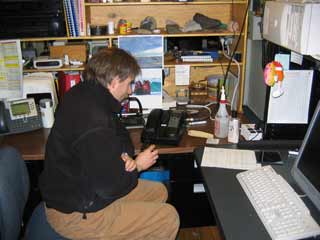 The first week in May 2005 brought the Antarctic Deep Freeze Association (ADFA) reunion in Biloxi, MS. This group consists of folks who came down during IGY, and this reunion marks the 50th anniversary of the original Operation Deep Freeze in 1955. One highlight of these gatherings is a telephone call to South Pole...this was the third such phone call I've been involved with, but this time I was at the Pole end of the line. Above left is a photo of winter manager Bill Henriksen talking to the group on the Iridium phone...and here's more info and pictures. Oh, the weekend also brought the belated Cinco de Mayo celebration, complete with the first annual "BF5K"--an indoor running event complete with sponsors and appropriate libations for all...and Saturday evening marked the debut of "Al Dente" (concert poster) in the B-1 Lounge.
"Astronomy on Ice" is the reason many researchers visit Pole nowadays, but Martin Pomerantz's new book with that title is the chronicle of his efforts, beginning in McMurdo in 1959 and at Pole in 1964, to establish the place as one of the world's finest astronomy sites. And a cosmic ray observatory. And a CMBR observing post. And a locus for long-term balloon flights.... Here's a 1 March press release about the book, which you can obtain from your favorite bookstore unless you happen to be wintering :( And here are a few more pages of information about Marty... Okay, speaking of Pole history books, one with a more recent outlook has just been published by 2004 w/o Nick Johnson--with excellent reviews from the likes of the New York Times. Is Antarctica really a big dead place? Make up your own mind...
The 2006 annual Antarctic Treaty Consultative Meeting ended on 23 June in Edinburgh, Scotland...and the detailed discussion stuff as now been made public in the "Final Report" section on the meeting home page. Unlike last year there is no dramatic Pole content. Some folks were unhappy that stronger action wasn't taken to limit tourism. But there was discussion about global warming (!) and complaints about the "road to Pole" traverse (Cape Argus news article). Another item discussed was the Hallett Station cleanup...the bulk fuel tank was demo'd, cleaned up and mostly removed in January 2006 (my copy of the report, which includes a map and some Hallett history). After Adventure Networks' (ANI) sudden departure from the NGA travel business in 2003-04, operations returned to normal in 2004-05. For 2006-07 ANI again offered their full program including those $33,500 flights to Pole, trips to Mt. Vinson, and a variety of other stuff. Antarctic Logistics and Expeditions (ALE) is the arm of the organization operating in PA and on the ice. Meanwhile, Cerpolex/PolarCircle hasn't announced anything new; in fact their old web site that discussed Snow Buggy trips among other things, seems to have faded away. Meanwhile, the second Ice Marathon and 100k were held on 13-16 December 2006 at PH with sixteen competitors. Weather conditions for the marathon were clear at first with later low cloud cover, light winds and 14°F/-10°C. The marathon winning time was 5:08:17; the 100k--12:55:06. The latter race was won by Richard Donovan. The first of these events was held in January 2006...a successor to the original South Pole Marathon that actually ended up at Pole in January 2002, with controversy. Entry fee for this year's event was $25,000 including transportation to the starting line. There will be another next year. The Ice Marathon was held at Patriot Hills on 7 January 2006...there were nine marathon participants, with times ranging from 5:09 to 7:10, and race director Richard Donovan did a 100k in 15:43, the first such documented ultra event. Sounds like this turned out much better than the controversial South Pole Marathon of January 2002 (Sports Illustrated coverage and Brent Weigner's diary of the earlier event, which covered the last 26.2 miles to Pole). The 2006-07 event trip is scheduled for 10-18 December (ANI site) so it is not too early to start training. Another interesting 2005-06 tour option--Travelquest again successfully completed their tour in conjunction with Sky and Telescope magazine. It featured a visit to the Patuxent Range meteorite collection area as well as an overnight stay at Pole. The 2005 Antarctic Treaty Consultative Meeting (28 ATCM, 6-17 June 2005) in Stockholm included further extensive discussions on tourism activity in Antarctica, including possible restrictions on the construction of permanent infrastructure to support land-based tourism, and preparation of site guidelines for visitors to popular spots. Here's the treaty secretariat home page, the final report page, and document page from which you can select various meetings or search for documents. Specific documents from this meeting that may be of interest to folks here include recognition of Amundsen's buried tent at Pole as a protected Antarctic historic site; the draft environmental evaluation for the new BAS station at Halley, Halley VI; a graphical report on tourism activities prepared by the Antarctic and Southern Ocean Commission (ASOC); liability for environmental emergencies; the management plan for Scott's Discovery Hut at McMurdo (the plan, Map A, and Map B); the 2004-05 Chinese Dome A expedition (and medevac to Pole); the Russian recovery of the Antonov-3T aircraft from Pole, and the proposal for Pole to be a "Specially Managed Area" (maps 1, 2, 3 and 4). The big summer construction milestone on 30 January 2005 was the granting of conditional occupancy of wings B1 and B2 just in time for the winterovers to move into B1, and the met office to become the first occupant of the new science lab B2. The first IceCube drill hole was successfully completed on 25 January, after the first attempt had to be abandoned after reaching 949m. Additional delays resulted from an unfortunate injury to veteran Swedish driller Sven Lidström, requiring his urgent medevac. The successful hole was moved 8m away from the first attempt. Later in the week, further drilling was suspended for the season, so as to insure enough time for drill camp winterization.
Meanwhile, the iceberg demolition derby continued. Ice around B-15A was breaking up rapidly. As for the ships...on Friday 21 January 2005, Krasin met up with the Polar Star at the ice edge . On the 23rd she was escorting the tanker Paul Buck. On the 23rd there were 4 ships visible from Arrival Heights--these two plus the Polar Star and the Nathaniel B Palmer. The icebreakers enlarged the channel, the NBP was at the pier on the 25th, and the tanker tied up the next day and offloaded, departing Saturday 29 January...only to have engine problems on the way north. The American Tern reached McMurdo on 2 February and began offload the next morning.
And the icebergs,...watch them for yourself...if you can figure out what they're going to do, you have your Wisconsin PhD all sewed up. Here are the links: NASA MODIS; UW SSEC; RPSC; and NOAA National Ice Center. NASA thought B-15A would crunch the Drygalski Ice Tongue by 15 January, but the big crunch didn't happen until April, and that was more of a nuzzle. In late December B-15A suddenly moved much closer to the Drygalski Ice Tongue, 10 miles away. After almost stopping, it moved again to less than 4 miles away, where it stopped again. Here is a 19 January NASA news feature with crystal-clear images and an animated time lapse sequence of the midsummer lurches. Crunch time. Was there any danger to folks? No, according to this 16 December 2004 NSF press release. But it was worried that the ice conditions might wipe out much of the penguin breeding activity on Ross Island.
At the end of November 2004 the north end of B-15A (or B-15, or, well, the big one) was firmly grounded. Still there was concern expressed by researcher Doug MacAyeal in a detailed interview in the 28 November Antarctic Sun. At that time Doug felt the real problem would not arise until 2005. But that was then. In January B-15A started to move north quickly toward the ice tongue and rotate a bit counterclockwise. Doug's iceberg page includes daily visible and infrared photos with commentary...also Denver posts satellite images daily. 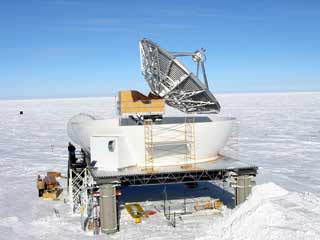
As the weather warmed up, outside work started up in earnest--one of the first projects was a large new radome to cover the SP MARISAT-GOES antenna (right, more photos). Meanwhile, 12 December saw the new Counting House successfully towed from its El Dorm location to the new site amidst the IceCube array. And later in the month the steel for A4 went up.
Speaking of the traverse, after negotiating some soft snow and crevasse fields at the south end of the Ross Ice Shelf, they quickly made it to the top of the Leverett Glacier the first week in January. At last report they'd gotten about 200 miles from Pole before turning around and heading back to McMurdo....(map and archived story).
Winter construction finished up ahead of schedule, with B1 (science) and B2 (berthing/emergency facilities) were virtually complete except for some flooring, furniture, and punch list items. The additional berthing (38 rooms in B1) is important as el dorm was gutted and moved for IceCube, and other Dome berthing in the annex and biomed is unavailable this winter. Summer activity also included the first phase of a new cryogenic facility to improve the winter storage of helium, as well as the massive crew and camp for the first phase of IceCube. Remember all those Florida hurricanes? Pensacola was hard hit, and one of the casualties was Que Sera Sera, that VX-6 aircraft that was the first to land at Pole on 31 October 1956. The R4D, which was parked in back of the Naval Aviation Museum, lost a wing in the storm...Joe Hawkins has the damage documented with NOAA photos. As of July 2006 no repairs had been made. Here's some photos of Que Sera Sera in better days... In addition to the webcam, the NOAA CMDL group has made significant upgrades to the main web site, including improved science links and some excellent photo galleries from the last few years, including those Jon Berry postcards. And elsewhere, the Canadian online comic strip "userfriendly" ventured to Pole featuring 2004 w/o's Sara Kaye, Henry Malmgren and Ethan Dicks...here's Sara's collection with links to all the strips. In other national program news, Chile's 12-member Army/Navy/Air Force scientific traverse from PH to Pole (and back) arrived at Pole 1 December. They had been scheduled to depart for the return trip on the weekend. The project has support from 2 Chilean Air Force C-130's as well as ANI; the military set up a temporary support base at PH. Projects include deep ice coring and other climate/global warming studies. Support equipment includes a crane-equipped Swedish Berco TL-6 "snow cat" as well as a Twin Otter (MercoPress news article). The Chinese national program successfully completed a traverse from their Zhongshan Station on the coast (69°S-76°E, about 60 miles southwest of Davis) to Argus Dome (81°S-77°E, also known as Dome A), which at an altitude of 13,250 feet (4,039m) (altitude according to the Chinese who made the first ascent) is the highest point on the icecap. The team arrived on 18 January (Explorersweb news article and a report by the Chinese delegation at the June 2005 Antarctic Treaty meeting (ATCM); but the trip was not without difficulty. Engineer Gai Junxian suffered chest pains from the extreme altitude (11 January Peoples Daily article), and was medevaced to Pole on 8 January by Twin Otter. Pole physician Christian Otto made the trip to Argus Dome along with South Dakota researcher Jihong Cole-Dai who acted as translator (NSF press release with photos and Chinese report from the ATCM); the patient had to stay a few days at Pole due to bad weather before he could be flown north to McM and Christchurch. The Chinese are considering a permanent station on the site by 2010 (China Daily news article); accordingly a delegation from the Chinese national program visited Pole on 2 February to have a look at the new elevated station. Meanwhile, the traverse returned to Zhongshan Station, arriving on 7 February (Peoples Daily article). The Antarctic Treaty Consultative Meeting (ATCM, 23 May-4 June 2004) in Cape Town resulted in plans for stricter rules on private travel, to include insurance and emergency contingency plans; some of the regulations were imposed for the 2004-05. Here's the treaty secretariat home page, and the meeting/final report page from which you can select the final reports for various meetings. This page includes links to the various meeting papers for all years. Also note this news story from South Africa. After Adventure Networks' (ANI) sudden departure from the NGA travel business in 2003, things settled back in under the new ownership structure, and for 2004-05 ANI was again offering their full program including those $33,000 flights to Pole, trips to Mt. Vinson, and a variety of other stuff. Antarctic Logistics and Expeditions (ALE) is the arm of the organization operating in PA and on the ice. Meanwhile, Cerpolex/PolarCircle didn't announce anything new about the previously proposed recovery of the Antonov-3 aircraft (which they were not involved with), but they did announce a slate of offered ventures that didn't happen, including a 3-day drive to Pole in some updated 8x8 Snow Buggies. One interesting specialty tour for 2004-05 was being offered by Travelquest featuring a visit to the Patuxent Range meteorite collection area as well as Pole. Didn't see them either... The Norwegians are upgrading Troll Station for year-round operations, with a winter crew of 7, beginning in 2005 after a February dedication visit by Queen Sonja. There are future plans for a 10,000-foot blue ice runway.
Tim Coffey, age 45, died on 28 July 2004 after a 70' fall from a radar tower he was working on near Nain, Labrador (on the north coast). Tim was the 1996 site manager; more recently he returned for work on the SPRESSO project. He's also been to Summit. Here's his obituary from the Concord, NH Monitor newspaper. The cyberterrorism redux continues. A bit more commentary published on the Register on 19 August 2004...seems that the DASI servers got broken into two months before the much publicized May 2003 Romanian exploit. And the folks at Slashdot had fun with it. This all started with politics...the U. S. Justice Department issued a report revealing new details, outlined in a 14 July Newsweek online article. Hmmm. This web site will stay out of the political debate, but I wonder how much money those Romanians could have gotten for all that AMANDA data. Oh yes, the original FBI report and the news article by thepoles.com are still around. Jerry Marty was interviewed by Jeff Rubin for an article appearing in the June 2004 Polar Times. Jerry reaffirmed that the construction project remained on schedule and successful, including a head start on the last 2 wings. And additional funding and design tweaking means that the completed station will have not 110, not 150, but 154 beds! 2004-05 will see erection completion and enclosure of A4 and B4, and 2005 will probably be the last winter that people live in the dome. What of the dome? Representatives of the dome vendor and the Seabees will visit next season to evaluate the return of at least part of the dome for the Seabee museum. By the way, in addition to being the Antarctic editor of the Polar Times, Jeff Rubin is also the author of that Lonely Planet guidebook to Antarctica... NSF has significantly enhanced and updated its home page and web site...for example, they've made a good collection of multimedia available on one page (but some of the items that were here earlier can no longer be found). The list includes content from all divisions of NSF; one item still here is this video on Antarctic logistics which includes mid-90s seismo vault footage and a balloon launch from the old BIT... Things remained quiet and smooth before midwinters day...construction was smoothly on schedule, the temperature dipped below that magic -73.3°C for the first time...and Ronald Reagan's death in California brings a commemoration. Meanwhile, the food growth chamber (greenhouse) is starting to be green. Here's hoping, since it is one of the more visible bits of station construction, close to the store.
Scientists from a Hamilton College-led team announced the discovery of a new undersea volcano just east of the tip of the Antarctic Peninsula. Here's more information and links. In early April 2004 there was a fast McMurdo medevac with multiple medical cases. This time the aircraft of choice was a USAF C-141 out of March Air Reserve Base. It arrived in Christchurch Friday 10 April in the morning (local time) and made the round trip to the Pegasus ice runway on Saturday. Weather conditions there were clear with a temperature of -13°F. The aircraft returned to ChCh at 1930 with 3 medical cases on board. The RNZAF had a C-130 on standby for backup. The three patients were given oxygen and IV's during the flight, and are now being treated in Christchurch hospitals, while the aircraft has returned to California. The most serious ailment involves stomach problems. Not many more details which is the norm of late, but it is interesting to note that two replacement w/o's went south on the aircraft. Here is the 8 April NSF press release. A 10 April 2004 article from the Age (Melbourne) has additional detail. Why the medevac subject was brought up here...the Navy (which contracts for aviation technical services) has been soliciting proposals for new runway lights for such an eventuality at Pole. They must be quickly deployable and provide standard VFR conditions for a Twin Otter at -100°F. Hmmm, whatever happened to all those Coleman lanterns? And back in Greeley, Colorado, the British balloonist David Hempleman-Adams (who has previously walked to Pole) bagged the open balloon high altitude record at 42,000 feet on 23 March. Afterwards, after dealing with the FAA--seems he may not have had a proper US pilot license or flight plan, he said he was considering a flight over Antarctica (David then went out for beer, and the FAA later declined to press charges or penalties).
The station closed on 15 February 2004 as planned. There had been 332 flights scheduled...and after the last flight departed there had been a record 329--essentially a successful flight season for a change, and a record (3 more flights than the previous record). Unlike 2003, the ship offload was timely, so fresh supplies (and beer) got delivered. The summer population averaged around 240. Now there are 75 w/o's...yet another record. The bigdeadplace site has a detailed interview, by an unnamed Polie, with Jon Johanson, the Australian pilot who overflew Pole in December. Here are my details and pictures of his venture. Ruth Siple, wife of the late Paul Siple (veteran of two Byrd expeditions and the first Pole SSL) died on 23 January in Virginia. Ruth was the long-time writer and editor of the Antarctican Society newsletters (more information and photo). And Virginia Fiennes, wife of Ranulph who led the 1981 Transglobe Expedition visit to Pole, died in England. Virginia wintered with the team close to the coast near Sanae; she ran comms for the 3-man team that crossed the continent. In November 2003 Ranulph ran 7 marathons in 7 days on, er, 6+ continents (the scheduled Antarctic run was relocated to the Falklands due to bad weather). She was diagnosed with cancer the day after Ran returned from the marathon venture. The strange aviation events didn't end for a few days after closing. Gus McLeod flew south again, landing at Marambio Sunday 15 February SP time. He then took off for Pole but turned around and landed after weight and icing problems. After waiting a few more days, he returned north on 19 February. Gus's web site now has the details and info on his flights north. On his first trip south he left Ushuaia on 7 February SP time for a round trip overflight of Pole. After some strong winds and icing problems he landed at Rothera...and then went back north. After trying unsuccessfully to go back to his original plan--a crossing of the continent with refueling stops at Marambio and McMurdo, he tried to do the round trip overflight of Pole, with a possible refueling stop at Marambio and return to Ushuaia. He had deleted formerly planned stops at Diego Garcia and Thule, which, like McMurdo, I can attest are hard to get landing permission for. Here's a CNN article about his start. Polly Vacher stated she wouldn't sell him fuel unless he had official landing rights at McMurdo. Gus first headed south from College Park, MD in December 2003. After engine repairs in Florida and more problems in Latin America, he continued south to Ushuaia. He, like Jon Johanson, has a kit-built aircraft, a modified Velocity with a canard wing design and a single push-prop. Pole construction continued hot and heavy and on schedule to the end of the season. Wing B1, one of the back wings on the second pod, was topped out on 20 January (photo at left). This will house more berthing and the emergency power plant. And wing B3, the last wing in the main east-west "leading edge" was topped out in December. The "Polar First" helicopter that visited Pole on Wednesday 12/17/03 (Pole photos and more info here) crashed 120 miles north of PH at 1400 Pole time (0100Z) Saturday 20 December. Both crew members were injured, they were flown back to PH by ALE and were flown on to Punta Arenas later the same day, where they are now recuperating. Here's their current web site. June 2004 update...Jennifer and Colin flew to the RAF base in Kinloss, Scotland to meet the rescue coordinators Antarctic Connection story). Other Antarctic transportation news from December: One Korean was killed when Zodiacs capsized in bad weather on Sunday 7 December 2003. The first boat with three men capsized while returning to base (King Sejong station near the south east end of King George Island) after seeing colleagues off at the Marsh runway. The three made it to a nearby island in their own vessel and were rescued by a Chilean helicopter. But a second boatload of 5 rescuers also overturned, and one of them died. The other four swam to shore and made it to a temporary shelter hut, where they were rescued by a Russian patrol. Here's a Korean English language news article. At Rothera, Polly Vacher, departed for Marambio on the 19th and flew on to Ushuaia the next day. She had to turn her Piper Dakota around earlier this month due to excessive headwinds on the way to McMurdo. She cancelled her transpolar flight and continued to NZ via the US. She arrived in Auckland around 30 January 2004. She let Jon Johanson use some of her fuel cached at Scott Base. The LC-130 that collapsed a nose ski on 5 December 2003 while taking off from a Ford Range (77°14'S. 142°24'W) field site was repaired and flown back to town on 12/14. They had just left a fuel cache for a climatology field party. The aircraft in Christchurch from which repair parts have been borrowed has also been repaired. And a helo suffered a "hard landing" near the Beardmore. NSF press release. The 2003 USAP traverses: the science traverse that left Pole Thanksgiving weekend made it to AGO4 and Taylor Valley as planned. This was a continuation of the multiyear ITASE traverse which started at Byrd in November 1999. Meanwhile, the Pole "proof of concept" venture ran into heavy soft snow and very slow going. They turned around on 16 January, 430 miles from the starting point, short of the planned destination at the Leverett Glacier. They made it back to McMurdo on 24 January. The trekkers...first Ilyushin flight to PH took some of them in on 11/30...the first tourist flight showed up at Pole dropping off some trekkers heading north. Adventure Networks (ANI)'s Antarctic operations have been sold to the new PH operator. What did this mean for the tourists, trekkers, and charity events that showed up at Pole? Actually, things worked well. October 2003 opening flights were almost on schedule...the first two LC-130's showed up on the afternoon of Saturday 10/25, after a day's weather delay. Meanwhile, 4 Twin Otters had arrived the previous day on their way to McMurdo for summer support of field camps. This year a total of seven Twin Otters transited Pole on their way to support USAP field projects as well as Italian/French operations at Concordia (Dome C). And there were 332 LC-130 flights scheduled for Pole--329 actually made it! The big iceberg B-15 north of Ross Island has broken in two...but as of midwinter the pieces just seem to be sitting there. Have a look for yourself from the best source--the Raytheon directory of iceberg satellite images which is updated at least once a week. Other news and details are available from the NOAA ice center press release. Also see this 2003-2004 Powerpoint presentation by Shelley Knuth, Douglas MacAyeal et al from the AMRC site at U. Wisconsin. The medevac was successful...after leaving Pole Sunday 9/21, 51-year-old Barry McCue, came forward to tell his story after successful gall bladder surgery 9/25. The full story is here, with pictures. The first 2003 McMurdo winfly flight for 2003-04 was delayed for one day by bad weather at McMurdo but finally took place on Thursday 8/21 when the C17 Globemaster piloted by Lieutenant Paul Groven of the 62nd Airlift Wing transported 137 passengers and 33,000 lbs of cargo to McMurdo and safely returned. Two C-17's and four C-141's participated. Main body flights followed on 9/30. The 2003 ozone hole was one of the biggest ever (9/12 Reuters article). Here are links to more historical and current data that you ever might want, thanks to folks like Andy Clarke and Loreen Lock. The winter was a quiet one--perhaps too quiet, as a series of hack attacks silenced internet communications for a bit. As a result the official Pole web site may remain unavailable. Meanwhile, the residents of the elevated station continued to deal with new-home quirks and glitches such as freezer problems (the wine in the freshie shack froze and the food in the new galley freezer won't). Midwinters Day 2003 was a success as it must be. Fortunately this one fell over a weekend, allowing for the max in festivities. These included mini-soccer, a luau, radio darts with other stations, and a Hash House Harriers run in, around, and under the station. Of course there were midwinters greetings shared around the continent, here is the one from Pole, with thanks to Joy Culbertson and Karina Leppik! Ulp...2002 was another year of significant medical news. At least this time it wasn't life threatening...but on 7/5/02 Dr. Tim Pollard performed surgery to repair meteorologist Dar Gibson's knee tendon. The event featured the latest version of "telemedicine" or assistance from up north via radio, phone and satellite. Here is NSF's press release with Jon Berry's photos, and here is the geek version from IT guy Henry Malmgren as seen on Slashdot! The station closed on schedule on 15 February 2003...at 1427 local time the last flight left, leaving behind 58 folks to face the winter in an utterly new environment. There were 293 flights out of an originally scheduled 350 (later revised to a planned 323). The construction efforts focused on the punchlist for the first phase of the elevated station. The summer plan was to achieve conditional occupancy of A1 and A2, but fire system problems uncovered just before station closing caused a "slight" delay (including lots of hard work, plus the callback of the fire system reps who were awaiting a McM-ChC flight). Fortunately, the problem was resolved, and the next event occurred on 4 March as official occupancy was declared. The first night in the new station rooms, scheduled to be occupied by about 40 of the wo's, was 5 March. About the same time, the galley equipment and supplies were moved/unpacked/cleaned and readied for the first meal upstairs. From McMurdo...despite the presence of 2 icebreakers, the tanker MV Richard G Matthiesen wasn't able to reach the wharf; instead offloaded via hoses strung across the ice (NSF press release)...something that has been required more than once in the past. This evolution delayed the closing flights from McMurdo (originally scheduled for 2/22) until 10 March, when the last 50 folks left McMurdo via a RNZAF C-130 aircraft. Meanwhile, the American Tern cargo ship arrived with difficulty about midnight 2/9, and departed with much more difficulty with help from the crippled Polar Sea on 2/17. NSF called in a second icebreaker (the Healy, which arrived 2/7) (NSF press release) after the Polar Sea broke one of its three screws in late January. And near Lake Fryxell in the Dry Valleys, one of the PHI Bell 212 helos crashed (NSF press release) with the two occupants injured. They were medevaced to ChCh in stable condition. The Russians are coming!! Somewhere, but not Pole. Despite this December 2002 Pravda article, the expeditioners from Russia (the International Mountaineering Club) planned multiple climbs in Dronning Maud Land. They brought two "snow bugs" (those 6-wheel vehicles that came to Pole a couple years ago) but apparently no balloons or parachutes. While the climbers did do their thing, both of the snow bugs broke down requiring an air evacuation by the Russians at Novolazarevskaya. Meanwhile, that Russian Antonov-3 that showed up last year will not be recovered for now.... The ITASE traverse arrived and completed all of their objectives, despite having to return to Byrd for wider tracks on one of their tractors and a better fuel sled borrowed from the Kiwis. They even did a mini-traverse towards the Pole of Inaccessability before parking their equipment on the berm for a future continuation in 2 years. Earlier in the summer the jacking operations were completed.
The MARISAT antenna platform got a major upgrade to support comms through the GOES satellite. It may get get a radome next season to reduce ice buildup (left) (January 2002 NSF photo by Nicolas Powell), seems that icing has degraded its performance. Other science projects included a new VLF antenna for Stanford to transmit towards Palmer, and the start of a new solar observatory. Flying kites!!! Teacher Eric Muhs spent early December at Pole working with the AMANDA and SPASE projects. This is part of the Rice "Teachers Experiencing Antarctica" project. He updated a diary daily on their site, as well as posting lots of panoramas and multimedia stuff around the station. He flew kites with w/o's Robert Swartz and Steffen Richter around the station, and sent live presentations back to his classrooms. Check it all out starting with his TEA (Rice University/Armada) page. 1977 and frequent Polie Brad Halter spent the first part of the summer at Pole, and finished the season at Dome C (Concordia, the joint French and Italian station in Antarctica) making validation measurements for the NASA Atmospheric Infrared Sounder on the Aqua satellite. Dome C is a happening place, this past year major construction continued on the future year-round station, and the Australians got their AASTINO research module up and running (this is the diary archive of the AASTINO setup). Originally the first 3 flights of the 2002-03 season were scheduled for 10/23, but after several false starts due to weather, and an emergency landing, the first two flights didn't arrive until Saturday 10/26. There were three medevacs on the opening flights. One of them was RPSC science tech Deborah (DJ) Williams, who twisted her knee on some loose ice back in March. The injury has gotten worse, recently she's been having traction treatments as well as consultations (via all the state-of-the-art medical/teleconferencing equipment now on station) with doctors at Duke University. Climate change on the Peninsula...the first week in April 2002 saw a major NSF-sponsored conference on this topic at Hamilton College in upstate New York. The meeting was planned many months before the recent iceberg incidents including the recent collapse of the Larsen B on the east side of the Peninsula. Here is the NSF press release. The workshop web site features abstracts from the presentations as well as streaming audio archives of the keynote speeches. The expedition web site used to include journal entries from their 2001-02 expedition, but they have been removed. The last flights of the 2001-02 season happened on 15 and 16 February...taking the remaining summer folks out and bringing in...steel beams for next summer (while leaving the mail and beer behind). The station summer season wound down after successful "topping out" and exterior closure of the next two sections of the new elevated station, A3 and B2, which will house science and medical facilities. Flight and cargo delays, as well as differential settlement problems, prevented the planned completion and winter occupancy of the new berthing and galley facilities which were first enclosed a year ago, so the winter population is 51, with some folks living in the suburbs of summer camp. What's happening right now?? The NOAA CMDL webcam gives excellent views of the new station, but [in 2002] you couldn't see much after dark. Here is the AASTO webcam [which was decommissioned in December 2005]. And for someplace a bit more brightly lit, NASA set up the first McMurdo webcam on a truelook.com site...long since replaced by the USAP McMurdo webcam. The South Pole Marathon (archived page), sponsored by ANI, finally happened on 21 January after weather and scheduling delays, with 5 runners completing half, full, or ultramarathon courses. It was won by Richard Donovan from Ireland, but second place finisher Dean Karnazes of San Francisco is complaining. He gave up his snowshoes and did the race in running shoes. Now the FBI and the State Department are involved. Richard hasn't gotten the promised prize money, and Dean is threatening a lawsuit. The details are here from Sports Illustrated. The 70South News has Richard's personal account of the race and the aftermath. This was only the beginning...on 5 April Richard ran a marathon at the North Pole...all alone, in two segments, in atrocious conditions...-76°F wind chill and 40 mph winds. A new one for the record books, 2 first Polar marathons in 3 months. More details on Richard's efforts to do ultramarathons on all continents this year are on his (archived) web site. But Richard was NOT the first person to finish a marathon at Pole. Station doctor Chuck Huss did the 26.2 miles on Boston Marathon day, 20 April 1981...more info and training photo here. On 8 January a small Russian AN-3 single-engined biplane arrived crammed with 14 folks including the vice-president of the Russian Duma (state parliament). Because he and other DV's were aboard, NSF granted them official status...and fuel...and later, bed space in the library and gym after their aircraft refused to start. Eventually after 2 days the DVs were flown out to McM/NZ on an LC-130, while the tourists with lesser status were picked up and taken to Patriot Hills by ANI. The aircraft was towed away to be parked for the winter, perhaps to be repaired next season. Scott Smith has photos and the story on Steven McLachlan's site. Meanwhile the construction work paused briefly during the week of 6 January to allow the installation of the official Time Capsule in one of the foundation beams. I have the exclusive story and photos from Katy Jensen. The event was witnessed by a DV group of congressional staffers, who also got to stay overnight because of bad weather (fortunately some new and comfy library couches had just been received). However, it seems that some of the time capsule contents were delayed in the mail...the capsule was quietly opened a week later to add some stuff sent from Washington, then the grade beam was welded up on 11 January. Meanwhile there was a fire, hoped by all to be the only "real" one of the season. A welder's sparks ignited some wood in the carpenter shop, resulting in 8' flames, fortunately put out with a dry chemical extinguisher. A good test of the fire teams. Oh yes, the temperature actually got up to +5°F, only 1 degree short of the 1978 record. Antarctic guide Doug Stoup returned to Pole in December, where he discussed last season's discovery of a 1937 Hershey "Ration Bar" with Katy Jensen. Did he really find it at Pole as was so widely reported by the media? Exclusive story here! I was interviewed by Kristan Hutchison of the Antarctic Sun for a special feature which appeared in the 25 November 2001 issue, on the past and future of the Dome. Therefore I've further updated the pages on building the dome. It's been known for awhile that the Dome will not be part of the new station. It must be removed from the continent in accordance with the Madrid Protocol. The exact method of removal was announced in December 2000--Chain Saws! Past efforts to save it and rebuild it in the US did not elicit the funding required for a more delicate demolition. Anyway, here is that excellent savethedome.com web site by 2001 w/o Jeff Kietzmann...a whimsical look at the past and future of this landmark structure. More recently, here is a commentary from the Antarctican news site. The station opened on 24 October 2001 with 348 scheduled flights, but the schedule slipped as it does every year. Lots of flights need to be used to bring in fuel, as the place can go through 6000 gallons per week nowadays. Movement of cargo to Pole improved because the Pegasus runway was readied for all-season use by wheeled C-130's, and an additional Air Force squadron from Little Rock, Arkansas was brought in to move cargo from ChCh to McM. During the early summer the new and old power plants were the subject of a massive gremlin hunt after a number of outages. The new plant was down for a fair percentage of the time early in the summer before a successful repair/redesign effort. "Frozen Under:" National Geographic has major coverage on the Antarctic in the December 2001 issue. In addition to this feature on life in Antarctica (this site includes a few more of those 360° panoramas from Pole and elswhere) there is a second article covering the visit to the Ross Sea icebergs in 2000-01. For the full story and pictures you'll need to consult the hard copy, if it never made it to your mailbox, check it out in at the library, well worth it! NSF's construction plans for the 2001-02 season included construction of the new seismic facility (SPRESSO) 5 miles from the dome...the next stage in quiet seismo vaults....close to the old Pomerantz Land site. Here's the NSF press release on the 2001-02 science, and the USA Today version. From Washington...a Congressional conference report suggests that $15 million will be appropriated for preliminary costs of the Ice Cube project, the 1 cubic km next version of the AMANDA neutron detector. This is a $250 million, 8-year project. And NSF's overall budget for 202 was increased by Congress by 8.4% to $4,789 million. This includes $300 million for "polar research and operations support," of which the "U.S. Antarctic Logistical Support" budget was increased 9.3% to $68.1 million. Science special...the 2001 w/o's completed a research project to reconfirm that the Earth does indeed rotate on its axis. A Foucault pendulum was installed in the future elevator shaft of the beer can. Yes, it did indeed change its plane of swing as the Earth rotated. The 33m stair tower offered a much better place to do this than the 16m dome where we tried the same thing in 1977. Here are details from physicist R. Allan Baker... On 28 September 2001 a major fire destroyed the biolab at Rothera, the large British Antarctic station at the southern end of Adelaide Island off the Antarctic Peninsula. The Bonner Laboratory was a new building completed in 1996-97...fortunately the alarms sounded early and there were no injuries to the 21 w/o's. However, weather conditions prevented fighting the fire. Details and photos from this BBC News article. The lab has since been rebuilt. On 12 September 2001 the w/o's learned of the tragedy unfolding in New York and Washington...and Jeff Kietzmann and Dave McDonald went up on the dome to put the flag at half staff. Here is the picture and story from manager Jerry Macala, and here is how USA Today covered it. (The flag was returned to full staff on Sunday, 26 September.) Palmer w/o painter Thomas Leipart died on 5 September from head injuries after a 1 September fall down the stairs aboard the R/V Lawrence Gould. He hod just arrived in PA after a crossing from Palmer. Thomas' wife Cindy from Arizona flew down to be with him before his death. He had planned to w/o next year at McMurdo. The NOAA folks at Pole have updated their CMDL home page with live links to ozone data, as well as tours of ARO and the station, historical information, and photos. Well worth a look. Pole MEDEVAC...Dr. Ron Shemenski, after suffering from a bout of pancreatitis, was successfully medevaced in a twin otter aircraft which arrived from Rothera at noon 25 April 2001 (Pole time) with OAE replacement doctor Betty Carlisle on board. Ron headed north the next day. The full story with photos and links is featured HERE. Oh yes, the aircraft was also carrying about 100 lbs of table salt...it seems that this vital commodity had already run short. The McMurdo medevac (NSF press release) also happened successfully in April 2001, carrying out a total of 11 Raytheon employees. Two folks had serious medical problems which prompted the medevac--a heart condition and a possible concussion; two other less-serious medical cases also were given the advantage of the flight; seven other folks also left McM for other reasons, perhaps relating to family problems at home. Or perhaps, er, other reasons, as discussed in this 28 April NZ Herald news story. The C-130 from the RNZAF headed south Tuesday at 0525 Tuesday 24 April +12/NZ and McM time (1325 Monday EDT) after a 24-hour weather delay. It landed at Pegasus, spent about an hour on deck, and returned to ChCh at 2030. Here is a press statement from Karl Erb, NSF Polar Programs director. Enough cargo made it to Pole during the 2000-01 summer season to support the interior buildout of the first phase of the new elevated station, which was successfully enclosed and heated. And the lights stayed on all winter. Read about the other milestones--the startup of the new power plant and the successful testing of the new earth station...(plus links to more background stuff) in the 24 January NSF press release. 2000-01 summer construction pictures of the elevated station are here thanks to Steven McLachlan and the folks at Pole. The new MARISAT/GOES 9-meter antenna, which promised to double the broadband access time, was successfully tested on 18 January 2001, but there were major "feed" and cold weather problems which required troubleshooting through much of the 2001 winter. Antarctica continues to break up! The iceberg C-19 is splitting up, per this May 2003 UW SSEC article and photo. The icebergs continued to cause shipping problems into McMurdo Sound in January 2003, although a sudden shift (along with the presence of 2 Coast Guard icebreakers) allowed some of the late summer cruise ships to approach Ross Island. The best continually updated file of Ross Ice Shelf photos, well annotated, is in this directory on the Raytheon server in Denver, where you can see the bergs nuzzling against the east side of Ross Island. They ultimately required a second icebreaker to help with the 2002-03 shipping season (Antarctican news article). In 2002 a hunk of the Lazarev Ice Shelf (69.4°S 15.9°E) broke off into the southeastern Weddell Sea and became D-17 (6 x 20 miles). Also in May 2002, 2 more chunks of the Ross Ice Shelf broke off...as noted in these NOAA/NATICE press releases on C-18 (41 x 4 nautical miles) photographed on 6 May, and C-19 (108 x 17 nautical miles, a bit bigger than Delaware) photographed on 11 May. In the C-18 photo you can see the beginning of the C-19 crack. Here is an NSF press release on the Ross Sea icebergs...Charles Stearns, the AWS guy from the University of Wisconsin (UWis), notes that the recent bergs take the Ross Ice Shelf back to the approximate size it was in 1911. Other photos and animations are found at the AMRC site from UWis, the automated weather station folks...YES, there are AWS's on the icebergs! During late 2001 at McMurdo, NSF thought that the two large Ross Sea icebergs may soon break each other up due to repeated collisions. Here's the press release. NSF used a second icebreaker to get the channel to McMurdo clear for the cargo and fuel shipments, but the clearing operation was successful. The icebergs B15A and C16 are north of Ross Island; this plus the weather conditions have produced much heavier sea ice than usual and they are blocking the flow of winds and currents that would normally help the ice go away. Here is additional late November 2001 news coverage from USA Today and the Antarctic Sun. Ventures to the new icebergs...In late January 2001, scientists from the U. of Chicago and U. of Wisconsin traveled via the US Coast Guard icebreaker Polar Sea to visit iceberg B-15A, a 90 x 20 mile piece of the icebergs. Here is the remnant of a slide show by Antarctic Sun senior editor Josh Landis, who got to go. The Ice Island expedition went to study B-15 and its neighbors "above, below, and within." The venture was partially sponsored by National Geographic; it had two missions--research and filmmaking. Steven Mclachlan has a page of photos of the expedition vessel "Braveheart" before they left Lyttleton on 17 January. Unfortunately heavy pack ice kept them from getting close to any of the large bergs. Here are some early November 2000 NSF photos by Josh Landis, who got to fly over them on one of the LC-130 exploratory missions. The icebergs might actually endanger the shipping lanes to McMurdo, Charles Stearns advised at the American Polar Society meeting in Boulder. The natural movement for the Ross Sea icebergs is towards the west; if present trends continue they could block the shipping channel along the west side of Ross Island. Stearns' Antarctic met data center (AMRC) at the University of Wisconsin continues to track and monitor the various bergs in the Ross Sea and elswhere. The newest, B-20 (renamed C-16), 30 x 11 miles, broke loose from the Ross Ice Shelf in late September 2000 and is north of Ross Island. The largest in the Ross Sea, named B-15 (170 x 25 miles) broke in half, 200 miles east of McMurdo in mid-March 2000. There are others, including one 80 x 12 miles just east of B-15, which has broken into several pieces, one of which has already made it to Cape Adare. Meanwhile there are icebergs which calved off the Ronne Ice Shelf (east of the Antarctic Peninsula) in early May 2000. The AMRC iceberg page is frequently updated with new pictures, video and information. The NOAA National Ice Center also covers these bergs. Events such as these have been the plot basis for more than one fiction thriller over the years. These were first noticed on 17 March 2000 in McM where Andy Archer, Matt Thompson and the other met folks studied these photos as well as the Terascan images, many of which appeared on the AMRC web site. 00-01 station construction pictures are here thanks to Steven McLachlan and the folks at Pole. The weather was rough on the flight schedule to deliver construction materials, but the full complement of winter construction folks were on hand to work on the interior of the first phase of the elevated structure. More stories about 2000-01 construction plans...a Christian Science Monitor article, and several NSF press releases...the summer construction (with photos), as well as the overall plans for the 2000-01 season and the science around the rest of the continent. And here are my details about the construction project. Radio days...National Public Radio reporter Richard Harris spent a day at Pole in 2000-01, and his report on T-shirt weather there aired on 11 December 2000. Check out the audio archive and listen along here, new stories continued to air through April. Rodney Marks left Pole on one of the first flights, his body was returned to Australia for autopsy and burial. Here is a page of information, memorial links and tributes... Rodney was the astronomer operating the AST/RO telescope, and he died from unknown natural causes on 12 May, after experiencing breathing difficulties while walking back to the dome from the dark sector. This was the third USAP death at South Pole Station, and the first during the winter. During the winter the w/o's decided to have their own funeral ceremony for him. They constructed an elaborate oak casket, and on 3 July the group gathered to load it onto a Nansen sled and transport it to a grave site. Rodney was laid to rest for the remainder of the winter, under the stars in the Australian sector about 15 feet from the Pole. The first main body flight arrived at McMurdo on 3 October 2000. This picture from Chuck Kimball documents what it looked like from a window in Building 159. Ozone...Pole NOAA data is online here. The surface Dobson ozone measurements have been collected since 1961; since these observations can't be taken in darkness, ozonesonde balloons have been launched weekly since 1986. Here is another "view" of the ozone hole from NASA with links to satellite data. The ozone hole was originally discovered in 1985 by Joe Farman of BAS; here is the BAS ozone page with links to additional data. Polar Symposium in Boulder: The American Polar Society held this biennial event on 4-6 October 2000...themes included data collection, communications, and the environment. Speakers included the weather guru Charles Stearns, senior NOAA scientist Susan Solomon, IGY veteran John Behrendt, and former East Base resident Jackie Ronne. Of course, the meeting was also a BIG Antarctican reunion party. Here is the web site for the society. This organization was founded during the time of Byrd's second expedition, and has been disseminating news and information about the Antarctic and Arctic ever since. Pole Souls Boulder 2000 reunion... Yes, we're proud to say that ALL of our 1977 winterover team gathered in Boulder, CO, the weekend before Midwinters Day. We shared stories, jokes, music, photos, videos, beer, good food, fun, and...some quiet time together. Yes, here is the photo documentation! Raytheon Polar Services Company... (RPSC) assumed the US Antarctic Program support contract as of 1 April. Their websites (now long gone of course) were http://www.polar.org and http://rpsc.raytheon.com. Here is my archive list of news about the contract award and the ongoing legal challenge to the Raytheon award. On 29 February ASA filed an appeal... After a highly successful science and construction season, Pole "closed" on 14 February 2000 with an all-time high winter population of 50 (about the average summer population back in 76-77). Cargo flights continued until the last flight at about 2300 on the 16th. Bicycling at Pole... this CARA-sponsored project (archive) spent the last week in January 2000 testing out fat-tire bicycles... McMurdo fatality...John Biesiada(archive), a Canadian contractor employee for SPAWAR (the Navy satcom/air traffic control folks) died early Saturday 8 January. Cause unknown pending an autopsy. After a Sunday memorial service in the chapel, the body was flown to ChCh the next day, and the autopsy results are here (Antarctic Sun article). Fox News covered a private geology expedition "Antarctica 2000" which included former astronauts Jim Lovell and Owen Garriott. During January they traveled via Patriot Hills to the Thiel Mountains, Pole and back. They found meteorites, and they got to sleep...on the floor of the gym. Their archive stuff and photos are gone, but Steven McLachlan had this archived page with lots of photos of the team, their aircraft, and the station. Sir Vivian Fuchs, leader of the 1956-58 Commonwealth Transantarctic Expedition (yes, he showed up at Pole to meet Sir Edmund Hillary in January 1958) died in Cambridge, UK on 11 November 1999 at the age of 91. Here's an obituary from SPRI. Coverage of the various 99-00 NGA visits to Pole...
PBS Millennium coverage...the New Year's feature listing and a picture of Brad Halter with the Pole survey marker...both were featured in the live coverage. Raytheon support contract award information
The first of the three "real" opening flights arrived at Pole at about 1215 South Pole time (+13) Monday 25 October 1999 (1815 CDT Sunday). The weather was -48°C/-55°F, winds about 10 knots. Dr. Jerri NielsenFor better or worse, the October 1999 events focused more media attention on Pole than the place has seen for many years--perhaps since 1929 when Admiral Byrd was wearing his sweater 1500' above where it is today. Later updates...in July 2001 ABC News reported that Jerri Nielsen would return to Antarctica with her family during the 01-02 summer as a physician on a cruise ship. Here's the story, with more details of her experience as a Polie. More recently there was news of a lawsuit by her former husband. Her book "Ice Bound: A Doctor's Incredible Battle for Survival at the South Pole" came out in hardcover, CD and tape versions on 18 January 2001 and hit the best-seller list. She was featured with fellow w/o's on an ABC Primetime, which first aired on 25 January 2001. Now that Dan Rather and Jerry Bowen have turned the CBS eye away from the dome, I've moved the stuff here. I'm not sure how long the current stories and videos will still be available. For some reason CBS considered this story "National News," ABC considered it "World News," CNN called it "Asia/Pacific," and the USA Today stuff is "Weather." Go figure. In February 2000 came the annnouncement about her book deal Selected NSF individual official press releases and statements [sorry, as of September 2005 NSF started rearranging them, as of June 2009 many still are unavailable]15 October Mission successful, Jerri's in McMurdo (Rita Colwell) 13 October Planes arrive in McMurdo 9 October Planes in ChCh 7 October official photo of Dr. Jerri at the ceremonial pole earlier in the winter 5 October Time to send in the Hercs (Karl Erb) 13 July Statement on Behalf of Patient 13 July Update on South Pole Medical Air Drop 13 July Briefing on South Pole Emergency by NSF director Rita Colwell 11 July airdrop is successful. 17 June Press Statement by Dr. Karl Erb on the medical status of South Pole personnel Background news with photos, links to other news releases and and information on the 11 July airdrop CBS News...
Other Pole media coverage from previous seasons...
1998-99 ventures: Eric Phillips with Jon Muir and Peter Hillary, planned a return trip from Scott Base/McMurdo to Pole pioneering a route up the Shackleton Glacier. They departed on 4 November with 419 lb pulks (seen here being weighed at Scott Base) and reached Pole on 27 January (seen here at the dome entrance). Eric has called this "the slowest ever South Pole expedition" and due to the late arrival they aborted the return trip (photos from Eric Philips). Their experience is well documented in Eric's book Icetrek, the Bitter Journey to the South Pole. |



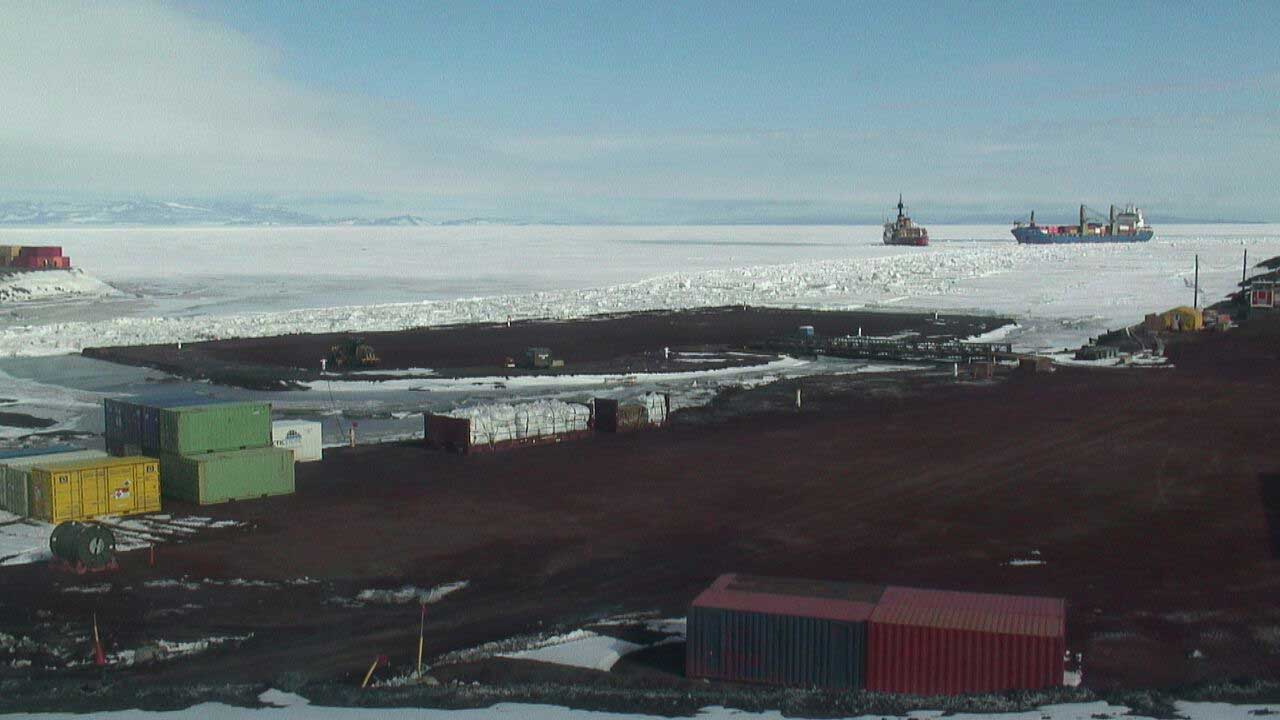
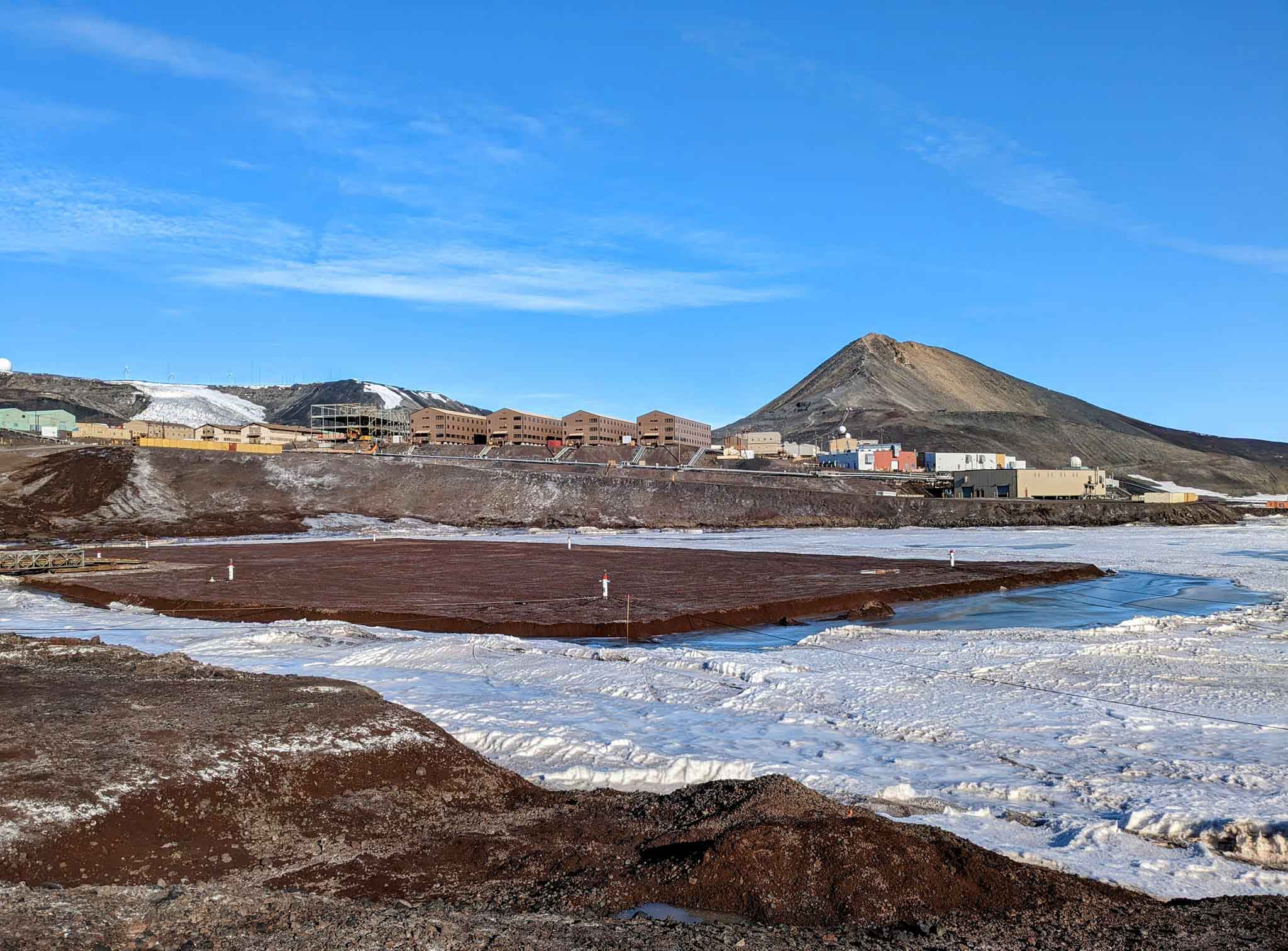
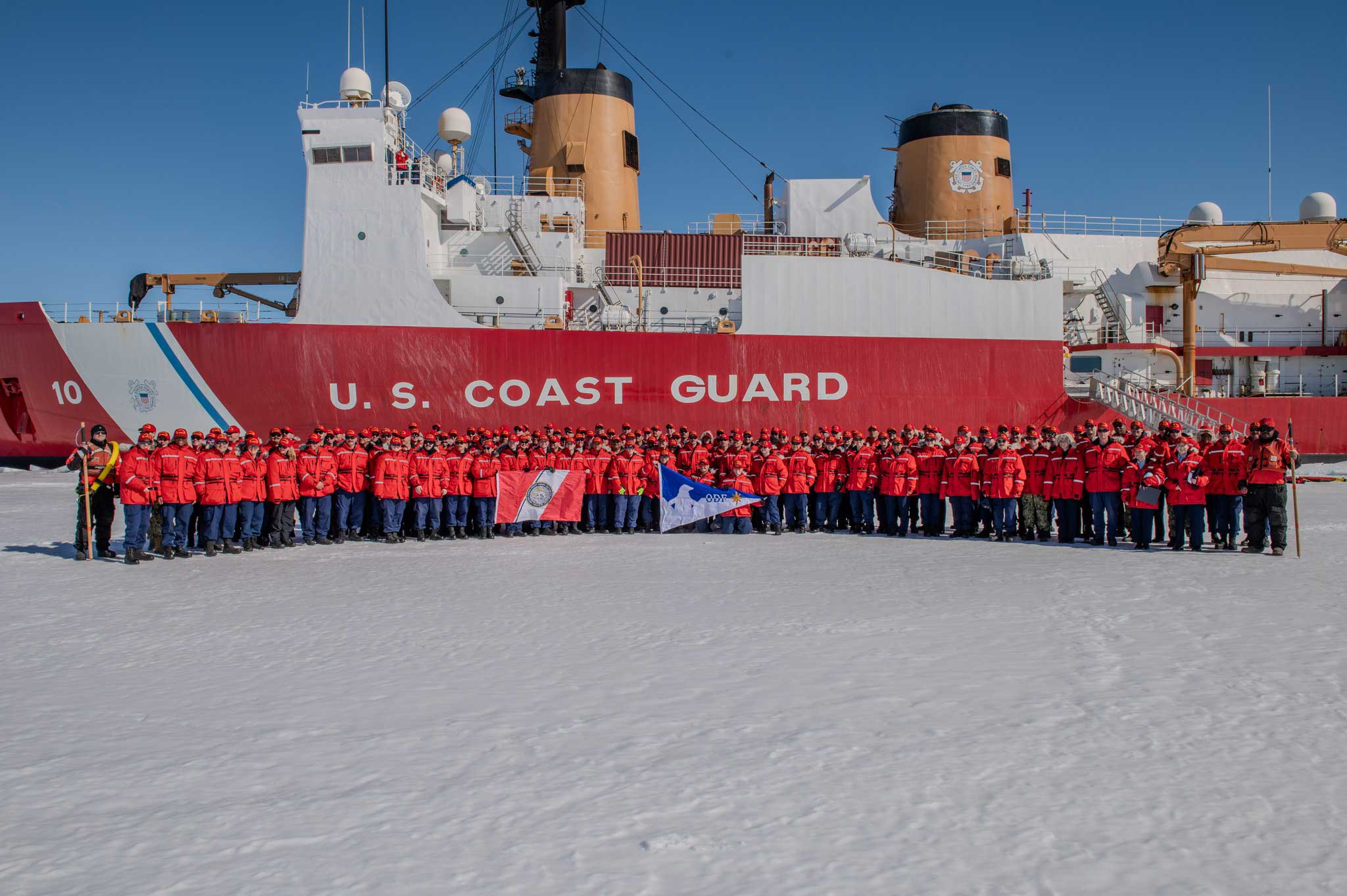
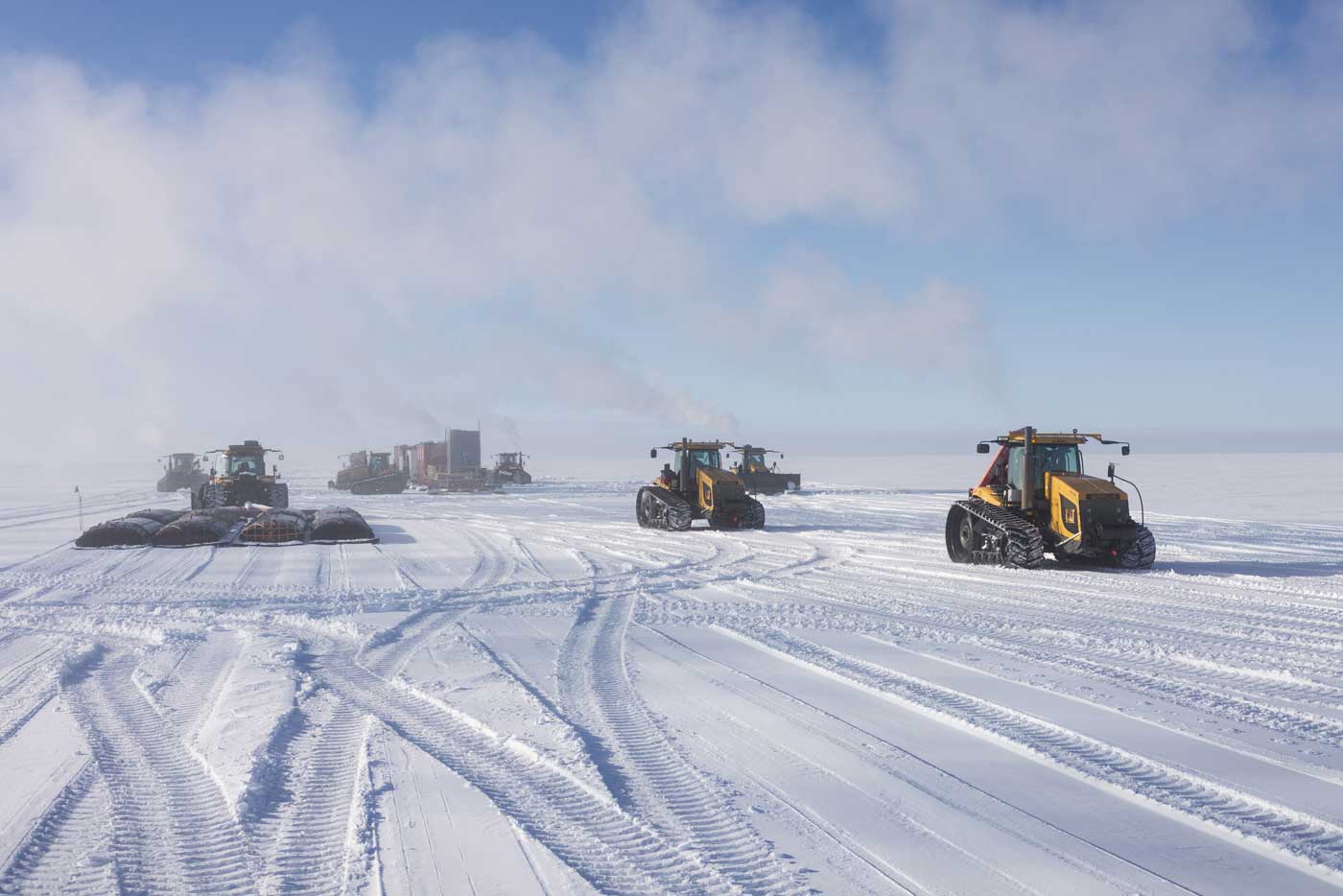
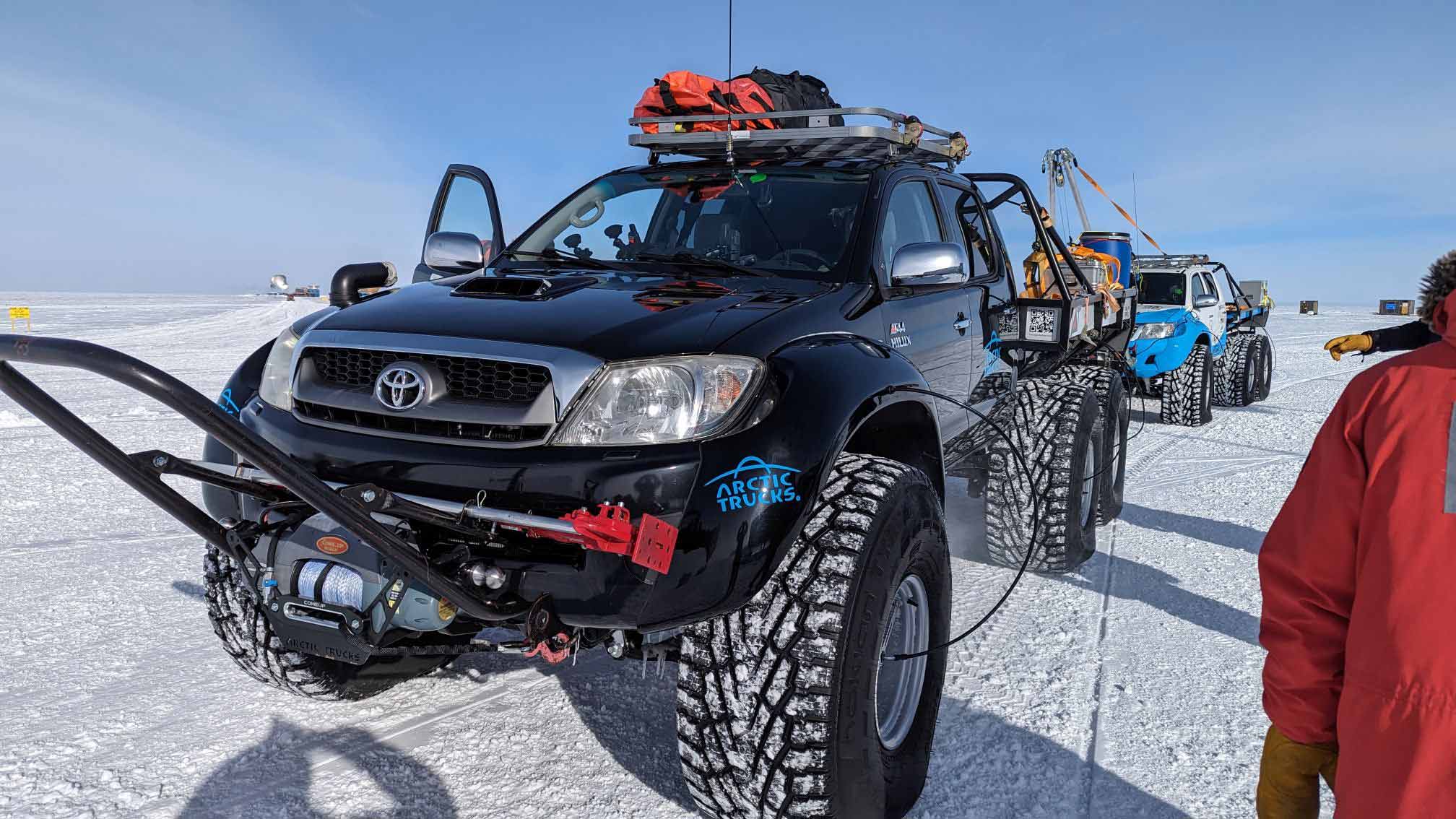

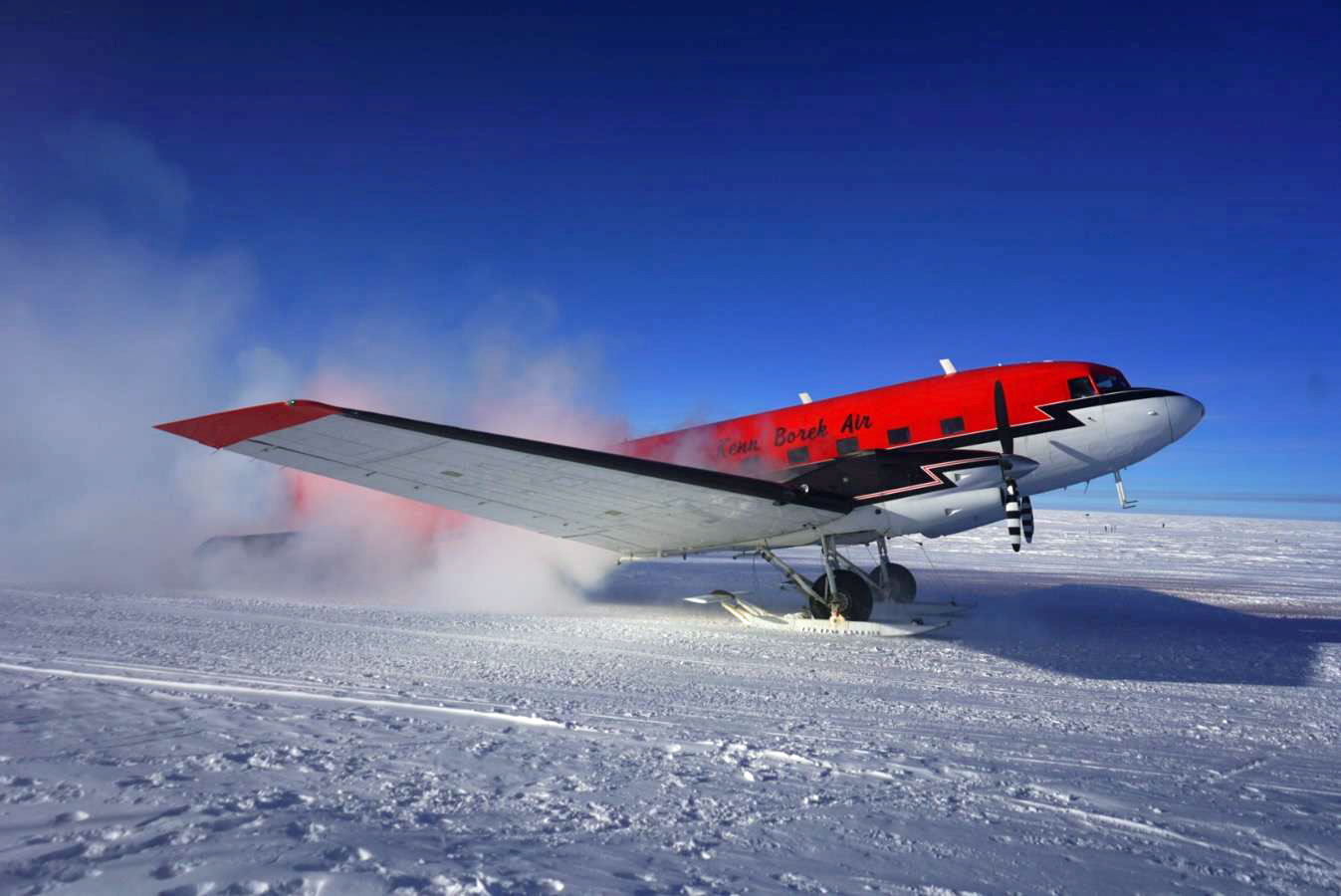
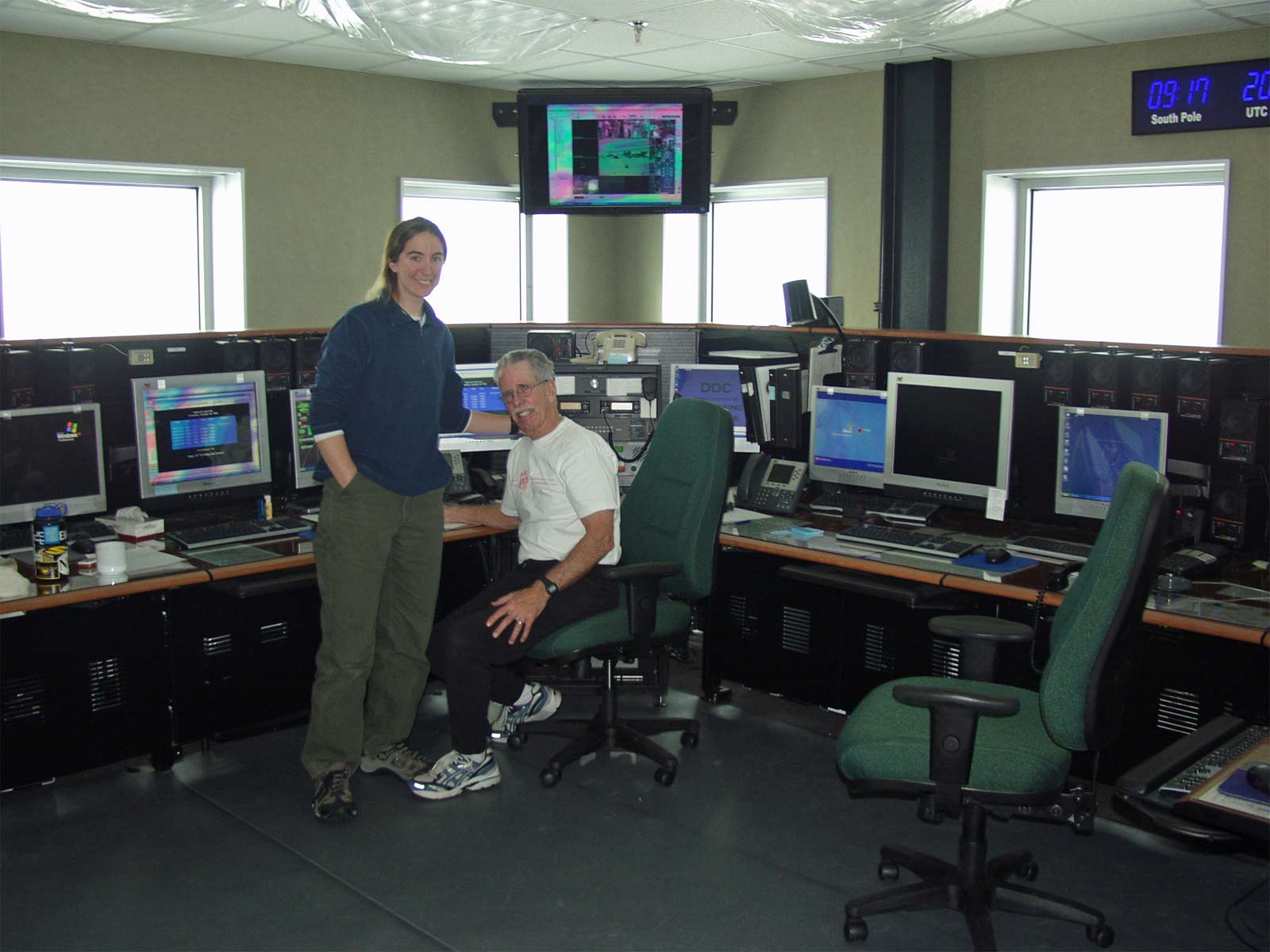
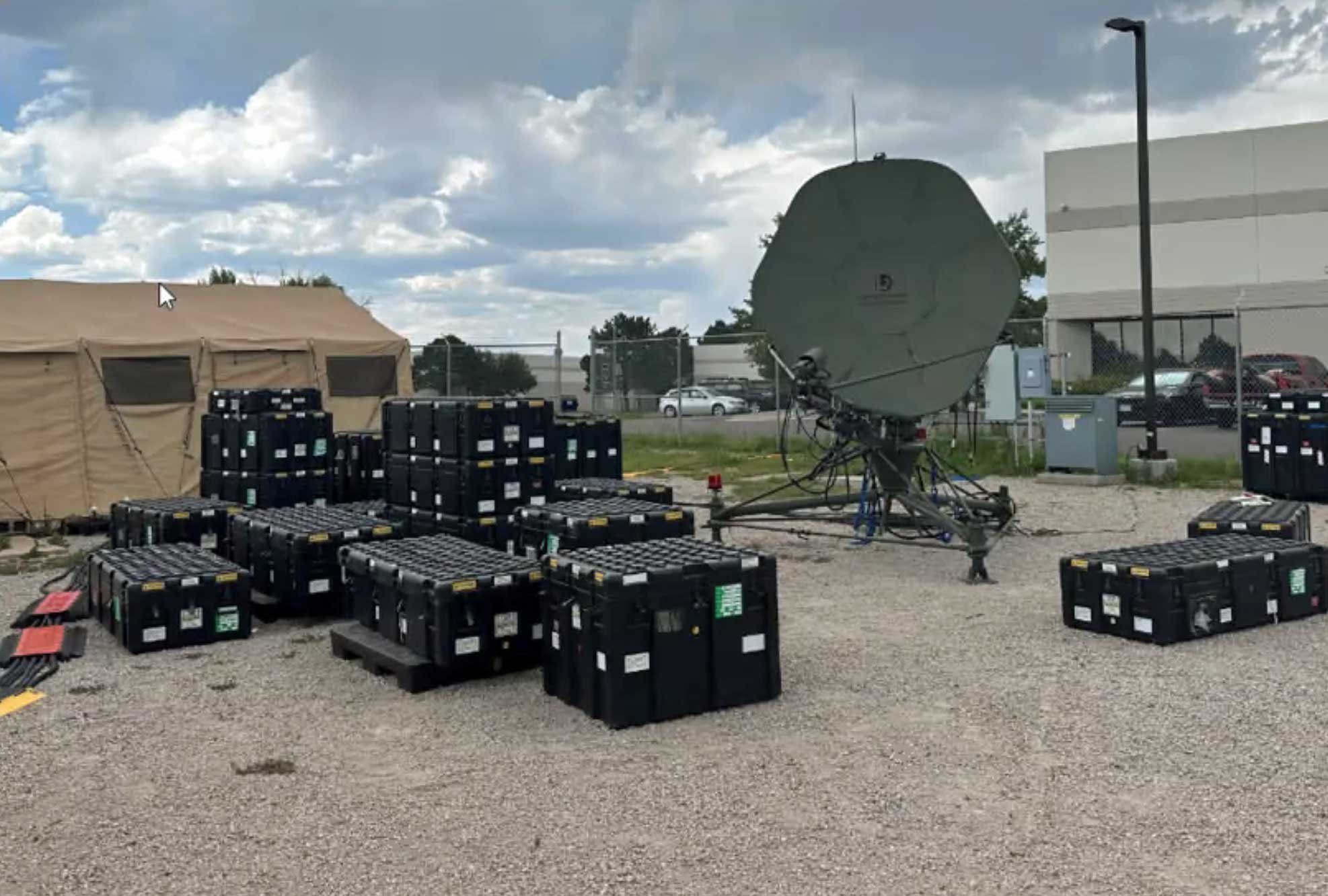
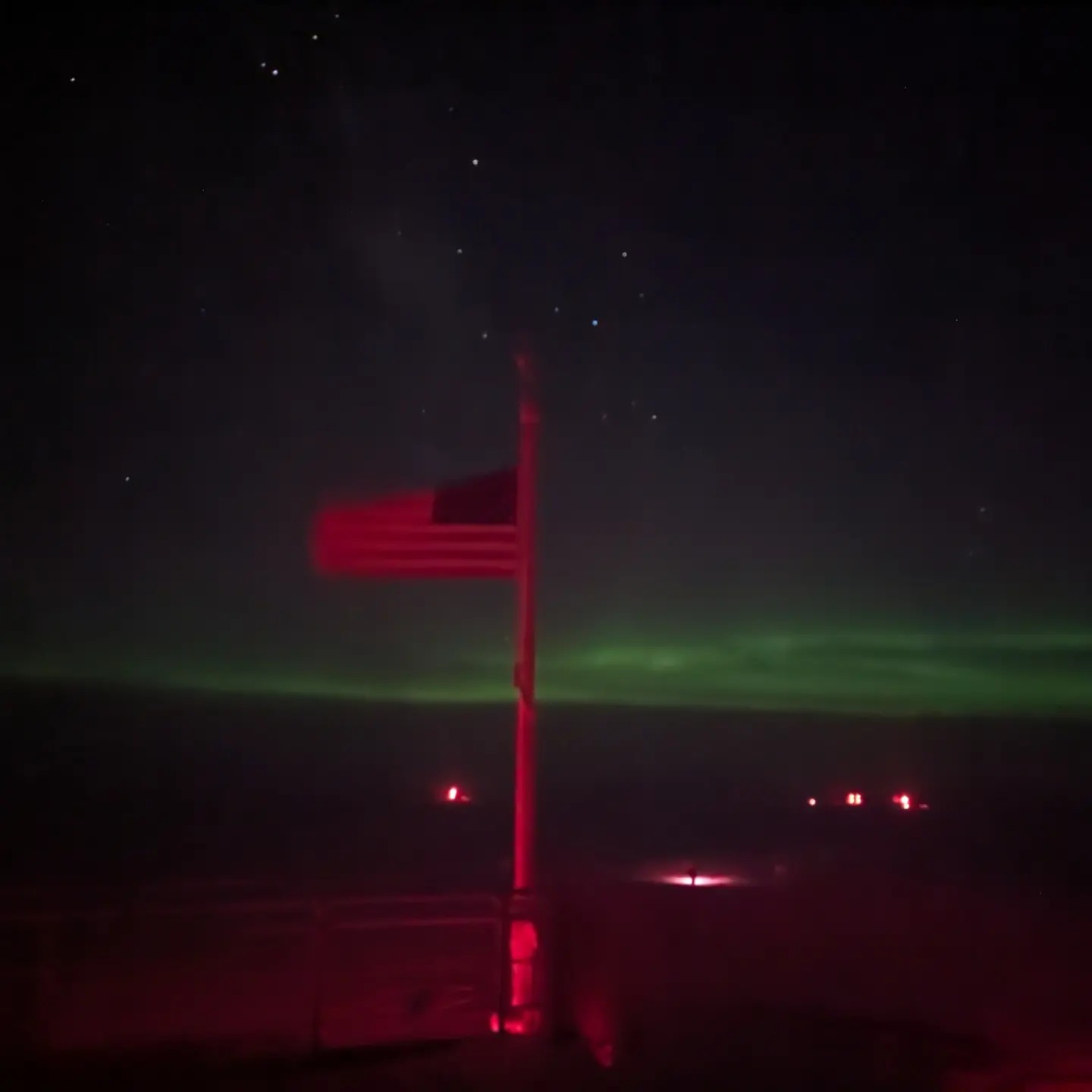
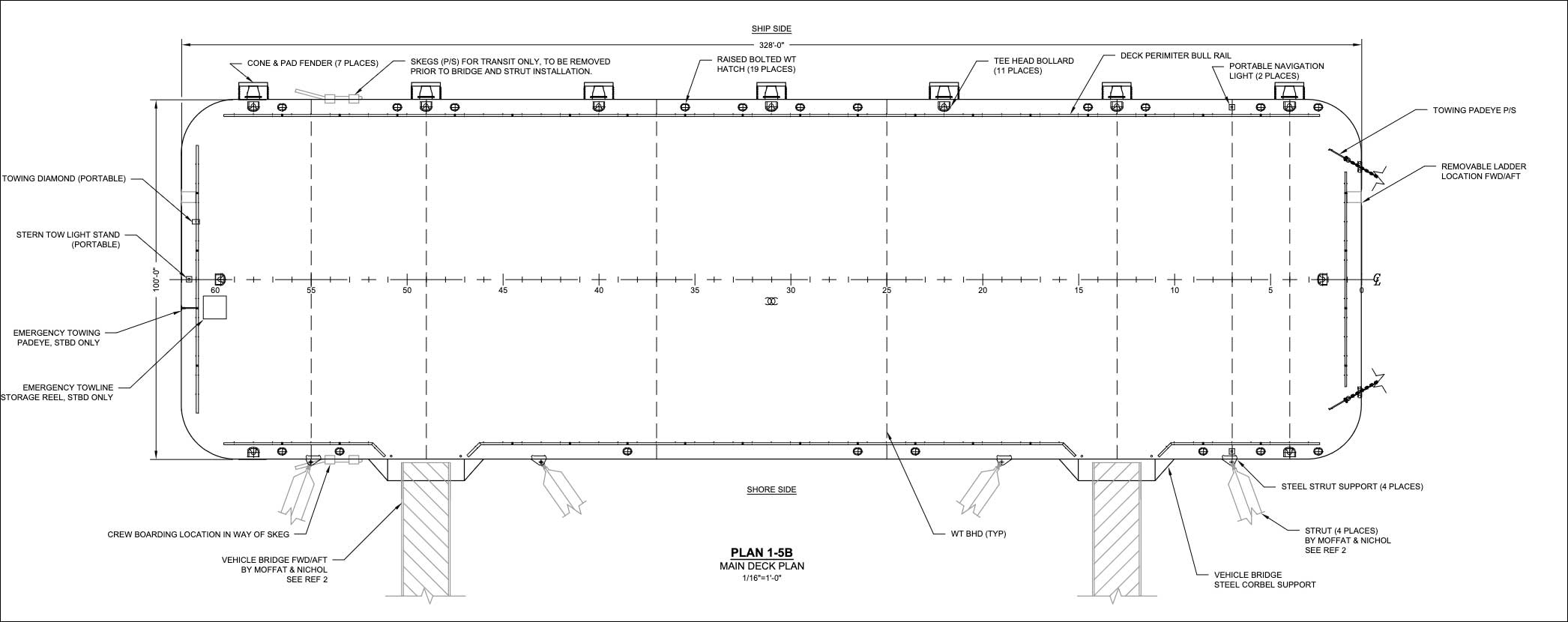
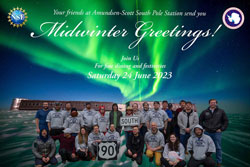

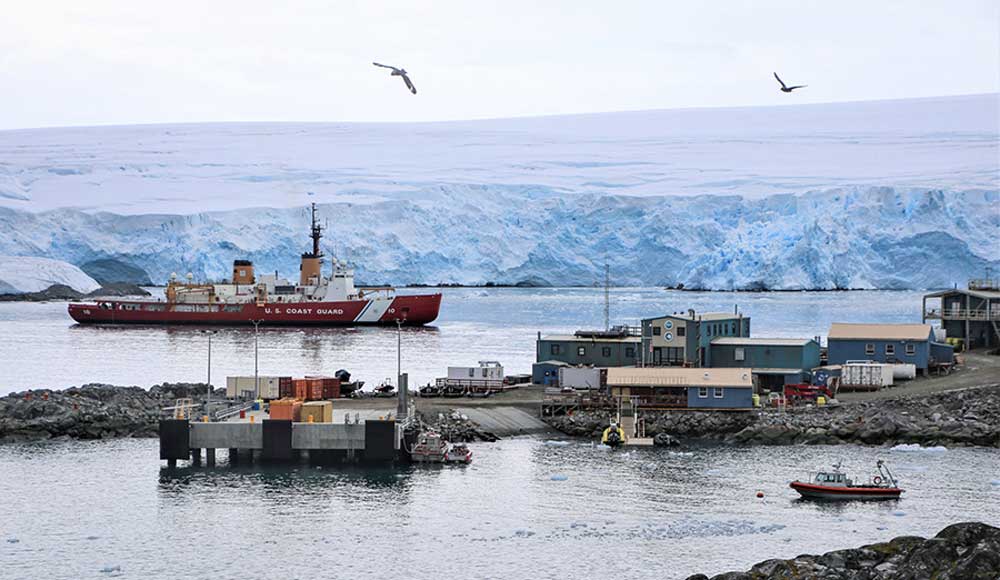
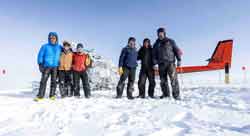
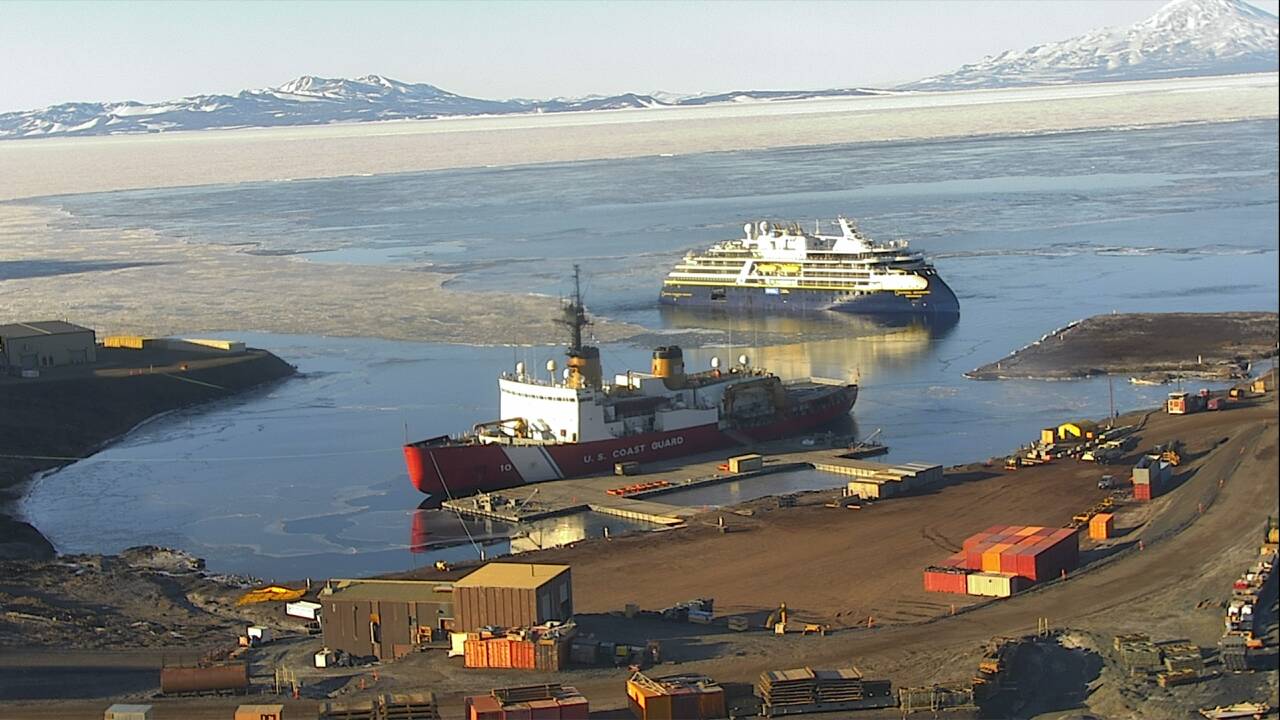
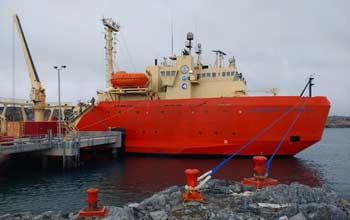
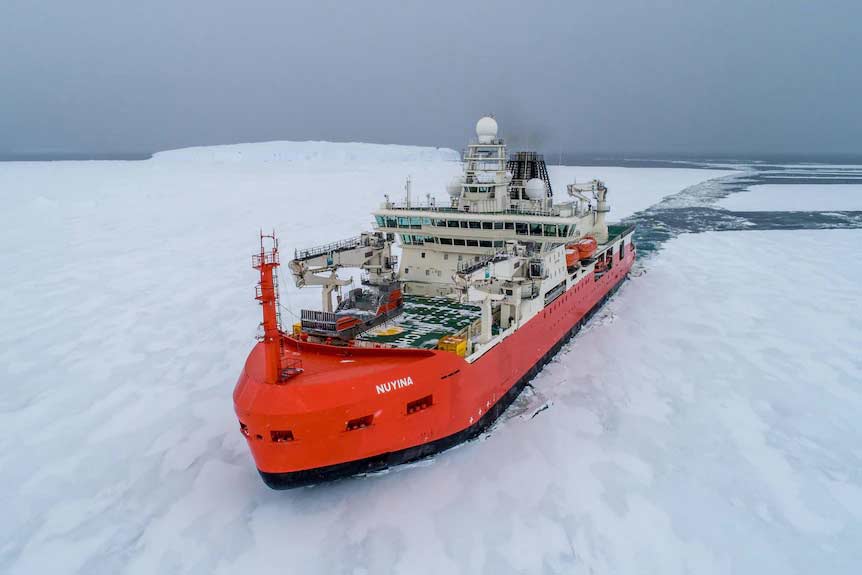
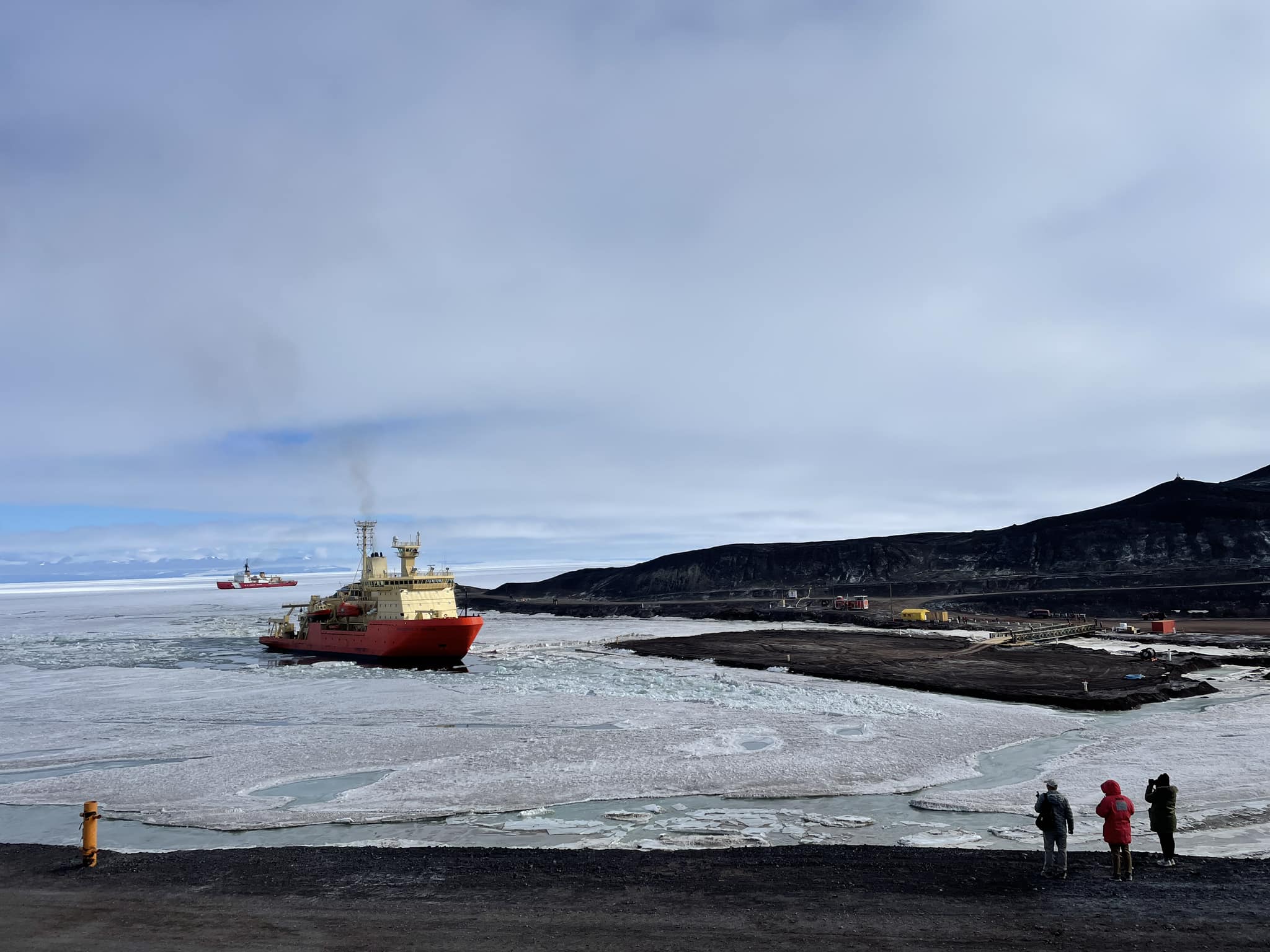

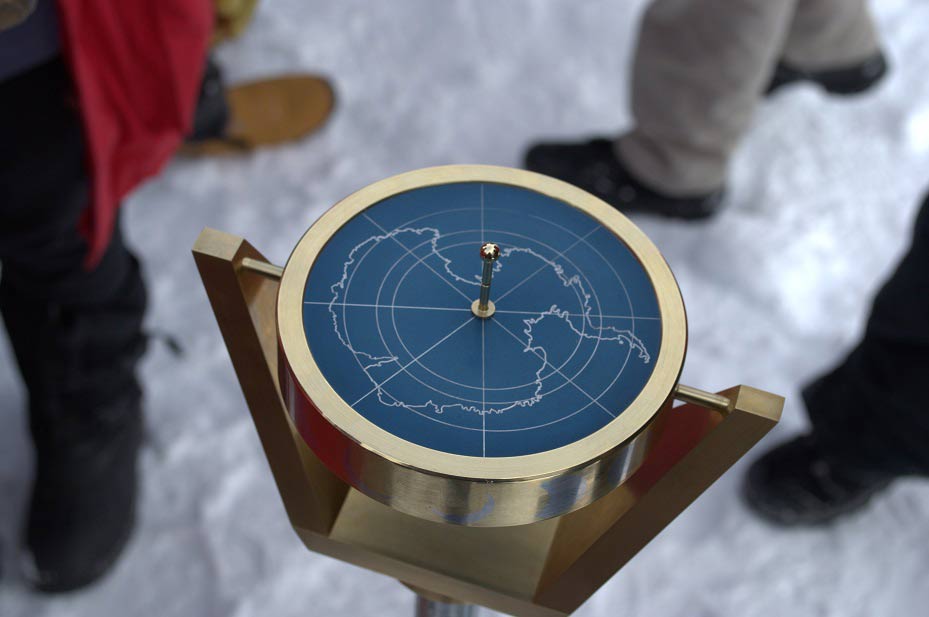
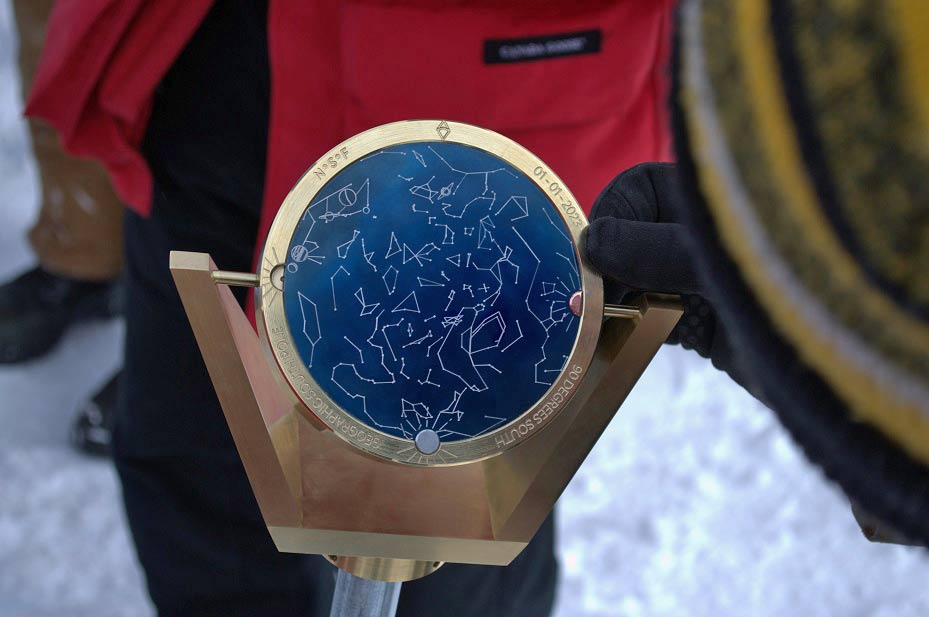
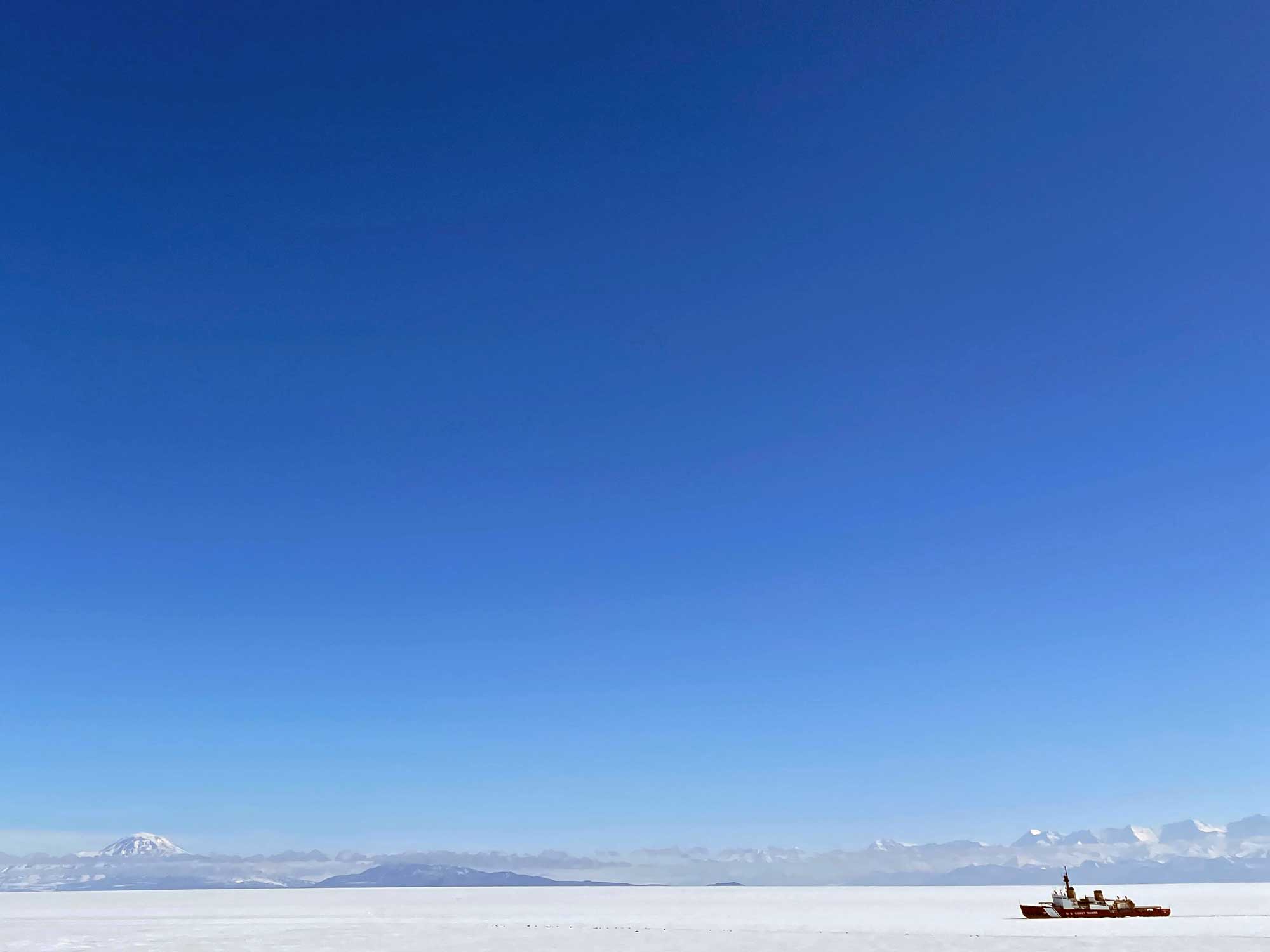
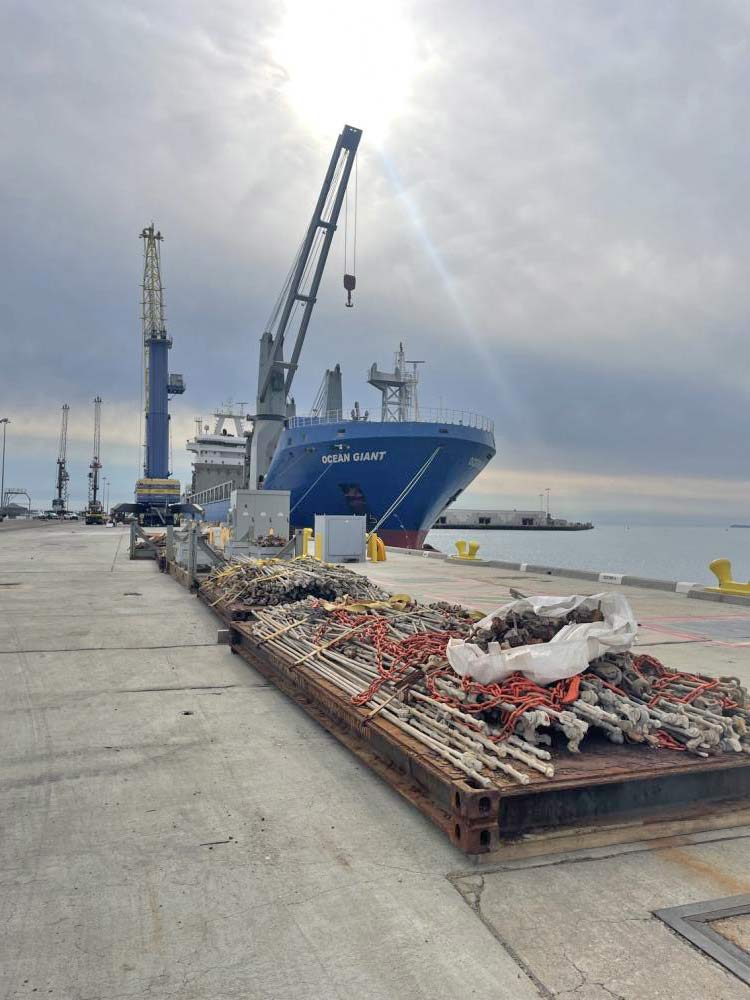
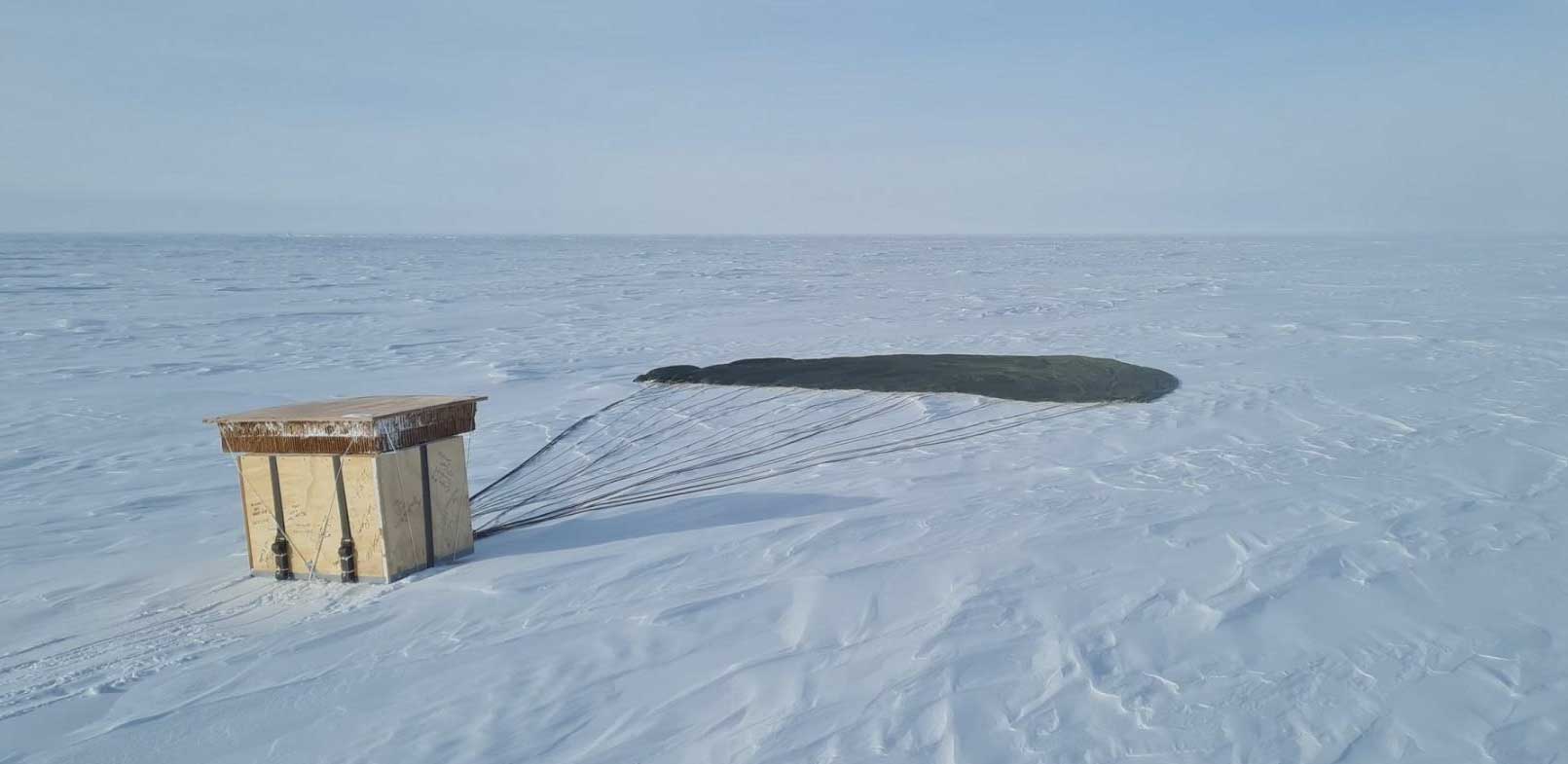
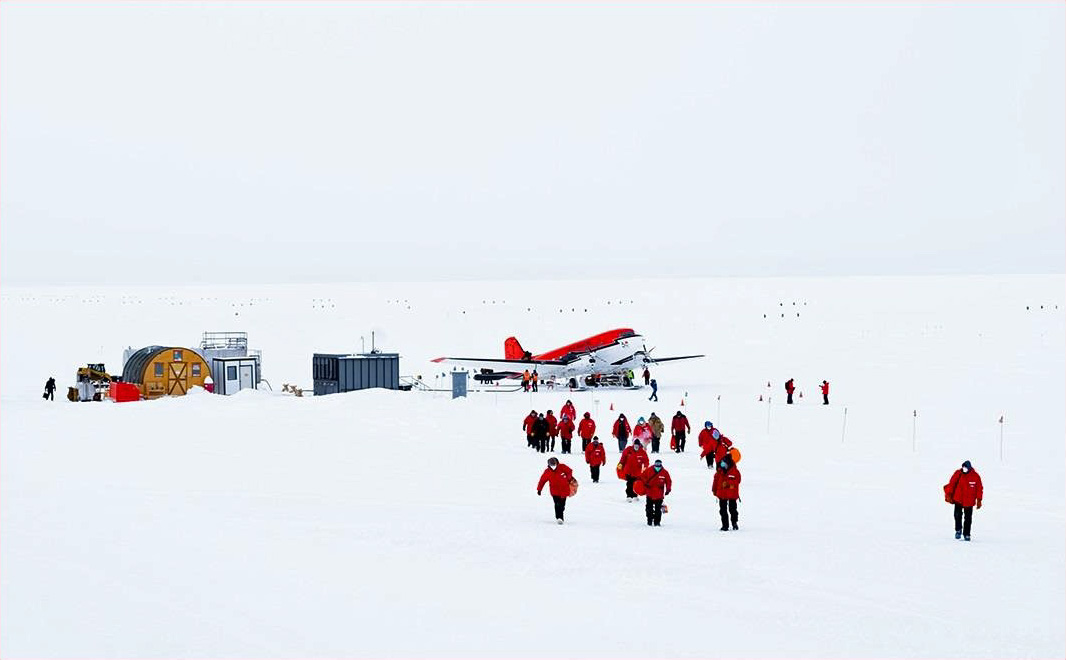




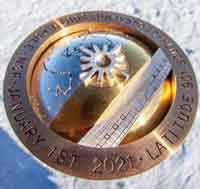
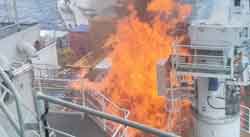


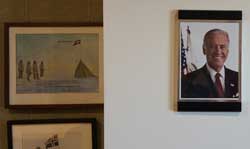


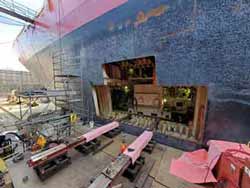


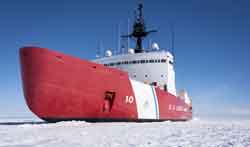




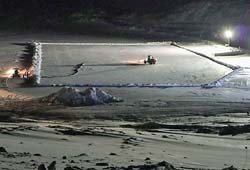

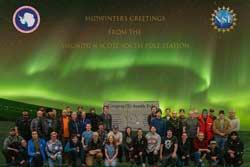





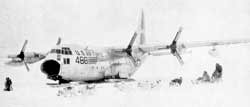


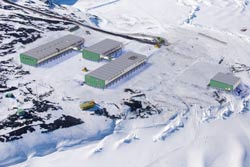





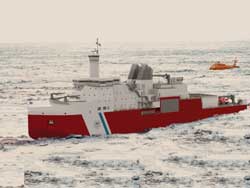


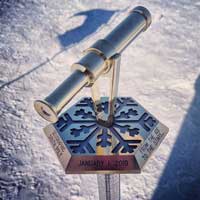




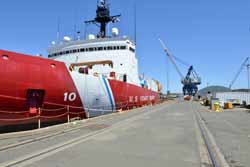
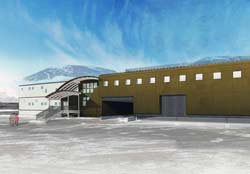
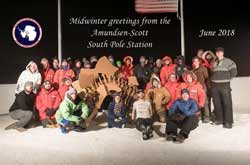
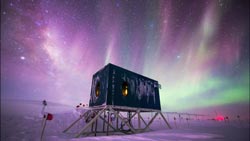


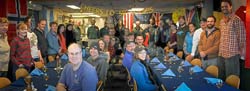
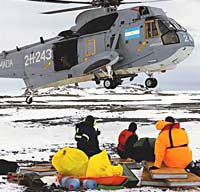


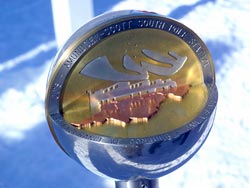


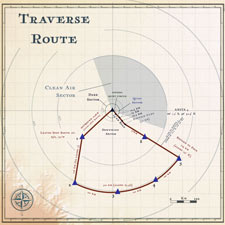










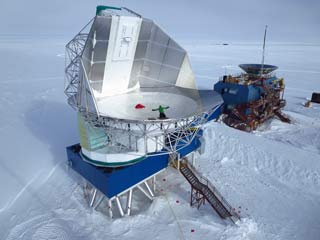
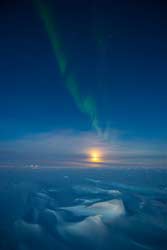



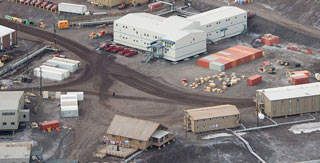

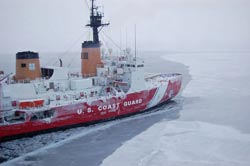
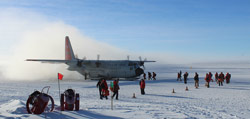

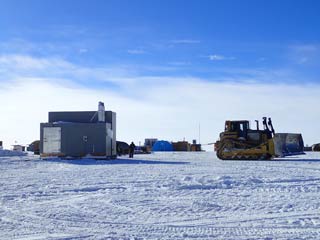


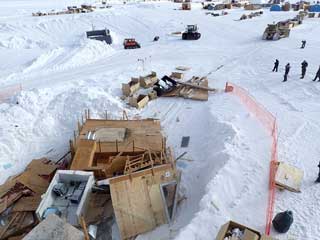
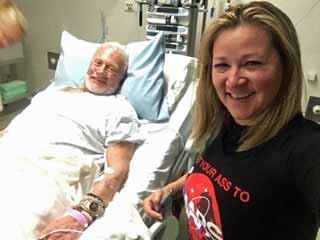
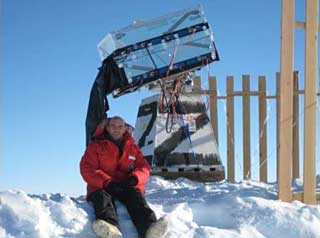


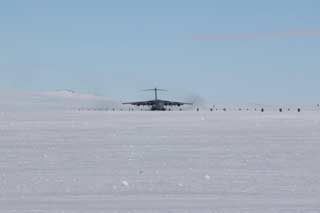


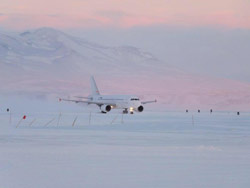
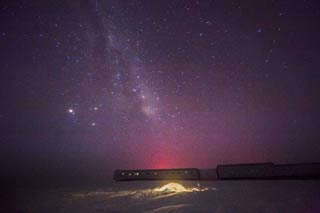
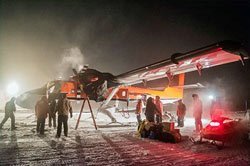



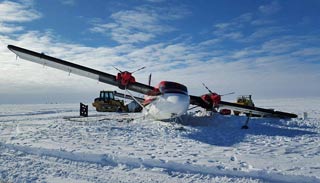

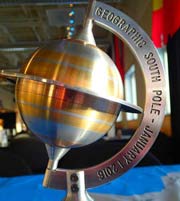
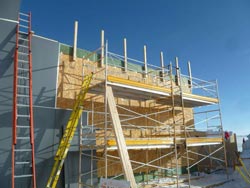





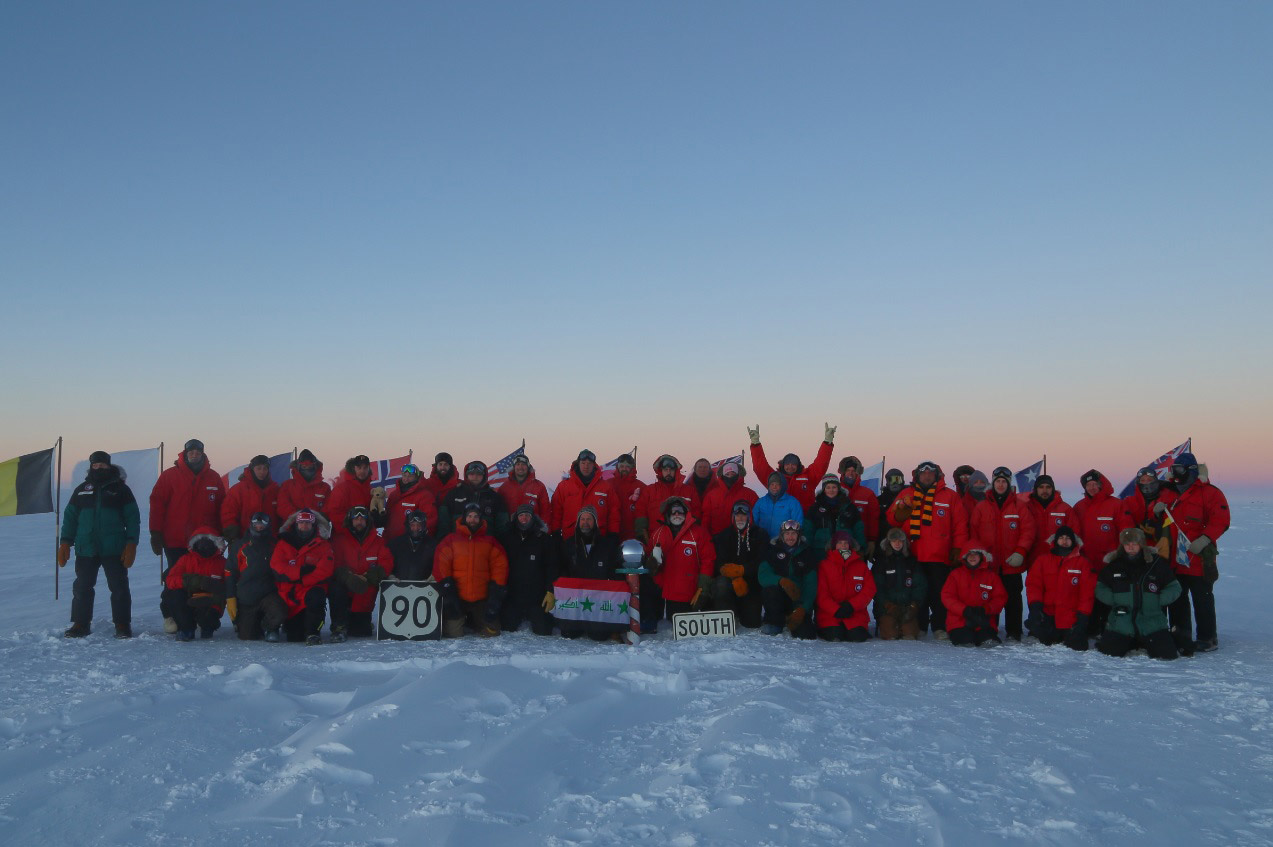




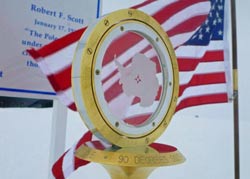


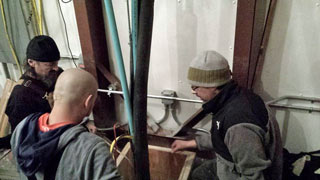


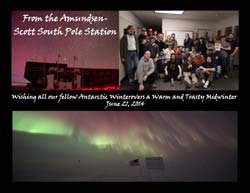
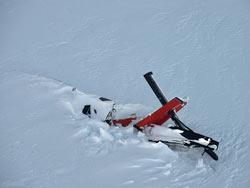
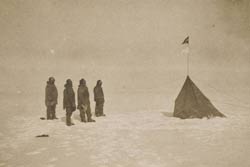


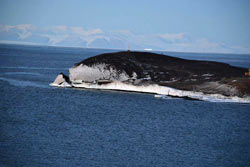
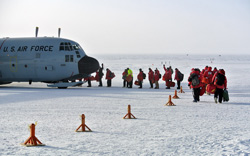

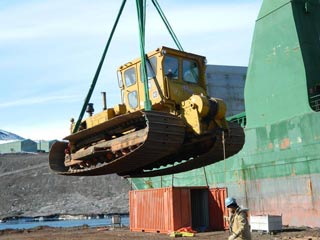





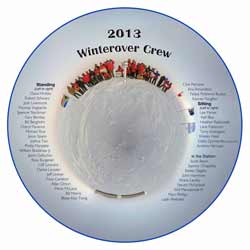


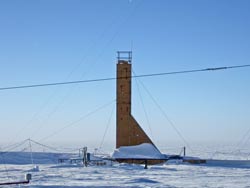




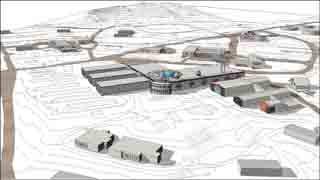


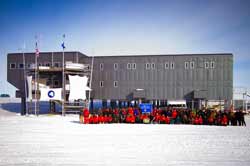
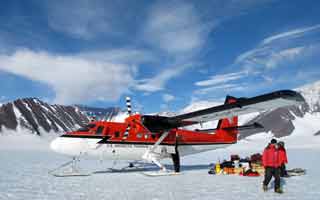
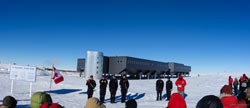


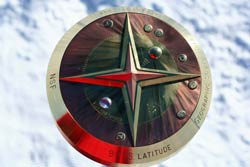
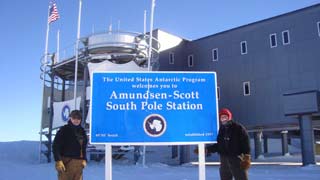





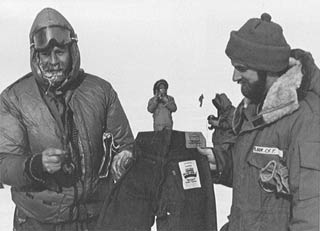


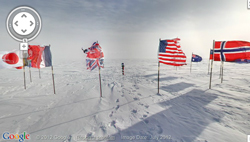

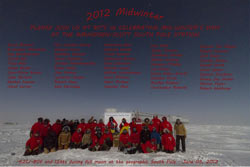
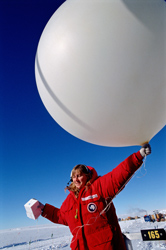


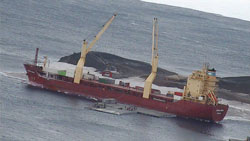

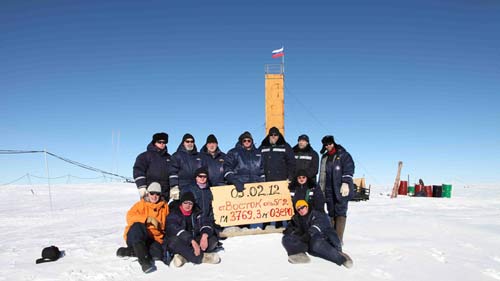



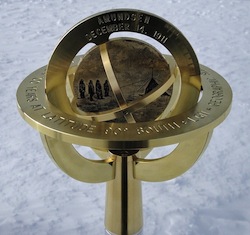


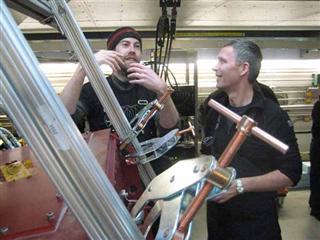
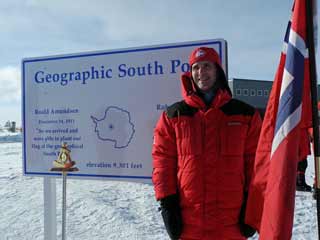

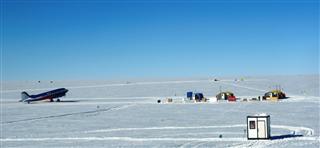
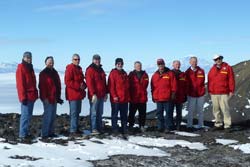
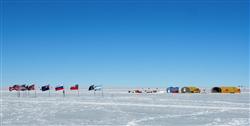

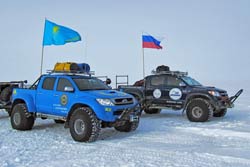



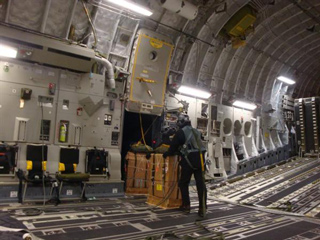

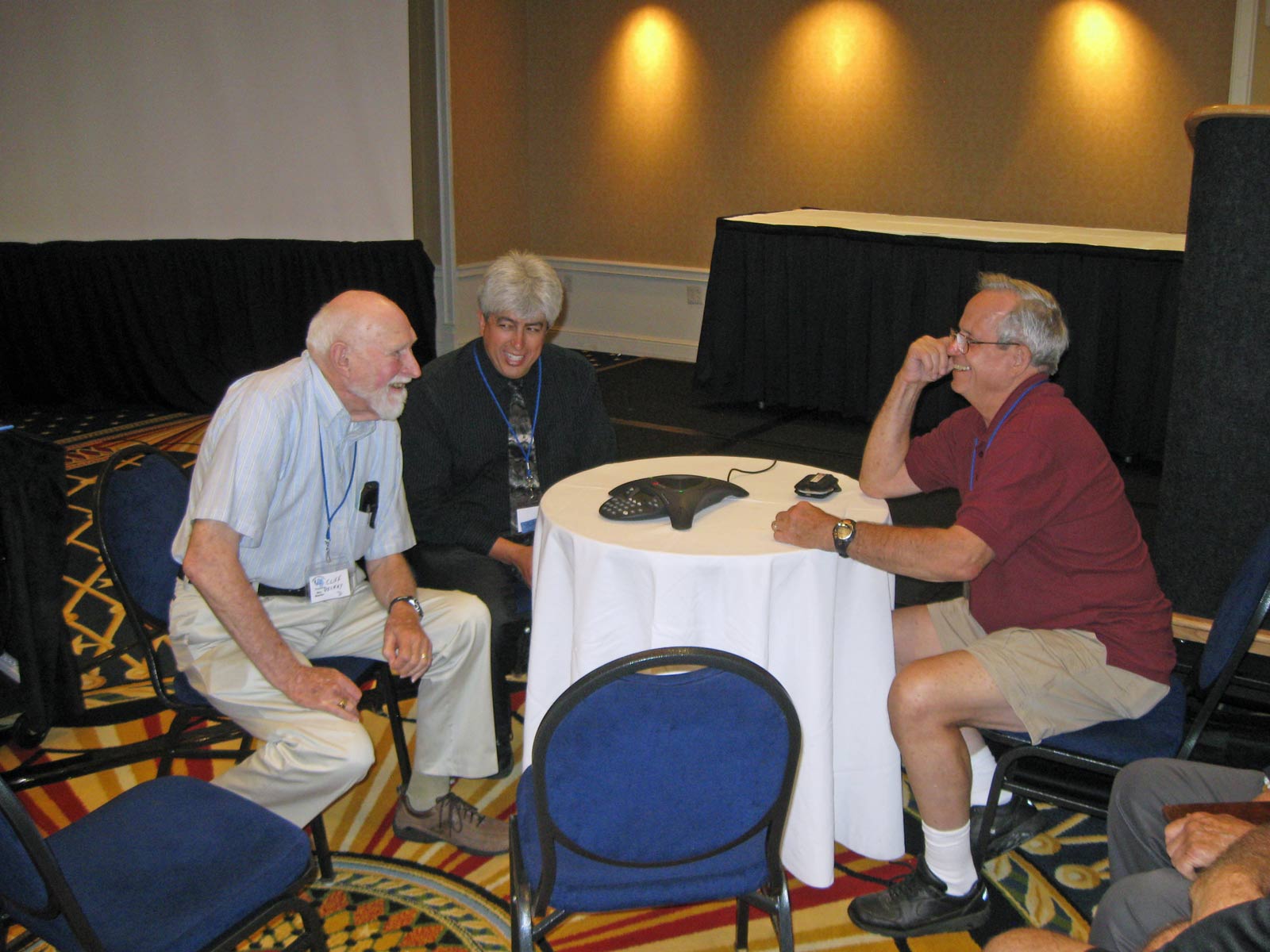


 (right, a composite view and more info)
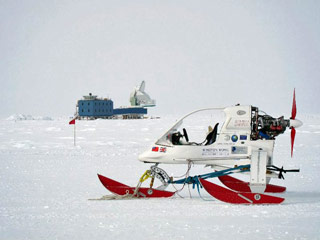
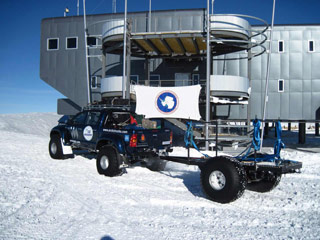


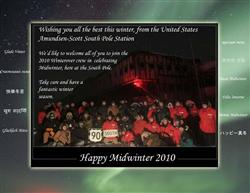


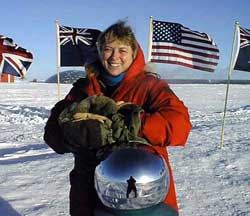


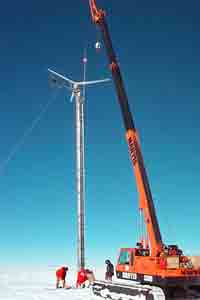


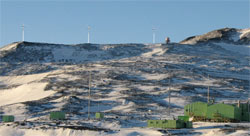

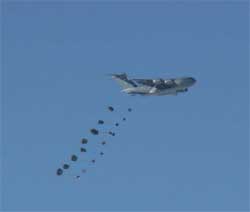 The AGAP South camp was initially established by USAP last summer, the AGAP North camp was being operated by the British Antarctic Survey (BAS) and the Australian Antarctic Division (AAD). A third "camp" was operated at Pole to serve as a site for high altitude acclimatization. The AGAP South camp received C-17 fuel airdrops. As of 20 December the North camp north of Dome A was set up, the first survey flights had been made by the specially equipped BAS Twin Otter. The team figured they were 15 days behind schedule, but they still completed about 50 survey flights, with the final ones on 10 January. They spent the following week demobilizing the camp before a scheduled departure date on the 17th. The AGAP North blogs are here from the


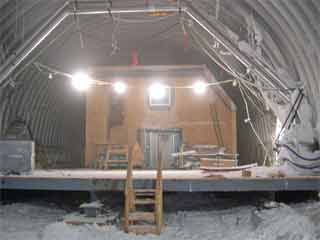




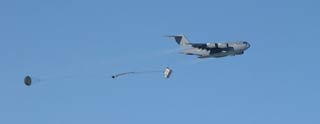


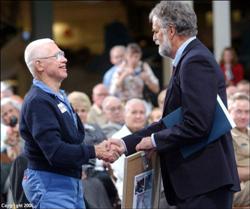 After over a week of delays, the first Hercs landed at Pole on 31 October 2006...the first flight was designated as the commemorative flight for the first landing at Pole 50 years earlier to the day, in 1956, by Navy VX-6 pilot Gus Shinn. The anniversary was marked in Gus's home town of Pensacola with a special meeting of the Gulf Coast members of the Old Antarctic Explorers Association...an event which was favorably covered by the Pensacola News-Journal. NSF rep Dave Bresnahan attended and presented Gus with a commemorative plaque (left, News-Journal photo).