Martin A. Pomerantz Observatory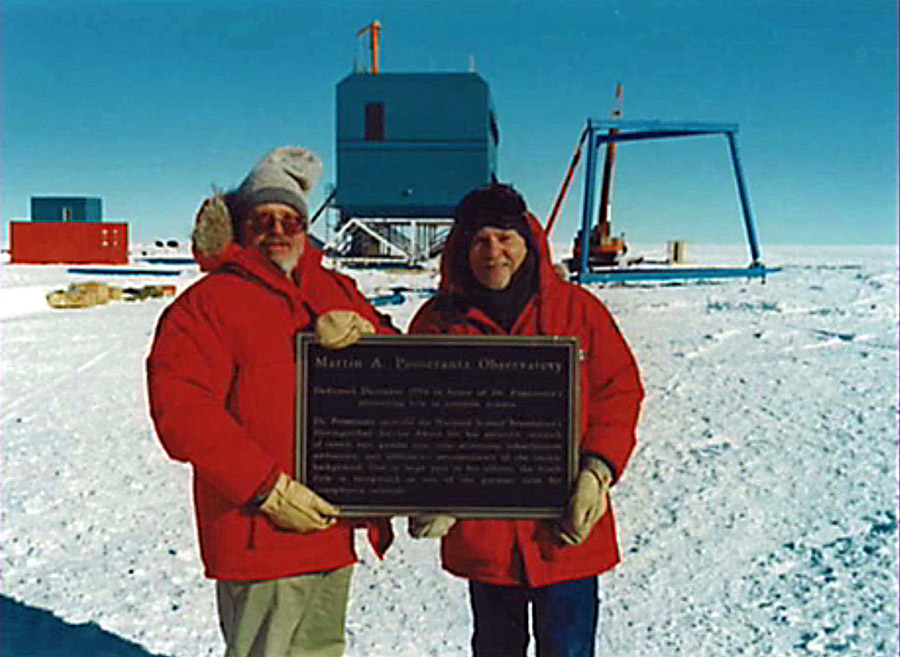 Above, NSF senior representative John Lynch (left) and Dr. Martin A. Pomerantz stand with the dedication plaque in front of the new building. Soon to be dubbed MAPO, this was the second of the four "blue buildings" to be erected and developed for science use at Pole (Jerry Marty photo). Below, the Antarctic Journal article: NSF dedicates Martin A. Pomerantz Observatory at South PoleAstrophysicist Martin A. Pomerantz has been honored in Antarctica with the dedication of an observatory bearing his name at the U.S. Amundsen-Scott South Pole Station. Pomerantz, who has worked in antarctic research since 1959 and conducted experiments at the South Pole since 1964, currently is involved in a helioseismology project to probe the Sun's interior. Now president-emeritus at the University of Delaware's Bartol Research Institute, Pomerantz has also led research in the fields of submillimeter astronomy, cosmic and gamma rays, and measurement of cosmic background radiation. Pomerantz came to Bartol in 1938 as a research assistant after receiving his A.B. from Syracuse University and M.S. from the University of Pennsylvania. He also holds a Ph.D. from Temple University, an Sc.D from Swarthmore, and an honorary doctorate from the University of Uppsala in Sweden. In addition to serving as a research fellow, professor, visiting professor, and lecturer both here and abroad, Pomerantz has led a number of National Geographic Expeditions; worked on eight national and international scientific committees; served on the board of trustees for the Franklin Institute; edited the Journal of the Franklin Institute; served on the editorial board for Space Science Reviews; and participated in five professional associations.
Construction of the observatory took less than a year. During the 1993-1994 austral summer, the observatory was framed up and closed in, and the interior work was completed during the 1994 winter. Located about 1 kilometer from the main South Pole Station, the observatory sits in a region known as the "dark sector," where electromagnetic noise, including light and radio waves, is minimized. Two nearby telescopes, SPIREX and PYTHON, can be controlled from inside the observatory. National Science Foundation Director Neal Lane conducted the ceremony to name the observatory on 3 December 1995 [sic.; the year was 1994]. The above article appeared in the Antarctic Journal of the United States, Volume XXX, 1995, published by the Office of Polar Programs, National Science Foundation, available here online (this individual article is not available separately. The photo of Marty at above left next to the nameplate plaque is from this National Solar Observatory historical (archive) page. Below is a closeup view of the plaque that I took in September 2005).   Dr. Pomerantz standing in front of one of his solar telescopes at "Pomerantz Land" (more information and image credit) An interesting historical juxtaposition--a bit of commentary by that Aussie Polie astrophysicist Rodney Marks, who made his first visit to Pole in 1994-95 from the University of New South Wales (UNSW). At the time among other things he was working on the infrared photometer/spectrometer (IRPS) experiment, an IR telescope measuring sky brightness. The project had been set up in AST/RO the previous summer, and he worked at moving it into what was then known as the AMANDA/CARA building. He happened to be on station up until the day BEFORE the official dedication. The guy would later winter twice and become famous for, well, here is what Rodney Marks had to say about the event and the time. |
