yes, I know it was on the common drive, but jon berry took this picture, click for info
[photo by Jon Berry, click for more!]

NEWS

street flyer

Yeah, I know...the sun set over a month ago. It is almost dark, or at least it was until last Friday when the full Moon popped up and makes things seem as bright as day again. Meanwhile, the logistics facility construction is ongoing, the South Pole Telescope is freshly greased and noiselessly scanning the cosmos...and after our monthly fire drill today (Thursday 24 April) we're getting ready for a big 2-day holiday weekend featuring another staging of that athletic event otherwise known as the BF5K...not to mention a plethora of live bands and solo performances in the South Pole Coliseum as it were. Hard to imagine that this place with 60 people could end up with so much musical talent--I'm psyched for it and I'll just be listening! Stop by if you're in the neighborhood, we'll leave the garage door open...no need for a designated driver, we have overnight accommodations. Here's the publicity release...


The sun is long gone...Friday 21 March was our big dinner celebration, although we still saw the sun for a few more days on and off and on. Maybe. So far the sunset party weekend we have had overcast skies and poor surface definition. Thursday morning 20 March I made the call that we had a "Stonehenge moment"--well, not really, but it seems that at let the sun shine in6 AM the sun shone directly in the window at the sun deck (directly above Destination Alpha (DA), the main station entrance) and a couple hundred feet straight down the main hall, so you could see your shadow in the doors at the other end. Hmmm, well, at left is my shadow on the doors to the beer can. And at right below is a photo I took of the sun from the same spot in the hallway, looking back towards DA. And here is a hero shot in the B3 hallway...remember I was playing hooky light o day from my morning treadmill run...

Not long after station close, there was a women-only sleepover at ARO. Well, I wasn't there, but thanks to Heidi Lim and Leah Webster's camera I do have documentation (below left) that we have a well-rounded population. At left below can be seen 11 out of 12 of the female population--From left: Katie, Deb, Calee, Heidi, Jane, Robin, Mandi, Amy, Leah, Terry, and Katie. Sue was absent--she had to go launch a weather balloon. Do check out Heidi's blog, she has been out and about on the station environs, with camera. Yes, we do have plenty of toilet paper for the winter, a highly qualified facilities engineer, and a well-trained trauma team...:)night away from home

The station was scheduled to close Friday the 15 February, but it happened a day earlier on the 14th, leaving 60 of us here, down from nearly 200 only a few days before that. Things are going well--Bill Spindler passed his "winter dental review" and finally moved back into the room he was in for the 2005 winter. With some familiar friendly next-door neighbors! In the first week after closing we had some warm (-20s F) temperatures, but now in the first week of March it is flirting with the -60s...

I must add a sad note here...former coworker and friend Mike Pavlak passed away at home on 23 January. Mike worked in the program for several years in the late 70s with H&N, and continued with it and its successor companies. He showed up at Pole to take over from me as the 1978 station manager. This page (at bottom left) includes a classic picture which includes both of us, taken while I was on R&R at McMurdo in January 1977, and here is a brief obituary (MS Word document) from the DMJMHN intranet site.

Well, the icebergs that plagued McMurdo Sound a couple years ago have gone bye bye (watch the icebergs)...but this year we had a new problem--heavy pack ice 500 miles north of McM, much worse than in recent years. The only icebreaker to show up this summer was the Swedish vessel Oden, which got to work after a science cruise from PA. Here's a planning document (1.5 MB pdf file) and a link to a PolarTrec blog on the venture. The science cruise departed from PA in late November, the beakers were sent to McM via helo on 7 January before the icebreaking duties began in earnest. Oden first made it to McM on 11 January, after finding much better ice conditions than in the past few years. Meanwhile, the cargo ship American Tern arrived at Lyttleton from PH on the on Friday the 25th as scheduled, and left a couple days later for the ice. But...the tanker was hung up at the pack ice edge, the Oden went up to help, putting the tanker Gianella arrival off until around Tuesday the 29th Offloading finished up and she left late on the 31st. The Tern showed at McM on 6 February and left around the 13th.

More on the heavy traverse season. ...the Norwegian-American scientific traverse--from Troll via Plateau Station (where they found the 1960-era USARP station intact--news article and diary entry) and the Pole of Inaccessibility (where they found that bust of Lenin)--was supposed to roll into Pole around 19 January, marking the end of the first phase of their 2-year project--a return trip from Troll. But...they ended up stranded after first one and then two of their four vehicles broke down, putting them 220 miles from Pole. First they requested USAP assistance, and accordingly the SP heavy traverse (which was heading back to McM) turned around and arrived back on station on 14 January. As things evolved, the project decided to winterize their equipment at their site, and a Basler was chartered from AL&E to fly the team and some of their equipment to Pole. The first 6 made it on the 20th, and the rest of them along with ice cores and other stuff made it on Monday the 21st. The group flew north to McM on Wednesday the 23rd.

The new station dedication happened on Saturday 12 January...the guest list was rather exclusive, and the on-station ceremonies were extensive. I do have lots of pictures, but since I'm rather busy doing other things at the moment :) for the moment I must recommend the NSF press release and the excellent Antarctic Sun coverage. An earlier story on this event came from the Aussie media. Meanwhile, the station has also been visited by the annual Congressional delegation.

The South Pole Traverse--yeah, that one, the one from McM--doing "trail maintenance"... rolled into the station on 8 January, after advance scout Bill McCormick wandered into the B3 lounge the night before and announced their presence. He was welcomed to Pole, and since he wasn't driving, he was handed a cold beer. The ITASE traverse--this year's venture from Byrd Glacier to Pole--showed up on the morning of Christmas Eve. Teacher Elke Bergholz has an excellent blog entry here. And a bit later there was a Chilean scientific traverse, which appeared to include some paying tourist members. Not unlike recent ISS (International Space Station) ventures. Hmmm.

if this is Friday it must be...many pax were asleep

This season has been an interesting one as far as aviation is concerned--starting with the "soft opening" using the Basler--something that was to be repeated at station close. Then on the morning of 7 December, TWO Twin Otters with 17 pax showed up from PH (left, photo from Thorsten Stezelberger). What did they do? Well, take pictures and visit the store, of course. And then there was that "mystery aircraft" that was flew over on 8 December without saying hello. But not without this picture (right) by Jill Fox, who was part of a campout and happened to have a camera at the right time. Well, it turned out to be that new Airbus A380...the full story is here thanks to help from the ExplorersWeb team. Oh, here's the complete Airbus press release and an ExplorersWeb followup.

And then the USAP-chartered Basler crashed on 20 December near Mt. Paterson, a West Antarctic field site 550 miles west of McMurdo, during a takeoff attempt after picking up the field party from the POLENET (Polar Earth Observing Network) project, that had just installed GPS units and seismic instruments at the site. Ten aboard-six team members and four crew, and no injuries (NSF press release), and Mitchell's blog with the full story and pics. This has put a crimp in the AGAP project as well as that oft-threatened "soft close". A team was sent in to repair the crashed plane; it was flown out via Rothera.

aw, chuteAnd then there was the C17 airdrop on 19 December. Unlike last year's event, this one, also one of those "proof of concept" things, made 4 passes, dropping about 20 pieces of cargo, in smaller pieces. Actually a great spectator event on a warm (-15°F with no wind) day (more pictures and info).

Oh, as for those NGA folks...the first group of "last degree" skiiers arrived on 15 December and got a tour of the place, including IceCube.

IceCube started its first hole of the season (#63) on Wednesday 5 December and completed it a couple days later. By mid-January they'd completed 16 holes, and they finished string deployment on the "stretch goal" 18th hole on 25 January, on schedule. They then moved and winterized the drill camp...the last of the summer folks went home on 13 February. Their goal for next season is 20 holes... And they completed all 28 of the planned IceTop tanks and associated cabling (it will still take a while for the water in the tanks to freeze). You can read their summer weekly reports here.

grammatically correct at last?Okay, while the domed station has been emptied of buildings over the past few years, a major exterior modification has begun...the station sign has been removed (right, photo from Lawrence-Berkeley IceCube driller Thorsten Stezelberger). This is the first phase of the removal of the Dome entrance, jacking of the former power plant (right) arch to match the elevation of the rest of the previously jacked arches, connecting them all together, and starting structural erection of the logistics facility in the old garage arch. Stay tuned...and follow along with my construction photos.

By now of course the station is fully open for business, but a bit earlier this month things were a bit dicey. The Today Show team from NBC made it to the ice, and while Ann Curry originally planned to go to Pole for a long visit, Mother Antarctica's weather didn't cooperate, so the team barely made it in for a brief triple-shuttle visit early on Friday 9 November. Those flights made it in late Thursday/early Friday giving most w/o's an opportunity to go north after a week's delay. Anyway, for the Ann Curry fans, here is a show website.

Hey, the all-new Antarctic Sun is up...thanks in part to editor (and 2004 Polie w/o) Peter Rejcek. The first issue (featured here) has coverage of what Andy Martinez has been doing with all of the old winterover pictures. Not to be missed!

The scheduled "official station opening" (first LC-130 flight) on Monday 29 October was cancelled--not for temps (it was a warm -45°F/-43°C) but for visibility. This plane was to bring a big summer crowd (plus more mail and baggage left behind by the Basler pax...) But, a second flight later in the day did show up. Along with more later in the week. At the end of that week things turned bad, on Saturday 3 November all 3 flights aborted...the one that actually made it to Pole (only to boomerang for low viz) ended up returning to Terra Nova!

Speaking of the weather, w/o Steffen Richter has created a great automagic weather page...bookmark this for up-to-date met info! And be sure to check out the other great panoramas and early-season aerial photos he's put up.

striped propellerOkay, the "soft opening" has gone down, with 5 of the 6 planned Basler flights. The first of these with new folks occurred on Thursday 18 October. In addition to 15 new faces and freshies, the aircraft also brought...flu shots (Heidi Lim). The Basler twin turbo had first landed at Pole Sunday 14 October (left, photo from Heidi) along with a Twin Otter. The Basler continued to McM and was to return to Pole Monday with the first 18 summer folks. And fly north with some w/o's. And repeat a few times. But bad weather in McM delayed the personnel changeout. It finally started on the 18th when 15 new people showed up and 2 left. The second Basler flight came the next day. The third didn't happen until 24 November. [Until now the earliest first flight was the 16 October 1999 LC-130 that came in to pick up Jerri Nielsen. But they didn't call that the "opening flight" either.]

What is a Basler? Basically a completely modified/rebuilt DC-3 (read, jack up the nameplate of a WWII DC-3 (or C-47, or R4-D or whatever) and rebuild and modify it). They've been to Pole before, here is more info on the previous visit and the aircraft. In any case, the plan is to get the population jacked up to 260 people by 5 November.

What will happen?? Well, the siding and "chamfer" project will continue, in an effort to save a few more BTUs and KWs as well as make the place look decent for THE DEDICATION OF THE NEW ELEVATED STATION scheduled for 12 January. With of course bunches of DVs scheduled in for a couple of double shuttles...not unlike the first station dedication was held at Pole in January 1975. Oh, yes, that means I must mention this bit of trivia: the actual first station dedication was held in early 1957 in MCMURDO, and the Polies didn't even find out about it until much later. Meanwhile, other construction activity will see erection of the base structure of the SPT ground shield, jacking of the last section of the arch (the old power plant section), removing the old Dome entrance and filling it in with arch connecting the old power plant and biomed arches, and beginning on the foundation work for the logistics facilities to be built inside this arch.

Update....the Norwegian-US Scientific Traverse is one of the more noteworthy International Polar Year (IPY) events. This is a 2-season international multidisciplinary return traverse, exploring the East Antarctic ice sheet, from the Norwegian Troll Station (where the team is now) to Pole. The first half happened in 2007-08, and it included a stop at the site of Plateau Station. Plateau was occupied for the 1966-1968 winters and featured a 30-meter met tower, similar to the one at Pole, although a late 80s event failed to find it. One of the participants is Colorado State researcher Glen Liston...who happens to be a 1983 winterover. Back then he was the maintenance mechanic. Their plans were to be at Plateau for 5-6 days drilling a 90m ice core. Well, it turns out they broke down a few miles away, but they still discovered the station only buried up to the roof...and the met tower. By the way, these folks have a great historic page about Plateau, with photos including one of that met tower. This traverse will also investigate some of those subglacial lakes which have become a big thing of late.

Would there there be a 300 Club in the 2007 winter? Well, no. Earlier this spring temps dropped briefly below -100°F a couple of times, but not long enough for anyone to gear up. Global warming?? Here's Heidi Lim's view of the scroll the first time the magic number popped up. So far in the 50+ years that folks have been at Pole, the only other winter that it didn't make it into 3 digits was 1964. And here were the dwindling odds that it might have happened (graph courtesy of the NOAA guys).

dome?moon over, uh, somewhereBefore the sun came up, in early September the cardboard came off the windows (left, photo from Laura Rip), and the visible astronomical displays are gone. But not before the 28 August lunar eclipse got watched by me in Nevada and documented by Robert Schwarz (right) at Pole (scroll down to August). Otherwise things have been rather quiet of late, in part because satellite antenna problems have cut back on internet visibility. You may have noticed (if you noticed the site of the midwinter picture) that the old garage/gym/bar whatever along with the power plant are no more. Winfly has happened, and MacTown is swarming with early summer folks, including one Nicholas Johnson, so surely McM is not a big dead place. As reported there, the Tax Court has ruled yet again that American USAP folks have to pay taxes. Lots more folks got caught, you can read their unsuccessful strategies here (search this page with your browser for "Antarctica"). The moral is, don't try it.

Yes, happy Midwinters Day, whenever and wherever you are and may celebrate it. Nowadays this celebration is a huge event (well, based on the size of the winterover crew vs the old days) and you now can check out the extensive documentation of things on some of the winterover web sites. 30 years ago things were more modest, here is how we celebrated in 1977.

The third annual BF5K was held at the end of April, here's a link to Jason Stauch's blog entry on this ingenious event. Yes, I participated in the first version, and based on my lousy finishing time I should have worn a costume. Other serious runners and exercisers are somewhere on the way to MacTown (virtually) as the Race to McMurdo was underway again, hot and heavy, this documentation by Heidi Lim. I must confess that I made it to Mactown and almost back to Pole (Papa) 3 in the 2005 version. On the temporary facilities side, note that the smokers have found a temporary warm place to indulge, "the 2.0 Lounge" which has been parked outside of Destination Alpha for the winter. Those of you who were around back then (2000-01) will recognize this structure as the former "SPARCLE Palace" which is described and depicted here, then and now. Butt...all is not good news for smokers. It has recently been announced that as of 2010 there will no longer be any indoor smoking facilities at any USAP stations....

Tony Meunier, one of the 1974 USGS winterovers, recently revealed to me that his publication U.S. Geological Survey Scientific Activities in the Exploration of Antarctica: 1946-2006... is now available online here. This 15mb PDF document (which actually has a much longer title) documents all USGS events, visitors, winterers, cachets, etc., between Highjump and the present.

Northern hemisphere events of note...this boreal spring and summer...first was the American Polar Society symposium at the OSU Byrd Center in Columbus, OH, 25-27...the eclectic program features speakers from the IGY era (including Dick Bowers, builder of the IGY Pole Station) and folks addressing IPY and current concerns. I was there and it was great to get together with old Polie and other friends. Two weeks later in Corpus Christi, TX, the Antarctic Deep Freeze Association (ADFA) met on 8-11 May. This group is composed primarily of the folks who WERE THERE during IGY, unfortunately I didn't make that one, which featured a videoconference with Pole. And last but perhaps not least, we of the 1977 Pole Souls had our second reunion in Boulder, CO, 16-17 June. Unlike the first one in 2000, a few folks didn't make this time...one guy who won't is Alex Zaitsev, whose presence is a victim of the current poor USA-Russia relations, meaning he didn't get a visa in time, although he did visit some of us in August.

So what's with all this stuff about folks driving to Pole? No recent or hard detail on the team website, although this International Herald Tribune article is pretty good. The team has applied for the appropriate permits...the only thing is that they have to get their vehicles and alternative fuels to McMurdo in December, which is before the shipping season begins. Hmmm. This may incorporate the previously announced trip by Steve Wozniak, and they may be using Hummers...well, we will see. USAP did three round trips to Pole in the 2006-07 summer, according to some of the news articles.

The thirtieth Antarctic Treaty meeting in New Delhi happened 30 April through 11 May. Not a lot of newsmaking issues this time, but new management plans for both Pole and Palmer were addressed (more info below).

not a bright day

Sadly, yet another unfortunate news event--the tragic shooting of 32 people at Virginia Tech--prompted the lowering of the Dome flag to half mast on 19 March 2007. At right is a picture of this event...here are a couple more photos with additional information and credits.

going going

Yes, the dome demo crew has been back at work. After spending a bit of time gutting the old garage, they attacked the science building in earnest. At left, upper berthing is history, stacked up to ship back up north (Brien Barnett photo). By now (late April) they've finished with the old UB/science building structure, gone back out to the garage arch to wipe out the old garage/carp shop/gym except for the floor, and gone back into the dome to remove the old UB/science floor. Cold temps have hampered equipment operations...but the plan is next to remove the old garage floor next, followed by the old comms floor. After the food gets moved. Again.

it works!

Happy sunset...20 March is the official equinox date in most of the world, but as usual the sun was visible for a few more days. The station bid the daylight farewell with the sunset dinner on 24 March. Another one of those great events...here's a picture of the 11 women on station this winter. Preceding this was the official 1 March inauguration of the International Polar Year...a 24-month modern version of the IGY that spawned the reason for the original Pole Station and the first of what is now 51 winterover crews (NSF press release on IPY, which includes a link to the IPY launch webcast).

Yup...after a day's delay, the station closed with the final 3 flights on Sunday 18 February, leaving 54 souls-- All about the last day of flights was not uneventful...the story was well told by Brien Barnett here along with a video of the aircraft going away. The last week of summer included lots of last-minute work by the "soft close" SPT team. While they didn't get to stay quite as long as they'd planned, their efforts resulted in a successful first light on Jupiter on 16 February (Eurekalert and SPT group press releases, as well as the NSF press release with videos). The photo at right by Jeff McMahon shows ironworker Brian Hardin celebrating the successful installation. Meanwhile, the IceCube data acquisition team also frantically worked to get those new detectors up and running. The final tally on flight operations: there were 359 flights vs the planned 372...but since the aircraft cargo loads were higher than expected, more cargo and fuel was moved than had been planned. The last C-17 out of Mactown happened on Saturday 24 February, leaving behind only 119 w/o's there, the smallest crowd in years. And there is discussion that the program downsizing may continue next season...along with the continued stretching out of the completion of the MacTown power plant upgrade....as those ancient 399's that were supposed to go away by now are still chugging away.

polie trash on deck

On the waterfront...the shipping season is over. At left, the cargo ship American Tern is seen departing on 10 February; this unique view is from the wharf control tower. Here is what the Tern looked like full of cargo instead of garbage, when it showed up on 4 February (the Tern photos are all by McM w/o Tom Hamman). At right, the tanker Paul Buck, arrived on 31 January with help from the Polar Sea (Antarctic Sun photo by Peter Rejcek). In the background is the NSF research icebreaker N. B. Palmer which had docked earlier to swap out scientists and cargo...and then headed east to PA on a long science cruise. The Buck wasn't around long...after discharging nearly 7 million gallons of fuel, it departed to make way for the cargo ship.

recreational boating?

And at Pole, IceCube finished the season with 13 strings completed on 29 January, and firn hole #14 completed with the new firn drill. This year the drill camp (Seasonal Equipment Site/SES) was staged for the winter at the next drilling location rather than being towed back to the berms. And the permanent IceCube lab had its official dedication. And the SP Telescope is now assembled (at least the big pieces) in all its glory big dish (left, USAP photo library shot by Scot Jackson). Some of the SPT crew were to hang around past the official 17 February closing date for a "soft close" as late as the 23rd, but that didn't happen, they left on the 18th like everyone else. Late summer official Pole visitors included the design team, on site to sign off on new cryo and look at the SPT building...and on Friday 19 January, Helen Clark, PM of NZ showed up for a tour of the place.

view from the shuttle terminalIt was helicopter week! FOUR arrived on Sunday 7 January (photo at right by Cynthia Chiang). The two military-looking ones are Russian MI-8 helicopters on an official expedition led by Artur Chilingarov--yes, the guy who was involved in the Antonov-3T adventures earlier in this decade. Here's an Interfax press release. One of the pax gave Russian President Vladimir Putin a phone call from comms. Meanwhile, that Polar First helicopter team had been at Fowler (71°S-71°W) but since they had good weather then they headed on 1200 miles south via PH and showed up as well in two red Bell helos--the team has been accompanied by a backup 407 piloted by two Bell Helicopter employees. It is not that often that four aircraft park at Pole...the only other time I know of was on 16 November 1976...but those were fixed-wing aircraft.

breaking newsIn the past couple of years, the big icebergs threatened to disrupt the annual sea resupply. Not so this year. The Coast Guard's aging but still powerful Polar Sea is almost to McMurdo as of 4 January. And NSF arranged for more help. At left, the Swedish breaker Oden (photo by summer Polie NOAA researcher Andrew Seaman) is seen breaking ice. This vessel first did a science cruise (a Swedish/Chilean/NSF joint venture) departing PA on 12 December for the Ross Sea. Then somewhere west of Cape Evans, the science team was flown to Mactown by helo, and Oden began its icebreaking effort. Here is more info on this unique science cruise from PolarTREC, a new teachers-in-Antarctica program.

Christmas holidays brought the usual events--the Race Around the World...fancy dinner...HF radio caroling, and other stuff that can be only done during a 2 day weekend. Here's a good page of holiday photos and video from veteran IceCube guy Darryn Schneider. But the day after Christmas saw a strange power failure caused by some DDC problems which precipitated a glycol leak in the power plant...all is well now. Outside...the British RAF team called off their trip on Christmas Eve due to medical problems 101 miles from Pole, they were evacuated to PA by ALE. Meanwhile, 2 members of the 6-person "last-97-miles" trek (starting from Shackleton's furthest south) led by veterans Mike and Fiona Thornwill--including Mike--had food poisoning before leaving PA...Mike continued but the other group member had to cancel out. Meanwile, the 4-man Royal Navy team arrived on the 27th, and Hannah McKeand completed the fastest trek ever, 40 days, on the 29th. More NGA info, links and a photo or two below...

oops, I dropped somethingOnce upon a time before the ski-equipped LC-130 Hercules, all of the construction material for the original IGY station was airdropped by a large Air Force transport aircraft known as a C-124 Globemaster. Well, in a twist of history, NSF had the Air Force try it again on 20 December--a proof-of-concept airdrop using a C-17 Globemaster III (right)...it was a complete success...delivering around 70,000 lbs of, er, flour and similar dry food. Here's the full story with pictures (and video).

give a liftThe second week in December was a good one for IceCube...first, the visiting design team inspected the new permanent lab several times and finally granted conditional occupancy on 8 December. At left is a view of the place just before the last major construction task--installing the cable tray bridge from the east tower to the second floor of the lab (these photos from IceCube which published weekly reports with photos throuth the summer). The team immediately frantically started moving in equipment and pulling cables. Meanhile, the drillers completed the first hole of the season on 14 December, eventually there would be 13.

raise a legMeanwhile nearby at DSL, the South Pole Telescope (SPT) was put together by teams of scientists, ironworkers, electricians, and, well, lots of people. The RPSC folks erected the structure and did the heavy lifts (right), while the science team from Chicago assembled the telescope components. The mirror supports were put together inside a large but unheated tent. The summer team were rather prolific bloggers as well, here is the main team blog with links to others. With photos of course. The two SPT pics here were taken by Jerry Marty and Bill Johnson on 8 December (USAP photo library)

A bit of history renewed...since the days of the original IGY station (which we may know as Old Pole) ham radio has played an important part in communications with folks and family back home. Perhaps a bit less important now that Polies have IP phones in their rooms, but it is still around. And to mark the transition from the dome to the new elevated station we have a transition from the old dome QSL card to this fresh new one.

Some older items of interest (other old news is in the archive):

WIRED magazine has a feature article on Jerry Marty, Carlton Walker, and the station construction in the July 2002 issue. Read about the settlement problems...why the place wasn't considered fit for occupancy for the 2002 winter.

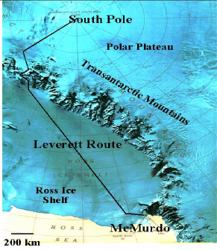
no way southPole land cargo traverses in the works...in October 2002 NSF flew a specially equipped D8 from Christchurch to McMurdo aboard a C17...this equipment was be used to prepare a road south towards the Leverett Glacier, eventually hopefully to Pole. This is to augment the LC-130 flights for station construction cargo as well as for ICE CUBE and forthcoming science projects. More information...

Another new science project...yet another telescope is planned, a 10-meter submillimeter telescope (up from 8 meters!) that will search for new galaxy clusters and study dark energy. Current plans are to attach it to the DSL (dark sector lab) University of Chicago press release. It will have a ground shield that is larger than the Dome (it is being built by Temcor, the same company that built the dome...).

On 8/13/02 NSF had a meeting with potential contractors and suppliers for a possible fiber optic cable to Dome C. Yes, you read that right (news article). Since Pole is way below the horizon for the commercial geosynchronous satellites, one option is to run a cable about 1050 miles to the newly constructed French/Italian Concordia Station at Dome C. (This station is scheduled for full-time occupancy next winter.) The project calls for several years of studies and trials, with the actual stuff involving traverses to get the cable to Pole and Dome C as well as along the route.

Back in mid March 2002 two other iceberg events happened. First, there was another piece of the Thwaites Ice Tongue (75°S-108°W) about 2100 square miles (NATICE which got designated B22. And then there was the collapse of another hunk of the Larsen ice shelf east of the Antarctic Peninsula. The Larsen Ice Shelf B disintegrated within the past couple of months, as evidenced by photos and animations from the NSIDC in Boulder, which also has links to other coverage. The BBC has an excellent article about both events.

Check out the amazing panorama of the inside of the dome by Marc Hellwig--seen here on Dana Hrubes' April 2001 page--warning it may make you dizzy!

The venerable New South Polar Times mailing list moved to a home on Yahoo, thanks to 2001 w/o science tech Andrea Grant. Join the discussion...

Why is one venerable structure (which I helped build out once upon a time) known as the Cheese Palace? Because it's the summer office of Jerry Marty, the NSF construction manager for the new station (and Wisconsin native and hardcore Green Bay Packers fan)... The Milwaukee Journal Sentinel sent a reporter on the ice, and the result is several detailed articles about Jerry, the construction project, and the station.

Pole area manager Katy Jensen posted diary entries from the 00-01 summer here.

The American Society of Civil Engineers has a major feature on the Pole construction in the December 2000 magazine, including articles by Frank Brier and Jerry Marty, and some (sorry, low rez) aerial photos, not to mention all of the gory details of foundation design, snow drift studies, etc.

Here is the link to my 1999 Doc Jerri medevac coverage. The spectacular April 2001 medevac flight to Pole is covered here. And my archive of other news, links to press releases, and older media coverage is here.

Other Antarctic news sites...

Thepoles.com is operated by Thomas and Tina Sjogren, the "Wearable" expedition folks that trekked to Pole in 2001-02. They are up to date on all the Pole NGA ventures as well as Vinson, Everest, the North Pole, and other similar attractions, and they have an excellent guide for planning your own stroll to Pole.

The 70 South News features Antarctic and related news from everywhere, updated daily by anyone, yes, you too.

The Spanish word of the day--yes, insulator foreman Richard "Chico" Perales was back at McMurdo providing a whimsical view of events on the ice for the 2003-04 summer. Archives are here.

The news page of the Antarctic Connection is updated at least twice weekly with current news from and about Antarctica.

The Antarctic Sun is now up in a new format for the 2007-08 austral summer, archives run back to 1996-97, the final year when the McMurdo newspaper was a Navy publication, the Antarctic Sun Times. Before then in the old days it went by other names....here is the story.

 NZ Antarctic Philately pages by Steven McLachlan . The news page features many current events, including many pictures from the various private expeditions at Pole this past summer. He also has information on the 99-00 cruises of the Polar Duke south of NZ in support of German and Italian science projects, 98-99 construction of the new base at Dome C...

The Australian Antarctic Division (AAD) published biweekly newsletters on NGA (private) expeditions, cruises and tourist events. Unfortunately this was discontinued in May 2003, but the archives are still available. They also feature a separate news page for the official Australian program.

The NSF Office of Polar Programs (OPP) page contains links and a search engine. Most recent press releases are also here, scroll to the bottom.

The rest of the story... can be read offline in the print newsletter of the Antarctican Society. Highly recommended, here's a recent Antarctic Sun article about how you can join up.

[top] | [home]

WEATHER 

The weather...How cold is it really? F or C? Real-time data is still out there in a few places if the satellites and automated weather stations (AWS's) are up. Try your luck, some of these sites might be working now. Unfortunately what all of these automated sites lack is, after all, the WEATHER! The new station has WINDOWS, unlike the old met office in the dome, but the met person still has to walk outside to see everything that is going on (met links updated October 2007).
NEW! A current Pole weather page complete with the sat photo, with thanks to Steffen Richter!
NEW! The BAS folks have a comprehensive met section with links to weather at Pole and other major stations.
NEW!From NOAA, current Pole weather!
from NOAA, various data is here, lots of newer stuff, but not the old weather plots.
from NOAA, detailed hourly data from 1975 to (update!) 2005 (FTP site)
from the NICO AWS 70 miles east of Pole (here's the graphical view).
HENRY, 70 miles north. Take your pick (graphical version).
[the "Clean Air" AWS at Pole was removed in January 2005]
Forecasts from the Weather Underground based on Pole data (best) and the NICO AWS.
Here's the Willy Field AWS near McMurdo (graphical view)
McMurdo weather (Weather Underground)
The Palmer (Bonaparte Point) AWS: text and graphical.
Palmer Station forecast from the Weather Underground
The sunlight/twilight charts for Pole (or anywhere), from 2004/06/08 AMANDA/IceCube w/o Ethan Dicks
The current time with a graphic view of the day-night terminator from space
The U. S. Naval Observatory has many calculators for sunrise/sunset, twilight, the moon, planets etc...
Peter Guest, meteorology professor at the Naval Postgraduate School in Monterey, CA, has an extensive page
of polar met resource links
...as well as information on his polar meteorology course


(here are links to the Antarctic Meteorological Research Center (AMRC, University of Wisconsin) data pages: home page and list of stations).

(Tricks: some wind speeds are given in meters per second. One m/s is about 3.6 km/hr, 2-1/4 mph, or 2 knots. Also, they may use a Julian date, this is the sequential number from starting from 1 through 365 or so. For example, 07031 is January 31, 2007.

Now about those satellites...
Pole basically uses 3 satellites that used to be geosynchronous...but since they are old the orbits have wobbled so the station can see them a few hours a day. MARISAT-F2, GOES-3 and TDRSS combined give a window of about 12 hours per day with an original theoretical 5 MBPS transfer speed. Yeah right. The RF building and MARISAT/GOES terminal 1 mile south of the station were first turned on in 2001, but it has suffered through cold weather problems off and on ever since. A radome was added in 2004-05, and there are future plans for a second terminal nearby. The system has allowed performance upgrades which have more than offset the continuing hardware problems--most recently in 2006-07 it was upgraded to provide ~60 MBPS. Most of the increased bandwidth goes to data transfer. In addition to the larger geosynchronous satellites there is, of course, Iridium, which is always available for official/emergency phone calls, and sometimes 24/7 email (for small emails <50k or so). Resources linked here:

The current link to satellite times and network information from the folks at Richmond (South Miami, formerly Malabar) (sorry, the other calculators have been taken down or moved behind firewalls).

a page from AMANDA with descriptions and photos of the current and historical satellites and their earth stations

an excellent June 2004 virtual tour of the RF building and antenna platform, complete with narrated video, featuring satcom tech Eyvind Flater, brought to you by NOAA tech Glen Kinoshita.
[top] | [home]  

SPORTS (?!)

Well, that big Antarctic sports event, the Antarctic Marathon (and half and ultra) happened this season at PH on 20-21 December, with 20 participants, including a wheelchair finisher and two runners that completed a 100k despite deteriorating weather. The winning 26.2 mile time was 4:42:32..You can do it next year for a mere $15,750 ex PA. And you can throw in a visit to Pole or Vinson at a discount. Lots of info including links to stories and video on previous events can be found here.

Not really a sports event, but they discuss such things, the thirtieth Antarctic Treaty Consultative Meeting took place in New Delhi between 30 April and 11 May 2007. All of the stuff discussed is now online here on the official site. In addition to all of the environmental stuff, they did pass a measure "protecting" Pole as a Specially Managed Area. Here is a link to the adopted measure and maps.

The complete list of 2007-08 (and later) ventures:
[For much better coverage, watch thepoles.com, run by Thomas and Tina Sjogren...or the individual expedition websites. Also note that all distances listed below are in statute miles (5,280 feet, 7/8 nautical miles or 1.6 km].
What may be happening in 2008-09 or later...
 
The Amundsen Omega 3 South Pole Race
is another upcoming competition (well, I do call this the "Sports" section) that is picking up interest. In the spirit perhaps of Kim Stanley Robinson's Antarctica we have a real life challenge announced for 2008-09, a 425-mile race staged south of Novo (south of what is left of the Filchner Ice Shelf,) in 3 legs, by 3-person teams. All equipment is provided, as well as some training events in the months before the race. Only £42,300 per person. This event was originally planned for 2002-2003, but this time it looks real, this is a freshly updated web site with news, schedules and sponsors. Oh, of course it will be filmed for a BBC series. Ahh, reality television...
Ben Fogle and James Cracknell
two Brits, are among the first to announce their participation in said Race. James is an Olympic gold medalist in rowing, and the pair came in first for pairs/third overall in the 2005-06 Atlantic Rowing Race, 2931 miles from the Canary Islands to Antigua. They're looking for a third, perhaps Leonardo DiCaprio. Or, if he refuses, actress Cameron Diaz. Hmmm.
Pôle Nord – Pôle Sud (French language site)
is Frenchman Charles Hedrich's next adventure, planned for 2009, when he hopes to leave the North Pole on skis in February and (after using various means of transport) arrive at our striped South Pole 10 months later. In 2007-08 Charles tried for a speed record to Pole but had to abandon the trip for medical reasons...
The Last Great Challenge
is the English businessman John Wilton-Davies' newly announced venture--a planned 2008-09 unsupported round trip from Hercules Inlet. John previously tried to reach Pole in 2006-07 but was delayed by weather and problems with a crevasse field, and had to abort his venture when the ALE airlift support season ended. This time he hopes to do the return trip in 77 days.

What was on in 2007-08...
 
Ronny Finsaas
set off from Pole on the afternoon of 20 January in an attempt to set a kiting record to PH. He made 190 miles in the first 2 days, and successfully made it to Hercules Inlet at midday on the 25th (SP times)--five days, or 60 hours of actual kiting, which included a record run of 312 miles in less than 24 hours. No website, but here is the thepoles.com article announcing his success. Ronny actually warmed up by starting at 87°S, 46°E (250 miles from Pole) between the 15th and 19th, with a rest day at Pole before the main venture.
South Pole 2007
...as a precursor to check out the course for the South Pole Race, Doug Stoup guided Brits James Fox and retired champion jockey Richard Dunwoody on an unsupported trek. They flew south from Cape Town to Novo on 29 November and then flew further southwest via DC-3 to the Herbert Mountains from where they started their trip on 1 December. James suffered from strain and altitude and was flown out on Christmas Day. Doug and Richard continued, as of 3 January they were at 86° 51' S. They reached the Pole late in the evening of the 18th, and were flown back to Novo. Here's a 26 October North Lake Tahoe (California) Bonanza article about Doug, who runs Truckee-based IceAxe Productions. And for some reason this page is still floating around. Hmmm. I wonder if Doug has found any more Hershey bars on this trip!
the Friluftsaktiviteter team
is leader Ine-Lillie Gabrielsen and Rita Glenne, two Norwegian women who planned a unique venture starting with a climb of Mt. Vinson, followed by an unsupported trip from the old Vinson base camp to Pole. Yes, a new route! They started from the base camp on 5 December; as of 16 January they were still 225 miles from Pole. But they made it on the 27th. Whew...ALE/ANI air support was supposed to end the 25th (Chilean time).
Vision South Pole (otherwise known as the Optical Express South Pole Challenge)
is doctor Cameron Hudson planning a 2007-08 venture in support of vision charities...the Cardiff (UK) eye researcher announced he'll participate in a 700-mile sledging trek as part of a group including guide John Huston (of Northwinds), Sumio Tsuzuki (who climbed Everest and Cho Oyu and starred in the Everest IMAX flick) and Peter Blaikie (age 70),starting at Hercules Inlet. Here is an early news article. The team left PA on 26 November, Peter decided to bag and was flown out on 8 December; they crossed 88°S on the 15th after shifting their schedule to 29-hour "days" in an effort to reach Pole before air support ended. They made it on 25 January.
The CANDU ANI Messner Route South Pole Expedition
started at the edge of the Ronne Ice Shelf and followed the route used by the 1989-90 Messner/Fuchs expedition. The resupplied group is led by guide Eric Philips (Icetrek) of Australia, along with Merete Gjertsen (Norway), George Szwender (Canada) (blog), Alison Levine (USA) (blog), and Bernice Notenboom (Netherlands) (blog). They reached their starting point on 5 December; as of 4 January they were 125 miles away from that reflective ball. Which they reached on the 14th.
Sibusiso Vilane and Alex Harris
are 2 South Africans who tried an unsupported/unassisted trek. They started from the inlet on 16 November, they passed 87° on 4 January and made it to Pole on the 18th to be the first to do so from their country.
The ANI South Pole Quest
ended up consisting of:
Expedition Antarctica--Swiss climber Evelyne Binsack's plan for an 18-month effort to reach Pole starting with a bicycle trip across parts of Africa and the Americas beginning in September 2006, and then try a ski trip from PH to Pole beginning in November 2007. Evelyne was the first Swiss woman to summit Everest, in 2001 (German/French language site only; more preliminary info in English here).
Adrian Hayes, a former British Army Special Forces officer who's lived in Dubai for the past 10 years, doing motivational speaking and selling Airbuses among other things. Anyway, after climbing Everest in 2006, he decided to hit the poles in 2007, starting with a 4-man expedition to the North Pole from Ward Hunt Island this boreal spring, followed by this trek to the South Pole. This Times of Oman article addresses both of Adrian's polar ventures. They started at Hercules Inlet on 12 November, and reached Pole on 28 December. This site has a detailed log with many photos; thepoles.com identified this as the "ANI South Pole Quest" guided by Canadian Devon McDiarmed. Other team members include Norwegian cross-country skier Hans Foss and Lebanese climber Max Chaya. Max has made it up Everest and done previous last-degree ventures to both poles.
Hvitserk South Pole expedition (Norwegian language site)
is a 7-person unsupported/unassisted Norwegian trek led by guide Bengt Egil Rotmo. The others are Jens Kristian, Ann Trude, Gro Mette, Bjørn, Truls and Lars. They reached their starting point on 12 November and reached Pole on New Years Day (SP time).
Beyond Endurance
originally planned a 2007-08 3-person Irish venture following Shackleton's original planned route across the continent from the Weddell Sea to McMurdo. That was scaled back to a 4-person supported Pole trip from Hercules Inlet. They had considered continuing going some distance past Pole, but this trek extension was cancelled. The team members included leader Pat Falvey (website), Dr. Clare O’Leary, Shaun Menzies (trip blog), and Jonathon Bradshaw (trip blog). This 3-year project included a trek across South Georgia in 2006 (and another planned one in 2008). The successful SG crossing was led by climber Pat Falvey, as was a boreal 2007 summer crossing of southern Greenland via DYE 2. They started from the inlet on 12 November. On 5 January they were at about 89° 20', they reached Pole early in the morning of 9 January SP time.
"Last Degree" ventures
included one from 89°S that started on 9 December, reaching Pole on the 16th. This one included Kevin Dempsey, Lance Ranger, Stefan Anders, and Armund Mussey, led by ALE guide Tim Hewette. This one is newsworthy because Kevin Dempsey continues to speculate about the station and the alien forces behind IceCube... :) Later, two separate "last 2 degree" groups were dropped off at 88° on about 10 January. They split up into 2 groups, one with Borge Ousland (guide): Nils Thomas Lien, Britt Thorstensen, Nicolas (Nick) Moga, Otto Kalvo, and Stephan Kucsko. The other was guided by Svante Strand: Adrian MacLaughlin, Andrew Pearce, Helen Turton, Rudi Jansen, and John Bourke. As of the 18th both groups were at 89 degrees. Borge's team made it to Pole on the 20th; Svante's group was flown to a point 8-1/2 miles from Pole, Borge went out to meet them as they came in. Yet another "last degree group" was the British venture Shackleton's Unfinished Journey which consisted of a group guided by vet Mike Thornewill and team co-leader Barry Harper, with Murray Howitt, Carolyn Aitchison, Deb Stevenson, Richard Durance, Lynsey Gawn, Dean (Woody) Woodcock, Jo Craig-Humphreys, and Mary ?. They were doing the "last 112 miles" that Shackleton didn't finish when he turned around at 88°23'S. They arrived at PH on 9 January, got flown to their starting point (well, latitude, not longitude) on the 11th, and made it to Pole on the 22nd.

What's off...cancelled, deferred, or forgotten...
 
Opération Pole Sud (French language site)
was Frenchman Charles Hedrich's solo attempt at a speed record from near the coast of Berkner Island, assisted by kites. He started on 2 December and made great speed for awhile--completing 350 miles through the 22nd, he had to abandon the trip due to a nagging urinary tract infection and fever. After waiting 5 days he was flown back to PH on the 27th. He's planning a new pole-to-pole 2009 venture...
Sub-Zero Antarctic Expedition
consists of Jason de Carteret (British) and Todd Carmichael (American) who are doing an unsupported unassisted trip from Hercules Inlet. They started on 28 November hoping to break the speed record of 40 days for this route. But Jason had suffered injuries during the first few days and was flown out on 5 December. Todd continued on until 23 December. Storms slowed his progress, and he decided to be picked up after pushing on to near 84°S. Todd is already planning a solo unassisted/unsupported try for next year.
Peter Valusiak
from Slovakia, had planned a solo crossing from Berkner Island to McM via Pole...which has been postponed until 2008. Not much that I can read on his Slovakian language web site, sorry.
Extreme South
is Robert Conway, a Type I diabetic who plans to be the first diabetic on insulin to reach Pole unsupported, and Toby Williams, another medical student from St. George's Hospital in SW London (a third team member, Doug Orr, backed out in 2006). Their trip to recreate part of the Scott/Shackleton route has been postponed until 2008-9 for financial reasons. By then they'll be doctors. They plan to use kites to help the otherwise unsupported trip from the top of the Beardmore to Pole and thence to Patriot Hills.
Icebird
is still planning their "kitesled" trip over a "new route," but they have been set back by the death of one of the original expedition members, Andrew McAuley, in a kayaking accident off the west coast of the South Island (NZ). They recently reworked their kitesled during a Norway trip, now they are trying to figure out how to finance their trip to a remote part of the continent, including provision for rescue. In the boreal 2008 summer they will venture along the shore ice of Hudson Bay.
Journey South 2007
was a planned 2007-08 four-man unsupported venture led by Briton Alex Hibbert, to be age 21 at the time of the expedition. Originally his plan was to be the youngest British person to reach the Pole and the youngest unsupported expedition leader. Later the plans were to do a new route from Halley to Pole. That was cancelled as well...latest plans are to do the North Pole in 2008.
South Pole Solo
is 24-year-old Mark Evison, from Dulwich (near London), he wanted to be the youngest person to walk to the Pole (from Hercules Inlet) alone and unsupported. But he's postponing things due to lack of funds for 2 years (well, looks like 2008-09) until he graduates from Sandhurst...
90° SOUTH
is the planned unsupported round trip from Berkner Island by Brits Ben Saunders and Tony Haile. They plan to pull sledges to Pole, and switch to backpacks for the return trip on skis. Hmmm...on 24 October they pushed this trip back to the 2008-09 season...in the meantime they plan a return trip to the North Pole.
Hummers to hit Highway 90
Apple co-founder Steve Wozniak announced he's planning to join an expedition of hydrogen-fuel-cell powered Hummers on a drive south from McMurdo in December 2007, along with astronaut Buzz Aldrin. Yeah right. The trip was to be filmed in 3D by Academy Award winner James Cameron. Another old story (scroll down). Presumably they intended to travel the much cussed-and-discussed "road to Pole," but they would first have to get their vehicles to McM. Hmmm.
Cynan Rhodes
has another green trip planned for the Antarctic, at least according to this news article. He's not going with the Hummer team, but will use an electric car to cross the continent. Right.

Here are my records of the 2006-07, 2005-06, 2004-05, 2003-04, 2002-03, 2001-02, 2000-01 and 1999-2000 NGA expeditions. Keep in mind that the older expedition web sites tend to disappear. The 2000-01 Russian "Millennium Expedition" (skydiving/ballooning) is covered on a separate page.

[top]

News archive page | Return to home page