Summer 1964-65
First year of Pole-Plateau traverse sets out from Pole on a zigzag track to the "Pole of Inaccessibility" (POI)(82°6'S-55°E) (4 December).

The expedition would leave vehicles and equipment at the POI for the winter and return the following season to continue their journey to Plateau Station. At left is a 1965-66 photo of the scene by Edgar Picciotto before the team set out on the second leg (Antarctic Journal, January-February 1966). More information about the Pole of Inaccessibility and the South Pole-Queen Maud Land Traverse, as well as photos, are here.
Campbell-Stokes sunshine recorders put in operation (16 November).

This January 1996 photo is from Pat Mock. Perhaps the ones picture here are the same ones that were used in 1965 and/or in use today. Old and reliable technology--sunlight is focused by the glass sphere and chars a line on a calibrated cardboard strip. In most latitudes without 24 hour daylight, only one instrument is needed. At the elevated station these are mounted on the roof.
Replacement D-8 shipped in and assembled.

The winter 1964 garage fire destroyed three tractors including one D-8, so this 78,000-pound replacement was shipped in (in sections) and reassembled by a 3-man team, working outside, in 3 weeks. On 8 January the assembled D-8 was used to start construction of the replacement garage, built at the end of fuel cache #1 (official U. S. Navy photo, from the Operation Deep Freeze '65 cruisebook Ten Years of Progress).
Balloon inflation and hydrogen generator buildings replaced.
 The original inflation shelter was at grade level
with the rest of the station, with hatch doors in
the roof. This eventually got buried. The new H2 generator hut was built on the
same grade level, while the inflation tower (which would
be destroyed by explosion a year later) was built
above the snow with telescoping support columns,
with the launch doors on the south (downwind) side.
This photo (by Steve Kauffman) was taken from the
forward scatter antenna looking northeast; the aurora
tower is at left, cosray is at far left, and the Dobson hut is at right.
The original inflation shelter was at grade level
with the rest of the station, with hatch doors in
the roof. This eventually got buried. The new H2 generator hut was built on the
same grade level, while the inflation tower (which would
be destroyed by explosion a year later) was built
above the snow with telescoping support columns,
with the launch doors on the south (downwind) side.
This photo (by Steve Kauffman) was taken from the
forward scatter antenna looking northeast; the aurora
tower is at left, cosray is at far left, and the Dobson hut is at right."Ceremonial flagpole" established.

The orange and black striped flagpole had, of course, been erected on the roof of the original garage when the station was being constructed in 1956-57. And it was an important stop for visitors...not that there were very many visitors until the ski-equipped LC-130's showed up during the 1960-61 season. But...by 1964, the station was starting to get seriously buried, and folks were warned not to approach the flagpole because of the potential danger of collapsing the station roofs. So the flagpole was moved to the snow surface, where it would become the "ceremonial flagpole" photo op site. When the domed station was completed, the bamboo pole was shortened to near its present length, although the top still had the pulley attached when I showed up in October 1976. At some point after the 1980 winter and before the 1984-85 summer, the pole was further shortened, painted red and white, and the square wooden top with the flagpole pulley attached was replaced with a thicker blue round piece.
This photo is also by Steve Kauffman.
Original field telephone system replaced.
GCA equipment installed; first GCA landing 1/31 with 2 miles visibility
Three icebreakers work into Winter Quarters Bay for the first time.
 Until this season, the cargo ships and tankers ships had tied up
at an ice edge some distance away from McMurdo. This year, the
USS Glacier, assisted by the USCGC Eastwind and the USS Staten
Island created a turning basin and a natural ice wharf, with
assistance from Seabees onshore. This was named Elliott Quay
after CAPT J. B. Elliott, Jr., the commander of Antarctic support
Activities. At left on 18 December, a rare sight...four ships!
Clockwise from bottom...the NZ tanker HMNZS Endeavour, the
Glacier, cargo ship USNS Pvt. J. R. Towle, and Eastwind. In
addition to these four vessels and the Staten Island, the tanker
Chatahoochee, cargo ship USNS PVT J. F. Merrell, and cargo vessel
USNS Wyandot (which arrived directly from Palmer Station)
also called. Tanker Chatahoochie made a total of 3 trips from NZ,
and Endeavour made two. A busy season!
Until this season, the cargo ships and tankers ships had tied up
at an ice edge some distance away from McMurdo. This year, the
USS Glacier, assisted by the USCGC Eastwind and the USS Staten
Island created a turning basin and a natural ice wharf, with
assistance from Seabees onshore. This was named Elliott Quay
after CAPT J. B. Elliott, Jr., the commander of Antarctic support
Activities. At left on 18 December, a rare sight...four ships!
Clockwise from bottom...the NZ tanker HMNZS Endeavour, the
Glacier, cargo ship USNS Pvt. J. R. Towle, and Eastwind. In
addition to these four vessels and the Staten Island, the tanker
Chatahoochee, cargo ship USNS PVT J. F. Merrell, and cargo vessel
USNS Wyandot (which arrived directly from Palmer Station)
also called. Tanker Chatahoochie made a total of 3 trips from NZ,
and Endeavour made two. A busy season!
Much of the above shipping information is from the Bulletin of the U. S. Antarctic Projects Officer, Volume VI, the January through March issues. The photo above is from the February issue. Other information on the construction of Elliott Quay is from the 1975 Navy Civil Engineering Laboratory report "The man-made McMurdo ice wharf-- history, construction, and performance" which primarily discusses the construction of the first artificial ice pier during the 1973 winter (the breakout of the ice in WQB resulted in subsequent erosion and destruction of the natural Elliott Quay ice edge and its subsequent reinforcement). The report is available here, it includes additional photos (of poor quality as this is a reproduced document).
21-mile VLF antenna near Byrd constructed.
Little Rockford summer weather station closed for the last time.
Palmer Station (Old Palmer) constructed and occupied.
McMurdo dispensary (the present one) construction started.
Winter 1965
OIC: LT R.M. Beasley, population 21 (list and photo).

New record low temperature (7/22), -113.2°F/-80.7°C.
Room-sized steam bath constructed in the shop building (original garage).
Cosray lab covered with the copper screening to reduce interference.
First w/o at (old) Palmer Station.
U. S. Weather Bureau, Coast and Geodetic Survey, and other agencies consolidated into ESSA (Environmental Science Services Administration) (5/13); ESSA would include the "ESSA Research Laboratories" (ERL), with Pole research based in Boulder.
Carl Disch goes missing at Byrd (8 May)
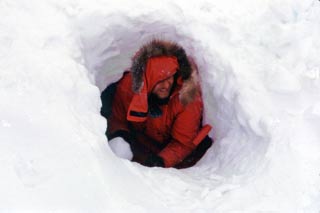
Carl Robert Disch was an ionospheric physicist working for the Central Radio Propagation Laboratory (CRPL)--a division of the National Bureau of Standards/Boulder Laboratories. He was one of two CRPL scientists wintering at Byrd. Early on 8 May he apparently got lost while returning from the remote radio noise laboratory and the main station during a windstorm; he was never found despite extensive winter and summer searches (photos and official Navy and NIST reports).
Brockton, a weather station on the Ross Ice Shelf (78°45'S-174°40W) established in October to replace Little Rockford (79°14'S-147°29'W near the former LA5-Byrd tractor trail).
North Star Research and Development Institute of Minneapolis assumes contract for operation of McMurdo biolab (and presumably Hallett's as well), October.
Summer 1965-66
The station opening flight was 23 October, the earliest to date.
Bust of Admiral Byrd dedicated at McM (23 October).
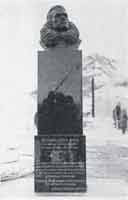
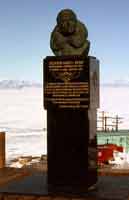
At first the memorial was located next to the original chapel; it would be moved and rearranged (!) as seen here, until it ended up in front of the Chalet where it is today (more photos and the rest of the story).
Rob Flint and others pass through on their way to the site of Plateau Station (13 December); that station was constructed (4 modules) and occupied permanently for the next three years at 79°S-40°30'E.
Second deck added in supply tunnel.
New heating system installed in balloon inflation shelter...
Fire suppression system installed in power plant.
First commercial aircraft flight over Pole (17 November) in a chartered 707.
 The flight, nicknamed Pole Cat (more info), holds several records including being the
first transpolar round-the-world flight. It
was organized and piloted by Fred Austin, who
then was a chief pilot for TWA. The aircraft
was the Boeing 707-349C #N322F with 35 on board
including 5 pilots, scientists studying the atmosphere,
and the first test prototype of Litton's inertial navigation system (which
worked perfectly). One of the pilots was Bernt Balchen, who had piloted Byrd's
flight over Pole in 1929. Balchen was at the controls when this flight passed over
Pole (it was plainly visible). He looped around the station several times. The aircraft
carried 2 2000-gallon bladders in the main fuselage for extra fuel storage;
these sloshed around alarmingly during takeoffs. The flight route was Honolulu/London/Lisbon/BA/ChC/Honolulu, 15-17 November (photos and stats from Wingnet).
The flight, nicknamed Pole Cat (more info), holds several records including being the
first transpolar round-the-world flight. It
was organized and piloted by Fred Austin, who
then was a chief pilot for TWA. The aircraft
was the Boeing 707-349C #N322F with 35 on board
including 5 pilots, scientists studying the atmosphere,
and the first test prototype of Litton's inertial navigation system (which
worked perfectly). One of the pilots was Bernt Balchen, who had piloted Byrd's
flight over Pole in 1929. Balchen was at the controls when this flight passed over
Pole (it was plainly visible). He looped around the station several times. The aircraft
carried 2 2000-gallon bladders in the main fuselage for extra fuel storage;
these sloshed around alarmingly during takeoffs. The flight route was Honolulu/London/Lisbon/BA/ChC/Honolulu, 15-17 November (photos and stats from Wingnet).
Large iceberg(!) causes problems with the shipping channel.

In December this guy floated into the channel... 800 feet long by 200'...and 80' above the waterline. Here the three Navy icebreakers nuzzle it out of the way (31 December 1965)--Burton Island, Atka, and Glacier. About a year later these icebreakers were transferred to the Coast Guard (U.S. Navy photo by A. W. Thomas, Antarctic Journal, March 1966)
This image is from the USAP Antarctic Photo Library. Here is another version.


First year of New Zealand Air Force C-130-H support flights to McM...and US Air Force C-130E aircraft also provide ChCh-McM airlift support.
Three 25,000 gallon DFA bladders added for additional bulk fuel storage.
Two Argentine military teams show up.
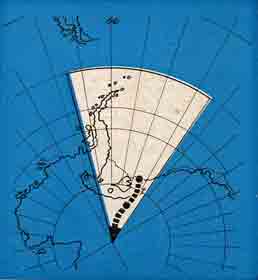
The first was an Air Force venture (a souped-up C-47 and two Beavers) that arrived on 3 November. Later in the season a 10-man Army scientific traverse arrived from Belgrano with at least 3 Sno-Cats (more information and photos).
Other summer visitors included Peter Scott (Robert's son) who arrived on an LC-130 flight from McM as part of a BBC film crew.
Balloon explodes while being filled, most of the balloon inflation shelter is destroyed (31 January).
 Here's what the shelter looked like after the
explosion; it had been constructed only a year earlier. The exact cause was undetermined, but hydrogen was routinely used by
met for the weather balloons (photo from
Henry Storm). Fortunately, the hydrogen generator room
below grade was not damaged. An emergency
replacement was erected on the original foundation
by a 10-man Seabee team from NMCB 6 in less than 2
weeks, it was much smaller, and its doors were oriented
more directly downwind than those of the destroyed shelter.; here is a look at
the replacement shelter in use (US Navy photo,
Antarctic Journal, May 1971).
Here's what the shelter looked like after the
explosion; it had been constructed only a year earlier. The exact cause was undetermined, but hydrogen was routinely used by
met for the weather balloons (photo from
Henry Storm). Fortunately, the hydrogen generator room
below grade was not damaged. An emergency
replacement was erected on the original foundation
by a 10-man Seabee team from NMCB 6 in less than 2
weeks, it was much smaller, and its doors were oriented
more directly downwind than those of the destroyed shelter.; here is a look at
the replacement shelter in use (US Navy photo,
Antarctic Journal, May 1971).

The first fatality at Pole occurs (14 February), Navy ASA supply w/o SK2 Andrew Burl Moulder is crushed between a cargo sled and the LC-130 during aircraft unloading operations. Visibility was poor, and the tractor driver who was maneuvering the sled could not see that Andrew was between the sled and the LC-130 ramp.
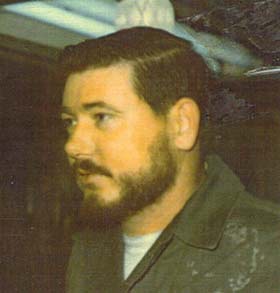
Here is Andrew Burl Moulder at Pole. Please visit my memorial pages with more information as well as photos and tributes from friends and family.
Eights Station (Siple Station predecessor) closed (15 November), its generators and equipment were later shipped to Plateau.
Byrd Longwire constructed 15 miles from Byrd Station for VLF research.
 It was the next predecessor to Siple Station after Eights and Delta One--which was 40 miles NE of Byrd and occupied by 2 contractor winterovers in 1962 and 1963. Construction started 10 December, 15 miles from Byrd, to use a 21-mile antenna which had been installed in 1964-65, as well as a new 10-mile antenna, for U. of Washington VLF research. The transmitter came from the Navy, originally for use in a submarine. Left: an NSF photo of the station from the May-June 1966 Antarctic Journal. The ATCO station modules and the transmitter would later be shipped back to McMurdo for use at Siple 1. This map shows the station layout (from this Sept.-Oct. 1966 Antarctic Journal article.)
The Pole-Plateau Traverse zigzags on to Plateau Station.
The first fatal VX-6 crash since November 1961 occurred on 2 February 1966 as an LC-47 (R4-D) crashed at 71ºS-156ºE (or at mile 60 of the old trail from LAV to Byrd Station). It was one of two aircraft sent to relocate a USGS mapping party. It stalled while trying to land in a partial whiteout, impacted violently, and caught fire. All 6 crew aboard perished. More information including from me is here from Joe Hawkins' VXE-6 page.
McMurdo construction: the original desal plant constructed next to the nuclear plant, along with first water distribution piping and first flush toilets...which were in the new/present dispensary. Desal plant, piping, toilets, and dispensary were tested and shut down until the following season. Also, demo and site prep started for Building 155, and the Earth Science Laboratory was completed.

This is the Earth Science Laboratory, building 138, which was later renamed the Thiel Earth Sciences Laboratory (TESL) for geologist Edward Thiel in 1973-74. Thiel was killed in the 1961 P2V crash at Wilkes. After the geology program was moved to the Crary Lab in the early 1990s, this building became known as F-STOP, home of the "Field Safety Training Program." It was demolished in February 2007 to make way for the new MOGAS tank constructed the following February. (US Navy photo).
Little Jeana weather station closed for the last time.
Winter l966
OIC: LT William R. Griffin, population 18 (list and photos)
After several power failures, PP mechanic installs automatic low frequency alarms (to wake him up if there is a problem).
Plateau evacuated to emergency camp (7/6-15) due to generator problems; pp mechanic fabricates homemade replacement gaskets based on radio advice from Caterpillar.
Winter medevac from McMurdo (7 June), PF1 (utility pipefitter) Robert Mayfield, who'd suffered a ruptured bladder from a fall.
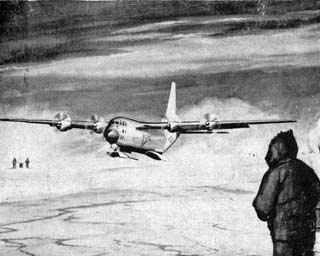
At left, an artist's image of the medevac flight landing at McMurdo. Robert was flown to Christchurch where he had successful surgery (more information and another photo).
There was another medevac from Byrd 13 September, aurora physicist Lawrence Spitz with acute peritonitis or appendicitis. LC-130 #319 flew directly back to CHCH from Byrd...no surgery until 3 months later (!).
Brockton weather station moved to 80°01'S-178°02W (October).
Summer 1966-67
Opening flight 10/19, even earlier than the previous year's record, not beaten until the 10/16/99 flight.
UCLA "Earth Tides" gravity meters installed.
First Navy parachute jump (12/23) at Pole, by Jim Thomann.
 Aviation Electrician's Mate (AE2) Jim Thomann, a member
of the VX-6 pararescue team, made the jump from an LC-
130 at an altitude of 16,000' (about 6,000' above the
surface). He breathed pure oxygen before jumping from
the cargo ramp. This was also the first free fall jump
at Pole--Jim delayed deploying his parachute for 10
seconds, by which time he'd fallen 3,500 feet. Earlier
in the season, Jim (along with PR2 John Cadwallader) set the
Antarctic free fall jump record of 7,000 feet, from an
altitude of 9,700 feet above the Ross Ice Shelf (this
record probably still stands). The surface temperature
at Pole was -40°F, with winds of 17 mph. Despite the
shifting winds, Jim landed within 600 feet of the Pole.
This was Jim's 500th jump. And his photo...thanks!
Aviation Electrician's Mate (AE2) Jim Thomann, a member
of the VX-6 pararescue team, made the jump from an LC-
130 at an altitude of 16,000' (about 6,000' above the
surface). He breathed pure oxygen before jumping from
the cargo ramp. This was also the first free fall jump
at Pole--Jim delayed deploying his parachute for 10
seconds, by which time he'd fallen 3,500 feet. Earlier
in the season, Jim (along with PR2 John Cadwallader) set the
Antarctic free fall jump record of 7,000 feet, from an
altitude of 9,700 feet above the Ross Ice Shelf (this
record probably still stands). The surface temperature
at Pole was -40°F, with winds of 17 mph. Despite the
shifting winds, Jim landed within 600 feet of the Pole.
This was Jim's 500th jump. And his photo...thanks!
The pararescue team did later jumps at Pole, including this one when I was there. The first parachute jump was by USAF TSGT Richard Patton back in November 1956!
Generator tunnel end wall rebuilt.
 One of the timber-reinforced tunnels as it
appeared when Bob Nyden took this picture in
1971...we're looking west along the south main passage toward the science building. I'm thinking that the open door is the emergency (outhouse-type) head.
One of the timber-reinforced tunnels as it
appeared when Bob Nyden took this picture in
1971...we're looking west along the south main passage toward the science building. I'm thinking that the open door is the emergency (outhouse-type) head.What is really of interest here is that splintered stud along the outside wall of the passage. Here's another photo taken from the same location...taken 5 or 6 years earlier by Navy engineer Steven Kauffman. The same splintered stud is visible. It doesn't look like the settlement has caused any additional bending or splintering over the intervening years (!)

McMurdo construction: Building 155 erection begins, desal and fresh water piping systems placed in operation, dispensary occupied.

Construction of this massively complex building would take awhile...6 seasons from the beginning of site prep in 1964-65 to final occupancy in 1969-70, although the galley portion of the building was in service a year earlier. This artist's conception of Building 155 appeared in the July 1966 Antarctic Journal, a shadow of the dispensary appears in front of it.
First test landing of C-141 aircraft at the McMurdo ice runway (0229 14 November).
 Looks like everyone has their camera out! And of course it helps to have sled dogs in the photo.
This would eventually become a common way to get to the
ice when there was a good runway available...
and after the mid 1990s these aircraft
could land at the Pegasus runway in
late summer. The date and time documentation of this landing is from the January-February 1967 Antarctic Journal. I rode the last C-141 to fly
to McMurdo in January 2005 a week before it
made the final such trip (U. S. Navy photo
courtesy Mike Davis).
Looks like everyone has their camera out! And of course it helps to have sled dogs in the photo.
This would eventually become a common way to get to the
ice when there was a good runway available...
and after the mid 1990s these aircraft
could land at the Pegasus runway in
late summer. The date and time documentation of this landing is from the January-February 1967 Antarctic Journal. I rode the last C-141 to fly
to McMurdo in January 2005 a week before it
made the final such trip (U. S. Navy photo
courtesy Mike Davis).This January 1967 Antarctic Journal article has more information and another photo.
Deep icecap coring project at Byrd begins.
102' met tower constructed at Plateau (similar to the one built at Pole 15 years later).
First ascent of Vinson Massif (17 December), at 16,860' the tallest Antarctic peak, in a USARP-supported venture led by Nicholas Clinch. They collected geologic samples from previously unvisited areas and did several other first ascents in the Ellsworth Range. Their exploits are detailed in this March-April 1967 Antarctic Journal article.
Palmer pier, fuel tanks constructed, Biolab pad and subfloor completed.
Winter 1967
OIC: LT R. C. Sullivan, population 21 (list and photo)... including the first Soviet exchange scientist Peter Astakhov.
First of 2 winters of major sleep project (EEG tests etc.).
Station evacuated to emergency camp for 24 hours (5/16) due to fumes from a broken 5-gallon can of carbon tetrachloride.
Electric heater falls out of a wall onto the wooden deck and starts smoking (7/4) threatening seismo equipment...no damage.
Trivia: average winter alcohol consumption was 54 cases of beer and 6 cases of liquor for each of the 20 men (some of whom were nondrinkers).
Fire destroys new Willy Field head modules.
First McM planned "winfly" held (actually 2, on 6/18 and 9/2)...here is the 11/67 Antarctic Journal article about it (Adobe PDF file).
 The 18 June flight included a biology team
from Old Dominion College in Norfolk, VA;
they were looking at what algae did in the
winter. The program involved extensive diving,
unfortunately good fast sea ice didn't form
until September, restricting access along the
normal sea ice routes. On one trip to Cape
Royds on 31 July this Nodwell found a crack
and sank (Antarctic Journal, March/April 1968, photo by
Graeme Johnstone). Team leader Jacques
Zanefeld injured his foot while escaping.
Oops. The taillights of the Nodwell stayed
on after it sank, casting eerie beams of red
light into the night sky. Folks up at the nuclear
power plant thought they might be UFO's (graphic from the McMurdo Sometimez).
Turns out that one member of the diving team (and the driver of this vehicle)
was Dave Bresnahan on his first trip to the ice. Here's a view of the group
on another day, with Dave in the "water" (Antarctic Journal, July-August 1968, photo by Bill
Boggs). The group left on the second winfly in September.
The 18 June flight included a biology team
from Old Dominion College in Norfolk, VA;
they were looking at what algae did in the
winter. The program involved extensive diving,
unfortunately good fast sea ice didn't form
until September, restricting access along the
normal sea ice routes. On one trip to Cape
Royds on 31 July this Nodwell found a crack
and sank (Antarctic Journal, March/April 1968, photo by
Graeme Johnstone). Team leader Jacques
Zanefeld injured his foot while escaping.
Oops. The taillights of the Nodwell stayed
on after it sank, casting eerie beams of red
light into the night sky. Folks up at the nuclear
power plant thought they might be UFO's (graphic from the McMurdo Sometimez).
Turns out that one member of the diving team (and the driver of this vehicle)
was Dave Bresnahan on his first trip to the ice. Here's a view of the group
on another day, with Dave in the "water" (Antarctic Journal, July-August 1968, photo by Bill
Boggs). The group left on the second winfly in September.


Summer 1967-68
Major excavation and rehab of power plant and adjacent tunnels.

This photo looks north along the builders' tunnel, which has been excavated to repair the collapsing power plant (structure at left). Straight ahead is the door of the BU/UT shop building which housed the steam bath and the water tanks. At right is the head. The power plant was moved one more time, to a structure closer to the surface and south of the power plant building shown here. Some of this structure was converted into a small gym in 1969-70 (NOAA photo by Fred Walton). Here's another of Fred's photos from another angle.
Long-distance medevac from Halley Bay staged through Pole (5 December).
Weather Bureau (ESSA soon to become NOAA) starts installing the GMCC stuff (geophysical/global monitoring for climatic change, later renamed CMDL).
Summer visitors include Werner Von Braun who joins the 200 club.
Memorial bust of Admiral Byrd (identical to the McM sculpture) dedicated (10/31) (story and photos).
First drill (mechanical) holes through Antarctic ice to rock at Byrd (7100') (1/29) with good 4-1/4" diameter cores (samples were recovered, but a drill became stuck at 6930' (2/1/69) and further recovery efforts during 69-70 were unsuccessful).
Major realignment of McM-Scott Base road completed.
Last of the original DC-3's (R4Ds or LC-47s or gooney birds, whatever) leave the ice.
First tourist vessel shows up at McM (Magga Dan, it runs aground!).
First fossil bone from a land vertebrate is discovered at Graphite Peak (Queen Maud Range)(12/28), it would help confirm what at this time was still the theory of continental drift.
Last leg of Pole-Plateau traverse, postponed for a year, zigzags from Plateau on into Queen Maud Land (78°42'S-6°52'W).
New Palmer construction crew of 33 men completes Biolab which is occupied (3/17), pad for GWR worked on.
McM construction continues massively.
 Here's an aerial view of the construction
progress on Building 155 from the January
1968 Antarctic Journal. In addition to this
project, the BFC (Field Party Processing
Center) shell was erected along with the
pad for building 165); a second desal unit
was installed in the "old water plant."
Flash desal units would continue to be
replaced every few years with different
metallurgy until RO units took their place.
Here's an aerial view of the construction
progress on Building 155 from the January
1968 Antarctic Journal. In addition to this
project, the BFC (Field Party Processing
Center) shell was erected along with the
pad for building 165); a second desal unit
was installed in the "old water plant."
Flash desal units would continue to be
replaced every few years with different
metallurgy until RO units took their place.First McM "long-duration" (24 hours) ballooning experiments launched from Windless Bight using 300,000 cf balloons, to look for extraterrestrial electrons and X-rays, conducted by PI Martin Pomerantz.
Winter 1968
OIC: LTJG John Hedley, population 21 (list and photo)
Snow melter building destroyed by fire (11 August); no injuries.
Second year of "Sleep" studies.

Starting with the 1967 winter, the University of Oklahoma spent two years monitoring behavior and sleep patterns at Pole. Methods included questionnaires, interviews, leisure time and interaction studies, and electroencephalographic (EEG) tests, such as NOAA guy Fred Walton is undergoing here. The Oklahoma team continued various medical studies at Pole for many years including our 1977 winter...their research teams brought some of the first female USARPs to Pole (NOAA photo from Fred Walton).
First winter of long-running "all-sky camera" auroral photography by S. I. Akasofu (UA-Fairbanks).
Serious roof leaks cause water damage to books, data etc. in science building.
R/V Hero launched (in the US, 28 March) (the story, with photos).
Major generator problems at Plateau; fire destroys garage, temporary evacuations to summer camp required.
Record low temperature at Plateau (-121.3°F/-86.2°C on 7/20 (some say that if Plateau would have been occupied when Vostok had its low temps, Plateau would have been colder).
Holmes and Narver awarded NSF contract for science support at McM, taking over from North Star R&D.
Summer 1968-69
Significant safety repairs required to enable station operations to continue.
Skua sighted (19 December).
Snow melter rebuilt; doubled capacity.
Power plant rehab completed (this wasn't the long term solution to the overheating/settlement problems; a new structure went up a year later).
Met GMD platform/radome structure raised 8' to clear drifting and planned power plant structure.

One of three ozonesondes launched by the Weather Bureau in December--actually a combined radiosonde/radiometersonde/ozonesonde of the newly developed ECC (electrochemical concentration cell) type. These flights reached an average burst height of 24,457m (about 80,000 feet). Not the first year for ozone balloons--the first ones, several of the carbon- iodine type, were launched the previous summer. ESSA/ NOAA used ozonesondes sporadically between 1967 and 1971, and regularly since 1986 (NSF photo, Antarctic Journal, March/April 1969).
Met GMD platform/radome raised 8' to clear drifting and new power plant structure.
Model of the proposed domed station set out in the snow for a study of snow drifting patterns.

The one-tenth scale model stayed around for awhile...this U. S. Navy photo appeared in the March 1970 New Zealand journal Antarctic. Here's another photo from Bob Nyden that showed up in the DF-73 ASA/VXE-6 cruisebook.

Major Japanese traverse arrives (19 December).

The 12-man glaciology traverse, led by Masayoshi Murayama, had departed on 28 September from the Japanese Showa Station (sometimes spelled Syowa, on East Ongul Island just off the coast, 69ºS-39.6ºE, roughly north of Plateau Station), with a refueling stop at Plateau; they stayed on station until after Christmas dinner before retracing their course, again via Plateau Station. They arrived back at Showa on 16 February (U. S. Navy photo; Antarctic Journal, March-April 1969).
Martin Pomerantz and Bartol team launch balloon-borne cosmic ray detectors from the ice near McM--the first year of a 2-season project. Some were tracked for more than 2 days--a precursor to today's long-duration missions.
Pomerantz also brings 2 small telescopes to Pole for summer solar observations and winter use by the cosray observer.
First regularly scheduled C-141 flights to McM (29 October).
VX-6 (Air Development Squadron Six) renamed VXE-6 (Antarctic Development Squadron Six) (1 January).
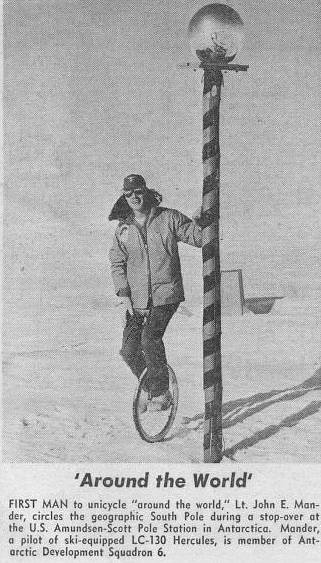
In recent times some of the long-term station residents have brought mountain bikes to commute to the far reaches of the station. During the 1999-2000 season CARA sponsored a research project to design and test a new prototype bicycle. Here is one of the cycling pioneers--LT John Mander of VXE-6 was a pilot on 320 during 1968-69, and he took this unicycle almost everywhere he went (caption).
First year without picket ships (2 destroyers stationed on the ChCh-McMurdo flight path for weather forecasting). These were no longer needed because of weather satellites.
Inland stations (Pole/Byrd/Plateau) adopt McM/NZ time (+12) during summer.
Third major airlift of penguins/skuas etc. from McM to American zoos.
McMurdo construction: shells of Building 165, Hotel California completed; pad for Chalet prepared;
BFC occupied; galley half of 155 completed--first meal served 30 January.
Plateau Station closed (29 January).
Private Convair 990A "Polar Byrd I" passes over Pole (22 November).
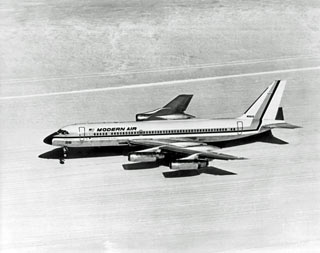
This was during the McMurdo-Argentina leg of a successful round-the-world flight organized by Fred Dustin, a veteran of Byrd's second 1933-35 expedition, and sponsored by the Admiral Richard E. Byrd Polar Center in Boston. It was actually a 25-day luxury flight that landed on all seven continents as well as at Thule, Greenland. This was not the first charter flight to land at McMurdo, but it was the first and only tourist charter airliner to stop by (the full story).
NGA solo pilot Max Conrad shows up at Palmer Station (21 December) in his twin-engined Piper Aztec; after continuing south to Adelaide Island, he bags his round-the-world trip until the next season due to the lack of 100-octane fuel on the ice (photo and more information).
Hero shows up at Palmer for the first time (25 December).
Palmer construction/problems--fire destroys construction camp Jamesways (12/18) with no injuries but loss of all personal possessions/clothing; blasting accident in March sends a boulder through the air 100 yards to crash through another Jamesway roof--it hit the Seabee OIC LT Harry Anderson in the head while he was drinking coffee! A medevac was required. All this while the pads for GWR and the helo pad (constructed from runway matting) were being cleared. Later the GWR shell was completed and the small boat ramp was built.
Winter 1969
OIC: LT Bradley J. Bowman, population 20 (list and photos)
August medevac conducted from Byrd due to diabetes complications.
Summer 1969-70
This was the first year with female USARPs working out of McMurdo, 4 OSU geologists headed for a field camp in the Dry Valleys. They plus 1 NZARP and 1 reporter, Jean Pearson of the Detroit News, become the first 6 women at Pole on 12 November 1969. They all step off the LC-130 ramp at the same time so no one is "first" (the details and photos).
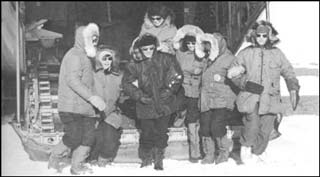
Here is one photo of the 6 women leaving the plane accompanied by RADM Kelly Welch...check out the caption (US Navy photo courtesy Billy-Ace Baker) as well as the rest of the photos courtesy of Kelly Welch.
 New power plant constructed.
The photo at right (from the 1972-73 summer; a US Navy cruisebook photo) looks north at the builders' tunnel; the power plant structure is to the west of the ramp. This was the last of at least 9 power generation buildings (prime and emergency) built at this station. Heat dissipation problems (and resulting settlement) of the buried
 generator plants at Pole was a never-ending problem--at least this structure wasn't buried; rather it was under a large integral arch. Left of the GMD dome is (I think) a garage. Strangely, I don't recall ever seeing this power plant structure from the surface (or from inside the station) when I was there in 1976-77.
At left is a view (from 12/70) looking south with the power plant behind the GMD. I presume this plant used those ubiquitous CAT 342 generators. Caption: "Smoke billows from the stacks of the power plant at South Pole Station" (US Navy photo from Dan Bolton).
generator plants at Pole was a never-ending problem--at least this structure wasn't buried; rather it was under a large integral arch. Left of the GMD dome is (I think) a garage. Strangely, I don't recall ever seeing this power plant structure from the surface (or from inside the station) when I was there in 1976-77.
At left is a view (from 12/70) looking south with the power plant behind the GMD. I presume this plant used those ubiquitous CAT 342 generators. Caption: "Smoke billows from the stacks of the power plant at South Pole Station" (US Navy photo from Dan Bolton)."Top hats" added to 2 other buildings.
 No, I don't know which building this is, but
before it was over all of the older buried
buildings ended up with these, 8' high false
attics, covered with plywood and sealed with
plastic or canvas. These reduced the roof snow
load and served as insulation barriers to keep
snow from melting and leaking in. U. S. Navy
photo, Antarctic Journal, July/August 1970)
No, I don't know which building this is, but
before it was over all of the older buried
buildings ended up with these, 8' high false
attics, covered with plywood and sealed with
plastic or canvas. These reduced the roof snow
load and served as insulation barriers to keep
snow from melting and leaking in. U. S. Navy
photo, Antarctic Journal, July/August 1970)
Dr. Laurence M. Gould visits to commemorate Admiral Byrd's flight.

The 40th anniversary of Byrd's flight from Little America over the South Pole was marked with a brief ceremony on 11/29. Participants included Byrd's pilot Bernt Balchen. Here Larry Gould is laying a plastic wreath at the base of the flagpole (Photo from the Carleton College archives).
Replacement OIC office/store/post office built
Max Conrad tries again from the other direction, arriving on 19 January.
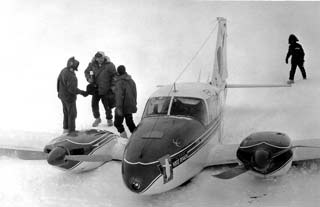
Max crashed (1/23) while doing practice takeoffs. No injury, but the aircraft was unflyable and is still there, safely buried. Here is the full story, fully revealed here for the first time.
2 Norwegians, the "Flying Vikings," Thor Tjøntveit and Einar Sverre Pedersen, show up in a twin-engine Cessna 421 12 hours after Max (20 January).
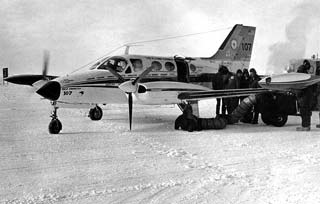
They stay 5 hours before returning to MCM. NSF policy for NGA visits such as these: "Such private ventures are charged for fuel and services." More information ...
Average summer population: 36 (this was the last season before new station construction started).
Station design completed; first vessel shipments of dome and arch structural material delivered to McMurdo.
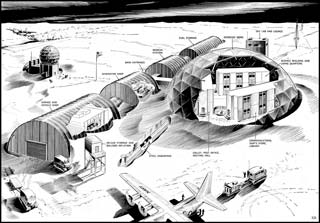
This portrayal of the proposed domed station appeared in August 1971, as the first conceptual image had been released by NSF earlier that year and appeared in the November/December 1971 Antarctic Journal. It and other images, including the link to that Popular Science article, are here.
Geologist Thomas E. Berg killed (19 November).
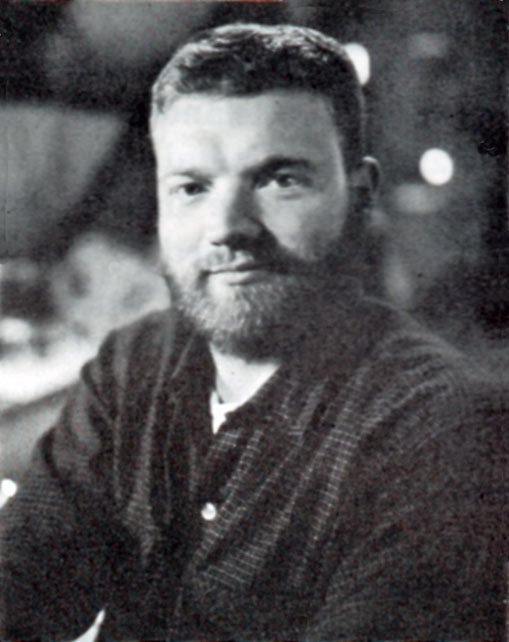
He died in a in VXE-6 helicopter crash on the side of Mt. McLennan. The engine of the aircraft failed; the pilot brought it down using autorotation of the rotor blades, but it slid 700 feet down the slope. Six of the eight men on board survived, but Tom was killed along with NZ cameraman Jeremy Sykes. A memorial service was held in the theater at McMurdo Station on 22 November (obituary).
In December 1970 the Field Party Processing Center was rededicated as the Berg Field Center in his honor.
Siple Station first named and established (3 December 1969) as a summer station for VLF research.
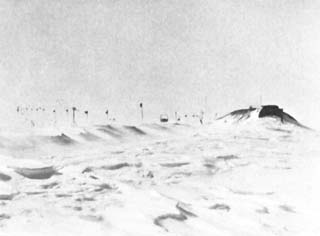
The station site was selected in part because it was a conjugate site on the Earth's magnetic field lines to another research site near Roberval, Quebec. The major project, operated by Stanford University's principal investigator John Katsufrakis, was the construction of a long dipole VHF antenna...originally constructed this season to a length of 8,000 feet, extended to 13 miles in 1971-72, and later extended to 26 miles. One difficulty of the site...it would get 8-15 feet of snow per year. The first station permanent structures would be completed in time for the first winterover operations in 1973 (more information and photos).
First "UGO" (unmanned geophysical observatory) set up by Stanford at Byrd (instrument capsule with propane thermoelectric generator on a 20' tower).
McM construction: Barracks half of 155 completed...

Here's the Chief Petty Officers' lounge in the new building. I dunno. When I first explored this facility a couple years later, it already was starting to get a bit dowdy, but the building has been massively upgraded since then. This and the next photo are U.S. Navy photos from the July/August 1970 Antarctic Journal.
...Hotel California completed...

Alas, it would be several years before the Eagles would transform the name of what was originally the USARP Hotel. The photo caption indicated this facility would house 65 people, seemingly about half of them in the bunkroom, AKA "mancamp" which I have experienced more than once, fortunately only one night at a time.
...and the Chalet is completed (in 1 season by H&N crews).


Naval Construction Battalion Unit 201 was originally scheduled to erect this structure, but they were unable to do so due to a reduction in manpower. H&N must have had an early start to construction. The picture at left was taken on 9 November 1969. And at above right, the structure is nearly completed. H&N construction folks spent the next couple of summers coating those precast concrete foundation piers with polyurethane to seal out moisture that was causing freeze-thaw damage. (Left photo by RM3 Ken "Hogman" Trettin, WO McMurdo DF-70; right U. S. Navy photo from the Antarctic Journal, July/August 1970)
First year with only one tanker delivery to McM; until now lack of fuel storage had required multiple trips with smaller ships.
Palmer GWR completed.
Winter 1970
OIC: LT Dean E. Fadden, population 21 (list and photos)


The comm center in 1970, a bit more brightly lit than it was when I visited it a few years later (caption/info) (courtesy Billy-Ace Baker).
First (and only) midwinter refueling of McM nuclear plant.
National Oceanographic and Atmospheric Administration (NOAA) formed (3 October).

The Federal reorganization of environmental and physical research agencies had been proposed to Congress in July. One concept had included the Coast Guard, but they were left out of the final plan. In any case, NOAA soon consolidated and expanded its research presence in and around Antarctica.
At left, an observer with ESSA (one of the major agencies consolidated into NOAA) is operating a Dobson spectrophotometer in the Dobson hut (undated NSF photo from around 1969-70). This device (which was invented by the British meteorologist G.M.B. Dobson in the 1920s) determines the amount of ozone in the atmosphere by measuring the absorption by ozone of UV light from the sun or moon.
Dobson observations have been made at Pole beginning in 1963.
Air Force C-133 CargoMaster, largest aircraft to land in Antarctica to date, makes first flight to McMurdo (10/21).
Summer 1970-71
Opening flight (31 October) is also a medevac for ill Navy w/o.
First of many visits by Dr. Harold Muchmore and team to take nose samples etc.
New station construction started (barely) with preliminary site prep and surveys.

Here's one of those famous or infamous Peter Snow Millers hard at work during the 1970-71 summer...this one seems to be doing well here, but they really couldn't handle the Pole altitude and snow conditions (photo from Gary Brougham).
Top hats (high roofs to replace crushing snow load) installed on two buildings; old power plant turned into rec building/gym, tunnel shoring added.

Construction of a top hat is underway, this is the USARP barracks, we are looking southeast, the balloon inflation shelter is in the back- ground behind the construction, and the aurora tower is at left. This photograph illustrates that the station is not THAT deeply buried, note the snow levels behind the construction area (US Navy photo from the Antarctic Journal, May 1971).
Pegasus (C-121J) crashes at McM (8 October) with only minor injuries.

This was last season of these Super Constellation aircraft on the ice (photos and crash story by Noel Gillespie on Dave Riley's web site) (Photo from Larry Lister). This photo of the other side of the aircraft is from Jim O'Connell, and here's a photo markup from the accident investigation, from this Aircraft Accidents Archives site. Joe Hawkins has more photos on his C-121 Constellation page.


Siple antenna extension to 13 miles partially completed.
McM construction: Building 165 (Admin) and 175 (originally Public Works, just below heavy shop) occupied; incinerator pad prepared; first copper-nickel flash evaporator installed to supplant corroding carbon-steel desal units; Elliot Quay facing completed.
 The multiyear project was extended because the
first cargo ship Towle ran into it earlier in
the season, and the second cargo ship Wyandot
ran into it after this work was completed. And of
course we know this massive bit of construction
didn't last very long (Antarctic Journal, May
1971). The icebreaker in this February photo is
the Staten Island; the Burton Island was also
present this season, not to mention the cruise
ship Lindblad Explorer which made two trips.
The multiyear project was extended because the
first cargo ship Towle ran into it earlier in
the season, and the second cargo ship Wyandot
ran into it after this work was completed. And of
course we know this massive bit of construction
didn't last very long (Antarctic Journal, May
1971). The icebreaker in this February photo is
the Staten Island; the Burton Island was also
present this season, not to mention the cruise
ship Lindblad Explorer which made two trips.
Coast Guard HH-52A helicopter crashes at 12,000 feet on the northwest side of Mt. Erebus (9 January).
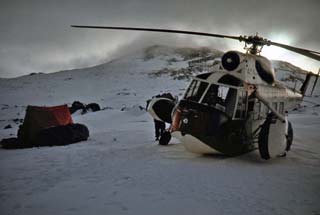
There were 4 souls on board, two crew and two pax including writer Charles Neider, who documented the events (sort of) in his book Edge of the World, Ross Island, Antarctica. The destination was Cape Bird, but they never made it. There were no serious injuries despite a reported lack of ECW gear. This photo is from good Polie friend Stu Rawlinson who happened to be one of the passengers. Here's the story and more photos.
The "Pederson South Pole Expedition" shows up in ChCh in mid-January with a Connie loaded with snowmobiles for a planned McM-Pole trek. to recover Max Conrad's aircraft. They don't get clearance, and it doesn't happen, but they did have plans to try again, but did not (the full story).
Byrd Longwire closed (29 December) after a month of VLF studies by electrical engineer Irene Peden.
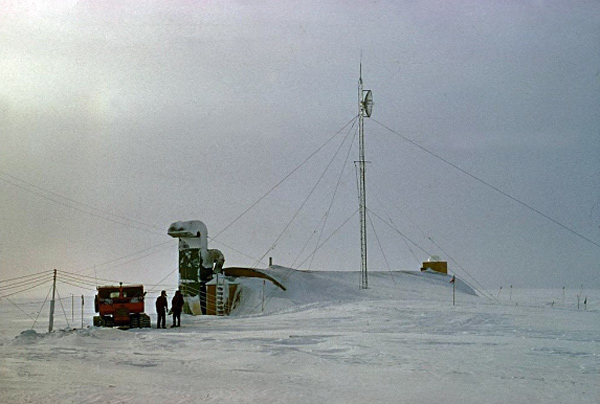 Irene, then at the University of Washington, had been the first woman to receive an engineering PhD from Stanford University in 1962. She would be the first USARP woman to conduct research in the Antarctic interior. The station had been constructed in 1965-66 and included a 21-mile antenna for VLF research. It had been occupied during some winter periods. The modules and antenna were shipped to McMurdo for rehab for use at the planned Siple Station (which the 1967 photo at left resembles). This photo is from Richard Spatz, an engineer responsible for running the station during the 1967 summer; it appears in his article about his experiences there in the October-December 2016 OAEA Explorer's Gazette available here.
BFC dedicated for geologist Thomas E. Berg (15 December).
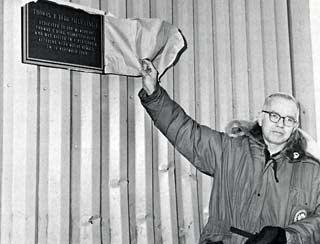
Tom Berg died in a VXE-6 helicopter crash on 19 November (more information and obituary). The photo is from the January-February 1971 Antarctic Journal; it depicts the plaque being unveiled by principal speaker Thomas B. Owen, NSF assistant director of national and international programs. Here's the full article and a couple of more photos.
First LC-130 accident (2/15), 318 is destroyed by fire on takeoff from Williams Field.
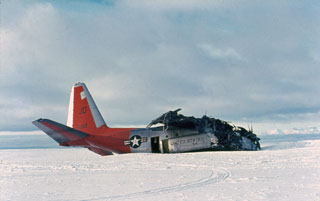
"The third plane lost during Deep Freeze 71 was an LC-130F, BUNO 148318 on February 15,1971. The Hercules was taxiing on the skiway at Williams Field for a flight to Christchurch. It taxied around the GCA...in poor visibility, and...
...the rest of this amazing story must come from AT3 Tom Gregg who was aboard for this mishap as well as for a the 321 mishap at D-59 the following season.
Winter 1971
OIC: LTJG Kevin Gallen, population 21 (list and photo).
USARP barracks rehabbed.
Former power plant converted to gym/recreation area.
W/O science (typical for this era): gravity/seismo (UCLA); met (NOAA), geomag/ seismo (NOAA), ionospheric studies (NOAA), cosray (Bartol).
CBU-201 (the Navy Seabee unit responsible for major Antarctic construction tasks) disestablished (5/7); to be replaced by units of NMCB-71.
"Holy Stairs" vestibule, the final/present main entrance, constructed, with a balcony, the marble plaque and Scott's and Amundsen's portraits.

The main entrance to South Pole Station as it appeared during the 1971-72 season. It was nicknamed the "Holy Stairs" perhaps because of all of the signs and flags mounted on it... but I've never learned the real reason for the name. (Bob Nyden's photo)
Summer 1971-72
John Rand shows up with CRREL team for major drilling project, failure at 10'.

This was John Rand's first of what would be many trips to Pole--he spent much of the summer on station. Here's his photo of the place, looking in roughly the same direction as the above photo. The Holy Stairs main entrance is at left.
Site prep for the dome completed; utilidor 80% done; dome foundation blocks and base ring constructed.
First round-the-world via the poles solo flight by Elgen Long passes over Pole (21 November) en route from PA to McM in a twin-engine Piper Navajo. This flight was officially sanctioned; a LC-130 aircraft had been positioned at Pole for potential escort or search duty if the weather turned bad. Here's a quote from Elgen about his Antarctic flight, with a link to additional info...
LC-130 #321 crashes at D59 (4 December) another JATO problem.
 Briefly, the aircraft crash-landed upon takeoff from D59 (a site on the French traverse route between Dumont d'Urville and Dome C, 125 miles/200 km south of Dumont d'Urville). The aircraft had flown from McMurdo to drop off supplies to a French-American glaciology traverse party that was en route from Dumont d'Urville to Vostok. During the takeoff for return to McM, two JATO bottles broke loose and rammed into one of the engines and its propeller (note the missing prop in the photo at left), causing a crash landing. The full story of the crash, aftermath, eventual (not without tragedy) recovery is here...as well as the brief Antarctic Journal article.
T-5 building dismantled at McM, shipped to Pole and erected for use as the construction camp garage.
Finn Ronne and wife show up briefly to mark 60th anniversary of Amundsen's and Scott's arrival (7 December).
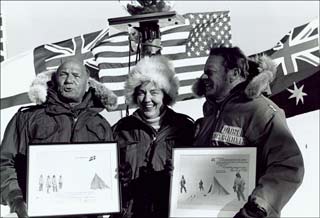
Finn and Edith "Jackie" Ronne were the first married couple to visit Pole together, and Jackie was probably the eighth woman to stand at the Pole. This photo shows them presenting two commemorative color prints to the station... (more details and credit)
First female to stay overnight--Chicago Tribune reporter Louise Hutchinson (7 December), who was covering the 60th anniversary commemoration, was stranded due to flight and weather delays.

Some things seem to look the same, but the original runway seen here was on the far side of the old IGY station. Here we are looking northwest, Old Pole is behind us, and further behind us is the site of the new/current skiway and the domed station construction. An LC-130 can be seen taking off; at right is one corner of the GCA radome (photo by GCA guy Ron May who slept in that radome...)
Original Stanford UGO shipped from Byrd, set up at McM.
Little Jeana vans moved to Brockton.
Buried Byrd Station ("New Byrd") closed (18 February).

Jim Mathews (who was there officially, looking for parts) found this message on a clipboard in the comms center in early 1980...he noted, as I have also seen, that abandoned stations seem frozen in time. The 16 February closing date mentioned in the message was presumably affected by weather. Future support operations would be continued from "Byrd Surface Camp."
I first learned about this evolution during my December 1972 visit to McMurdo.
Among many artifacts left behind was a black D-8 that came from LAV in 1957, as well as another that had been painted red. The black D-8 was dug out in this October 1986 Antarctic Journal article (which also describes the locations of the surface camp and the older stations), and I'm led to believe that at least one of these stretch D-8's was recovered.
Siple construction: arch completed and enclosed; 13-mile antenna completed.
McMurdo incinerator completed.
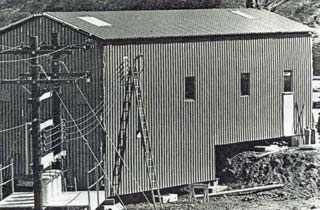
The incinerator in this building was successfully tested, but it was never used for various reasons... (more information and photos).
Other McM construction: fire station/phone exchange building occupied; transmitter building shell erected; new Williams Field berthing modules assembled, pad for sewage treatment plant prepared; (the sewage plant never was built).
McM biolab dedicated the Eklund Biological Center (EBC) (27 February) for Carl R. Eklund.
 The first part of the laboratory had been built
in 1959, and it had been expanded many times
since then (more recent floor plan) from the "replacement science facility" link on this Ferraro Choi page. The main portion of
the dedication was held in the Chalet; then
the party moved outdoors (photo), where NSF rep
George Llano unveiled the the dedication plaque.
From left: Sayed El-Sayed (Texas A&M), Llano,
Mary Alice McWhinnie (DePaul), and Betty Landrum
(Smithsonian; photo source and more information).
Eklund spent 2 years at East Base with the USAS,
and was the science leader at Wilkes for the 1956-
57 summer/winter. He died in 1962 (biography from
the USAS East Base site). The biolab was demolished in the early 1990s after the
replacement Crary Lab was opened.
The first part of the laboratory had been built
in 1959, and it had been expanded many times
since then (more recent floor plan) from the "replacement science facility" link on this Ferraro Choi page. The main portion of
the dedication was held in the Chalet; then
the party moved outdoors (photo), where NSF rep
George Llano unveiled the the dedication plaque.
From left: Sayed El-Sayed (Texas A&M), Llano,
Mary Alice McWhinnie (DePaul), and Betty Landrum
(Smithsonian; photo source and more information).
Eklund spent 2 years at East Base with the USAS,
and was the science leader at Wilkes for the 1956-
57 summer/winter. He died in 1962 (biography from
the USAS East Base site). The biolab was demolished in the early 1990s after the
replacement Crary Lab was opened.

Brockton closed for the last time (February).
Winter 1972
OIC: William R. Talutis, population 22 (list and photo).
Top hat over the galley collapses requiring major winter excavation effort.
March McM storm destroys 3 years of Elliott Quay pier facing.
McM nuclear plant shut down 9/18 for leaks, would never be restarted.
Summer 1972-73
Construction camp for 130 men (the one that would burn in 10/76) built near new station.
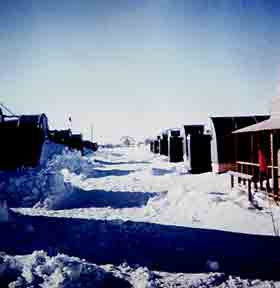
Here's the then-new construction camp--the Last Chance Saloon porch is on the right, Straight ahead in the distance is the rising skeleton of the Dome (photo from Bob Nyden) (here is the rest of the story about the construction camp). The Navy construction crew on site for the new station this season was 102 men.
Snow miller problems continue to slow new station foundation construction.
Wheeled aircraft tests conducted on taxiway surface prepared with the Peter snow miller (I guess the tests didn't work).
Four U. of Canterbury researchers rescued after 5 days at sea off their Cape Bird site (2 December).
 The men (including an American and an Englishman) set out on this 16-1/2 foot trimaran when both of their outboards quit. Winds and current pushed them away from shore...they abandoned their vessel and moved from deteriorating ice floe to ice floe with limited food...supplemented with a captured penguin. Searches didn't find them until they were sighted by an ice observer on a northbound RAF Hercules and rescued by a VXE-6 helicopter. This happened just before I arrived at McMurdo in early December, but I only learned of this here: New Zealand Geographic article (photo source)...also of interest is the fact that said RAF Hercules was the one I spent 8 hours on a few days later...it boomeranged (term not invented yet) and we immediately got put on a VXE-6 Herc for 8 more flight hours.
USGS sets up first Doppler satellite tracking geoceiver system; schedules first w/o's.
50x12 foot structure for helium bottles constructed south of balloon inflation building; helium was being used for met balloons and Gill hydrogen generator was partially dismantled.
917 crash-lands on new skiway in front of dome (1/28), no injuries and most cargo is salvaged, aircraft a total loss.
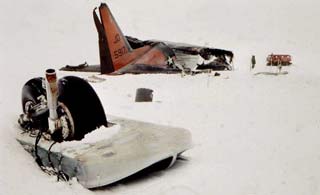
The full story...this view of the crash scene was taken the day afterward by Ralph Lewis, who was on the first flight into Pole after the accident. Here are more pictures including the story of this aircraft up until it got buried in 2006. For many more photos and the crash story, jump directly to Joe Hawkins' 917 page...
Experimental Rodriguez well constructed under NCEL direction; placed in service after successful production of 1000 gallons per day (the concept had been developed by Army engineer Raul Rodriguez at Camp Century, Greenland in 1960-61).
Utilidor finished; dome erection completed (1/4) after assistance from Huck fastener tech rep; half of arches erected; building erection deferred.
Byrd Surface Camp erected.
Glomar Challenger discovers traces of hydrocarbons beneath the Ross Sea, stirring interest in mineral development.
"International Square" (area with flags and Byrd bust) erected at McMurdo.
Other McM construction: B-75 (rehab for gym) completed.
DVDP (Dry Valley Drilling Project) does first drilling, test holes near McM.
Hallett Station closed. It had been used for summer penguin studies for many years.
Siple Station (I) permanent structures completed and turned over (1/25), occupied.
Winter 1973
OIC: LT Fred Walcott, population 22 (list and photos)
Rodriguez well freezes up after DFA in boiler fuel line (no heat tape) congeals.
Doctor Ron Swarsen conducts w/o study of fingernail ridge growth.
First Siple winter (4 men); new transmitter sends first VLF signals from Siple to Roberval, Quebec (12 May). Documented by friend Bill Trabucco's May-June Antarctic Journal article.
First McM midwinter airdrop, done by RNZAF P-3 Orion aircraft.
First McM ice wharf constructed after major difficulties with previous "Elliott Quay".
Summer 1973-74
Removal of PM3A nuclear plant in McMurdo begins (9 October).
Bernt Balchen, Byrd's pilot on the 1929 Pole flight, dies at age 73.
Major power problems at old station, 2 generators hard down for awhile.
Navy (mostly) construction crew is on site at Pole for new station: 146 men; H&N crew works on utilities in utilidor, fuel piping, and other utility systems.
Zoller's air sampling hut arrives.

It was originally deployed upwind of the station (not far enough the first time, as there was too much contamination from LC-130's). This was NOT the first air sampling project to happen, as the now-famous Scripps CO2 (etc.) air sampling project began at Pole in 1957...it was later taken over by NOAA. And Zoller (with the University of Maryland) had first conducted air sampling at Pole in 1970-71. At left...the inactive hut as NOAA guy Brad Halter and I inspected it in November 1976 in the clean air sector. That well-built ATCO module has a fair amount of later history.
 The holy stairs in 73-74...this hero shot of the
European photographer Franz Lazi shows the best
detail I've seen of the memorabilia on the west
side (those photos of Scott and Amundsen were moved
to the library/pool room in the dome; they are now in the elevated station).
Notice the door on the left side, there is a small
arrow pointing to the "entrance." Unfortunately
that arrow wasn't there in 1976, and we wasted a
lot of time digging looking for the door. This photo
is from Lazi's 1980 book "Antarktis, Antarctica,
Antarctique." He made several trips to the ice
in the 70's and at least 2 visits to Pole.
The holy stairs in 73-74...this hero shot of the
European photographer Franz Lazi shows the best
detail I've seen of the memorabilia on the west
side (those photos of Scott and Amundsen were moved
to the library/pool room in the dome; they are now in the elevated station).
Notice the door on the left side, there is a small
arrow pointing to the "entrance." Unfortunately
that arrow wasn't there in 1976, and we wasted a
lot of time digging looking for the door. This photo
is from Lazi's 1980 book "Antarktis, Antarctica,
Antarctique." He made several trips to the ice
in the 70's and at least 2 visits to Pole.
Parachute jump at Pole, on Christmas Eve by 4 members of VXE-6 pararescue team, from a true altitude of 12,800'. This wasn't the first such evolution.
Speaking of Christmas, here's a look at the ceremonial Pole in December 1973.

Complete with a (small) Christmas tree, not to mention the traditional signpost, one of many things that disappeared when the Navy left. This photo is courtesy of Charlie Richardson.
NOAA/GMCC "clean air" project expanded, moved to top floors of aurora tower.
NASA installs tracking equipment for proposed winter "Project Hawkeye" satellite launch.
First significant female science contingent, 2 biomed techs--Donna Muchmore (Dr. Harold's wife) and Nan Scott from U of OK spend 2 weeks on station.

Looking north at the supply tunnel in about 1974. Behind the tractors you can catch a glimpse of the RAWIN dome atop the galley building, as well as the surface power plant. (Antarctic Journal, March/April 1975, with help from Jeff Kietzmann).
First documented bicycle ride at Pole (January).
 This U.S. Navy photo shows Frank Brier, then a research structural
engineer with the Civil Engineering Laboratory (later the
Naval Civil Engineering Laboratory, NCEL) at Port Hueneme. The particulars--Frank
and fellow engineer Joe Barthelemy smuggled
a disassembled bicycle to the ice in their ECW gear. Their trip around the world took about 10 seconds,
the weather was sunny and -25°F with a 10 knot
wind. The Pole was marked with a 4x4 post. I
first met Frank in 1976 in Anaheim when he was
reviewing the Clean Air Facility drawings; he
later was the NSF facilities director for most
of the elevated station project. At the
time Frank said he'd submit the feat to the
Guinness Book of World Records.
This larger photo includes the caption, and here
is another photo (of either Frank or Joe). These are from a no-longer-available epicrides.com site. Archived text: "Polar engineers Joe Barthelemy and [Tucson resident] Frank Brier smuggled [due to strict weight restrictions] a fully disassembled bicycle in their Antarctic gear. After reassembly, they pedaled over the nearly 10,000-foot thick polar ice sheet, circling all 24-hour time zones at the South Pole, just days after its 'precise' position had been staked by the U.S. National Geodetic Survey."
This U.S. Navy photo shows Frank Brier, then a research structural
engineer with the Civil Engineering Laboratory (later the
Naval Civil Engineering Laboratory, NCEL) at Port Hueneme. The particulars--Frank
and fellow engineer Joe Barthelemy smuggled
a disassembled bicycle to the ice in their ECW gear. Their trip around the world took about 10 seconds,
the weather was sunny and -25°F with a 10 knot
wind. The Pole was marked with a 4x4 post. I
first met Frank in 1976 in Anaheim when he was
reviewing the Clean Air Facility drawings; he
later was the NSF facilities director for most
of the elevated station project. At the
time Frank said he'd submit the feat to the
Guinness Book of World Records.
This larger photo includes the caption, and here
is another photo (of either Frank or Joe). These are from a no-longer-available epicrides.com site. Archived text: "Polar engineers Joe Barthelemy and [Tucson resident] Frank Brier smuggled [due to strict weight restrictions] a fully disassembled bicycle in their Antarctic gear. After reassembly, they pedaled over the nearly 10,000-foot thick polar ice sheet, circling all 24-hour time zones at the South Pole, just days after its 'precise' position had been staked by the U.S. National Geodetic Survey."
Oh, this may have been the first two-wheeled cycle ridden at Pole, but this unicycle made its appearance in 1968-69.
Navy/civilian construction crew peaks at 146; utilidor and arch construction completed, last module delivered 12/15, most buildings shelled out. NMCB-71 turns over station construction to NSF/H&N at the end of summer (7 February).
UC Davis group shows up for preliminary micrometeorology study--to provide design data for the future project at the domed station.
H&N awarded support contract for Hero/Palmer operations.
VXE-6 UH-1N helicopter blown onto its side at Cape Crozier due to high winds.
 This happened in November 1973. In January 1974 the helicopter was recovered by a Navy surface traverse using an LGP D-8 towing a 20-ton sled, accompanied by a light snow vehicle. The helo was then prepared for vessel transport to the US for repairs. Because of this incident, helicopter flights to Cape Crozier were banned for several years. I just now (2022) learned of this from a friend...in November 1977 after my Pole winter I had a boondoggle helicopter trip to the Cape Crozier penguin rookery. The above U.S. Navy photo and info is from the March-April 1974 Antarctic Journal, and this map from the ANZ photo library shows the ground route used during the recovery...this route was retraced by said friend a couple of years later, and he reported that the D-8 tracks were still visible. Note at lower center on that map...Igloo Spur is the site of Edward Wilson's and Appsley Cherry-Gerrard's midwinter 1911 journey seeking Emperor penguin eggs, chronicled in Cherry-Gerrard's 1922 memoir The Worst Journey in the World.

Penguin Power and Light (McM power plant) gets 2 more 500kw White diesels making 6 total (needed now that the nuclear plant is dead).
Siple dipole antenna raised for the first time.
DVDP does its first holes in the Dry Valleys.
First AFRTS TV broadcast at McM (9 November).
McM snowcraft survival (Happy Camper) school gets first NZARP instructor, mountaineer Colin Monteath.
The McM Earth Science Laboratory was named for Edward Thiel as the Thiel Earth Sciences Laboratory.
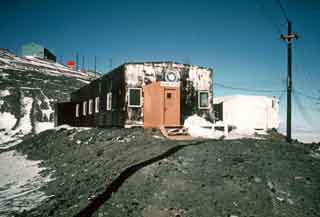
Geologist Thiel had been killed in 1961 plane crash at Wilkes. The building, uphill from the BFC and given the acronym TESL, was later the location of "F-stop" (field safety training); it was demolished in 2006-07 to make way for new fuel tanks. More info about the building, geologist Edward Thiel, and his tragic death is here. Here's a 1965-66 photo of the newly constructed building.
Winter 1974
OIC: LT Bob Braddock, population 21 (list and photo)...

...as the venerable IGY station enters its last year of life.
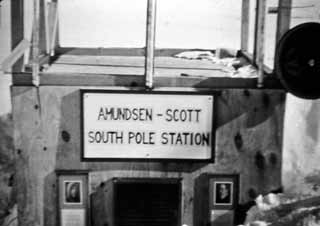
It turns out that the last winter in this drafty drippy place was surprisingly well documented by unknown photographer(s). A few years ago a winterover discovered a large collection of negatives in the old station... including this photo of the main entrance...and many others of life, times, smiles and glum faces. This is really a unique bit of history, and if anyone recognizes any of the folks depicted, please let me know. Check out the lot!
Stanford AWS tested; powered by 10-watt radioisotope generator after the TEG fails.
Scott's memorial cross on Ob Hill blown over by major July/August storms.
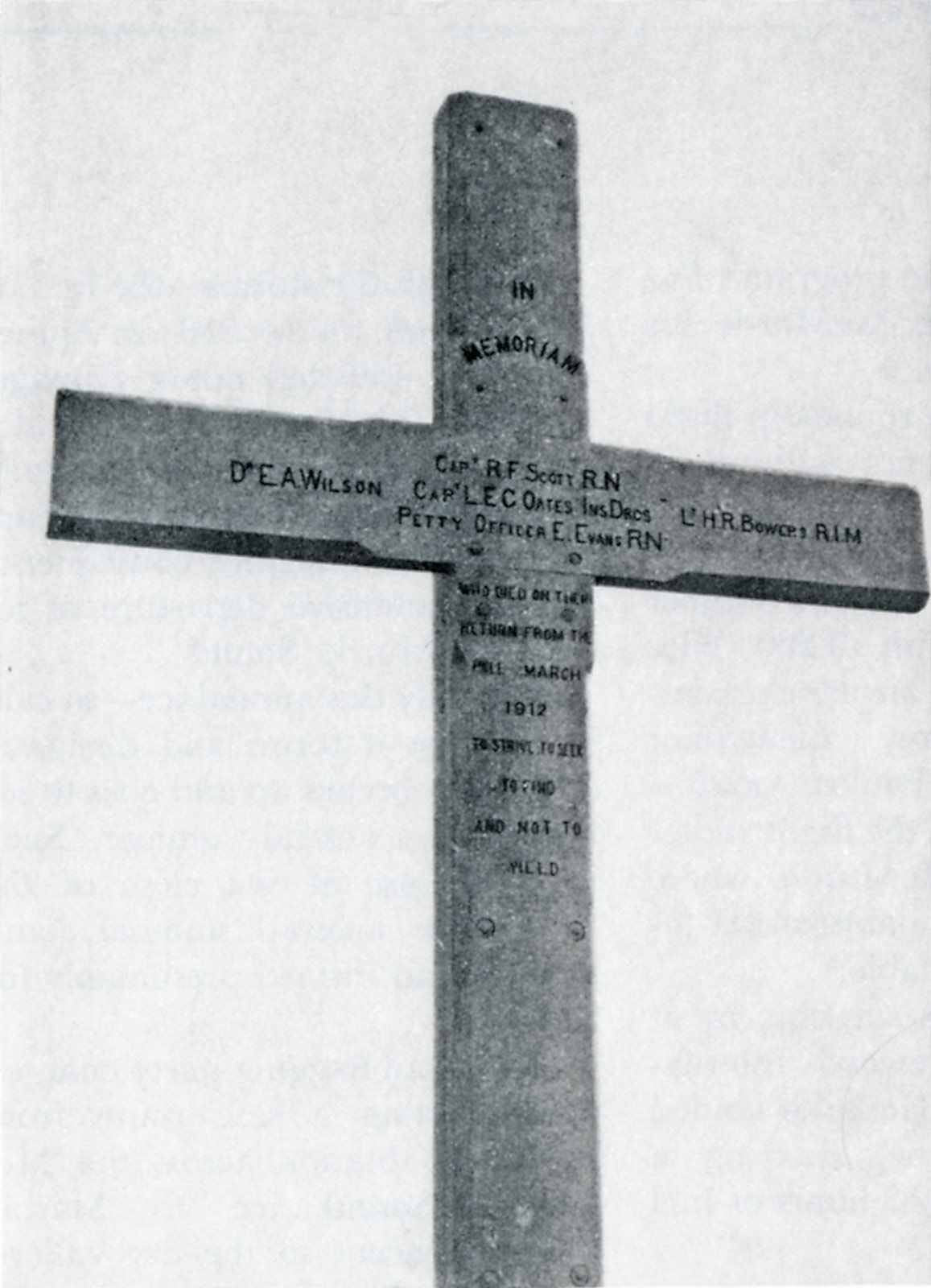
The storms did minor damage to several McMurdo buildings; more significantly they drove out much of the annual ice at the end of the winter, blocking access to Marble Point. A team from Scott Base uprighted the cross in its original foundation on 24 September, presumably the first repairs since its 1913 erection by members of the British Antarctic Expedition. In 1913 it took seven men two days to haul the cross, made of Australian jarrah wood, to the top of the hill. "It was well secured, and will remain in position for an indefinite period," wrote an expedition member. The 1913 photo at left is by Frank Debenham (Antarctic Journal, November/December 1974). As a comparison, here's my January 1977 hero shot at the cross.
First female w/o's at McM; SSL Mary Alice McWhinnie and Mary Odile Cahoon.
PICO established in Lincoln, Nebraska for the future RISP and other ice drilling projects.
Top of page | Continue to 1975-90